
Inequality = Civilization
Inspired by Scheidel's The Great Leveler and Escape from Rome

So I’ve recently finished Scheidel’s Escape from Rome and The Great Leveler, about why Europe (and not China or Rome or anyone else) developed the scientific method and industrial revolution in Escape, and about wealth inequality in Leveler.
For anyone who hasn’t read him, Scheidel is great - he’s a more academically rigorous Yuval Harari or Jared Diamond, a big picture historian who likes to cross disciplines and consider long spans of time and grand narratives, one who tries to postulate about the most relevant and impactful and plausible counterfactuals, and who does a good job of setting out a big picture thesis, then addressing the main objections and alternative interpretations in a rigorous, bottom up way over the succeeding chapters.
I’ll just quickly one-liner those two books:
Escape from Rome - empires prioritize stability and keeping the people on top in place too much to ever engage in enough Schumpeterian destruction to actually let tech that can change the world propagate and change it; it required the Hobbesian ceaseless “warre of all against all” in Europe, because that environment alone let technology and social and financial technologies ferment and compete into the ultimate science + industrial technology package that conquered the world and led to today.
The Great Leveler - inequality will literally always happen as long as there is surplus, we see this well before agriculture, and it generally monotonically increases with time along with peace and civilization; the only things that can “reset” inequality temporarily are death and violence on a massive scale - war, revolution, being conquered, and pandemics - there are ZERO ways to peacefully mitigate inequality that have ever succeeded in any society ever.
It starts before we’re even human
Inequality has always been with us, going back to well before we were human.
It’s uncontroversial to say that some animals are stronger, faster, smarter, or better looking - that’s biological wealth, and it generally cashes out to reproductive wealth.
Did you know chimp reproductive skew would be .26 - .88 on a Gini index? As in, the dominant alpha male generally sires between 26% - 88% of the next generation, and it would generally average somewhere around .33-.66.
Another fun fact - in bonobos, the famously 10x more peaceful (as measured by reactive aggression incidents) and loving flavor of chimp, the reproductive skew is even higher than in pans?
This is actually an interesting foreshadowing of the larger point here - because as civilization, peace, and law and order expand and endure, so too does inequality inevitably go up.
But the thing with biological wealth is that it’s only loosely transmissible, especially if you’re having ~50% of the next generation, because being at the top is fundamentally limited. What you really need is a more transmissible form of wealth for inequality to really get a foothold.
It continues with “surplus”
One of the parts of the book that interested me most was Scheidel pointing out that you don’t need agriculture to see generational inequality in human societies - actually all you need is surplus.
So if you look at indigenous societies that lived near abundant riverine resources, in the golden Natufian age, in societies that lived by hunting buffalo,1 and similar situations, you find inequality.
“According to one count, about 8 percent of the recovered skeletons from the Early Natufian period, about 14,500 to 12,800 years ago, wore seashells, sometimes brought in from hundreds of miles away, and decorations made of bone or teeth. At one site, three males were buried with shell headdresses, one of them fringed with shells four rows deep. Only a few graves contained stone tools and figurines.”
So of the three types of wealth, you basically have biological (foragers / hunter gatherers), land and livestock (herders and farmers), and material goods (all 3, but much more concentratable in herders and farmers, because HG have to carry all their stuff everywhere).
The combination of diverse inequality constraints that apply to different types of wealth and the relative significance of particular types of wealth accounts for observed differences by mode of subsistence. Average composite wealth Gini coefficients were as low as 0.25 to 0.27 for hunter-gatherers and horticulturalists but were much higher for herders (0.42) and agriculturalists (0.48). For material wealth alone, the main divide appears to lie between foragers (0.36) and all others (0.51 to 0.57).”
But with the advent of property and wealth in generationally transmissible forms, wealth and income inequality becomes an enduring feature of human society.
To put numbers to that, it means if you take top wealth decile parents compared to bottom decile, a top decile forager / HG child is 3x more likely to reproduce, and for farmers it’s 11x, and for herders, it’s 20x.
Moreover, the general pattern we see is that inequality starts, and as long as the society persists, it generally tops out pretty close to the maximum feasible Gini. Because an income Gini of “1” isn’t possible - there is always some level of subsistence necessary even for the peasants or slaves at the bottom, and this necessarily pulls it away from “1” (which would be “one person has all the wealth”).
Scheidel points out that an income Gini of around .5 is probably the maximum feasible, and points to a Roman Empire income Gini of ~.4, and what that actually looks like is “about 1.5 percent of all households captured between a sixth and close to a third of total [GDP] output. These numbers may well underestimate their actual share, because they derive income from putative return on estimated wealth; political rents would drive up elite income even higher.”
So let’s recap:
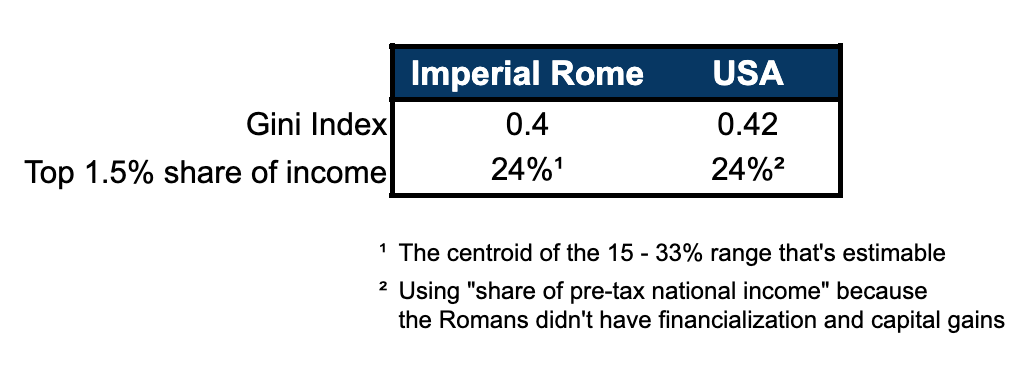
We hitting close to home yet?
The essential ingredients
Okay so basically we need some surplus, which agriculture helps. Once you have agriculture, you almost always end up with hierarchy, which we’ll touch on in the next section. And then if your hierarchy is successful, if you have an empire and peace and roads and markets and that kind of thing, you can actually even progress a little bit technologically.
The Chinese are famous for this. Everyone knows they invented gunpowder many hundreds of years before the West. So why didn’t it go anywhere?
It did! They used gunpowder in seige warfare, made cannons, made literal hand-cannons and grenades, which Ghengis Khan’s Mongols used in their globe-conquering warfare (that’s right - Mongols with grenades!), and much more.
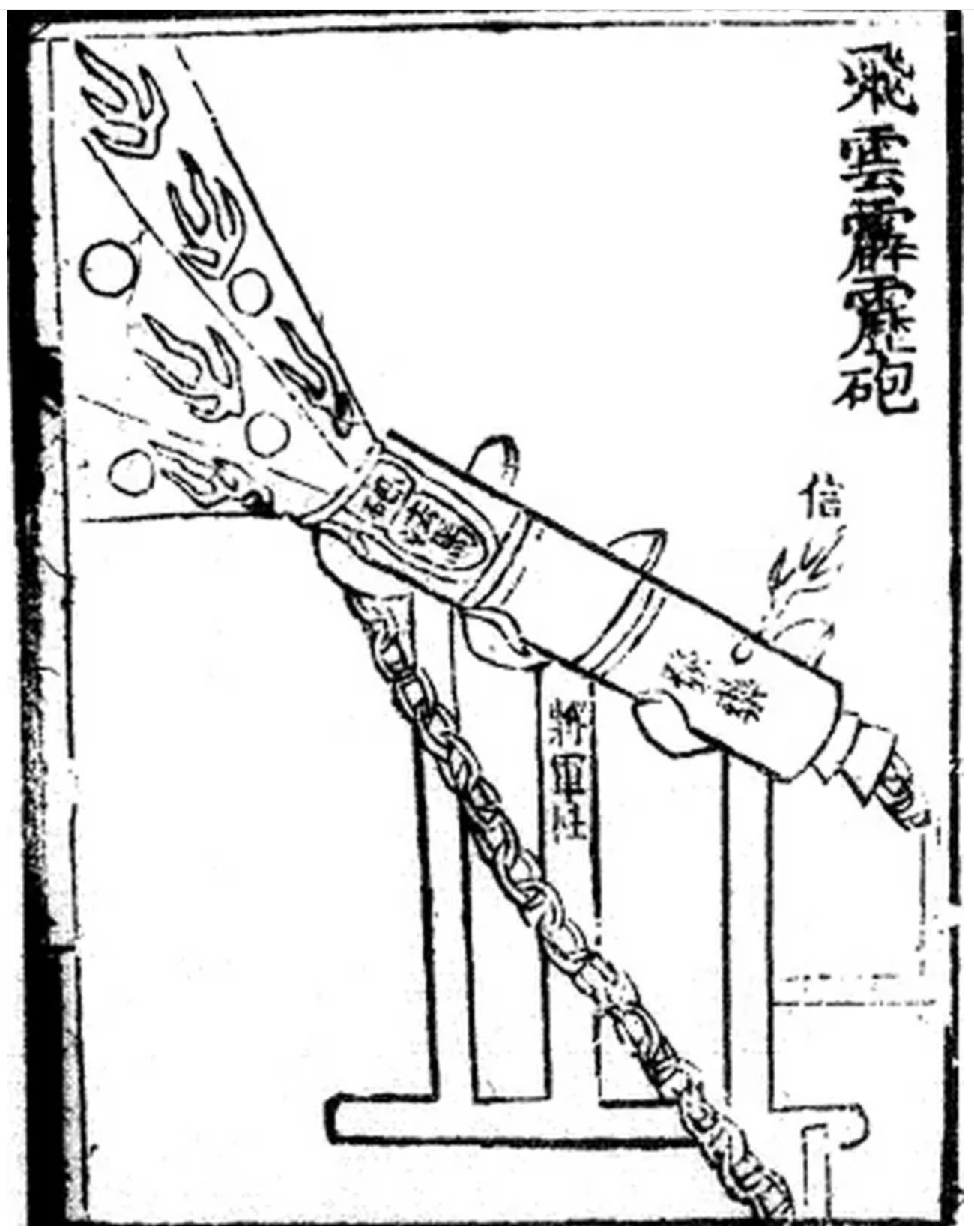
From the inimitable Psmiths:
“Along the way what we see is not a gaggle of childlike orientals marveling over fireworks and unable to conceive of military applications. We also don’t see an omnipotent despotism resisting technological change, or a hidebound bureaucracy maintaining an engineered stagnation. No, what we see is pretty much the opposite of these Western stereotypes of ancient Chinese society. We see a thriving ecosystem of opportunistic inventors and tacticians, striving to outcompete each other and producing a steady pace of technological change far beyond what Medieval Europe could accomplish.”
Part of why China was doing so much better around the turn of the millenium (1000 AD) was that they still had state capacity and peace, and that fostered innovation and wealth-creation of the “making” type.
“Reduced to essentials, history has known only two ideal-typical modes of wealth acquisition: making and taking. The advent of surplus production, domestication, and hereditary property rights paved the way for the creation and preservation of personal fortunes. In the long run, institutional adaptations that were conducive to this process, technological progress, and the growing scale and scope of economic activity raised the ceiling on individual or familial wealth accumulation, thereby increasing at least the potential range of the dispersion of income and productive assets.”
So basically, just having surplus is usually sufficient to foster inequality, and as economic activity, technology, or logistical multipliers like roads and ports raise the potential range of outcomes, that tends to foster yet more inequality.
So why DID China end up getting roflstomped in the Opium Wars by some pissant 20x smaller country?
Well, entire books (like Scheidel’s Escape) have been written about it, but basically empires prioritize keeping things stable and the top people up top, so the Schumpeterian creative destruction necessary to actually adopt innovation into the fabric of your society, and have that ultimately manifested in your technology, never takes root - it only takes root in a seething hotbed of competition and gamesmanship among near-peers, ie Europe. It takes scrabbling for any scintilla of advantage for hundreds of years AND accidentally inventing finance so that you can tap future income streams for present investment.
If you know anything about Chinese history, you know that whichever flavor of Chinese empire is in power, it’s basically one dropped teacup away from 10M+ casualties. I mean, you know the memes! Or if you don’t, I’ll at least introduce you to them, because I still think they’re hilarious:

So this is WHY stability is such a huge deal for China, and why they prioritize it above all else. They’ve literally seen the consequences umpteen times, and are trying to avoid deca-mega-deaths.
So not only does peace and prosperity inevitably lead to ever-increasing inequality, if you have too much peace and prosperity, it actually stagnates your society overall and you’re going to get pwned by a bunch of backwoods pugilists that spent the last 500 years beating each other up in the woods in increasingly sophisticated ways, and accidentally invented world-beating transportation and military technology.
And how strong is just “having surplus” in terms of reaching explicit hierarchy and kings snaffling all the good stuff?
“Once again, however, it was the scale of the economic surplus rather than the mode of subsistence as such that served as the critical variable. In the survey of 258 Native American societies already mentioned, 86 percent of those groups without significant surplus production also lacked signs of political inequality, whereas the same proportion of those that generated moderate or large surpluses had developed at least some degree of political hierarchy. Among 186 societies from across the world that are documented in more detail, known as the Standard Cross-Cultural Sample, four in five hunter-gatherer communities had no leaders, whereas three-quarters of farming societies were organized as chiefdoms or states.”
Okay, so one of the lines I like most is the one farther up there - “reduced to essentials, history has known only two ideal-typical modes of wealth acquisition: making and taking.”
The dominant choice throughout all of history is “taking”
Why do agrarian societies all end up hierarchical? Basically because the ones that didn’t were conquered and overrun - hierarchy is necessary to muster larger armies. Intergroup conflict has shaped our societies clear back to chimpanzees, and in the Environment of Evolutionary Adaptiveness where everyone was hunter gatherers, roughly a third of all men died by violence, and 20-40% of men had descendants (versus ~80% of women).2
Why do we always end up at kings and empires? Because an empire is a more successful warmaking organization for society, and it lets your society outcompete everyone else.
“In quantitative terms, agrarian states proved extremely successful. Although these numbers cannot be more than controlled conjecture, we can guess that 3,500 years ago, when state-level polities covered perhaps not more than 1 percent of the earth’s terrestrial surface (excluding Antarctica), they already laid claim to up to half of our species. We are on more solid ground in estimating that by the beginning of the Common Era, states—mostly large empires such as Rome and Han China—comprised about a tenth of the earth’s land mass but between two-thirds and three-quarters of all people alive at the time. Shaky as they may be, these figures convey a sense of the competitive advantage of a particular type of state: far-flung imperial structures held together by powerful extractive elites.”
The second reason is that empires foster greater amounts of peace, trade, and economic multipliers like roads, markets, ports, and so on, and this allows both the diffusion of technologies and practices that improve agricultural productivity (better soil turning or planting technology, Champa rice which led to the Chinese population doubling, etc), and denser populations, which increases the sizes of your armies.
Starting with the Sumerians, you see elites appropriating theoretically public assets for personal enrichment (state and religious lands and buildings, state boats, fishing rights), lending money and foreclosing when the borrowers couldn’t pay them back, and overcharging for things like funerary services.
It doesn’t stop at physical assets either, because corvee labor was a big part of many ancient societies. “Corvée arrangements in the Inca empire were among the most extensive recorded in history, but use of coerced labor was also widespread in Egypt, the Near East, China, and Mesoamerica, to name but a few places.”
One of the more interesting things Scheidel dives into in Escape is how profoundly far state capacity fell in post-Roman Europe. The reason they could barely field armies of hundreds to a few thousand fighters at the most, compared to the Romans frequently fielding hundreds of thousands across multiple fronts, was that medieval kings lost social technologies as fundamental as “taxation.”
Medieval kings literally couldn’t tax most of their people, especially any of their nobles with actual income. How does a state of affairs like this ever come about? What’s even the point of being a king if you can’t tax anybody?? What does being a king even mean if that’s true?
Basically, it meant they’re the local big man, who had the biggest stretch of productive land in the area, and the most buddies or vassals, so the most local military capability. That’s pretty much it. They’re a little richer and have a little more surplus and force projection capacity compared to everyone else.
That means if you want to get other nobles on board to get their handful of men for a war, you need to be able to promise good booty from that war - plunder, land, or captives, usually, and this need to incentivize and wheedle and cajole other nobles to come on board is WHY armies were so tiny back then. Sure, the king conquers a chunk of Outgrouplandia in his name, and the king probably takes the biggest share, but a lot of that land is going to have to end up with the other nobles to pay them off for helping him win. The king wants that land to still be in his name, and to only grant the nobles the right to profit from the serf’s output from that land. They want to grant the income stream, not the fee simple. But there’s a continous and never-relenting push from the nobles to make it owned and hereditary, and that’s usually what happened.
Because the medieval era was one where defensive technology temporarily outstripped offensive, and kings give land grants to nobles, it ended in a dynamic where in one generation the king rewards his allies and subordinates, in the next generation they make that land grant hereditary and build a castle, and soon after stop paying taxes entirely. Because what will the king do after you stop? He would have to go and round up an army again and literally lay siege to your castle for a year or so, and that would cost him far more than he’d ever recover. He was barely able to net positive rounding up a few hundred knights and conquering a whole other country! Castles were literally strongholds, that the offensive power of the time wasn’t competent to overcome.
And this pattern? Royal land grants turning into hereditary estates? A common pattern everywhere, everywhen.
“Land grants were an almost universal means of rewarding key associates, being handed out by the chiefs of Hawai’i and the god-kings of Akkad and Cuzco, by Egyptian Pharaohs and Zhou emperors, by the kings of medieval Europe and by Charles V in the New World. Attempts to make these prebendal estates hereditary within the families of the initial beneficiaries and eventually turn them into private property were an almost inevitable consequence.”
But what is the model here in terms of people getting rich? 100% “taking,” top to bottom. The whole system is predicated on making war and taking assets from other people.
Okay, so that’s the bottom tier of state capacity, basically the “warring chieftans” model.
But what about when you do have an effective empire, that can actually tax people and has state capacity? You still don’t get rich by innovating better agricultural technologies or practices for your serfs or slaves, you get rich by being close to political power, which puts you in a position where you can milk the populace.
“I present two case studies to illustrate these premises: the Han and Roman empires, each of which, at the height of its power, claimed about a quarter of all people on earth. Ancient Rome has been labeled an empire of property in which wealth was created, above all, by acquiring land, whereas Chinese fortunes were made from officeholding rather than private investments. This contrast seems overblown: in both environments, political power was a critical source of income and wealth, inextricably intertwined with economic activity, and a powerful determinant of material inequality.”
But political proximity and milking the populace is just “taking” again, on a more distributed scale.
Han China:
“Officials concealed embezzlement by fabricating arrears; exaggerated the scale of natural disasters that required tax exemptions; falsely declared barren status for their own land; borrowed tax advances from the rich, stole the money, and then applied the liabilities as arrears to commoners; reclassified land but collected taxes at the usual rate, pocketing the difference; and withheld or falsified receipts. Gentry and retired officials often paid no tax at all, with active officials and clerks passing the burden on to commoners in exchange for a cut of the profit. Finally, land was registered under as many as hundreds of false names, which made it too cumbersome to track down small arrears. Corruption by high officials was a standard mechanism of wealth accumulation, the more so the higher the rank. According to one estimate, average incomes of officials amounted to a dozen times their official, legal incomes in the form of salaries, rewards, and allowances, but well more than a hundred times for a governor-general and as much as 400,000 times in the case of He Shen, Grand Secretary of the Qing court in the second half of the eighteenth century.”
He Shen is worth a read if you want a portrait of comical excess - when his close buddy the emperor died and he fell out of favor and his estate was seized, his total property was estimated to be worth 15 years of imperial revenue, and included 10 banks, 12,000 acres of land, 100 large ingots of pure gold, several tons of silver, and 24 solid gold beds, among much else.
From Rome, which combined warfare and expansion and large-scale population farming among the elites. For context, the average person lived on something like 200-300 sesterces a year:
“Great wealth now flowed from proximity to the new rulers—the emperors—and their court. Six personal fortunes of between 300 million and 400 million sesterces are reported for the first century CE, in excess of anything known from the Republican period: built up by top courtiers, most of them were eventually absorbed by the treasury.”
“Provincial governors were now paid up to 1 million sesterces a year for their good services but continued to extract great wealth on the side: one governor entered the province of Syria as a pauper and left it dives (rich) two years later. A century on, a governor of southern Spain unwisely bragged in his correspondence that he had extorted 4 million sesterces from his provincials and had even sold some of them into slavery. Much farther down the food chain, an imperial slave overseeing the imperial treasury in Gaul commanded the services of sixteen underslaves, two of whom were in charge of his apparently extensive set of silverware.”
“Because average per capita GDP amounted to only about twice minimum subsistence net of tax and investment, the projected level of Roman income inequality was not far below the maximum that was actually feasible at that level of economic development, a feature shared by many other premodern societies. Measured against the share of GDP that was available for extraction from primary producers, Roman inequality was therefore extremely severe. At most a tenth of the population beyond the wealth elite would have been able to enjoy incomes well above bare subsistence levels.”
This is a class of politically connected elites that construct society in ways that lead to them hoovering up the majority of the overall surplus, and this is the universal default for societies with surplus.
And yet what do people complain about today? Capitalism. Billionaires. Makers.
“So for Varna in 6k BCE as one example, a single leader was laid to rest “with no fewer than 990 gold objects weighing more than three pounds total: he was covered in gold ornaments that were probably attached to his original clothing, carried heavy gold rings around his arms, and wielded an ax scepter; even his penis was sheathed in gold. This man’s grave accounts for a third of all gold objects found at this site and a quarter of their total weight.”
That guy wasn’t a maker. He didn’t found a company, or invent something, or grow the pie for anybody. He just milked a bunch of peasants better than the next guy, and became “the dude with the golden dick.”
For literally 8 thousand years, that’s been the societal model. “Taking” is waaaayyyy easier and more common than “making,” and even the empires we admire like the Tang or Song, or Republican or Imperial Rome, were all fundamentally fueled by “taking,” both from the broader populace, and via war and expansion which brought back booty and slaves and land to redistribute and farm, and when that expansion ran out, so too did the Roman Empire.
Scheidel wrote his book because he wanted to see if any society ever had figured out a way to successfully temper the unrelenting drive towards more inequality that we see in every state or empire across the world without fail. He found that yes, they had - if almost everyone dies, things get more equal, because when everything is ashes and ruins, everyone is equal.
Total war, transformative revolution / communism,3 complete state failure or getting conquered, all of those are GREAT ways to fight inequality! Is there any other way, anywhere, through all of history?
“Pandemics complete the quartet of horsemen of violent leveling. But were there also other, more peaceful mechanisms of lowering inequality? If we think of leveling on a large scale, the answer must be no. Across the full sweep of history, every single one of the major compressions of material inequality we can observe in the record was driven by one or more of these four levelers.”
Having a “making” society is the biggest possible deal
The thing that let us escape a regime where “taking” was the only path to wealth was a pivot to a set of social technologies that elevated “making” over “taking.”
This is Scheidel’s Escape from Rome thesis. We in the West managed, largely through dumb luck (and lack of steppe nomads), to fall into a self-perpetuating attractor where people and companies and societies are rewarded for making things that other people find useful, instead of taking. This is capitalism, and meritocracies, and global trade, and valuing education and innovation and startups and much else.
It makes the pie much bigger, in a way that “taking” doesn’t and can’t, and it makes everyone more prosperous.
And it’s driven by both types of changes - cultural, and genetic
The two countries that famously drove most of the creation of that “making” cultural attractor were England and the Dutch. They’re the ones that did the most financial innovation, commerce, and inventiveness, and drove the most innovation and change.
One fun factoid from Greg Clark’s oeuvre is that rich families in England had higher fertility than poor families, and specifically that breaks down to something like the top 10-20% having notably higher fertility than the bottom 80-90%, and this was true for the 300 years from 1500 to 1800 when that attractor was being created.
How much higher? The top 10% had a surviving fertility of ~4.5, and the bottom 80-90% had a surviving fertility of ~2, or replacement. This was obviously for several reasons, from better nutrition, less crowding, more attentive nursing, and more, while conditions for non-rich folk in this time were exceptionally filthy, crowded, and squalid.
But what does it mean for the rich to have twice the carrying capacity of the poor? It means they become a greater fraction of the next generations. Particularly written over 300 years, this actually becomes really meaningful!
If you model this conservatively at 2 vs 4, even taking into account that rich people split their inheritances, and having more kids means more wealth dilution, and that only the top decile in every given year truly has the higher carrying capacity, that 10% fraction of hard working, inventive go-getters comes to represent more than 3/4 of the total population over that 300 years:
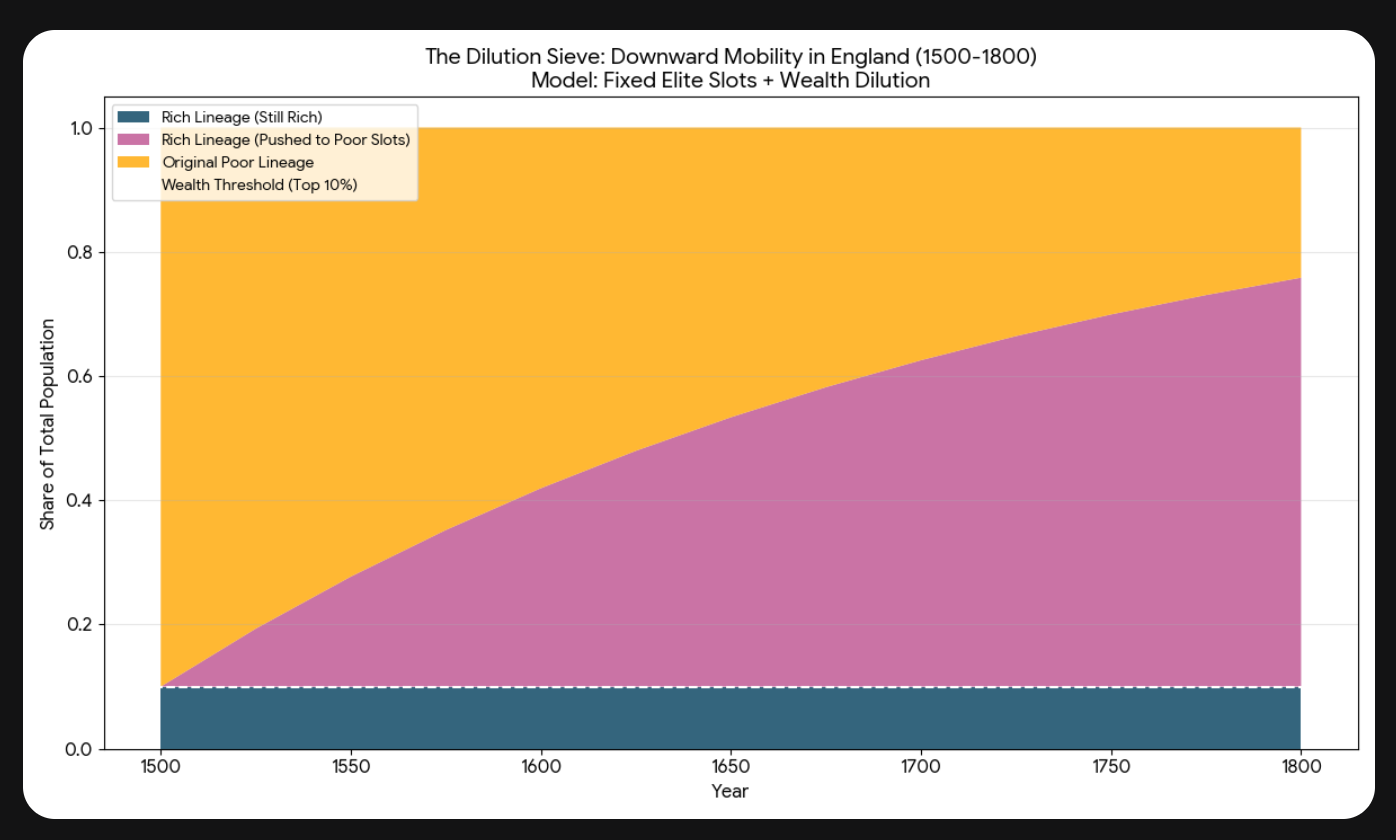
Think of what’s happening here! The English have created a system where “making” is rewarded, where thrift and industry and hard work and innovation and execution skills are directly tied to reward that benefits everyone. Exactly the traits you want more of in your children, friends and neighbors, and in the broader population in toto! Particularly if you wanted your entire country to level up. And did it work?
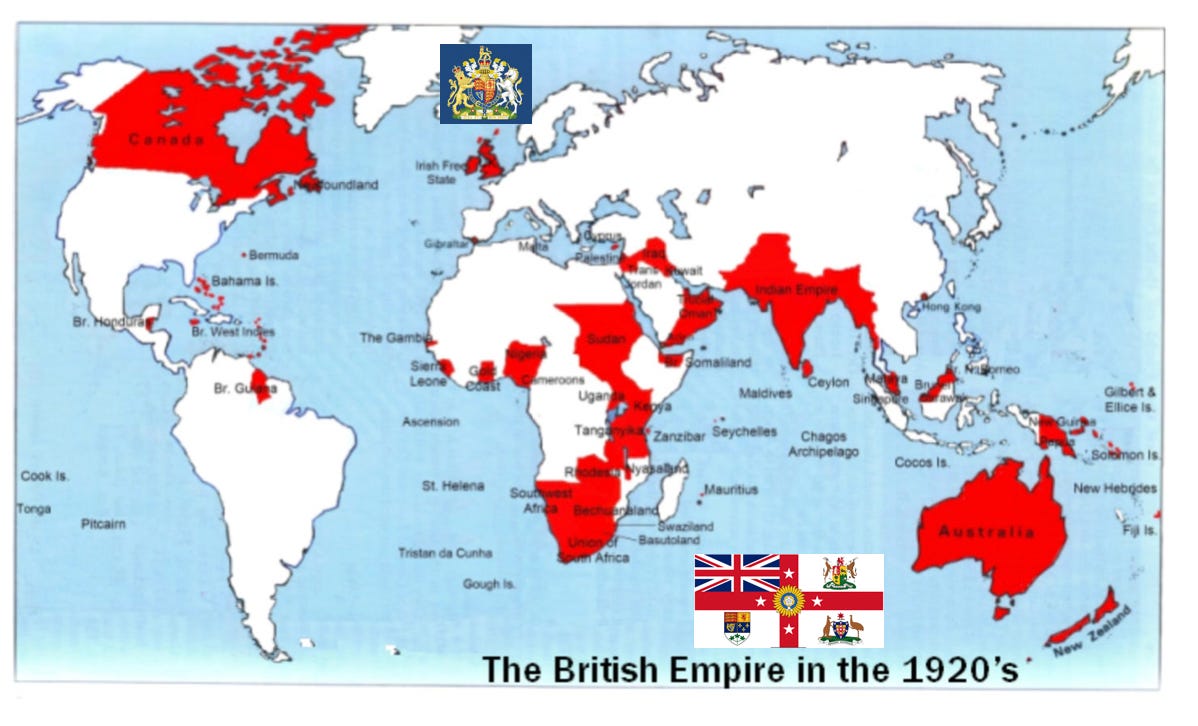
Oh yeah! I thought I remembered a time when the British weren’t a bunch of poor, frightened mice, huddling in their holes and ratting each other out to the literal thought police.

Man - how the mighty have fallen, right? A cautionary lesson for us all, that hopefully we here as their wealth-and-power spiritual successors are smart enough to listen to before it happens to us.
Moving on
Do you know the part of the Rome vs USA I left out up there? The taxes:
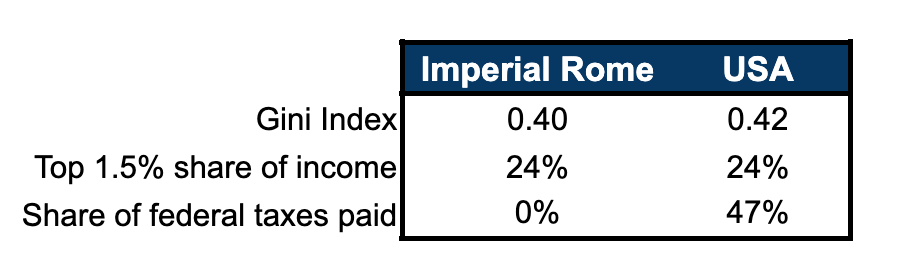
The overwhelmingly most frequent outcome for elites throughout history were for them to pay no taxes - being tax exempt was practically part of the definition of being elite, because being elite meant proximity to the ruler and those in power, and those guys are the ones taking and benefiting from taxes, not paying them, and that’s how taxation works in a “taking” based society.
And therein lies all the difference!
In a “making” society, the top 1.5% makes just as much money as a proportion of income now, but pay 10x the taxes,4 which supports the bottom quintile and various public goods (which still, no doubt, features various politically connected entities feeding from the public trough, as has always been the pattern).
Moreover, because a “making” culture deliberately values creating and growing the pie, we have a middle class, and Rome didn’t. Remember “a tenth could live above subsistence” in Rome up there? How much of the US lives above subsistence? The bottom SES quintile is fatter than the top quintile! Having capitalism and billionaires and meritocracy is amazing!
Is meritocracy a fully perfect solution? It is not, and I’ve written about that before. If we lived in a true meritocracy and that was common knowledge, probably ~80% of people are going to feel bad about it, because they’re not where they are because of bad luck or oppression, but because they suck. Status is relative and zero sum, and always has been. But if that’s true, the majority of people are always going to be unhappy.
Ruxandra Teslo has recently written compellingly about this, too, how the loss of religion at the large scale has left a void that robs people who aren’t in the top quintile winning the status games we all collectively agree are the important ones (education, career, money, attractiveness) of meaning and purpose.
A lot of people today look at that dynamic and say that capitalism is the problem. Or the apps, or the corollary there, tech oligarchs. Or billionaires.
But the point of sketching this picture is to show that people who hate capitalism or billionaires and think inequality is a uniquely modern problem, are fundamentally on the side of tyrant god-kings sitting on thrones of skulls, because that’s the only alternative. Even if you raze society to the ground with one of the 4 horsemen, which has happened countless times, you get the tyrant-kings just one or two generations later.
And if you don’t get the tyrant kings? If you enjoy peace and prosperity and a big post-war boom? Even if you instituted punitive income and estate taxes for the first time ever around WWI or WWII to fund the resources needed for high mobilization war, which most countries did (leading to a steep fall in inequality across all of the affected countries), inequality still works its way up!
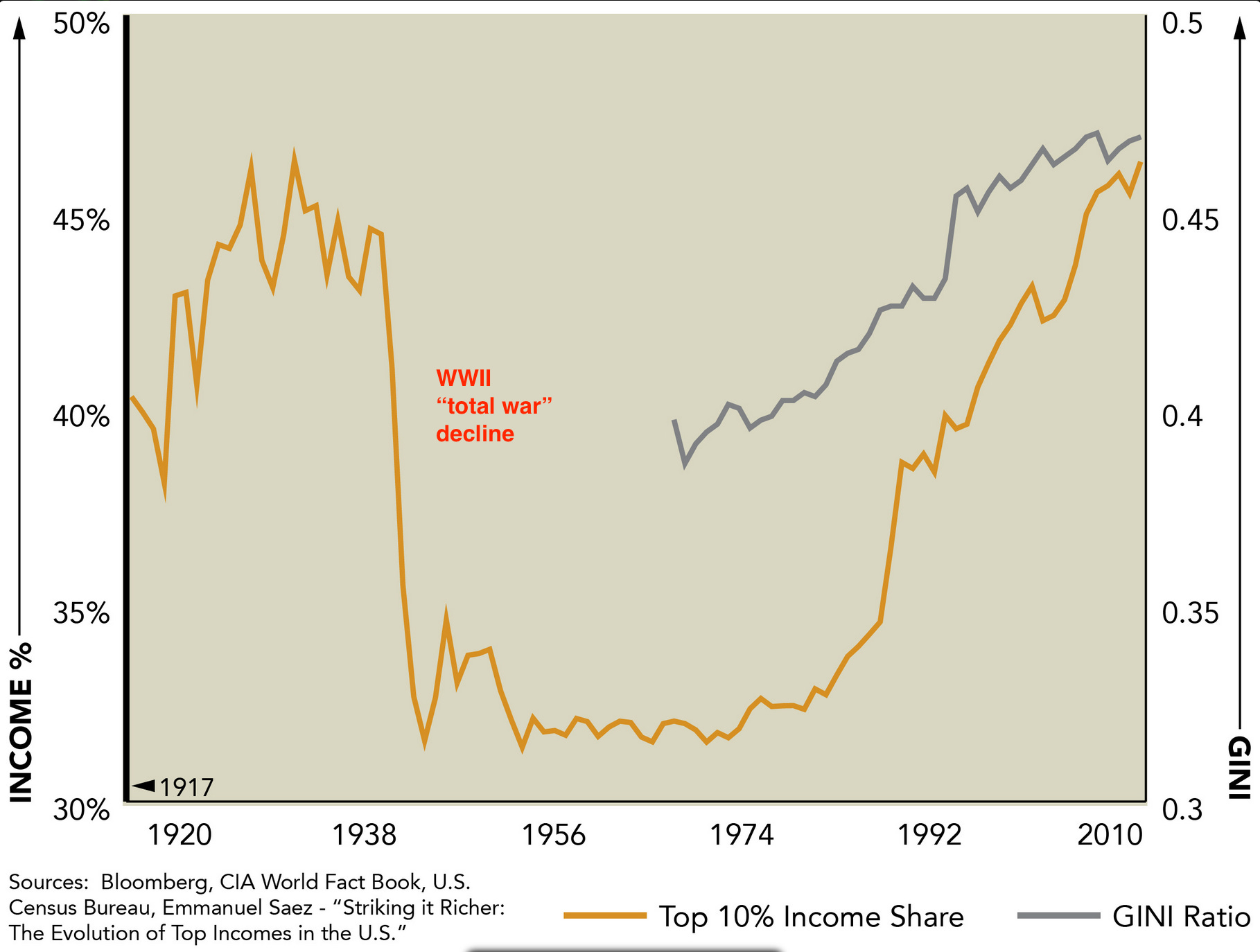
Once again, inequality = civilization; it always goes up in times of peace and prosperity. But in a “making” economy, this grows the pie for everyone, and that makes all the difference:
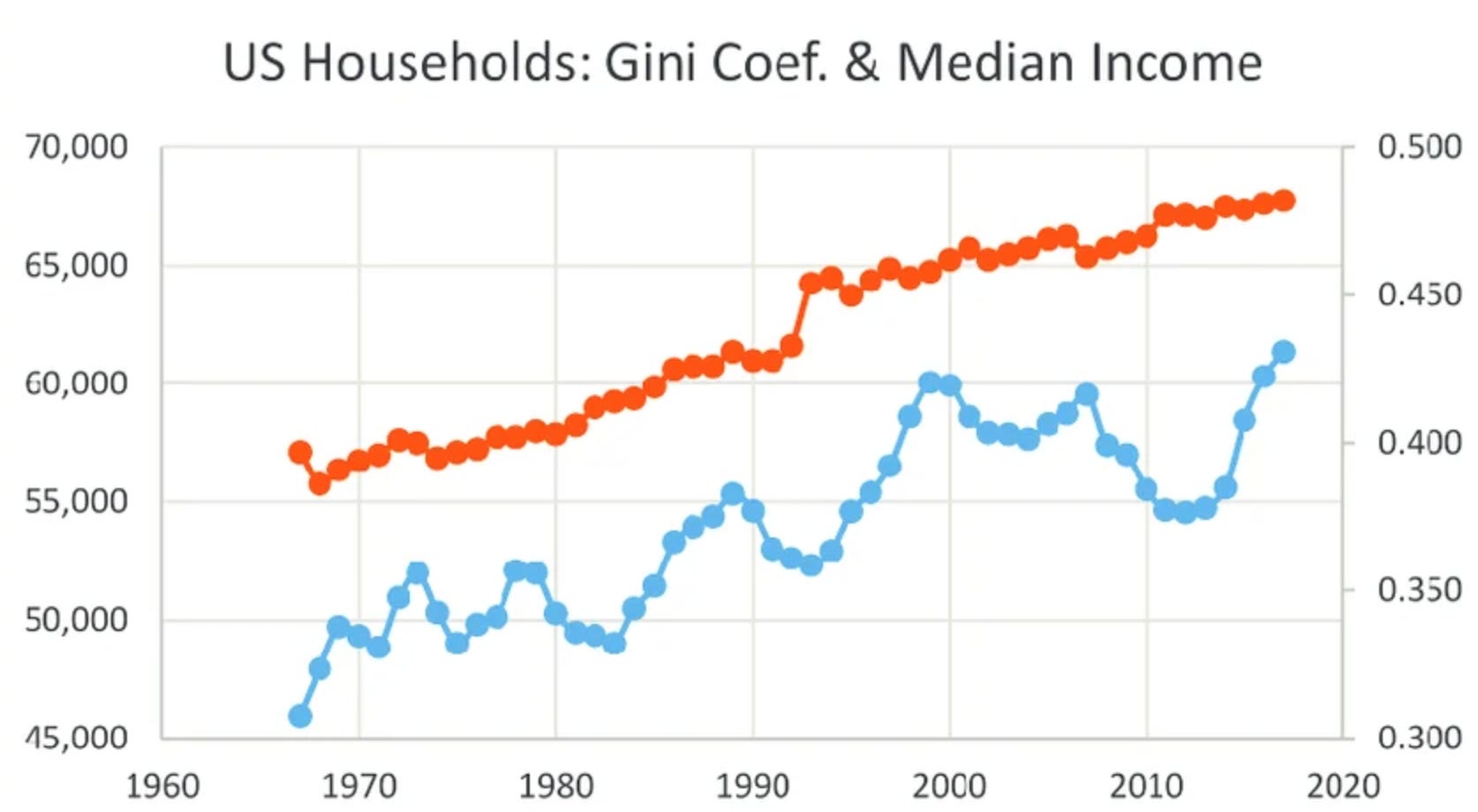
You will ALWAYS have inequality
You just get two flavors to choose from. You can choose the “taking” flavor, or the “making” flavor. That’s it.
Well, maybe I’m artificially limiting our options here - you can also have deaths and violence on a mass scale, and / or that plus communism. But as long as you’re opting out of megadeaths, and have peace and prosperity, you will have inequality!
This is true at a structural level - even if Picketty’s r !> g, those with capital / passive income will always accumulate more income and wealth, because “passive + active” will always be more than “active,” and savings compounds over time.5
The alternative isn’t “no inequality,” it’s the other flavor of inequality, ie tyrant-kings and rapacious elites squeezing whatever they can out of the hoi polloi, which is literally still the pattern in most developing countries, which is most of the world by population.
Capitalism, and the headline synecdoche that are the fruits of capitalism, billionaires, make. They grow the pie for everybody. Brin and Page, Bezos, Musk, Zuckerberg, Gates - all those guys.
Everyone hates Facebook and Google, but a whole slew of completely free products that 2-3B people use every month exist because of them, from Google search, maps, gmail, Whatsapp, Instagram, and more.
Amazon is one of the most amazing companies on earth, and contra Scott, Bezos is obviously individually and personally responsible for giant chunks of Amazon’s success. Scott tries to say “well somebody would have made a big online retailer, that’s an obvious niche that’s going to be filled” but Bezos specifically made a big bet on AWS, against most of his executives’ wishes, he specifically reinvested for more years than many others would have, and that end result has let him optimize the hard real-world problem of getting packages to hundreds of millions of people so well that you can get almost anything from groceries to iphones within 0-2 days. The counterfactual without Bezos is probably going to be a much worse, much smaller company, that provides much less value to everyone. Think Walmart’s online offering - that’s the counterfactual, and who even uses it?? Think how much more value Amazon (driven-by-Bezos specifically) provides to hundreds of millions of people every day than that counterfactual!
The billionaires on the Forbes list have created literally ~10M direct jobs, and that’s completely ignoring ancillary companies that contract with them to provide goods and services, the other companies which have those billionaire companies’ offerings or platforms as a core part of their business model, and much more.
So to all the anti-billionaires out there - THAT is your realistic alternative. It is not some happy cartoon fairy tale where HR ladies and janitors are paid millions just because, it’s a god emperor on a throne of skulls and his top 1% buddies rapaciously milking everybody for fun and profit.
And if you succeed in total revolution, and tear everything down so all is rubble and ashes, yes, you’ll succeed at reducing inequality. For a single generation, after which, as long as there is peace, inequality will rise again and keep rising, as long as there’s peace and stability.
Choose wisely.
On the Comanche:
“In other cases, the introduction of the domesticated horse as a conveyance could have disequalizing effects even in the absence of food production. In the eighteenth and nineteenth centuries, the Comanche in the borderlands of the American Southwest formed a warrior culture that relied on horses of European origin to conduct warfare and raids over long distances. Buffalo and other wild mammals were their principal food source, complemented by gathered wild plants and maize obtained via trade or plunder. These arrangements supported high levels of inequality: captive boys were employed to tend to the horses of the rich, and the number of horses owned divided Comanche households rather sharply into the “rich” (tsaanaakatu), the “poor” (tahkapu), and the “very poor” (tubitsi tahkapu).”
Historically, ~80% of women reproduced and 20-40% of men. This was informed speculation at the time of the time of Baumeister’s 2007 APA address (the earliest use of the 80/40 meme I could find), but genetic data has since proven it over ~150k years.
“2” would be 80/40, “3” would be roughly 80/27, “4” would be 80/20.
Yellow line, right hand axis:
https://imgur.com/JWIsva9
Scheidel cites absolutely stunning figures for the amount of deaths communism had to perpetrate to level inequality. China:
“By the end of 1951, more than 10 million landlords had been expropriated and more than 40 percent of the land had been redistributed. Some 1.5 million to 2 million perished between 1947 and 1952, and millions more were stigmatized as exploiters and class enemies. The rural economy suffered accordingly, for fear of appearing to be well-off dissuaded peasants from working more than the minimum necessary for survival: villagers felt it was “glorious to be poor”—an altogether sensible strategy in the face of violent leveling.”
“All these violent interventions soon paled in comparison with the horrors of the “Great Leap Forward” from 1959 to 1961, during which mass starvation induced by failed government policies claimed anywhere from 20 million to 40 million lives. Direct state action lagged not far behind: by the end of the Maoist period, between 6 million and 10 million Chinese had been killed or driven to suicide by the state, and about 50 million others had passed through the laogai camp system, where 20 million of them died.”
Russia:
“Coercion carried the day: by 1937, fully 93 percent of Soviet agriculture had been forcibly collectivized, individual farms had been crushed, and the private sector had been reduced to small garden plots. This transformation had come at enormous cost: more than half of the value of livestock was lost, as was a seventh of the total capital stock. The cost in human lives was even more staggering. Violence spread explosively. After 60,000 “first-category” kulaks had been arrested in a matter of days in February 1930, the tally rose to 700,000 by the end of that year and to 1.8 million by the end of the following year. An estimated 300,000 deportees died during the process owing to the horrific conditions they experienced during transport and at their destination. Maybe 6 million peasants starved to death.”
“Violent equalization through collectivization and dekulakization in the countryside went hand in hand with the persecution of “bourgeois specialists,” “aristocrats,” entrepreneurs, shopkeepers, and craftsmen in the cities. This trend continued with the “Great Terror” of 1937 and 1938 when Stalin’s NKVD arrested more than 1.5 million citizens, close to half of whom were liquidated. The educated elite was specifically targeted, and people who had undergone higher education were overrepresented among the victims. No fewer than 7 million people entered the gulag complex between 1934 and 1941.”
Can’t you just enact communism without megadeaths and reduce inequality that way? NO! He points to several counter-examples, like Nicaragua, for one example, where a single family owned 20% of all the land. The Sandanistas took that, and eventually 50% of the land and redistributed it to small farmers, but without killing big chunks of the populace.
“In Nicaragua in 1979, the victorious Sandinista rebels—Marxist socialists rather than hard-core communists—initiated land reform by seizing the estates of the Somoza family, which covered a fifth of all farmland. Expropriation expanded in the early 1980s to include other large estates. As a result, by 1986 half of all farmland and half of the rural population had been involved in reform, mostly by creating cooperatives or setting up smallholdings. Even so, by the time the Sandinistas were voted out of power in 1990, Nicaragua’s market income Gini was still very high, in the low to mid-0.50s—similar to those of Guatemala and Honduras and higher than in El Salvador at the time, all of them countries characterized by severe maldistribution of income and wealth. In this environment, the revolutionary government’s abstention from violent coercion and commitment to democratic pluralism appear to have been decisive factors in constraining effective leveling.”
The ONLY way to achieve leveling of inequality and bring Gini indexes down is by slaughtering huge chunks of the populace. And even that is entirely temporary - both Russia and China have jumped to .50+ Gini’s (ie notably more unequal than both the US and Imperial Rome) when they adopted more capitalist economics.
Wait, 47% isn’t 10x zero! Yeah, it’s kind of complicated though - Roman elites were expected to build public works, put on gladitorial games, etc - and for context, a single gladitorial games generally cost about 1M sesterces (ie 5000 years worth of an average laborer’s income), and building public baths and temples and buildings also cost a lot.
If you squint and call that “taxation” it might equal 4-5% of Roman GDP, so then 47% is 10x. However, I might also point out that rich families did those things to increase their public profile and acclaim, so that they could ultimately run for and win profitable political positions like the senate, or being a consul, or for governorships in the provinces, and they typically made many times more than their “public contributions” if they succeeded. So really, they were just trying to maneuver themselves / their families into roles such that they could get even richer most of the time.
This of course rests on some widespread cultural assumptions that are currently true, like 1) the great majority of people with passive income still generate active income, 2) the great majority of people have zero passive income, and 3) capital has a time value such that it grows over time if safely invested. But these seem like pretty strong and widespread factors that probably aren’t going away anytime soon, both in the US and worldwide.
The two interesting things to me are:
1) The successful in NWE choose to have more kids and accept downward mobility for some of those kids. This isn't a given, lots of elites have chosen lower fertility as the price to maintain status for their descendants. The moment they run out of conquests and the pie is fixed they start restricting fertility.
2) The English and Dutch were the most equal societies out there. Noble Rights, Merchant Rights, Peasant Rights, violence as criminal rather than civil matter. The winners of the English Civil War were people who wanted Puritan consumption ethics and the Roundheads were proto-communists.
It's generally been the most equal societies that produce the technological advancement. Tsarist Russia, the Confederacy, the Spanish Empire, etc didn't.
Even really good unequal societies today (say Singapore or Hong Kong or Dubai) are good at being tax havens and finance hubs, but aren't producing frontier technological development. Denmark gave us GLP1s.
Oh and those super unequal societies have terrible fertility rates.
I would posit the following:
1) Having a slave caste is really bad for a society, because it makes exploiting the slave caste rather then being more productive the path for smart people to get rich.
2) I think you want your top X% to simultaneously feel safe and uncomfortable. Safe enough to have kids and take chances. Uncomfortable enough to feel like kind of a loser if you don't reach your potential.
The Dissident Right is largely a wordcel revolt against makers and practical thinkers. Evola was a nebbish who hated industry and modernity because he couldn't picture gears in his head. This is not to deny that the modern elite is often worthless and gay, but that would be solved by fewer regulations and more competition, not some retarded 'Nietszchean aristocracy' (historical aristocrats were ugly and smelled bad btw).