
Cheating: much more than you wanted to know
Chads, chuds, trads, and buds

Big title, how well can we back it up?
I think if I were coming in cold to a post like this, I’d want to know the following:
How often do people cheat, by gender?
Who cheats? What factors make somebody more or less likely to cheat?
How often do partners forgive cheating? Is it different between men and women? How often do people admit cheating? How often should they admit it?
Is “once a cheater, always a cheater” true?
Are there any big tells that say with high certitude that somebody is cheating?
What should we consider when choosing a mate, to minimize cheating?
What can we do behaviorally to minimize the chances of getting cheated on once we’re already in a relationship?
Well my friends, all of this and more is going to be answered today, along with much more!
The high level story is that cheating is a crime of opportunity, on both sides. Additionally, on the feminine side, it’s a game of standards, and…this is less true on the male side.
The majority (75%) of male cheaters are sad opportunists who nuke their marriages over a single body added to their count, and the majority of women seemingly cheat to hop relationships.
How can I say this with confidence? Read on!
How many people cheat?
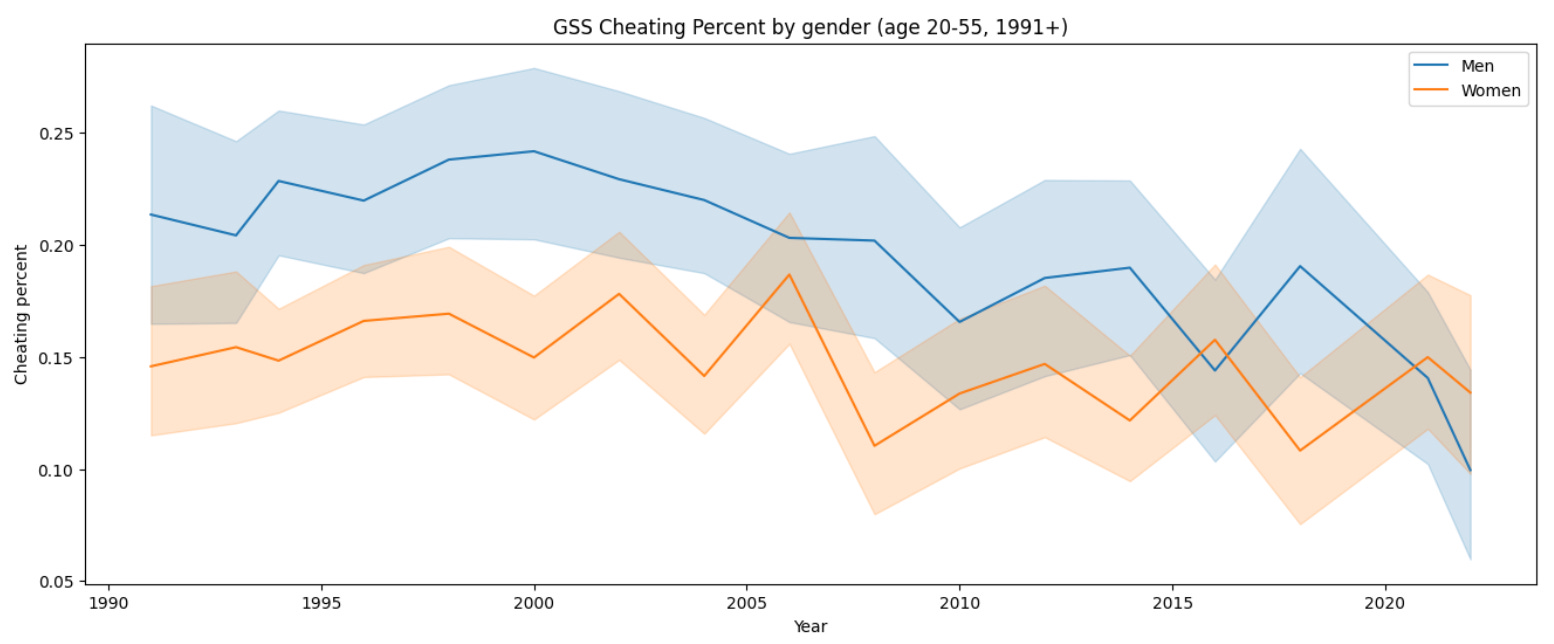
How many people cheat? For men, it’s roughly 20 - 35%, and for women, roughly 15 - 25%, lifetime numbers.
The results of a 2007 meta-analysis of 50 studies (Tafoya and Spitzberg, 2007) showed a lifetime prevalence of infidelity in 34% of men and 24% of women.
“In this relationship” rates are generally the lower ends of that range, say 20% / 15% for men / women.
GSS “ever cheated” data is a little lower than Tafoya, and it’s thought that this is due to survey methodology (in person surveys vs online ones show lower numbers for obvious reasons), and generally shows 15-20% for men and 10-15% for women.
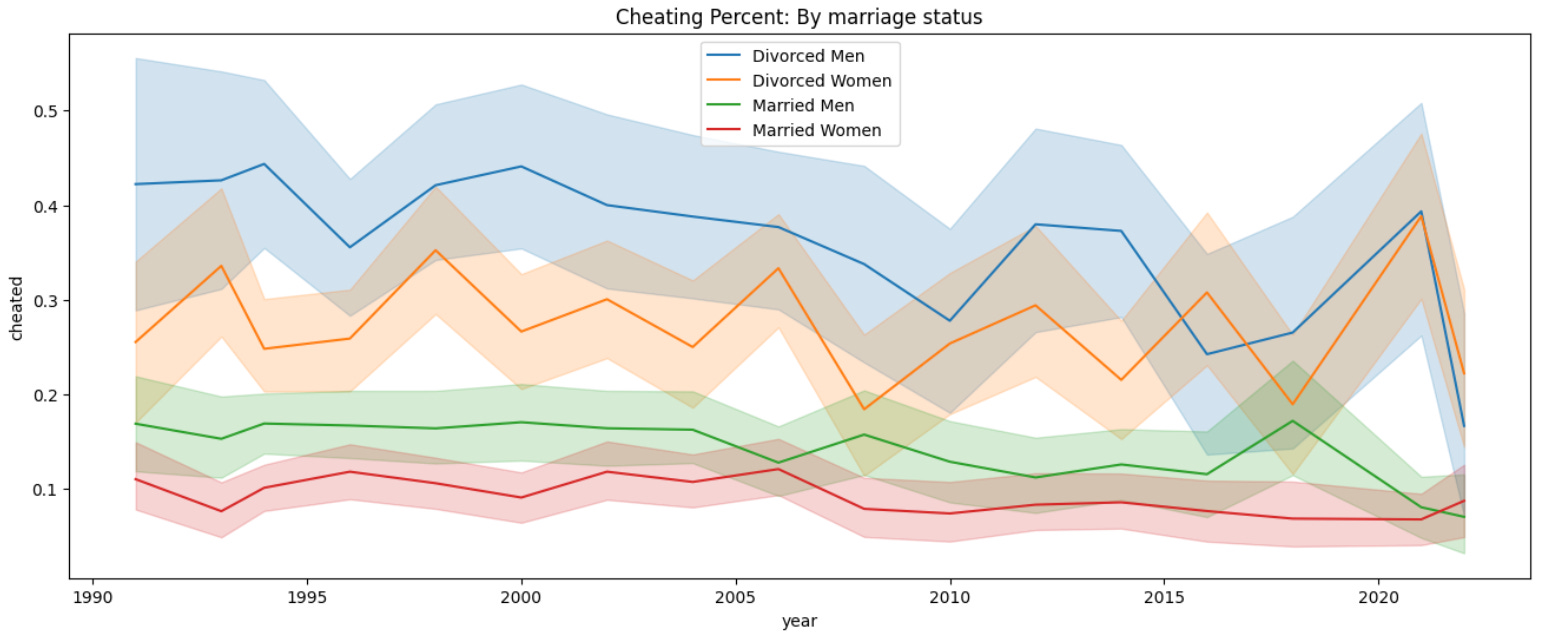
The rate goes up roughly 1.5 - 2x for people who are merely cohabiting instead of marrying, and obviously divorced people have higher rates than “currently married.”
To forgive is divine, but have you considered lying and getting away with it?
Can we infer how many admissions of cheating end in divorce, and how many get forgiven?
If you look in GSS at first marriages only, and compare them to people who are separated or divorced, and take the number of cheaters who are still married over the number of total cheaters across married / divorced / separated, you get a ~42% forgiveness rate.
But wait surely this is skewed! What if the still-married didn’t admit it, and the divorced did? Can we do better?
Let’s turn to Allen & Atkins (2012) where they looked at couples in therapy. Of those who reported cheating to the therapist (but not their partner), ie those who were concealing their cheating, 60% of men and 49% of women were still married, versus 33% of men and 23% of women who admitted cheating to both their partner and their therapist.
So you see a clear gender split - men are less forgiving of cheating. Lying about cheating also seems to be keeping a lot of marriages together! Does this come back to bite them?
In a 5-year followup, the couples with admitted infidelity had a 43% divorce rate, and those who lied and were later found out had an 80% divorce rate. Both of these compare against a 23% base rate for couples with no infidelity.
The literature is noisy, but in-relationship cheating admission rates are roughly 50/50 “do admit” vs don’t.
We can do some simple math here - sadly, our honest cheaters are probably not benefiting from their honesty, except perhaps morally or in a “having a clean conscience” way.
We don’t know the “non-admitted cheating discovery rate,” but if you game it out, and take the proportion of marriages surviving at 5 years, lying cheaters prosper right up until a roughly 90%+ discovery rate.
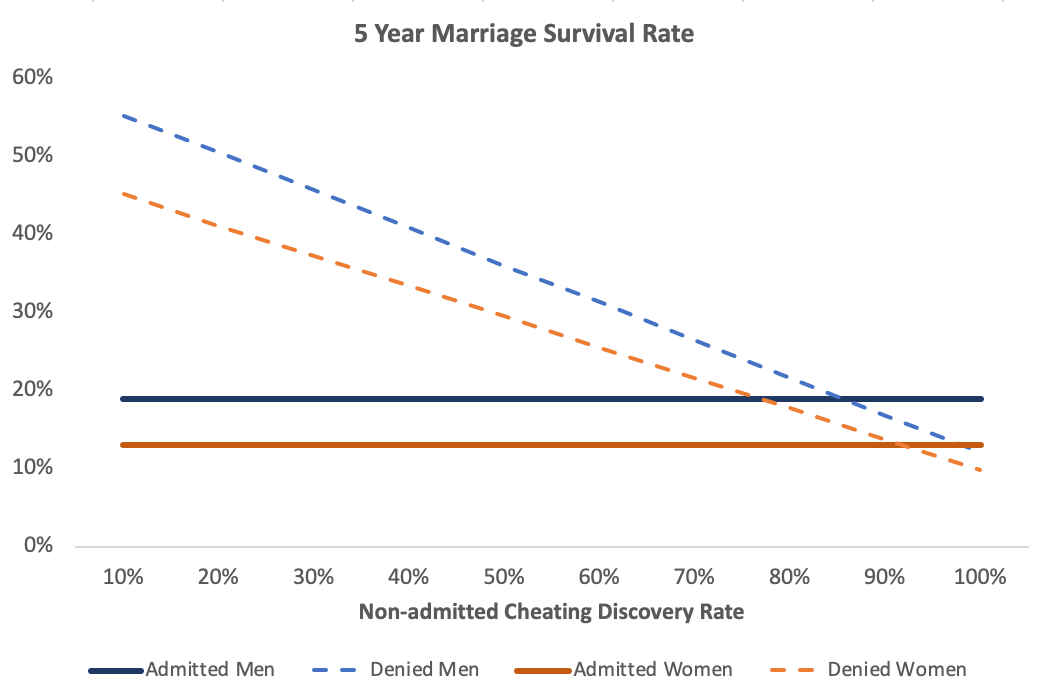
And before anyone gets excited by the above (I can more than double my chances of staying married by lying!), if you were really interested in staying married, just don’t cheat to begin with:
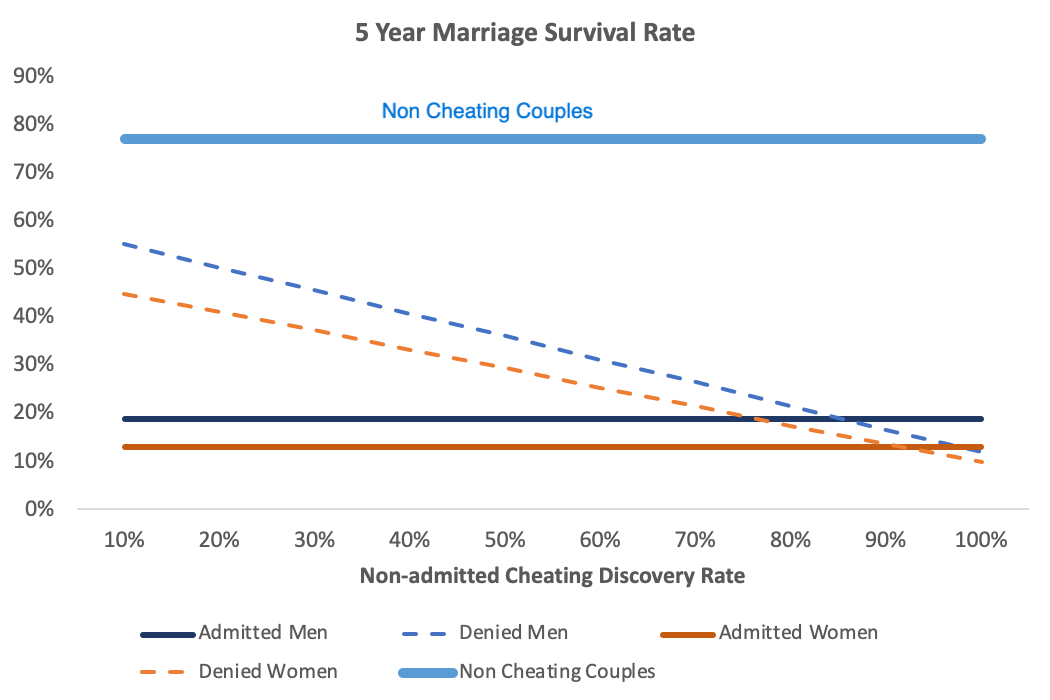
So it might “protect” your marriage in the short term, but if it’s ever found out, you’re pretty much done. And a reasonable floor on the discovery rate is probably the percent who admitted it - I’d bet a lot of them admitted it because of discovery. So if the floor is ~50%, maybe you don’t need a lot of additional discovery over 5 years to hit a 90% rate?
If you want some odds ratios, cheating gets you a 4.1 OR of being divorced and NOT remarried after cheating, and a 5.8 OR of being separated.
So…good luck, everyone thinking of cheating! It’s pretty likely to nuke your marriage.
Why do men cheat so much more than women?
Those cads! Those scoundrels! Mountebanks, ne’er do wells, and flimflammers! Obviously they cheat more because they suck!
Okay, but seriously god or nature has some ‘splaining to do on this front, because…
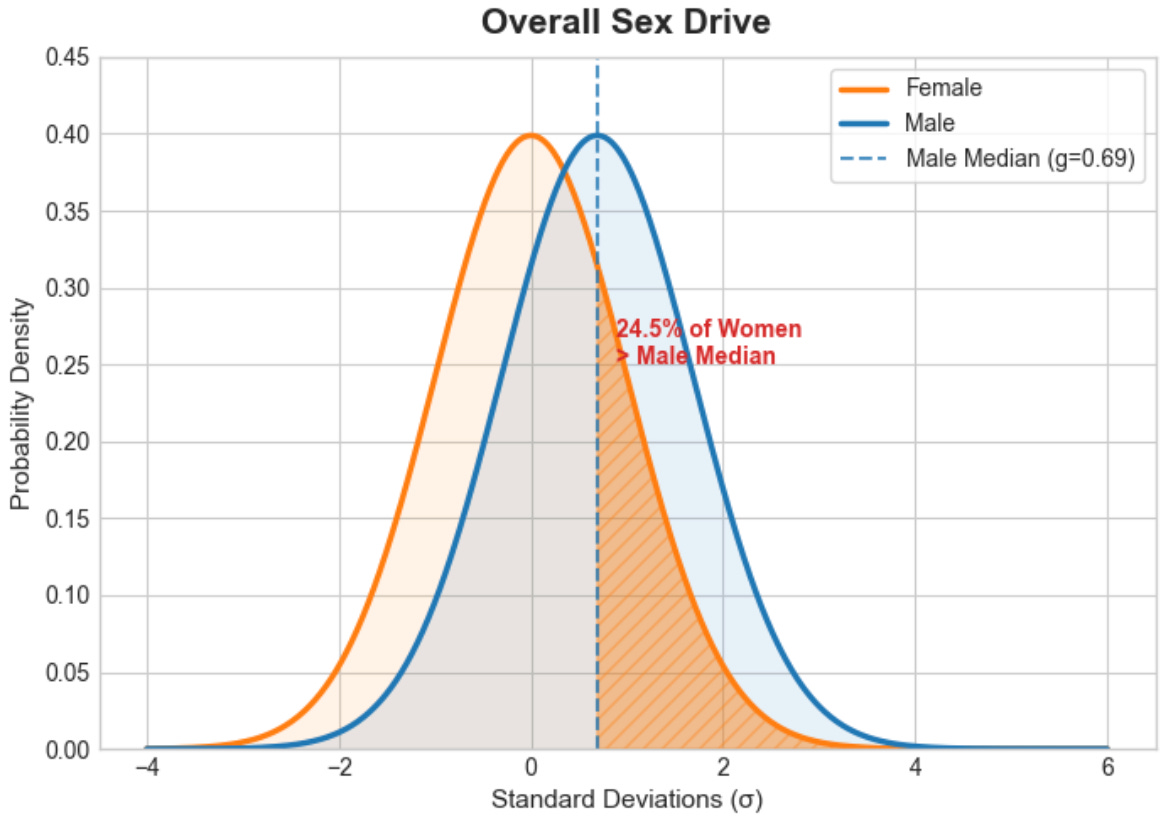
The MEDIAN man has a sex drive that’s at the 75th percentile for women. In other words, for every median man, only 1-in-4 women will match-or-better them in libido. And god help you if you’re at the male 95th percentile - only 1-in-100 women will match you then.
We were put on this earth to remain unmatched and sexually unsatisfied in the overwhelming majority of relationships, apparently.
And of course, from an evolutionary psychology standpoint, men have vastly higher payoffs and lower costs from sex-in-general, including cheating.
For any given round of casual extra-pair sex, the man gets to have fun AND maybe get an additional descendant out of it, then skedaddle off into the night, whereas the median woman might be saddled with a pregnancy for 9 months and then an additional child for the rest of their life. It’s all about incentives, on both sides!
So women are naturally more thoughtful on the “pairing” and on the “sex” fronts, and having a lower libido was probably beaten into our female hominid or mammalian ancestors over tens of millions of years, which neatly takes us to our anti-Panglossian present day, where neither men nor women get to be sexually satisfied when paired, on average.1
What are the risk factors for cheating?
Now we get to the fun stuff!
For instance, did you know self-identifying as a feminist makes it more like for both men AND women to cheat?
Isn’t that nice? Some genuine “walking the talk” on the equality front, who says there’s no truth in advertising! Feminist women really ARE just as good (or bad) as men!
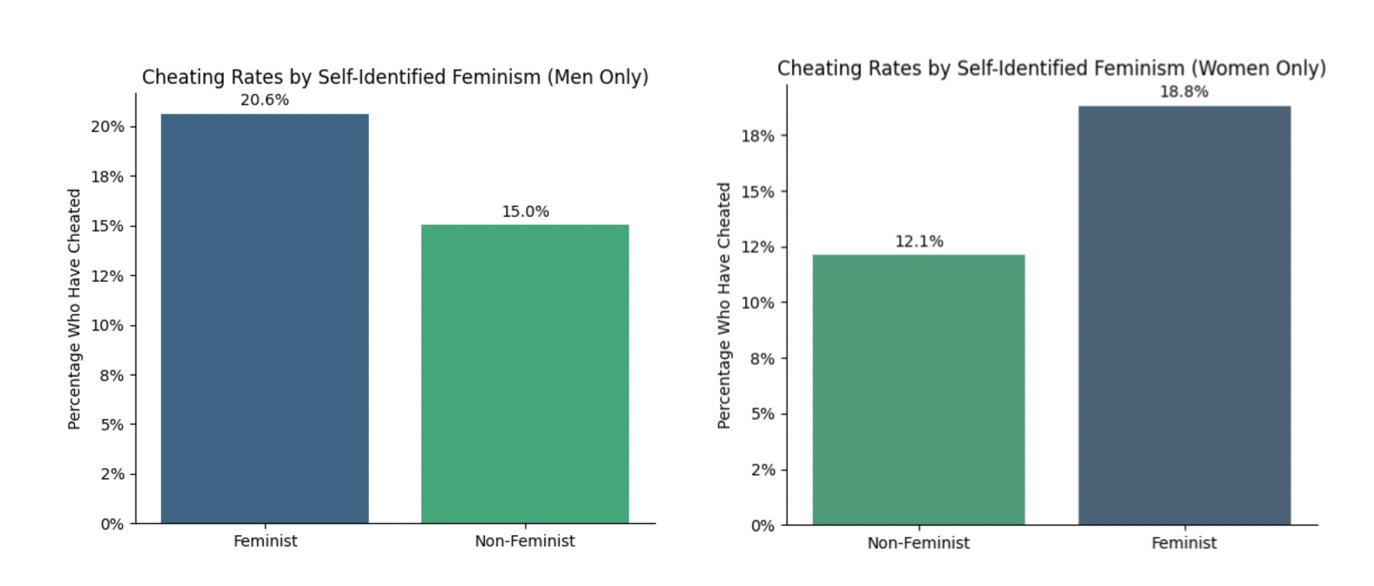
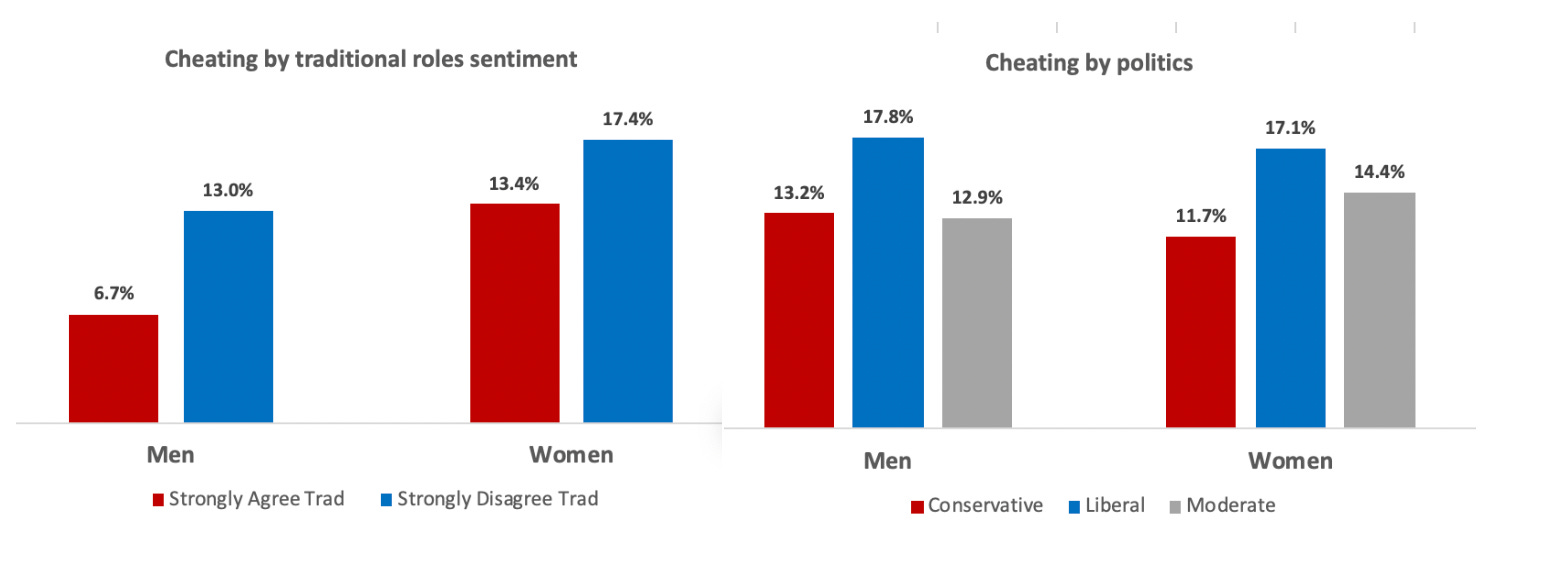
And given this one, the fact that trads and conservatives of both genders are less likely to cheat isn’t going to surprise anyone either, along with people of liberal politics topping the cheating charts:
What about Big 5? Are any of them predictive?
This was such a lift for me to surface - there’s one year (2006) in GSS that people answered Big 5 questions. Inevitably, they didn’t answer any of the sex questions - no body count, no monthly sex, no cheating info. So all the most predictive variables couldn’t be used. I moved mountains, cut and sliced 5 different ways, built 4 different models - and at the end of it, after finally achieving a decent AUC and Brier score, basically nothing was predictive but neuroticism in women and extroversion in men.
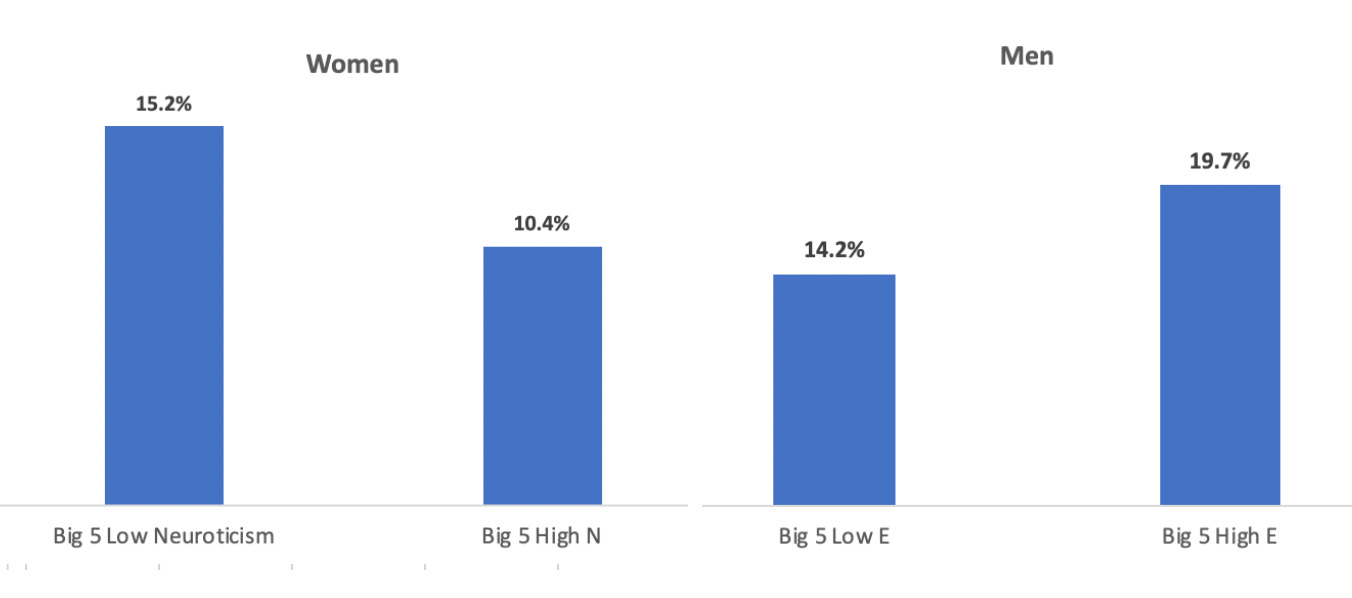
These don’t pass any reasonable p value due to small Big-5-answered sample sizes and are based on modeled risk scores, but we’ve also seen them corroborated in the literature, I just wanted a self-replication.
Male extroversion being a risk factor is obvious - cheating is about opportunity, the bigger your social circles and the more people you interact with, the likelier something comes up.
Neuroticism - the unsung monogamy hero
But why would LOW neuroticism women be more likely to cheat??
Well, for one thing being high N is probably protective because they worry more about the consequences - and for another, the female cheating model is mainly driven by mate switching, which we’ll get into later. What would mate switching successfully require? I’d guess it’s something like high self-awareness and cool evaluation of relationship and mate quality, along with a good sense of the probability of actually upgrading and sticking the landing, and a low N woman is likely better at all of those.
And on the flip side - hey! We finally found an upside to women being more neurotic than men! The “male female libido” mismatch? It’s close to being gender reversed for Big 5 neuroticism - the median woman is roughly at the male 65th percentile. So those low neuroticism women? Pretty rare!
Also, Bryan Caplan may want to update a little here on his heuristic on who you should marry, where he strongly advocates for finding a low N woman:

What about religion?
Surely religion is protective against cheating? Shouldn’t belief in our heavenly father, that great big Elf-on-the-Shelf in the sky keeping an eye on all our sordid goings-on, tamp down on cheating?
Not really! But you’re slightly better off with a Buddhist, a Muslim, or a Catholic guy, or a Catholic, jewish, or Christian girl, and even then they’re all pretty close to the base rate:
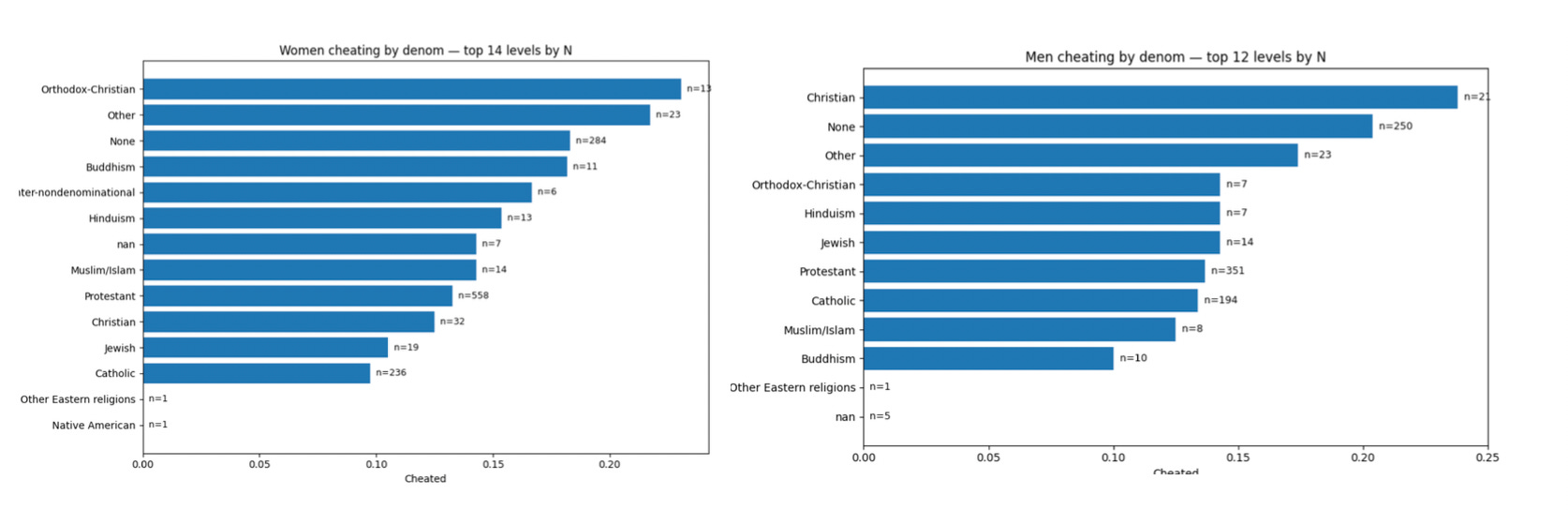
Sure, those godless heathens with no religion seem to cheat more, but the generic Christians and others are pretty close, and honestly, they all clock in pretty close to the base rate.
Well, that’s fine, lots of people talk a big game about being religious, but what about religious attendance?? Surely, going to church more often is protective?
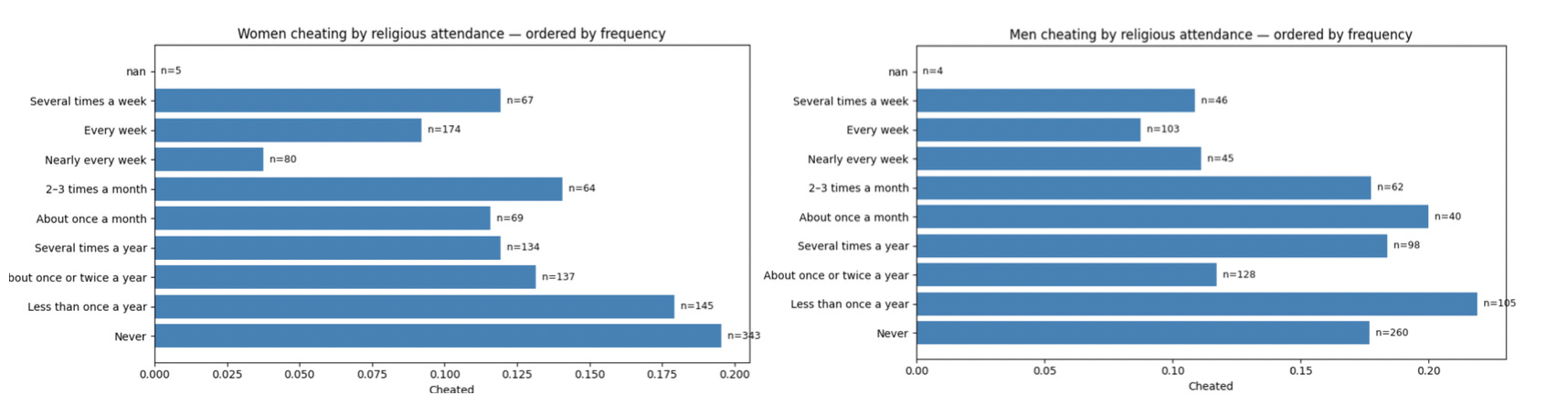
Once again, our godless heathens dominate cheating, but you know, 1 to 2-3 times monthly attenders are doing pretty badly, too, and you’re better off with a “never attender” man, or an “about once or twice a year” person of either gender.
So not really sure what to conclude here except that no, religious attendance is also not really protective.
Cheaters gonna cheat, apparently, and plenty of them are happy to do it no matter how much time they’re spending at god’s house.
What about friends?
An evergreen topic! Let’s talk about the spiciest friendship application - that’s right, I’m talking about “backup mates.”

A decently strong finding in the literature (Cohen’s D ~.2 - ~.4) is that both men and women look for the traits they value in a mate in opposite sex friendships. And it gets pretty explicit - attractiveness is pretty important for men when considering female friendships, and men reliably report desires to have sex with those female friends, and both of these are true whether they’re single or partnered.
If you want a jaw-dropper of a factoid on that front, from one of Zvi’s latest roundups:
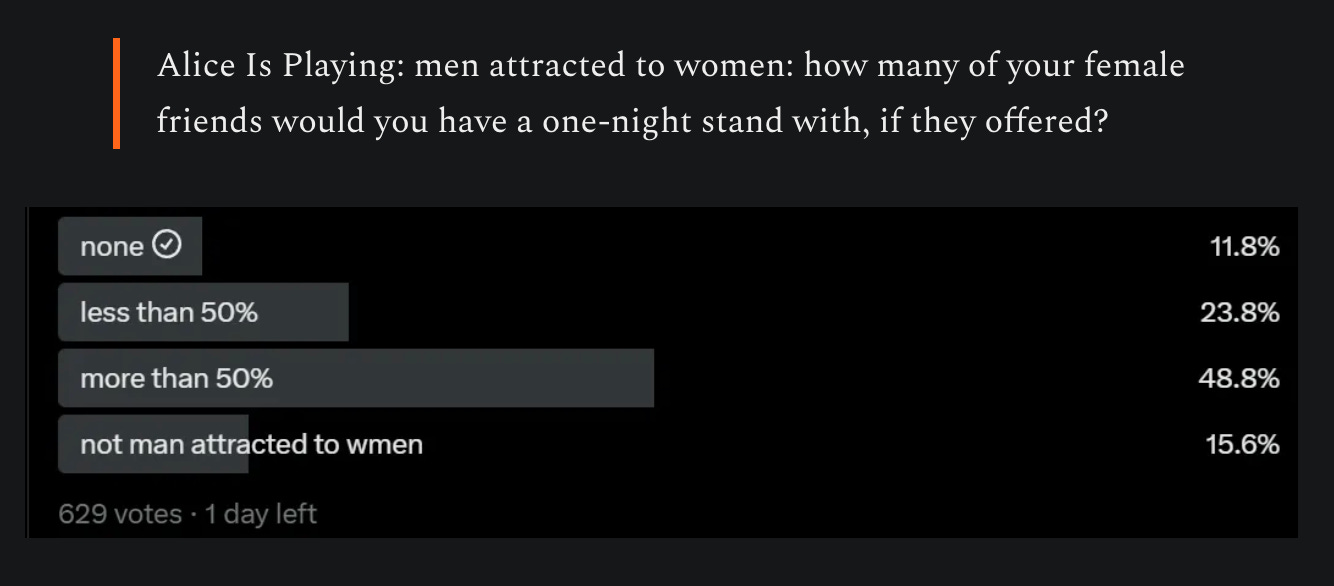
Stunningly, ~90% of men would admit to being willing to happily sleep with at least one of their female friends, and about half would sleep with more than half of them. More at the post, which is a fun read.
Women do the same thing when evaluating friendships, and do so more when single than paired. Both tend to hide or conceal “backup mates” from their partners if they’re in a relationship, and when they’re discovered, said backup mates reliably cause fights.
It’s difficult to find a good citation on what percent of people have “backup mates” like this, but things behave pretty much as you’d expect when studied.
From David Buss:
“When we surveyed roughly three hundred people about how they would feel if their primary backup mate had sex with someone else, on a scale from “happy” (+3) to “upset” (–3), men more than women said that they would be upset, but only by a small margin. But when we asked how upset they would be if their backup fell in love with someone else, women were roughly twice as upset as men, with the average upset being –2.5. Similarly, women were more upset than men—extremely upset—if their backup entered into a long-term relationship with someone else.”
And indeed, if we look at the literature, we see that the most common infidelity partner is “a close personal friend” at 53.5%, and the next most common at ~30% a neighbor, coworker, or long term acquaintance.2
So beware your spouse’s close opposite-sex friends, neighbors, and coworkers! They’re the ones they’re most likely to cheat with, and probably the ones most likely to be their “backup mates.”
Although given that they’re usually concealed, not sure how you can really act on that, beyond being such a great partner and spouse you end up in the ~80% of couples that remain faithful.
Bounty as endless as the sea - income and spousal support
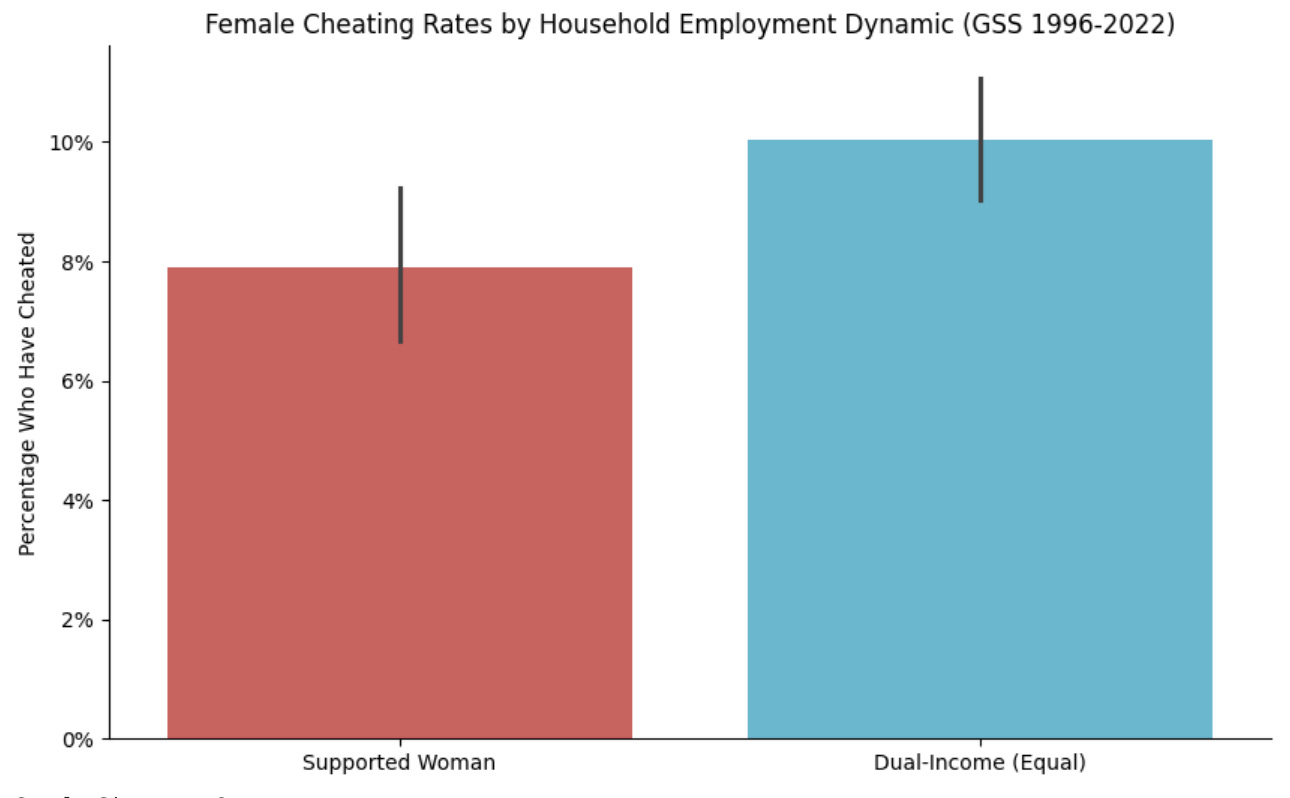
What if you’re a good, hardworking woman whose man has run into hard times? Are you going to be rewarded for digging deep, working hard, and supporting both of you?
Nah, you’re about 1.5x more likely to be cheated on by your loser husband. Womp womp.
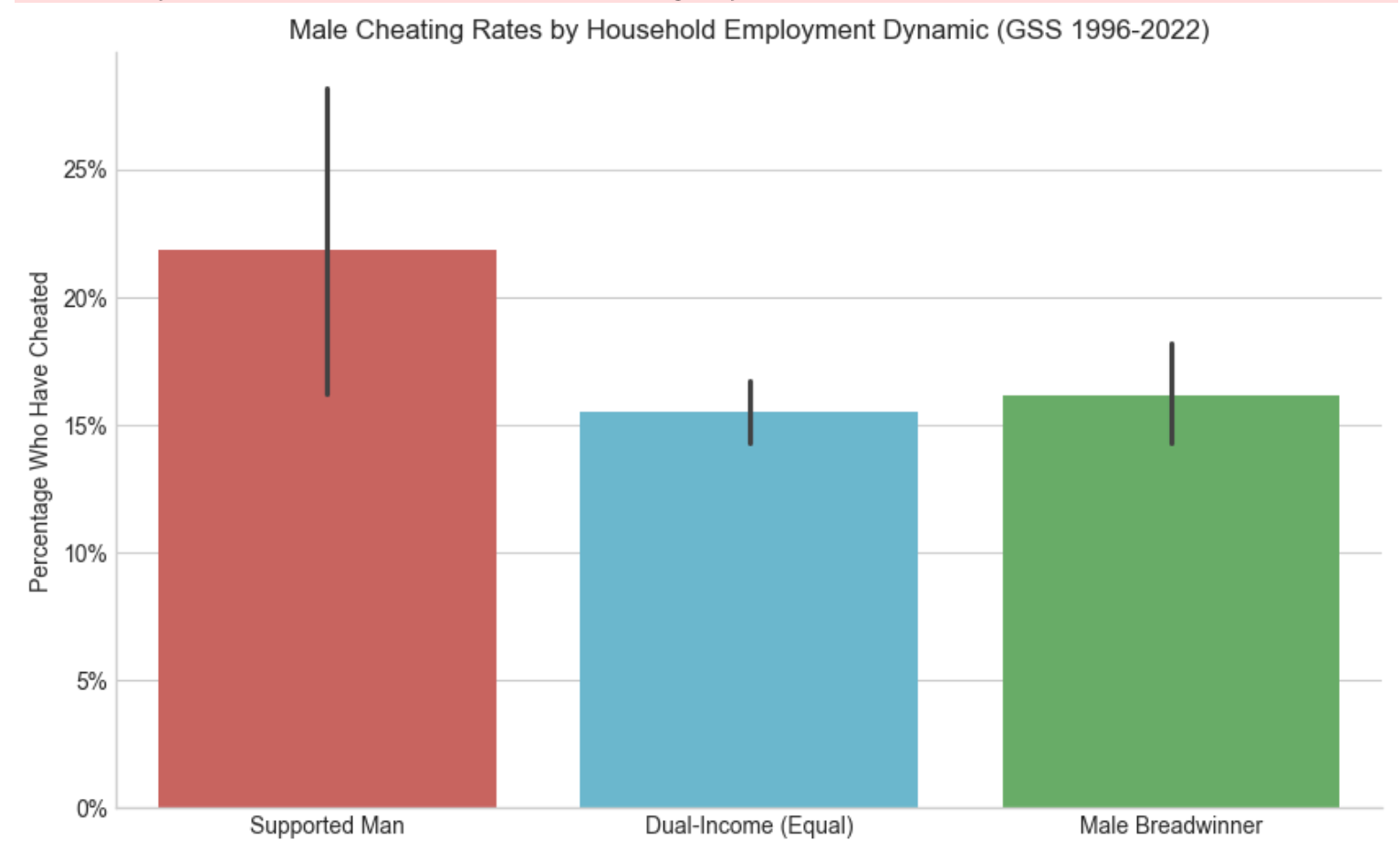
Once again, women just can’t catch a break, can they? Which I went over about 20 different other ways in my “Dear Manosphere, women legit have it harder than men, fight me” post.
Do we see the reverse? No! It’s noisy, but supported women probably cheat a little less than dual income households. They definitely cheat less when supported when they have a college degree, which we’ll see later.
Income does some really fun things. So back to our thesis that female cheating is a matter of standards (as indeed female pairing in general is), we can clearly see this in the data as cheating shoots up in higher income men and women, with a fun peak at $100k individual income for both genders, after which more income is protective for women, and more income increases risk of cheating in men.
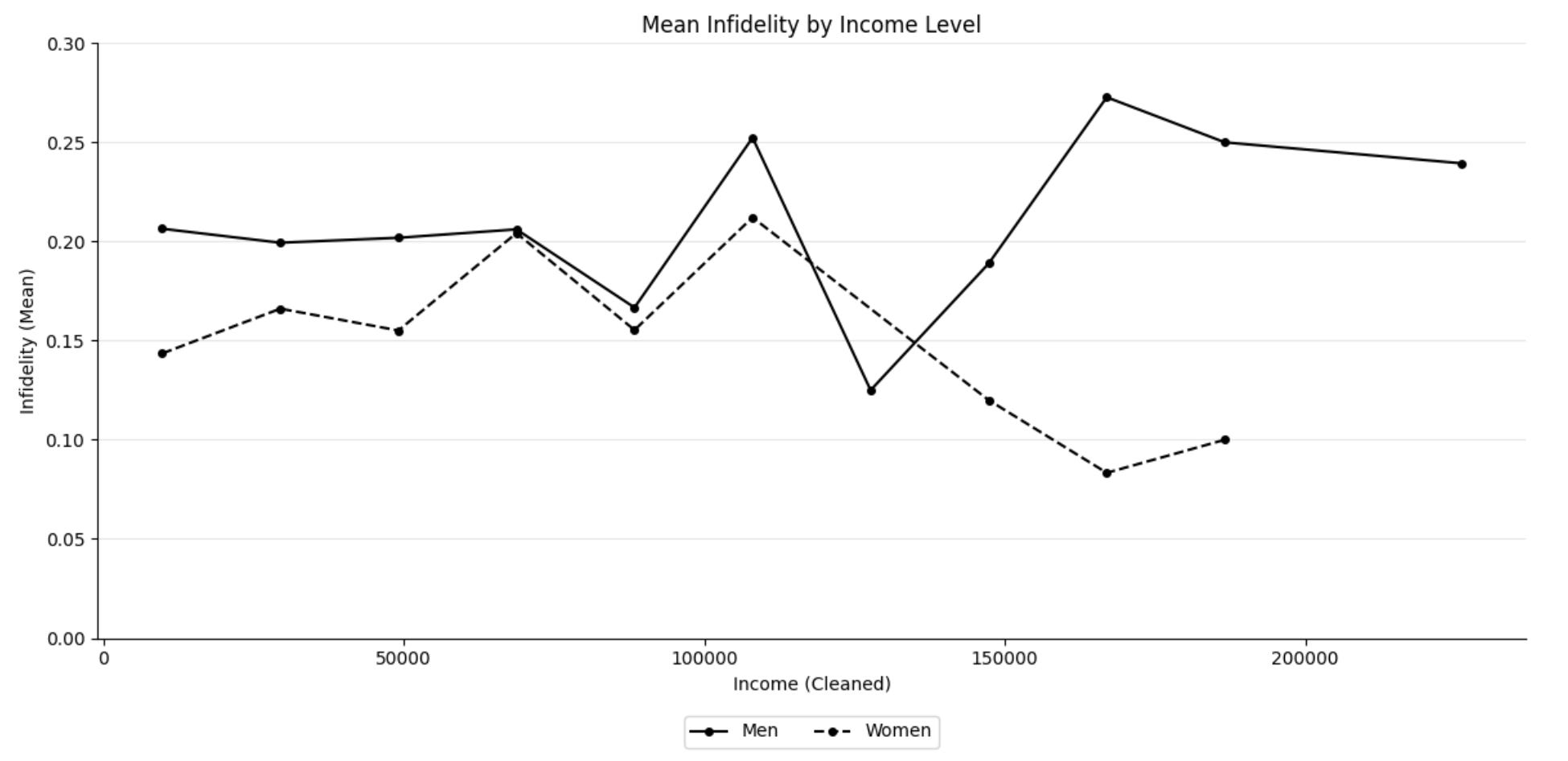
Just a word on our particular incomes here - the variable being used here is ‘conrinc,’ which is inflation adjusted personal income. However, due to what I consider a fairly questionable choice, conrinc is indexed to year 2000 dollars. So a $100k income was actually top 5% then, so ~95% of people are below that number in this chart.
One other thing you might notice there - that dip from $60k - $90k personal income or so. This is the “virtuous middle class” effect, and they cheat the least! You also see this reflected in the “dual income” graph above.
So what’s going on with that wild sawtooth up there? Cheating jumps up for everyone at $100k, then dips for both men and women at $125k. To put it succinctly….HUH?
Well, we have some hidden stratifiers there. Basically what’s happening is $100k is a local status peak for non-college men, and then the $125k data point is primarily college men in better than top 5% income careers, and education is a big stratifier.
We can see this presaged when looking at occupational prestige:
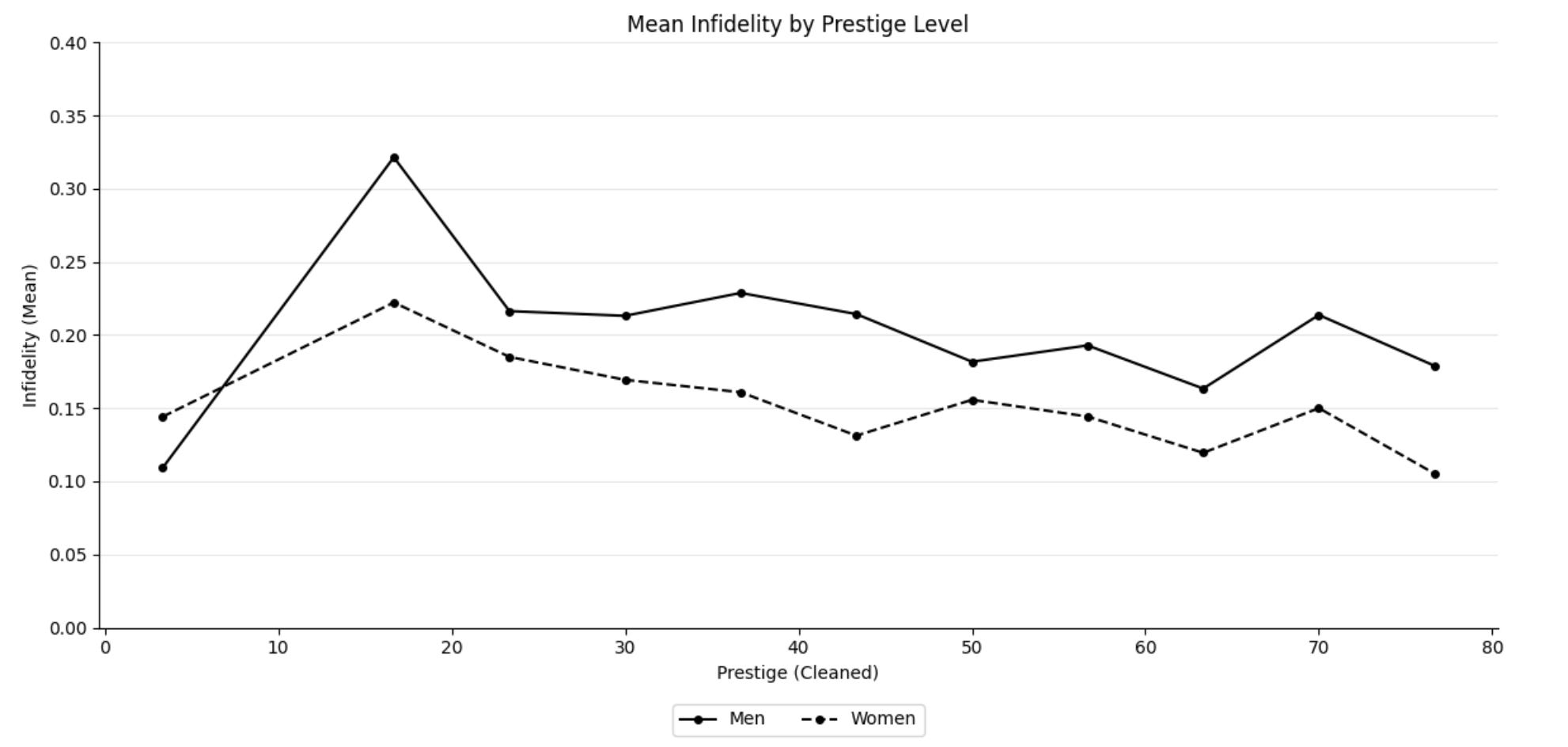
A little prestige is apparently a dangerous thing! That big jump is basically bottom tier guys and girls getting a little status from their jobs, and cashing in to the max. It’s interesting to think about what that might represent - moving out from a family house into your own place, and now it’s easier? I wonder.
And then cheating mostly declines with prestige, with a little bump at the very end. Why is more occupational prestige protective for cheating? Largely because it correlates with education, and education is a big deal - not just because it loads you down with a house price’s worth of student debt, but for cheating reasons, too.
What about educational attainment?
Do we stratify by education? Yeah, very much. One of the great trends affecting our societies today, and marriage in particular, is that marriage is increasingly a luxury good.
Every generation, more and more women opt out of marriage:
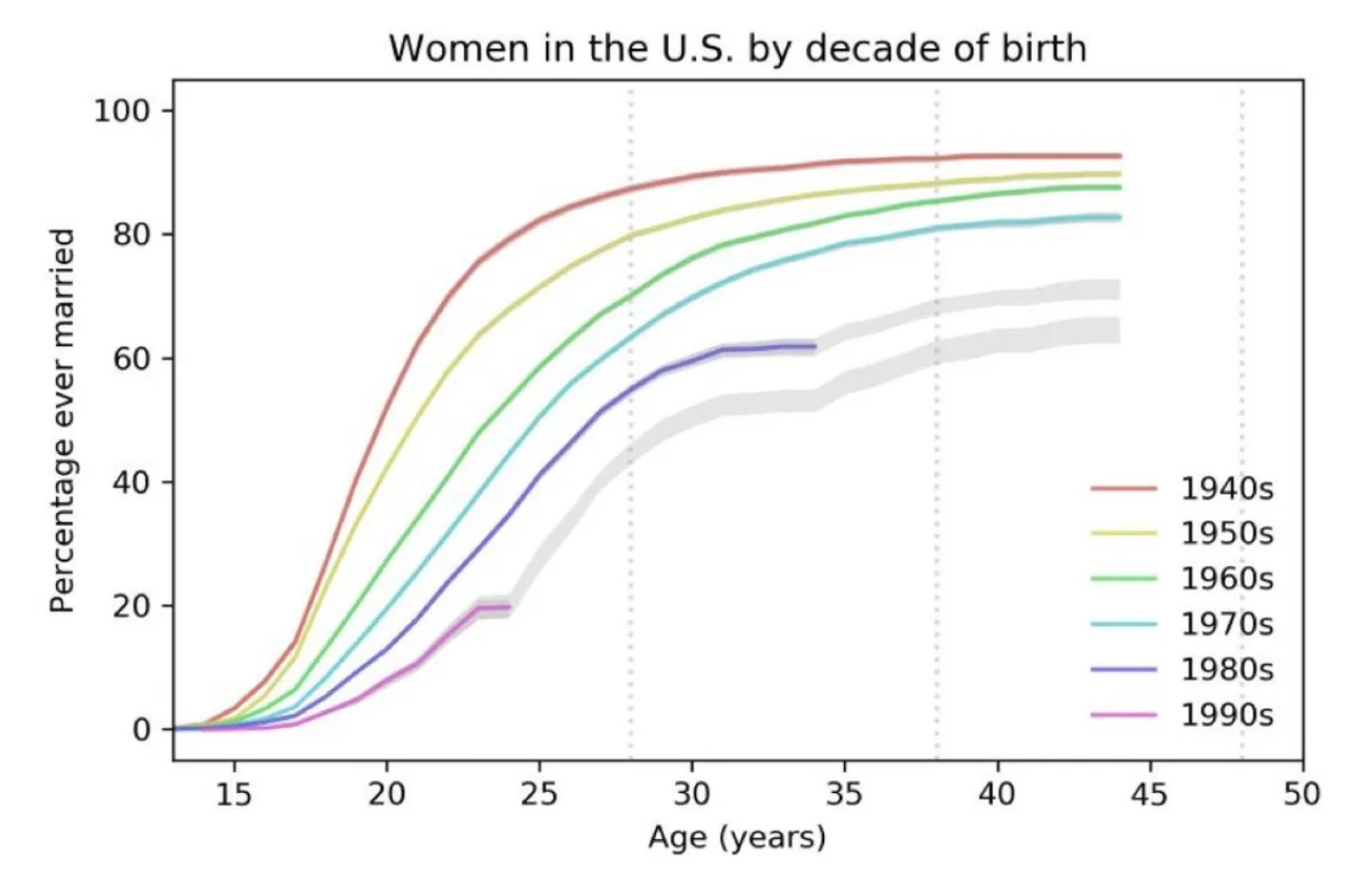
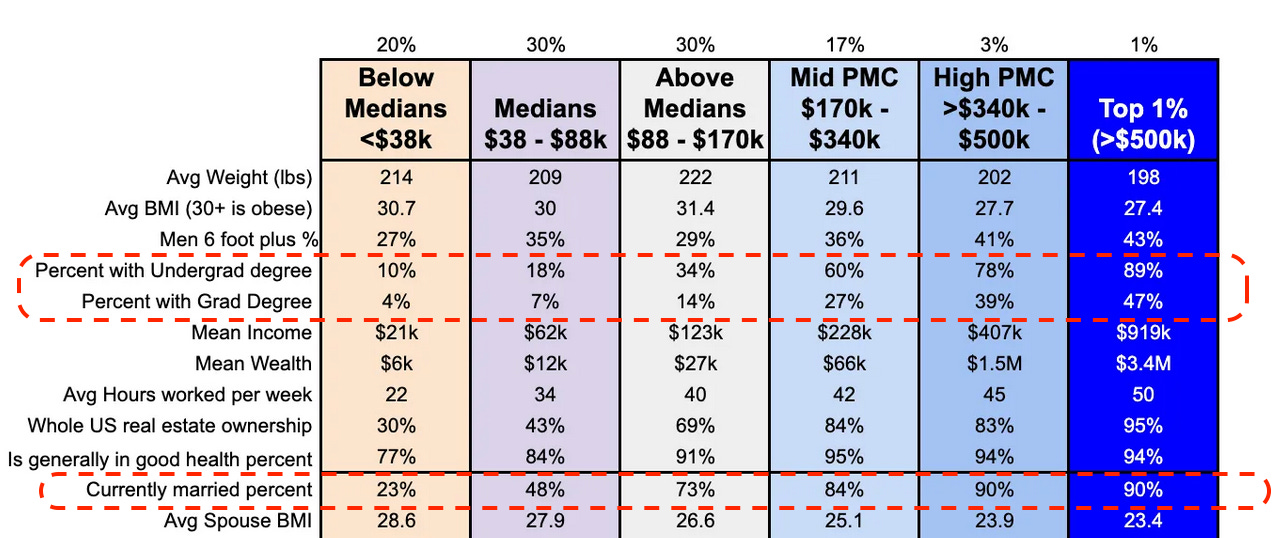
And surprising nobody, those opt-outs are concentrated in the lower male SES tiers. In the bottom quintile of income and education men, only 20% or so get married, and only 48% at the median.
But in men in the top quintile and above of education and income, marriage rates are 85-90%, and college degree rates are 60-90%:
Are the women responding to a genuine quality signal?
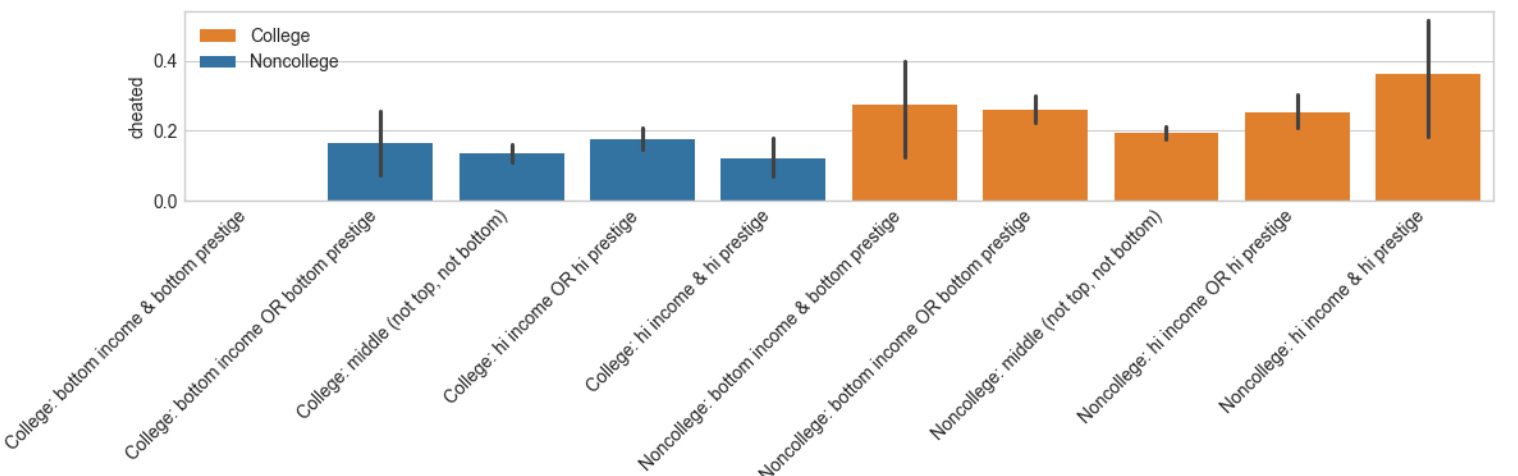
But of course! Those baccalaureate boys are WAY less likely to cheat on you! For a college boy, generally the more they make and the higher status their job, the less they’re going to cheat on you - but the trend is reversed for non-college men, where past the middle, cheating steadily ratchets up the higher income and prestige they are. These were our $100k peak guys - they’re making good money working tough jobs, and they are using that money and status to the max!
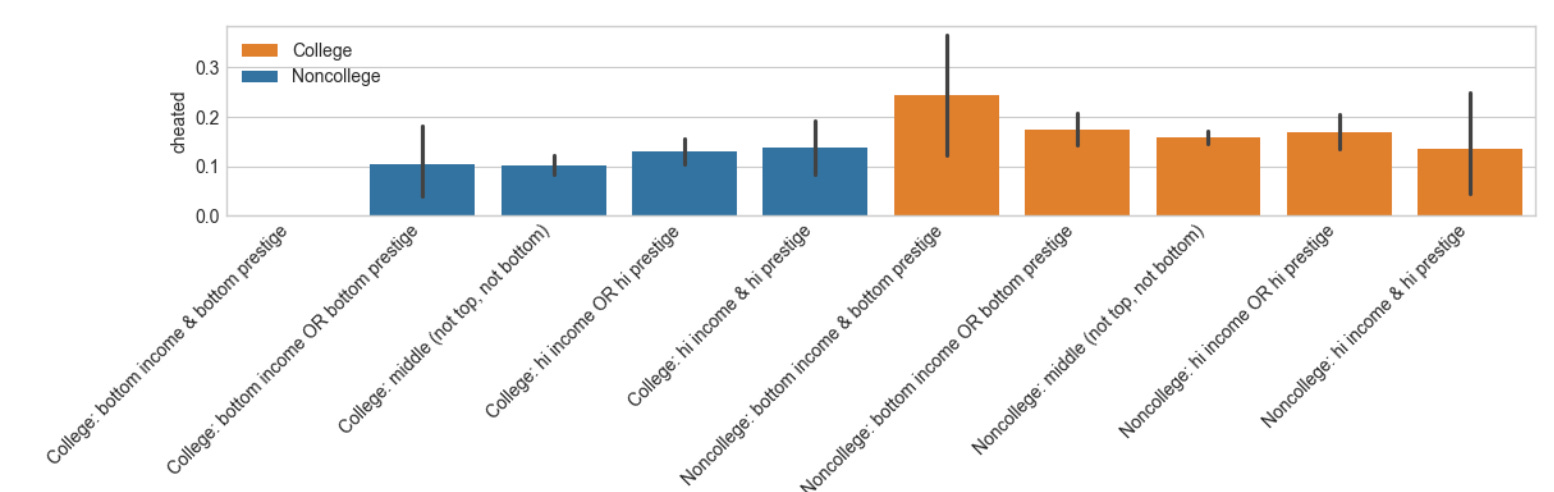
What about for women? All reversed! Those college girls get MORE likely to cheat on you the higher up they go, and non-college girls are reversed, status and income is protective.
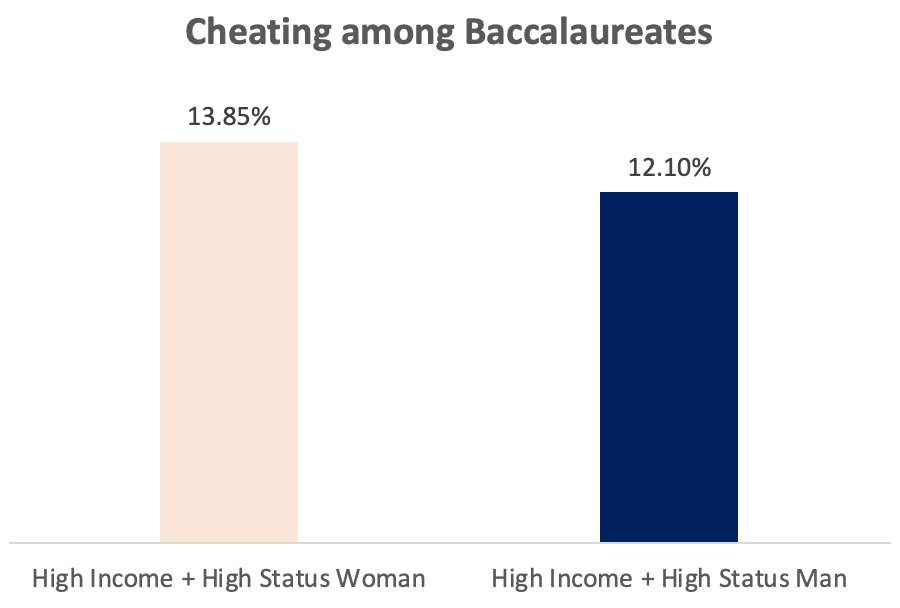
A high status + high income college girl is actually more likely to cheat than a high status + income college boy!
Gender equality, at last! I’m crying a little, we fought so hard for this…
Mission accomplished banner, do your thing!

What does cheating do to body counts?
So as we went over in the beginning, cheating is an opportunistic phenomenon, and men and women have different motivations. In addition to being comically mismatched in libidos, they cheat for different reasons.
For men, once they’ve decided to cheat, it’s basically all upsides with no costs (well, except for the fact that cheating is the primary cause of divorce, and increases your odds of divorce and separation by 4-5x, as we discussed).
But for a WOMAN to cheat, the guy has to be noticeably better than her current mate. How much better? Just as one point of triangulation, and to fan the flames and ardor of any lookcels out there, a guy in the bottom 25% of looks is roughly 10x more likely to get cheated on than a guy in the 75th percentile or better:
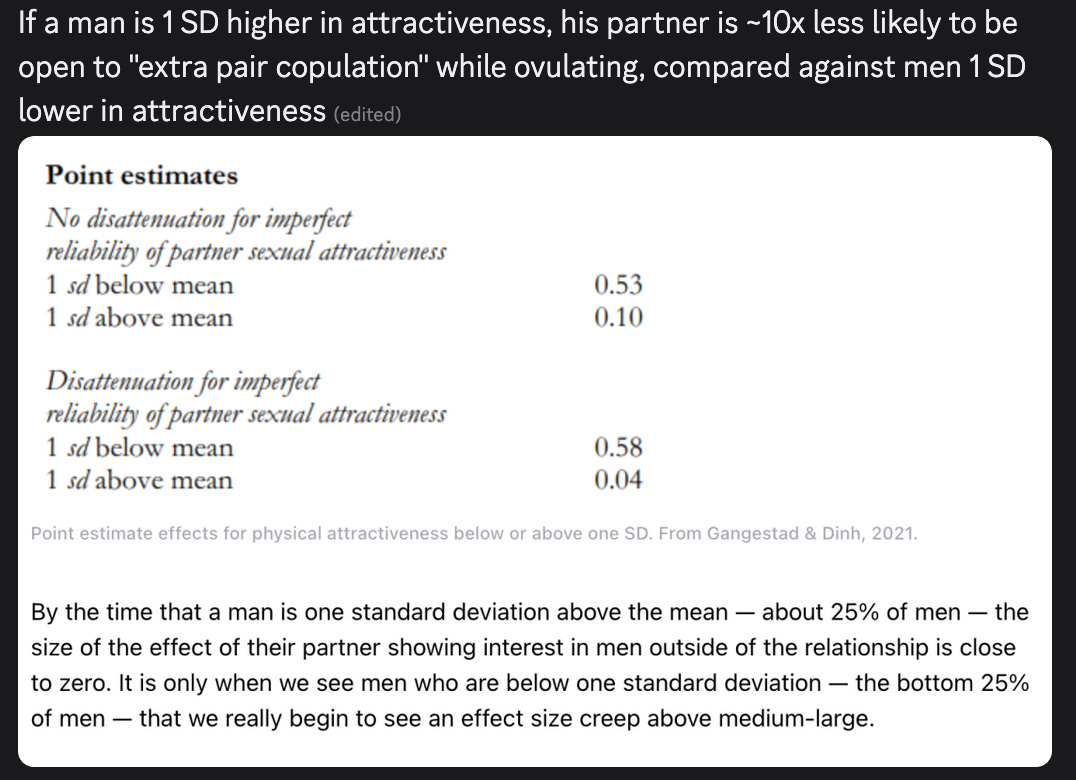
Women will also cheat for “mate switching” potential. That is, if there’s a guy noticeably better than her current partner, who seems credibly interested in the woman and has signaled that they’d like an LTR with the woman in question, a woman is more likely to cheat.
How any men out there might use this information when talking to any women they know with notably uglier-or-lower-status-than-themselves boyfriends is now a private matter between themselves and their conscience.
But you know, just to stir the pot, I will point out there’s a decent chunk of women that basically “never hit the ground” in the sense of never formally being single, who monkey branch from one relationship to the next. The literature is mixed, but depending on how you define it, this ranges from 6 - 30% of 18-25yo or 18-28yo women.3
Which monkey-branching is a crystal clear demonstration of backup mates in action! It’s not just for sitcoms and evo-psyche papers, folks!
So there’s a decent chunk of women such that this might be the ONLY way to pair with them. Not suggesting you should cheat on your own partner, but I do feel like facilitating somebody ELSE cheating while you’re single might be different, morally.
After all, if it wasn’t you, it would have been some other moke, and that other guy probably sucks compared to you! Certainly he’s less accomplished, erudite and well read than you - after all, you’re here, reading this post! And it is an unassailable fact that my readers are a standout collection of all that is good and admirable about humanity.
Overall, doing that might be lower risk than you might think, in terms of your own future relationship quality. As we will see, “once a cheater, always a cheater” is pretty clear for men, and less clear for women.
David Buss talks about male and female infidelity in his book When Men Behave Badly, and reports the following:
“Moreover, men who cheat do so with a larger number of sex partners. Men seeking sex on the side apparently are serial philanderers. Women are choosier even in this domain, typically having a single affair. And of those women, 70 percent cite love or emotional connection as the key reason for the affair.”
But this has obvious implications for body count, too. Female cheaters are largely going to cheat in the rare circumstances of a major step upwards. A male cheater is going to cheat whenever he can. But because women are picky, most men cannot - there’s a big quality bar to be passed, and most men fail.
Obviously the larger superset of cheating men is a long tail of sad opportunists who managed to talk somebody they worked or interacted closely with into cheating once, but it was nowhere near a systematic thing, and they racked up just one or two more in an overall small body count.
And indeed, do we see this born out in the data!
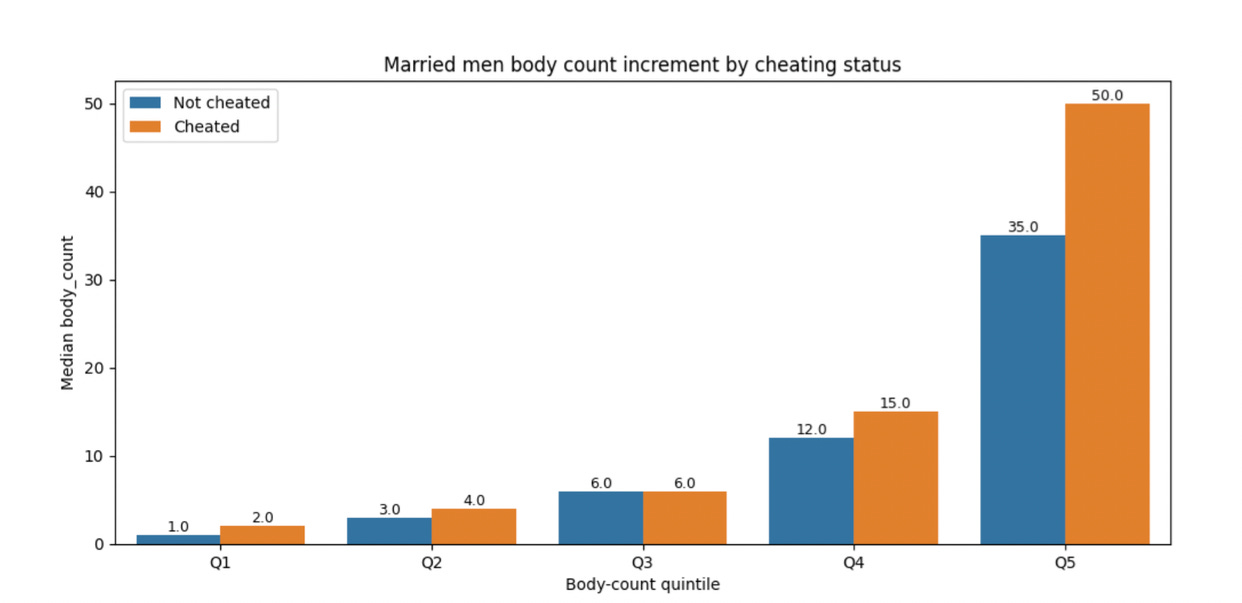
See how stratified “successful male cheating” is? Cheating for 4/5 of all male cheaters is largely a matter of adding a single body to their count over their entire lifetime, and a full 75% of all male cheating sexual partners are concentrated in the top quintile. Power laws and Matthew Effects everywhere!
So that top quintile? A 20% cut of the 20% of cheaters. That’s a pretty selected ~5% or so of men, more or less. Think of our income and prestige jumps. It’s pretty likely a lot of these guys are selected on things like that, as well as looks and social skills. If anyone are “Chads” they’re right there. Actually, I call these guys “Chuds,” because they’re cheating to get their body count, the vast majority of Chads are actually faithful, which we’ll touch on later. They’re also having all the sex by monthly volume, incidentally, as I went over in my post about Chadopoly mathematics.
But these are our “once a cheater, always a cheater” guys. All the other guys would probably have LIKED to do it, but couldn’t pass quality bars, and probably got justifiably divorced the one time they succeeded.
So what about women? Why would pairing up with somebody who cheats to “mate switch” into a relationship with you ever be a good idea? Isn’t “once a cheater, always a cheater” true?
It is not! At least, for women, at this level of aggregation.
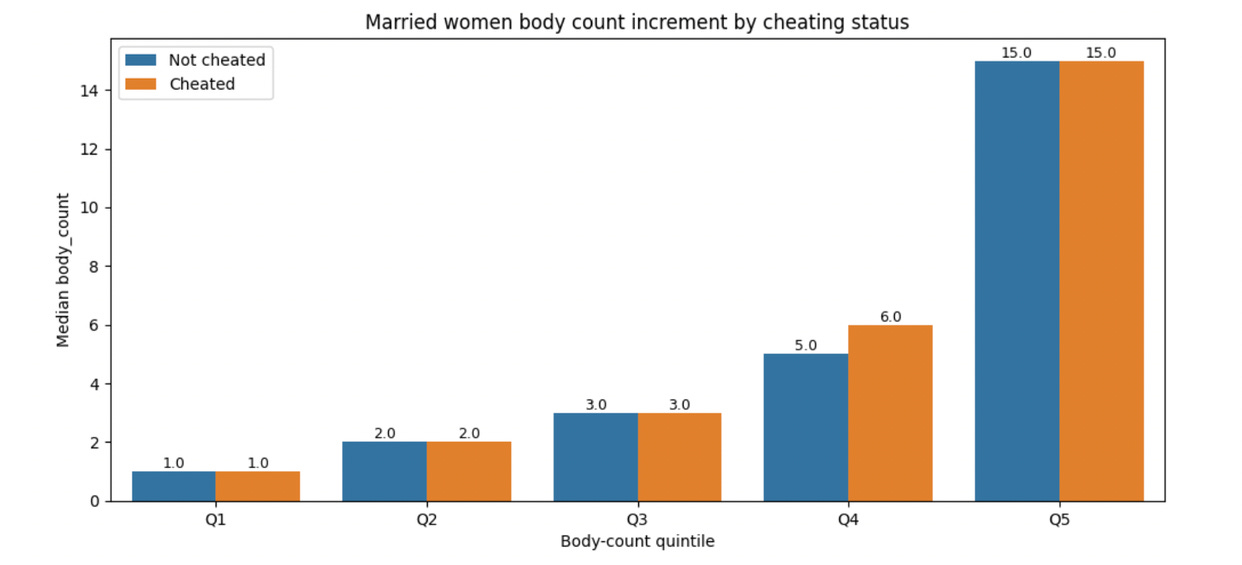
For women of a marrying disposition, reflecting everything we pointed out above, cheating barely even adds to their body count! The majority seemingly cheated only once, to hop to another LTR (because the cheating portion by body count quintile had the same total number of partners).
“Once a cheater, always a cheater” is apparently true for men who can pass quality bars, but not for women. I was actually surprised here! I genuinely thought it would be true for both genders.
And a quick footnote for anyone saying “Wait, how can those distributions be true?”4
So I thought of another way to test our “once a cheater, always a cheater” hypothesis - of the spouses who divorce and remarry, what is the cheating rate in their 2nd+ marriages?
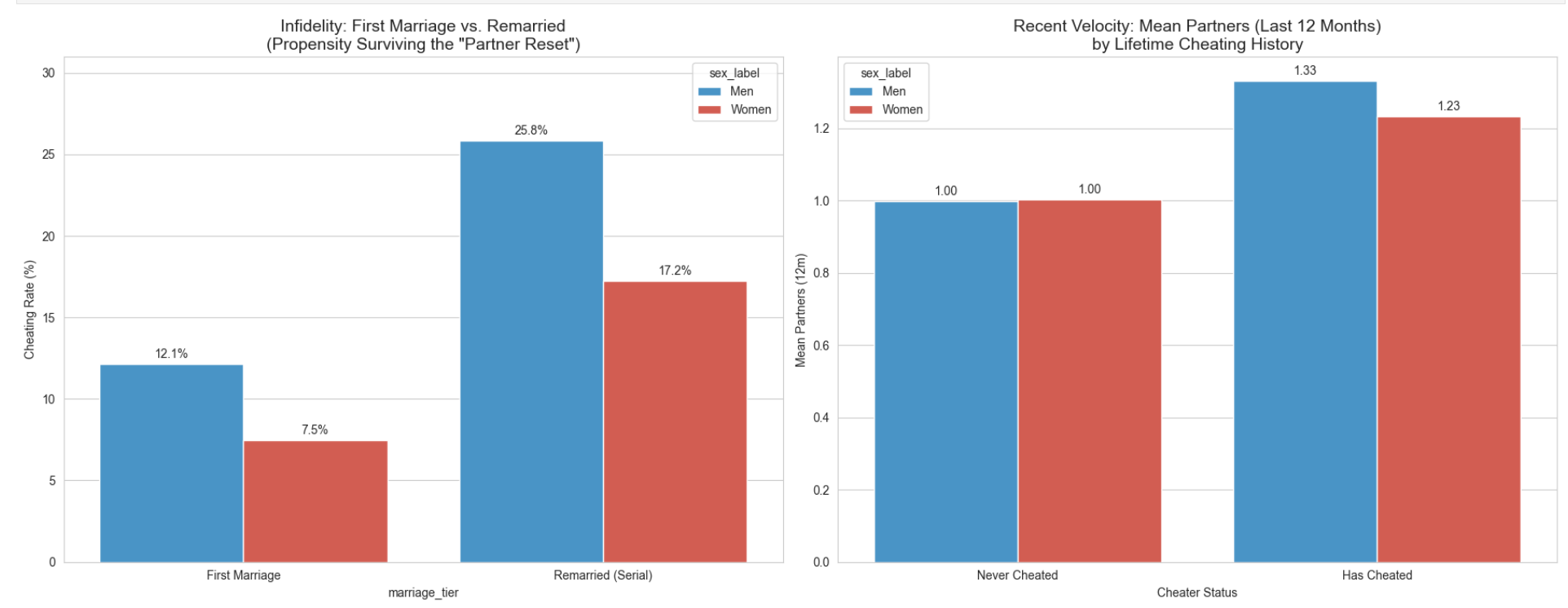
And here we see the truth laid bare! Both men and women enjoy a ~2x increase in cheating rates as they go from 1st to 2nd+ marriages, implying cheaters do indeed keep cheating, and that divorcees of both genders are negatively selected. On the RHS, I’ve taken the mean of partner count in the last year by cheating flag, and we see that roughly 1/3 of men and 1/5 of women who have “ever strayed” are still straying in the last year.
So it IS true for both genders, it’s just weaker in women, so weak that it doesn’t show up in the aggregate body count graph in the same way it does for men. It looks like your odds ratios are roughly doubled if you intitate a relationship with a partner who cheated to switch to you.
But how do you know if somebody is likely to cheat? Maybe your monkey brancher is in a special set of circumstances, a damsel or gentleman in distress, who will surely straighten up and fly right if they pair with such a sterling character as yourself!
You know what, I’m just going to Shap all of this
I mean, it’s fine to use Mark 1 eyeballs and caveman precision while hammering on one variable at a time, but we’re more interested in the big picture right? What we need here are Shapley values.
Sure, this matters, and that matters, and that other thing might matter in certain circumstances - but I want to know HOW MUCH each thing matters, in relation to each other. Like big picture, what are the biggest factors, how much do they add to cheating risk, and what clusters are they defining?
And fortunately, we can very much do this! One xgboost model and some Shap values later:
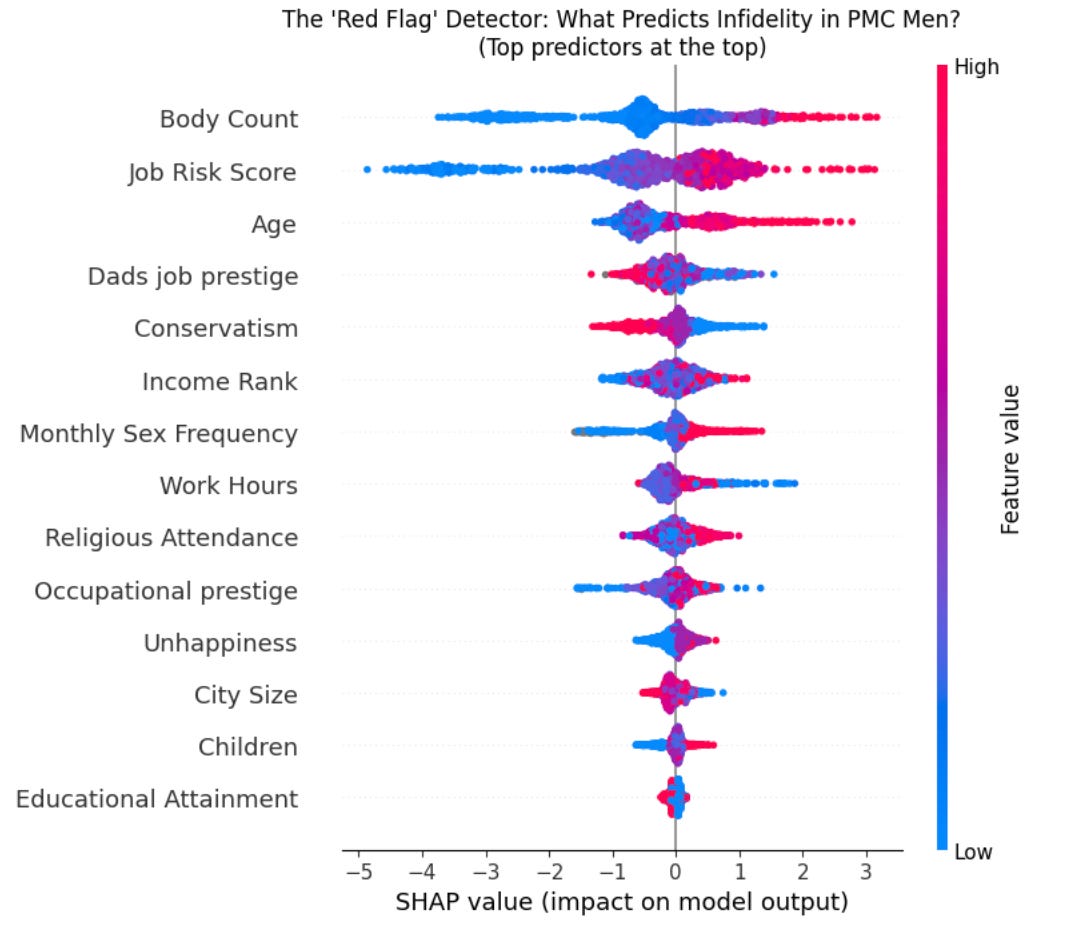
Alright, so what do we see? Broadly, men with high body counts, in certain jobs, who are higher income, who are older, who are liberal in political views but still attend church once every week or so, who have kids and are in suburbs and who are maybe unhappy with their relationships, are the most likely to cheat.
But those variables are in order of importance! Unhappiness in relationship is one of the weaker correlates with cheating, barely adding .7 to the overall cheating score in the very worst cases! Body count and job risk were each 5 times higher!
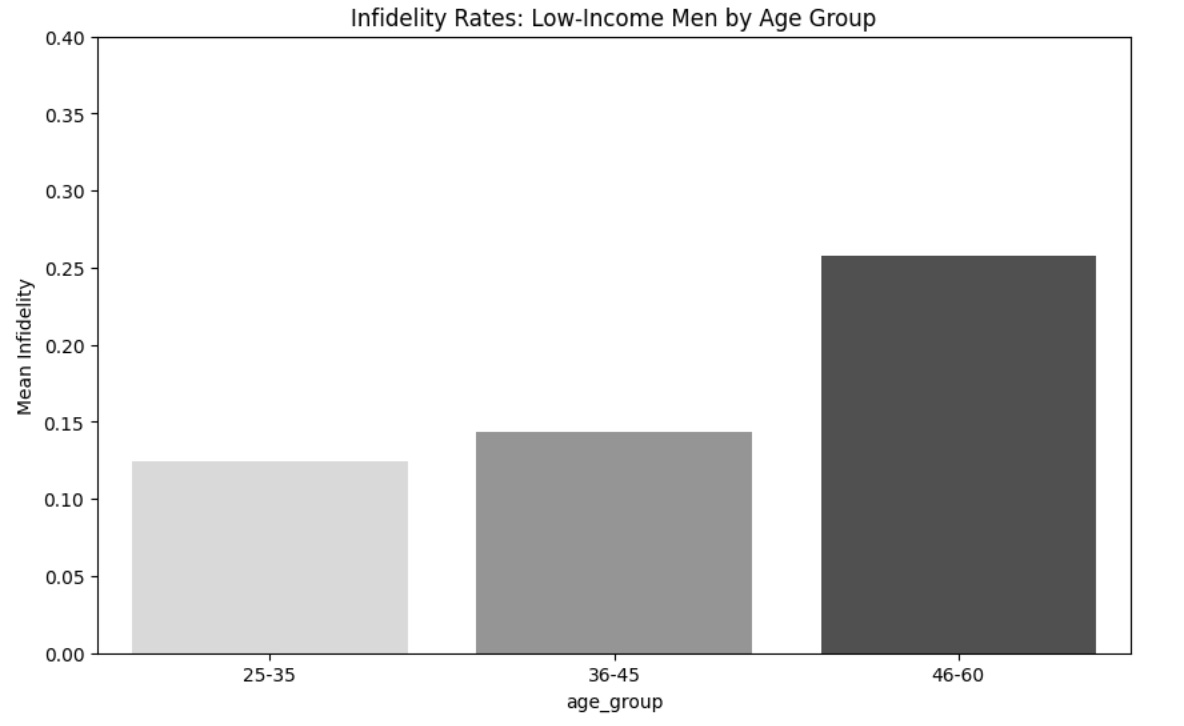
Age was a little more than 4x higher, and that’s no surprise either - unsurprisingly, the odds of cheating go up the longer the relationship has gone on, largely because it’s a factor of opportunity and for men, status, and both increase with age.
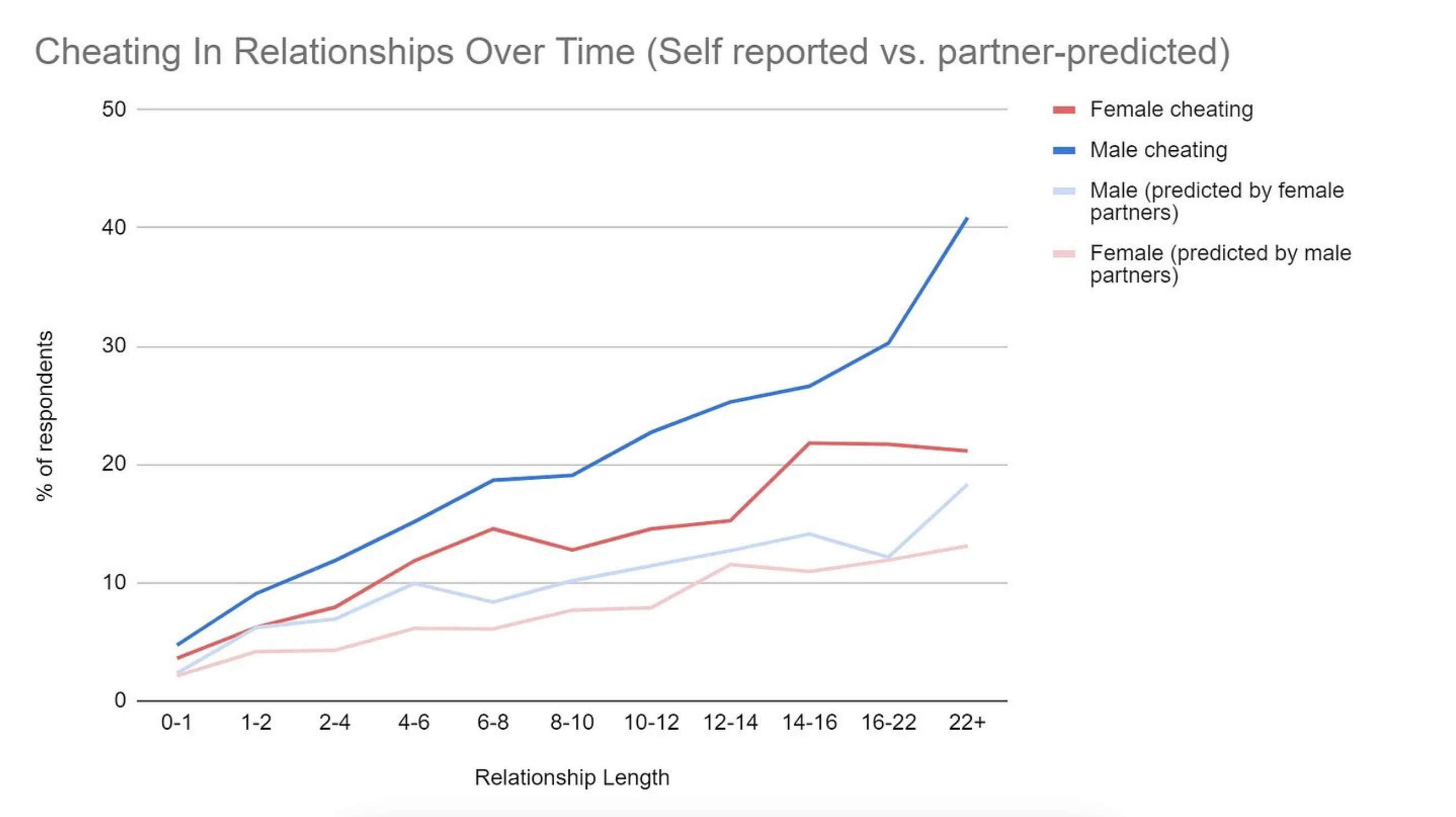
This is true regardless of other factors - you can consider the bottom 3 income deciles of men, and older men have cheated a lot more. Cheating above all is opportunistic, and the longer you’re around, the more the opportunity:
And what is this “job risk?” Broadly, there is a family of jobs that are higher risk. Jobs that involve a lot of interacting with other people, that are relatively easier and lower stress, that give them some free time, jobs that involve traveling, these jobs are a higher risk for infidelity for PMC men.
Who are we looking at here?
Now let me explain the population we’re looking at in our Shap values chart.
So I wanted to model a segment that was relevant, because as we know, cheating is greatly stratified by income and education - non-college folk cheat more than the college educated, low income people cheat more than the middle class, and I think to most people reading this, knowing that doesn’t change anything.
What anyone reading this wants to know is “what makes my college educated husband / wife more likely to cheat?” And that’s what I’ve done - I’ve confined the population to men with bachelor’s or better, and to being at least 60th percentile income and occupational prestige. This still leaves the virtuous middle class college educated, and the less virtuous higher tiers, so we’ll have a good sample of both cheaters and faithfuls, to pick up on actual signal.
It’s ALSO a lot more useful than a model that will tell you “yeah, don’t marry any lower class men / women with no college degrees who have a little job prestige,” because duh - everyone reading this was already following that advice by default.
This probably explains “dad’s job prestige” being protective - it’s a class argument, and generally the higher prestige and the higher class your male partner, the less he’ll cheat.
So our model has told us that men with high body counts, who are older and higher status, who work a specific set of careers with relatively easy work weeks that interact with a lot of people, those factors are allocating most of the risk.
Now some smaller factors that still add something - if they’re liberal in politics, if they attend church once every week or two, if they have kids, and if they’re unhappy, the risk is higher.
A sad note for all the good wives out there
This one was interesting to me - within male cheaters, monthly sex frequency is a bigger risk the higher it is, and I would have expected the opposite.

So these creeps lucked out and actually have a devoted and awesome wife who’s taking good care of them in the bedroom - does it boot the wives at all? NO!
Sorry ladies - if your guy is a cheater, him having a high libido is risky enough that taking good care of him doesn’t offset it, likely due to the crazy mismatch in male and female libidos.
Once again, a man at the 90th - 95th percentile will only be matched by a 1/40 - 1/100 woman, and this plainly shows through here - and even these “high” monthly sex frequencies are more or less laughably low (it’s a categorical variable that caps out at ~16 times a month, ie once every other day).
So the size of the risk allocated has been decreasing with each one of those additional attributes - if your hubby says he’s as pleased as can be? If you guys don’t have kids yet? He can still be at high risk of cheating!
So as an archetype of the max risk man, think a good looking liberal politician who slept around a lot before he met his wife, who goes to church but isn’t conservative and has kids - that’s the guy maximally likely to cheat.
You heard it here first, folks! Future presidential contender Gavin Newsom? Definitely cheated on his wife.

From woman’s eyes this doctrine I derive
Alright, let’s look at women - same deal, we limited it to college 60/60 percentile women.
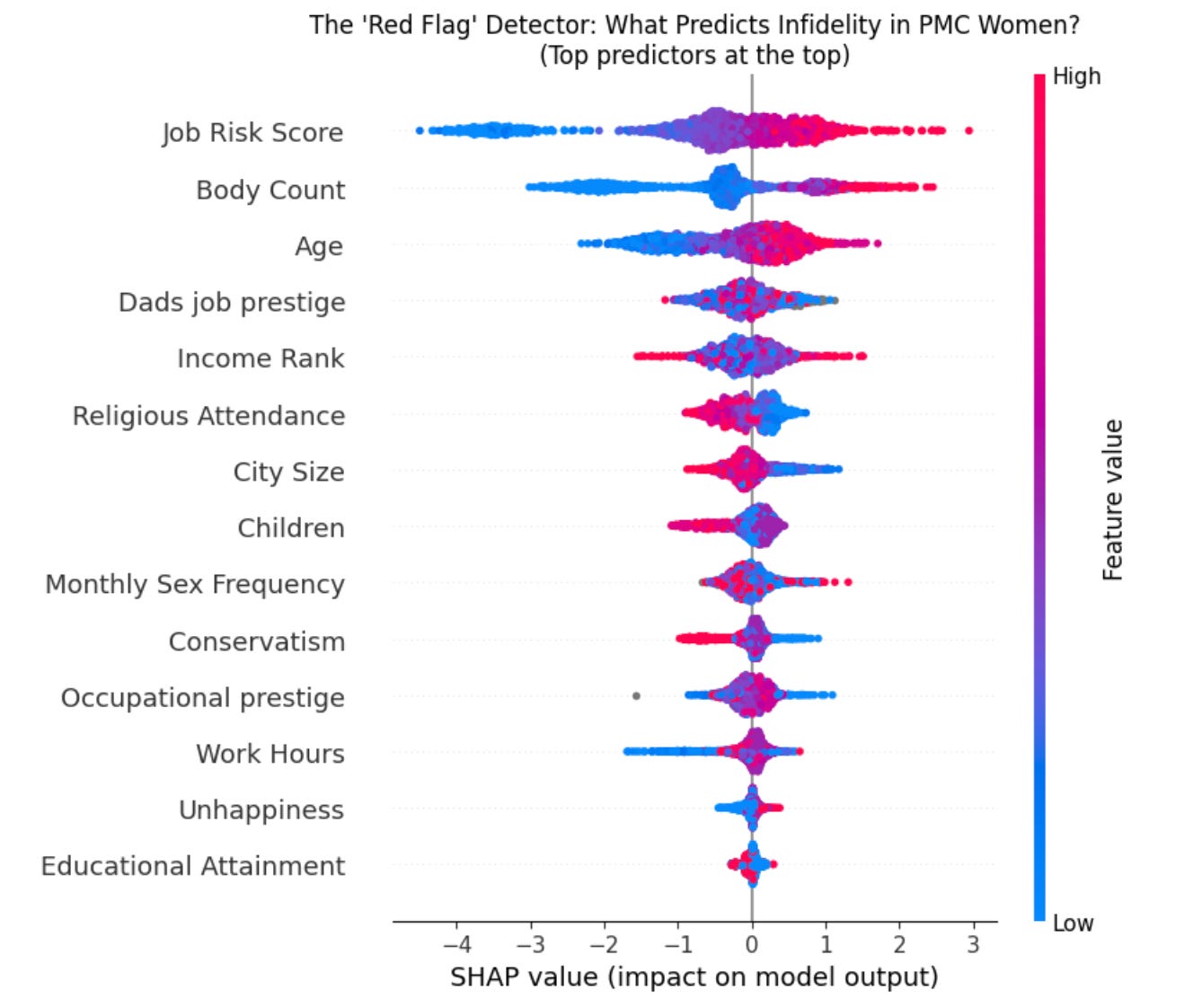
Our top 3 are still the same here.
What’s high risk?
High body counts and high risk jobs are our top 2, followed by age
Next we get living in the suburbs, higher monthly sex frequency, and occupational prestige, with lower prestige being more likely to cheat
Finally, we get lack of religious attendance, liberal politics, and unhappiness

Income is interesting here, because high income can both be a significant risk factor, or significantly protective. What does that mean? It maps back to the high risk jobs - broadly, there’s clusters of both high and low risk jobs, each of which are fairly well paid, and that’s why we see this split.

Man, look at that sex frequency! Ain’t NOBODY winning! There’s a handful of professional women with high libidos who are more likely to cheat, likely because they’re not getting enough too, just like the men! These are those top 1-2% of women with actual libidos, and somehow they were unlucky enough to get paired up with a median-or-below libido man or something, because even they are seemingly mismatched and at higher risk of cheating.
What’s protective?
Having kids, not working many hours, and being happy, conservative, and church attending
Almost like we’re starting to see a picture here, huh? Trad wives represent!! You heard it here first, folks. Amish women are peak faithfulness.
So who is the highest risk woman? As an archetype, think an attractive, high body count liberal lawyer who doesn’t attend church, and is in a demanding and high status career. Sorry fellas - Ally Mcbeal would not have been a faithful wife if you’d landed her.

But what are some specific high risk jobs? You can’t just tease a “high risk job” category and not give us specifics, PB!
Do what you love, and you’ll never work a day in your life
You’re right, that’s not fair at all, let’s spill that hot goss!
What are the high risk jobs for men? As we touched on earlier, they’re mostly jobs that involve interacting with more people, easier work weeks, and in some cases, that high risk, high income bracket.
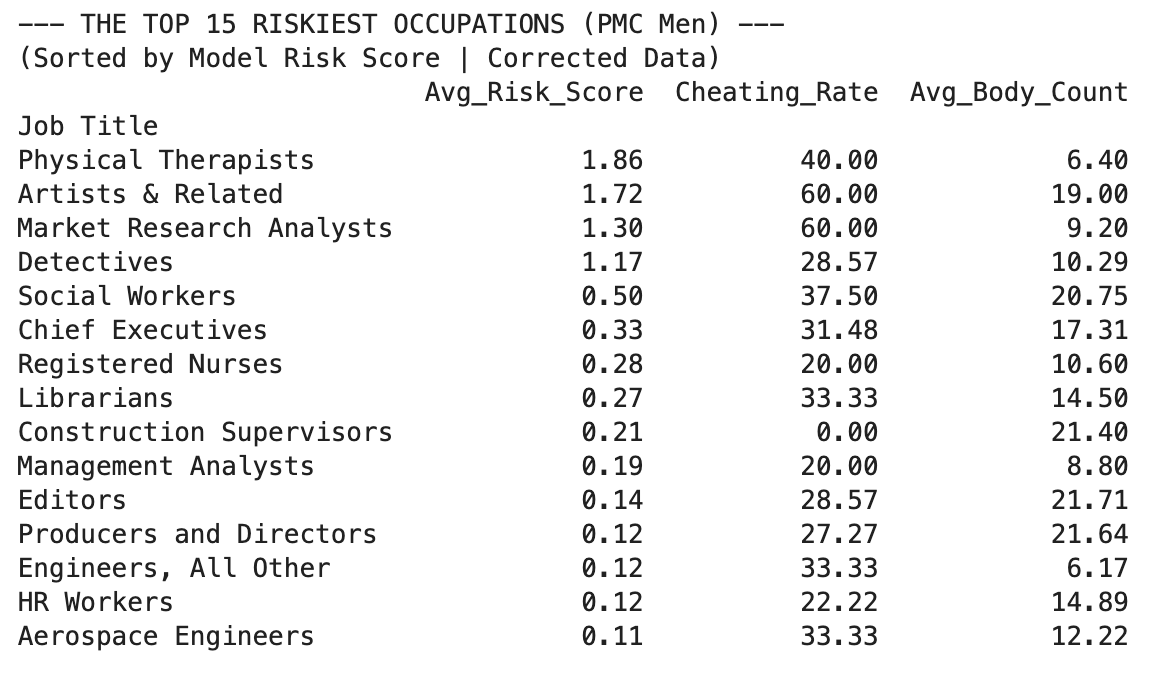
Whew! Can’t trust male physical therapists, social workers, nurses, police detectives, librarians (those Chads!), engineers, HR workers, aerospace engineers, and certainly not editors, producers, or directors.
I find the engineers and construction supervisors here interesting - they’re definitely not working around a lot of women! And that can obviously explain the nurses, social workers, librarians, physical therapists, and HR guys. But I think they probably travel more, and maybe they’re one of the ~30% of men on dating apps who are married,5 either when they travel, or both at home and traveling.
What about for women?
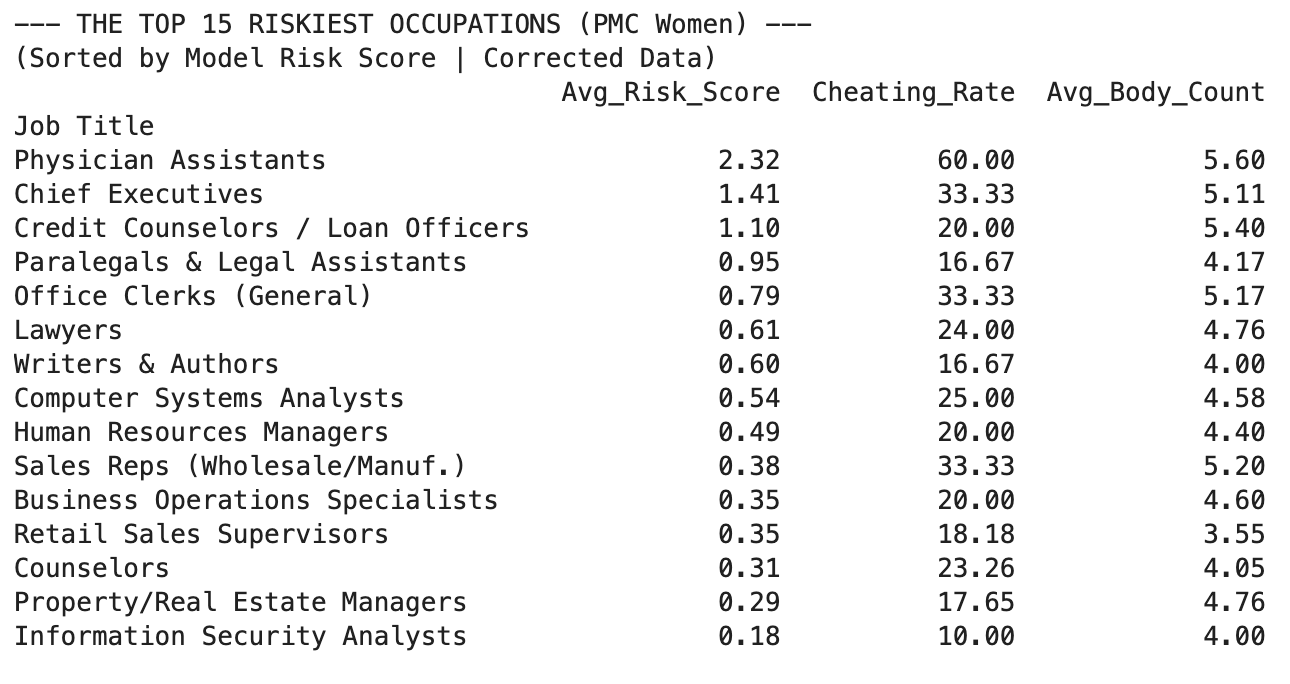
PA’s, CEO’s, credit counselors, paralegals, lawyers, HR again, systems analysts and BPO specialists (really?), and "retail sales supervisors” - cocking a single eyebrow at all of you, ladies!
What do PA’s, CEO’s, lawyers and paralegals, HR managers, sales reps, BPO and office clerks all have in common? They interact with a lot of relatively higher status guys all day long!
Okay, so who are the safe ones?
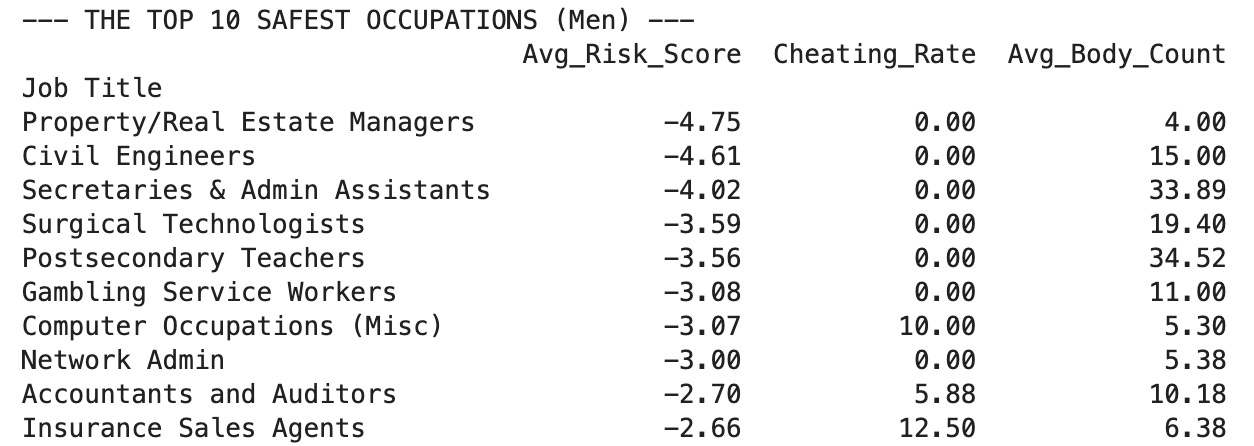
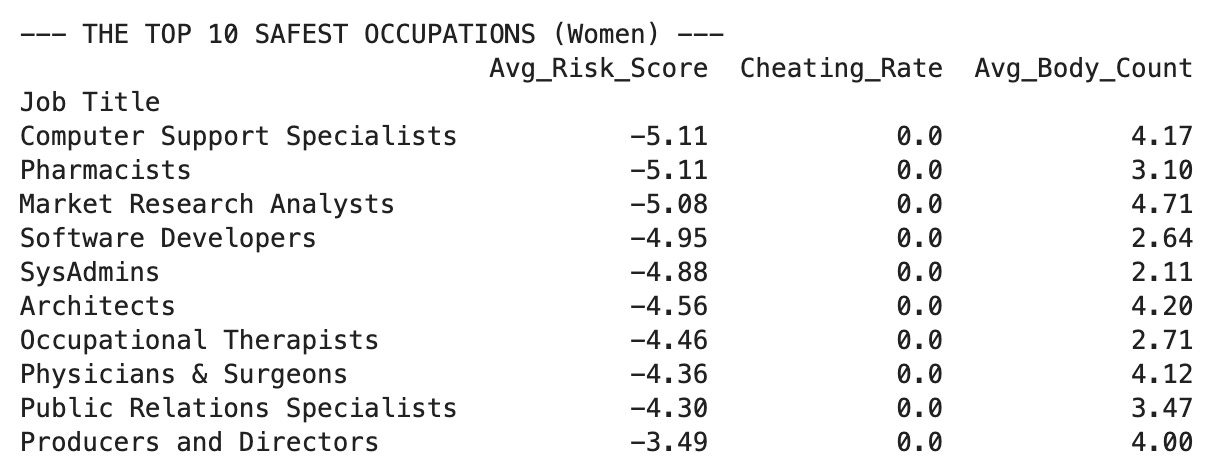
Interestingly, men and women are directly flipped on two - Market Research Analysts, Producers and Directors? Actively high risk for men, actively low risk for women!
So ladies, better start looking for accountants, network admins, and male secretaries! Ha!
Men, if you want a high status wife that works, better make sure she’s a pharmacist, dev, architect, doctor, or producer / director!
And here we have the earlier wives’ incomes being both high risk and protective. All those women make good salaries! And so do CEO’s, PA’s, and lawyers! So you can certainly have a high income wife with little risk of cheating, and you can also have the reverse.
Man, the wives’ list of safe jobs sounds WAY better than the husbands. Am I wrong? Am I the crazy one?
I feel like male network admins and accountants and secretaries might generally struggle on the dating market, and female doctors and devs and pharmacists probably do pretty well?

I’ll close on Stay at Home Moms
Wait a minute, a lot of you guys may be saying! I don’t care about what godless, oversexed Ally Mcbeal type women do, I want to know if MY wife will cheat! And I am a TRAD, sirrah! My wife is a stay at home mom, and the very picture of demure, church-going femininity!
Well depending on whether your wife has a degree or not, you may want to think about those kids - in non-college stay at home moms, the risk of cheating skyrockets with kids.
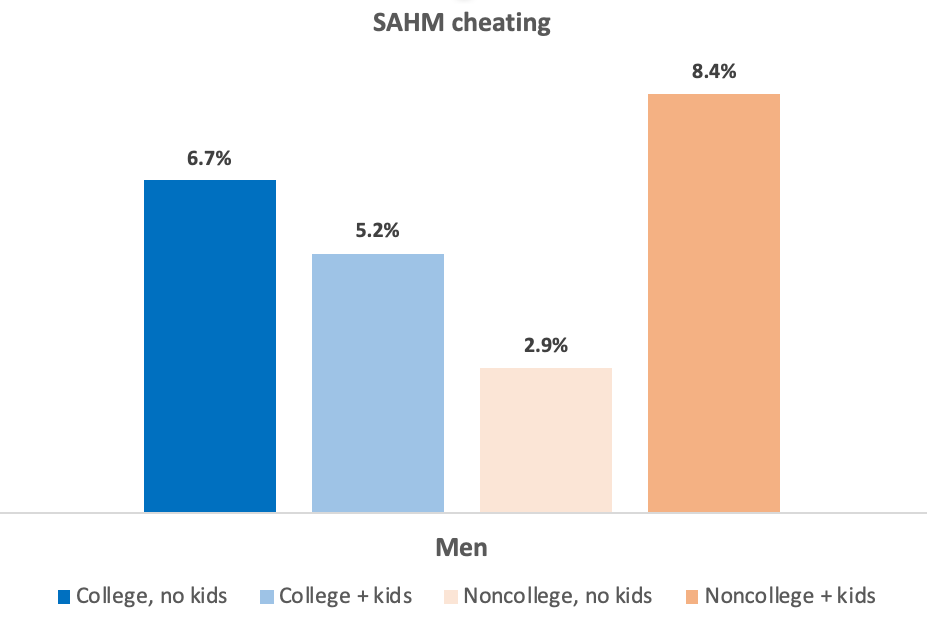
For baccalaureate stay at home moms, you start off safe, and then having kids makes you safer. It’s a huge contrast if you compare a college educated high achiever career wife with a college SAHM!
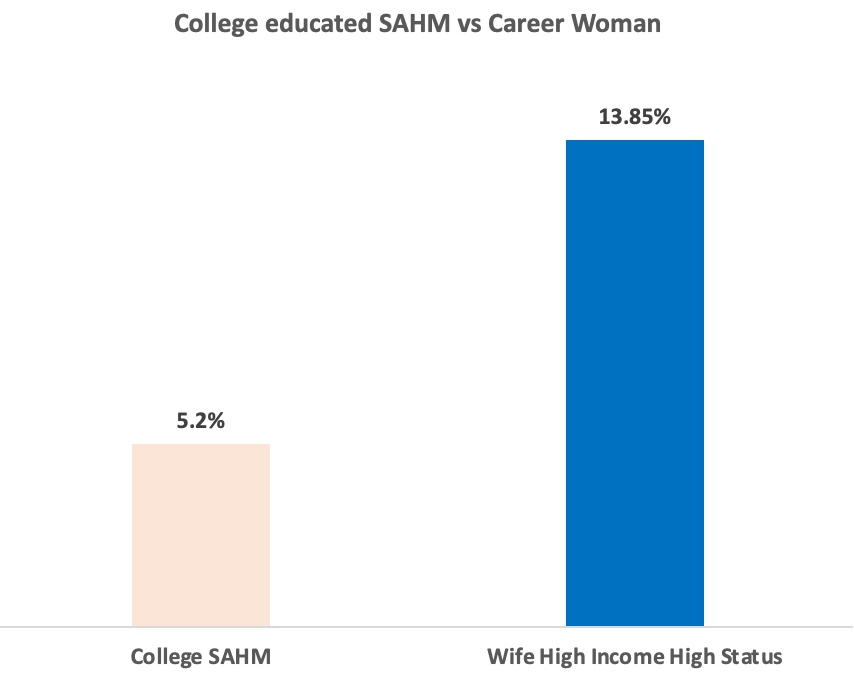
Obviously you can only truly win by making enough money that you can lock down a doctor or pharmacist, make her a SAHM, and still support a good lifestyle on your one income. THEN you’re rolling in the deep, friend!
So let’s have a look at the SAHM’s.
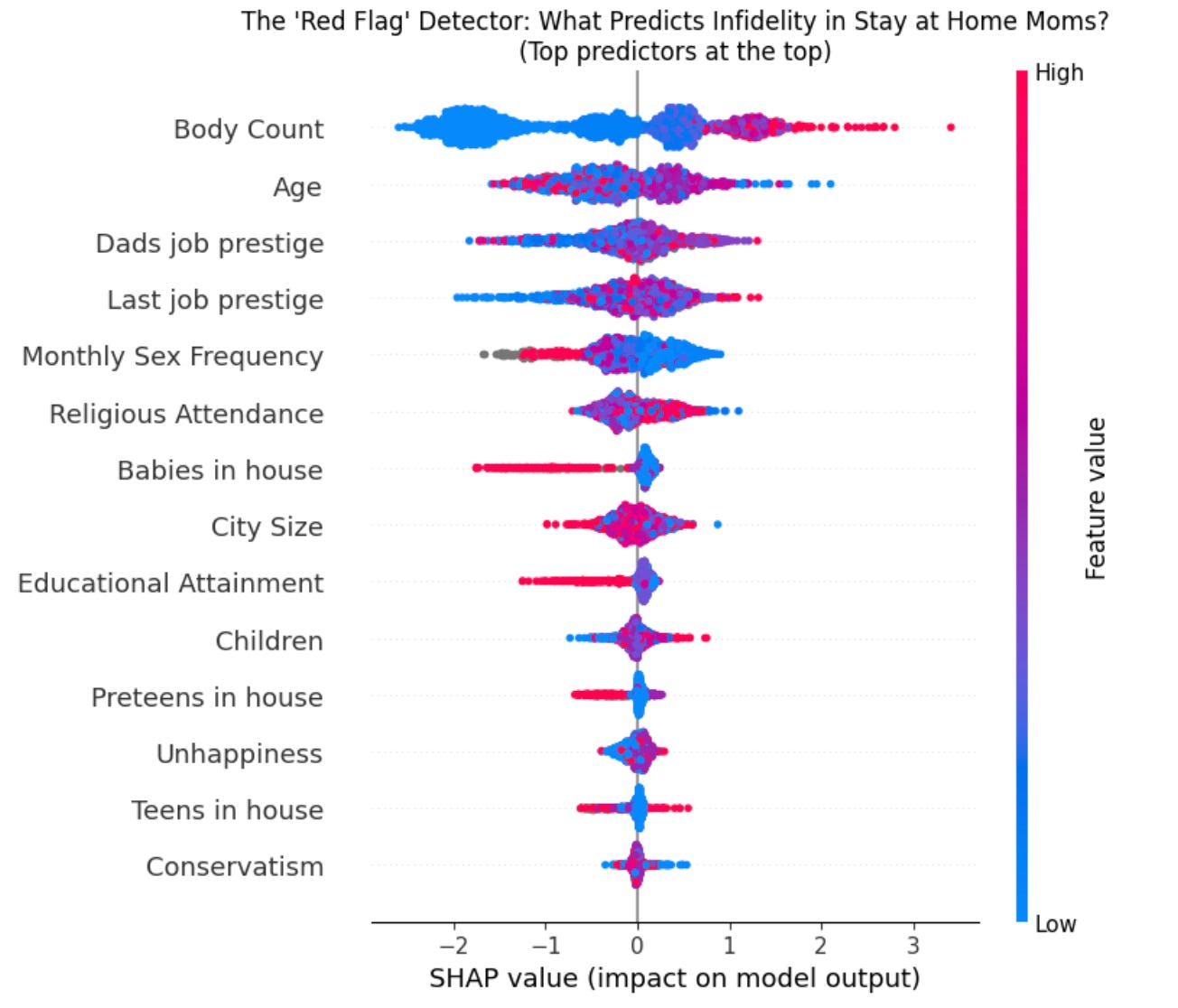
What’s higher risk?
High body counts, lower age, and higher last job prestige
Religious attendance is actually higher risk now for SAHM! Once again, cheating is an opportunistic thing - for our young trad wives, church is apparently the source of their densest social network and most interactions with other people
Not having enough sex nukes you here - gents and trads, make sure you’re taking care of business on the reg if you want your young trad wife to be happy!
Which factors are protective?
Lower body counts, having babies, and low prestige last jobs - all most impactful - and that “low prestige” point is reversed vs PMC women
Next comes having a lot of monthly sex, and having a grad degree
Then preteens in the house, and surprisingly, being in a bigger city / core downtown is protective!
If you have more appetite for reading big pandas tables, I pulled the PMC “sinners and saints” by men and women, literally the attributes of the top 20 individuals most likely and least likely to cheat according to the model I built, for both genders at the links in this sentence.
Before we start casting the first stone here
So obviously if you’re on a date and any potential spouse-to-be is honest and says “yeah, I’ve slept with 10 or 20 people” (or even 30-40) you should immediately push the giant red button and dunk-tank them and yell “next!” Right?

I feel it contingent upon me to point out that even if “body count” is the highest risk variable, you need to consider it in light of all the other factors.
If you stratify by body count and consider the top quintile for each of our segments, the vast majority, 70 - 80%+, have still not cheated!
The vast majority of top quintile body count people, our Chads and Stacies, are still bro’s and bro-ettes!
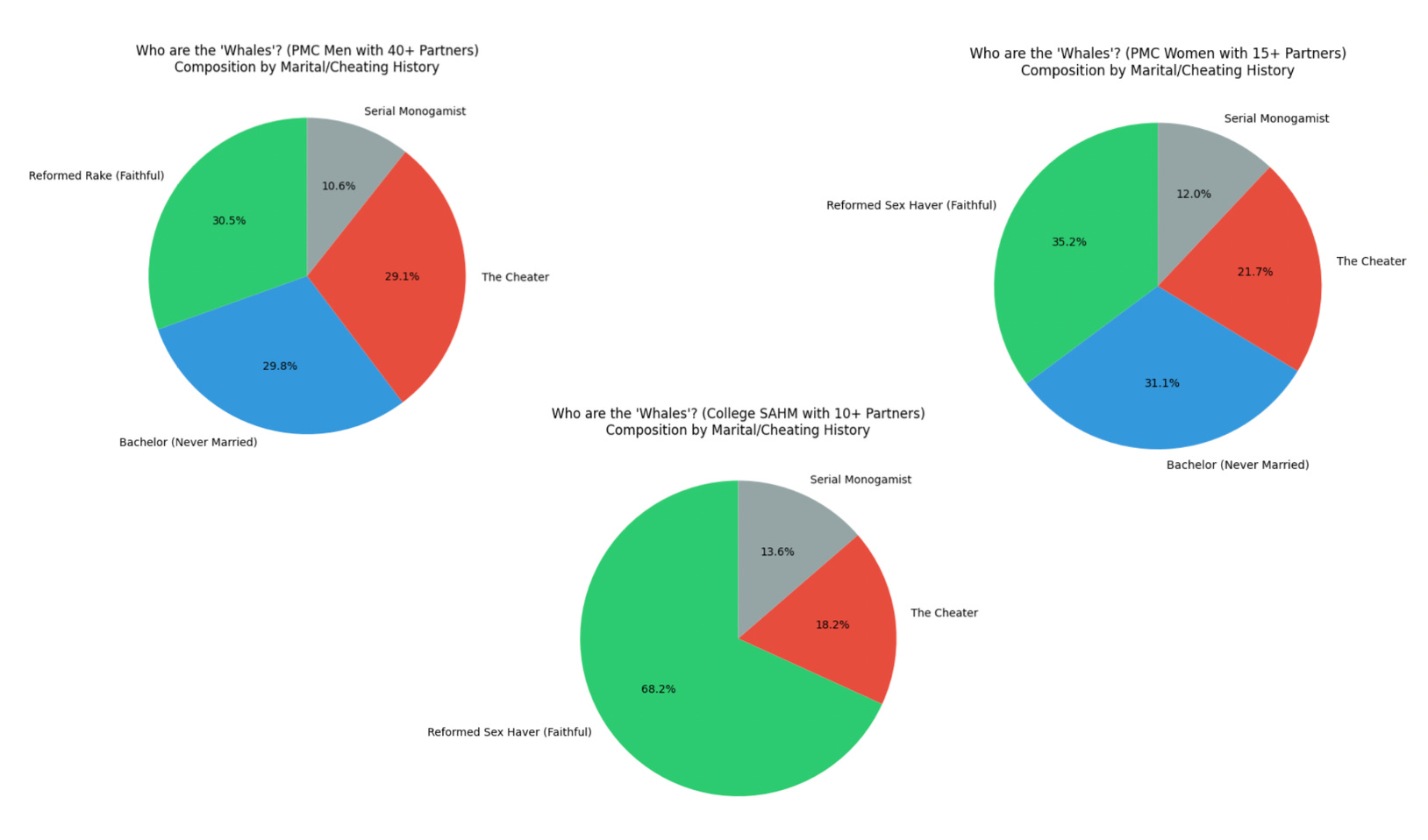
So don’t necessarily get your Spanish Inquisition costume out quite yet (nobody expects the offhand Spanish Inquisition aside!) - because base rates being what they are, the vast majority of high body count people have NOT cheated.
These risk factors need to be considered holistically, in conjunction with all the other risk factors, and not as single factors.
And similarly, of course, the vast majority of CEO’s, PA’s, nurses, lawyers, and HR people - sure, they show up as higher risk in our sample, but GSS has small samples by occupation and that info isn’t dispositive.
It’s always fun to dunk on lawyers and HR people, but at the end of the day, they’re (probably) human too. Or you know, a lot of them might be LLM’s by this point - hi Claude Code!
Either way, decent chance they’re not cheating on their respective spouses. I have it on good authority Claude Code is a bro and would never do that.
One final fun fact
If you ever catch your partner with a dating app on their phone, there’s a REALLY big chance they are cheating.
In a representative n=10k Dutch study on sexuality, ~50% of men who were using dating apps while in a committed relationship actually reported sexual intercourse with another person they met on a dating app. This was not the case for women.
All women - literally 100% - who were using dating apps while in a committed relationship reported engaging in extradyadic sexual intercourse (Rutgers, 2018).
Given our cheating body count info above, this doesn’t surprise me. The majority, literally 75%, of male cheaters are sad opportunists scrounging around in the bottom of the barrel for a single extra partner over their lifetime, and usually nuke their no-doubt depressing marriages when they succeed. So all the men trying to do this in this study? Half failed, not from any courageous moral stand or probity, but simply because no woman would have them.
Men are rate limited by women, in other words - without passing some significant quality bars, they simply can’t persuade women to sleep with them.
But women? Women aren’t rate limited at all - so if they’re on an app, they ARE cheating, full stop. So, uh…good luck with those lawyers and HR managers who say they forgot it was still installed, or that she installed it just to boost her ego!
It’s probably more than her ego getting boosted - her body count’s going up too!
Takeaways and summa
Okay, we’ve been over a bewildering amount of stuff, and gone through a frankly distressing amount of charts and data excerpts. We laughed a little, we cried a little, but ultimately we need some form of narrative resolution here.
Give it to me straight, doc - I’m not going to be able to keep all these particulars lined up, just give me some key takeaways or heuristics!
Alright, here’s my best shot.
As a man
Female cheating is driven by opportunity, mate switching, and having a noticeably better option around. Most importantly this only happens maybe ~15% of the time, base rates are really on your side here.
If you don’t have a wife yet:
Consider college degree women, who are less likely to cheat overall.
Try to go for younger, lower body count women in a lower risk career, and you switch the three biggest risk factors in your favor.
What are the higher risk careers your wife can have? Anything in law or HR or sales, and being a PA or CEO or other office worker around a lot of higher status guys.
I’d suggest trying to find religious, conservative women, but base rates being what they are, I think most men may struggle with that.
If you have a wife already, what you can do behaviorally:
Try to level up in your career and trad that wife up! Supported wives cheat less, as do wives who work fewer hours
Make sure you take care of business and have regular monthly sex with her
Having babies and preteens in the house is pretty protective, so consider having another kid
Put some effort in - try to be at least okay if not actively good on the attributes she cares about, within your broader monkeysphere - mate switching only happens with a big step upwards, and if there’s not a big gap between you and other guys around her, you’re probably fine
Wife tier list
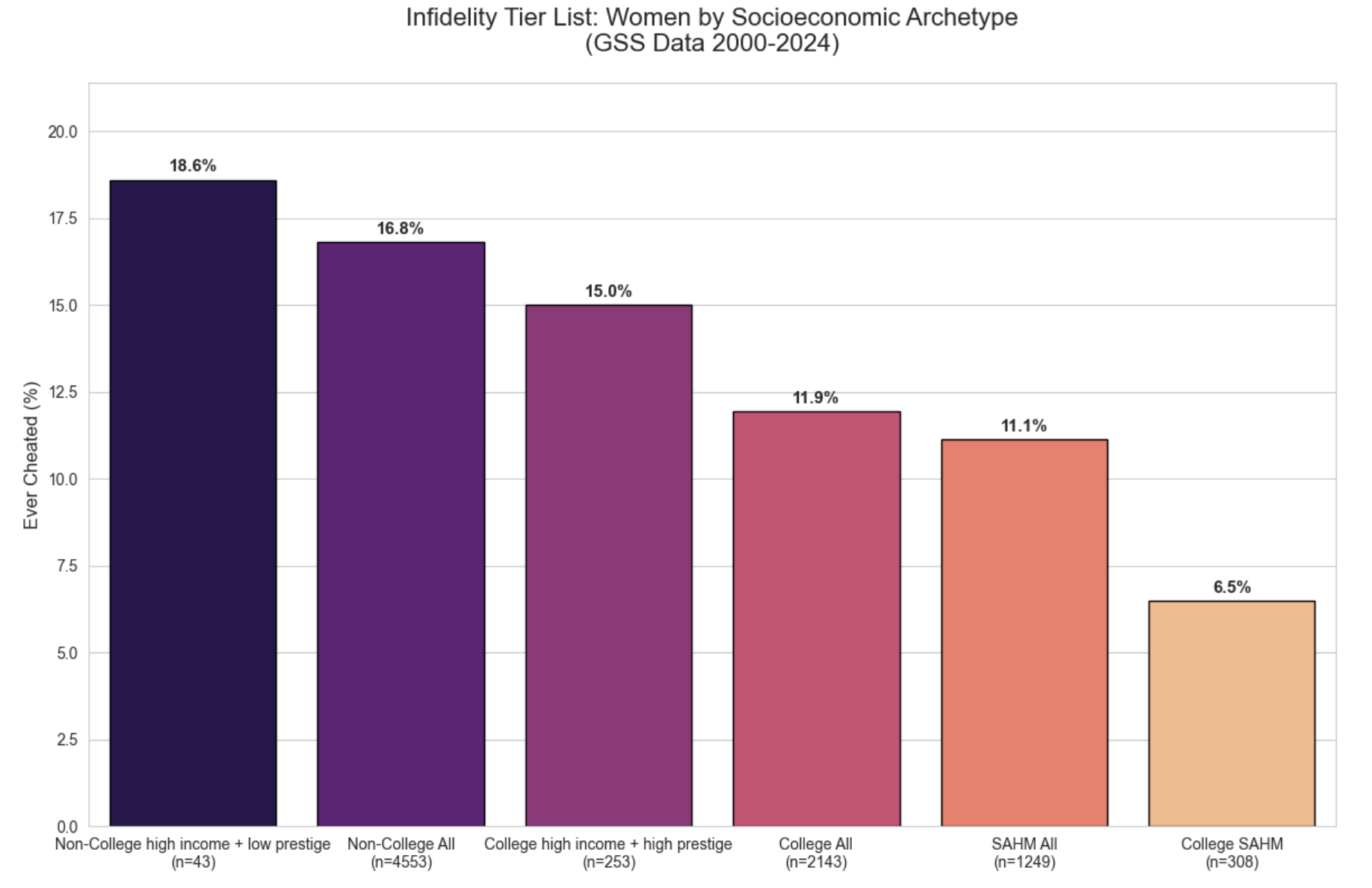
As a woman
Male cheating is mostly about opportunity and sex, and less about emotional connection and mate switching. It still only happens 20-30% of the time, so the odds are 70-80% on your side.
If you don’t have a husband yet:
Definitely choose a college boy, and the higher income and prestige the better, as long as you stop before the top 3-5% or so (which is currently ~$250k - $300k).
Choose a lower body count man, or a lower risk career man, ideally both.
What are the higher risk careers? Ones that interact with a lot of people, travel, or both. CEO’s, police detectives, HR and social workers, nurses, engineers and construction managers, and producer / directors.
If his dad had a high prestige career, bonus.
Conservative, religious men are less likely to cheat.
About 75% of cheaters will admit cheating in a past relationship - use this info wisely. If a man has cheated in the past, it’s likely he’ll at least be open to cheating again, and if he can pass quality bars, he probably will.
If you already have a husband, what can you do behaviorally?
Being a wife is apparently a thankless task.
Hopefully you’re in the 70-80% that are fine, because there’s not a lot you can do, behaviorally. Even if you have his kids, make sure he’s happy sexually, and both of you go to church regularly, all of those increase his odds of cheating if he’s a cheater!
You won at dating and marriage and landed a high prestige, high earner? Sorry, that also increases the odds.
Maybe you can really dig in and support him, let him be a Stay at Home Dad? Got bad news for you there, too…unless he’s a college boy.
I guess all you can really do is perform vigilance. If he admitted to cheating in a prior relationship, if he’s often on work trips, if you see a dating app on his phone, if he gets text messages he subtly angles away from you to look at or answer, step up your digging!
If not, hopefully you’re in the 70-80% that are fine - godspeed and good luck!
Husband tier list
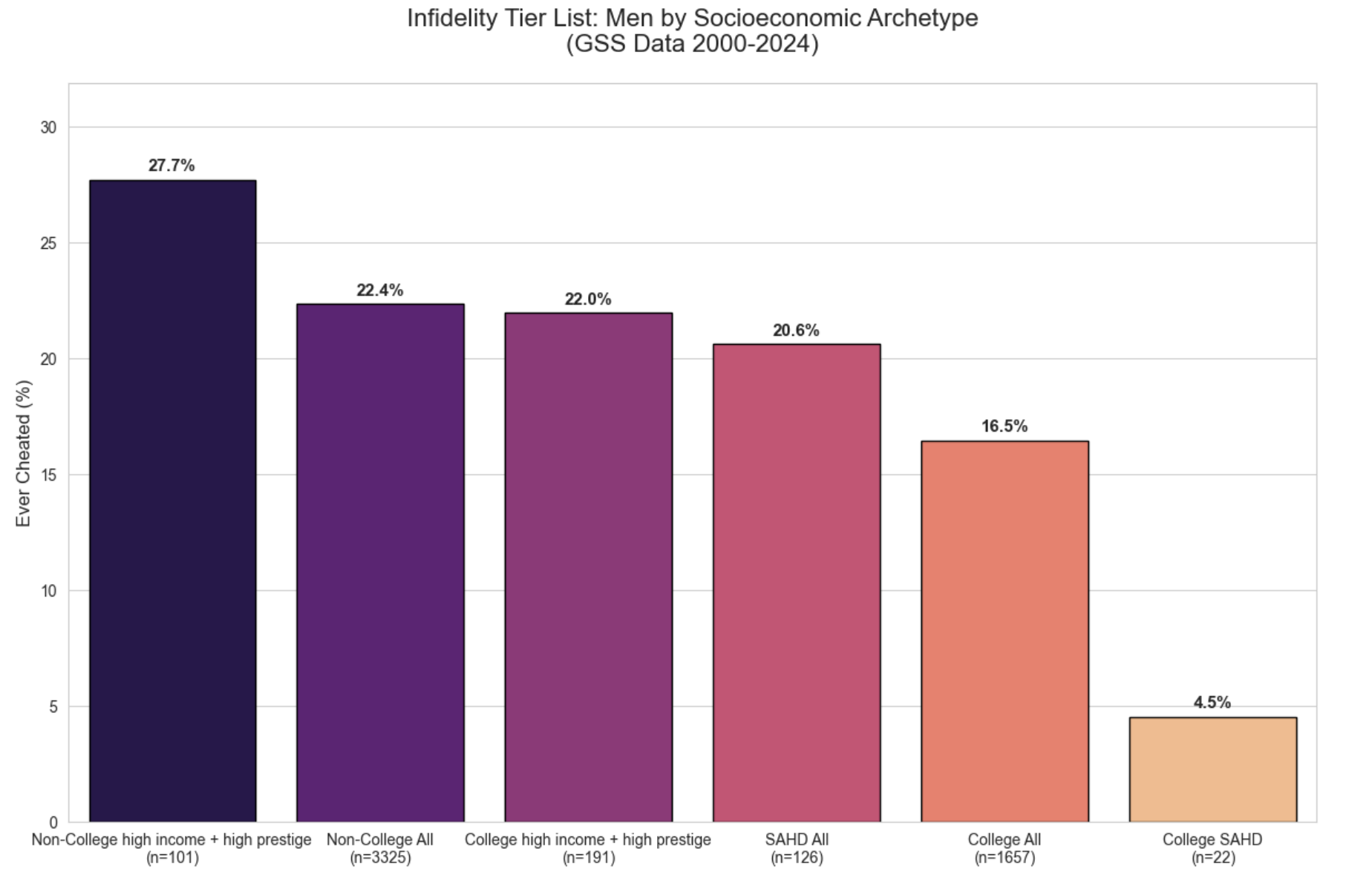
I’ll take the “most men are unsatisfied” thing as given, because it’s pretty obvious women are rate-limiting most men in terms of the amount of sex they’d like versus what most men get, and plenty of studies say so. And for a commentary on women not being satisfied, more than half of women of all ages report “sexual difficulties” and not being satisfied, see here for the graph, some statistics on the absolutely abysmal median male sexual performance, and more flavor.
So if you look at “relationship concurrency” in National Survey of Family Growth, about 6-8% (unweighted vs weighted) of women 18-28yo demonstrate concurrency in the past year.
If you instead look at Rauer et al (2013), women 18-25yo who are basically always in a serious relationship and had 2 or more different relationship in the 18-25 year period are ~30% of women.
Shouldn’t those sumproduct to the same overall number across men and women? And yes, that’s true in a closed system, but not in the actual world. Yes, men lie up and women lie down - and it’s thought that women lie down a little more than men lie up.
The gap with women is typically bigger, in the sense that in studies where they hooked them to devices they thought were a lie detector, their numbers rose up to mostly meet the men’s numbers, so it’s probably something like “men lie 5-10% up and women lie 10-20% down,” in an overall population-wide average, taking a median.
So that might explain the mismatch between the first 3-4 quintiles, but couldn’t explain the unbridgeably mismatched last one.
What could explain the last quintile mismatch? Age differences, travel, and sex workers probably all contribute - if those high body count men are older and sleep with younger women it would skew this snapshot-in-time, if the high body count men travel and rack up any sexual partners outside their home country, or if they visit sex workers and the sex workers are a small portion of women (they have to be under 1% looking at the percentiles), all of this can contribute to that mismatch.
Cite - David Buss When Men Behave Badly Chapter 2
So supported loser husbands cheat more but stay-at-home-dads way less, meaning the optimal strategy for women is to be wealthy to support your partner but also find the time to have kids. This however makes for a bad situation for men, as a wealthy woman who could support you likely went to college and is in a prestigious job around other high-status men.
The only viable pairing is then independently wealthy husbands turned stay-at-home-dads cruising off passive income and pharmacist wives. Simple as can be
Warning! Anecdata, but: "Physical Therapist" is also the rare job where the odds of being sexually harassed at work are ~equal for men and women. Truly, equality abounds!