
Chadopolies and cheaters
Body counts, chads and chuds, and a short teaser on cheating

I previously mathematically proved the Chadopoly is real in my review of Spiegelhalter’s Sex by Numbers.
Let’s go through it quickly for anyone who hasn’t seen it. If you want to skip it, just press here to skip down.
In the beginning was the Chad
Just for fun, can’t we make a “Chadopoly” argument using math, too?
If we can say “33% of guys are having 66% of the sex,” I think we could unfurl our “Mission Accomplished” banners. Let’s begin.
First, let us consider by number of total sexual partners. The largest slice of people have only 1 sexual partner in their lives, but there’s a long tail - it’s our old friend, a Pareto distribution!
This is from Natsal 3, generally regarded one of the highest quality data sources in the space:
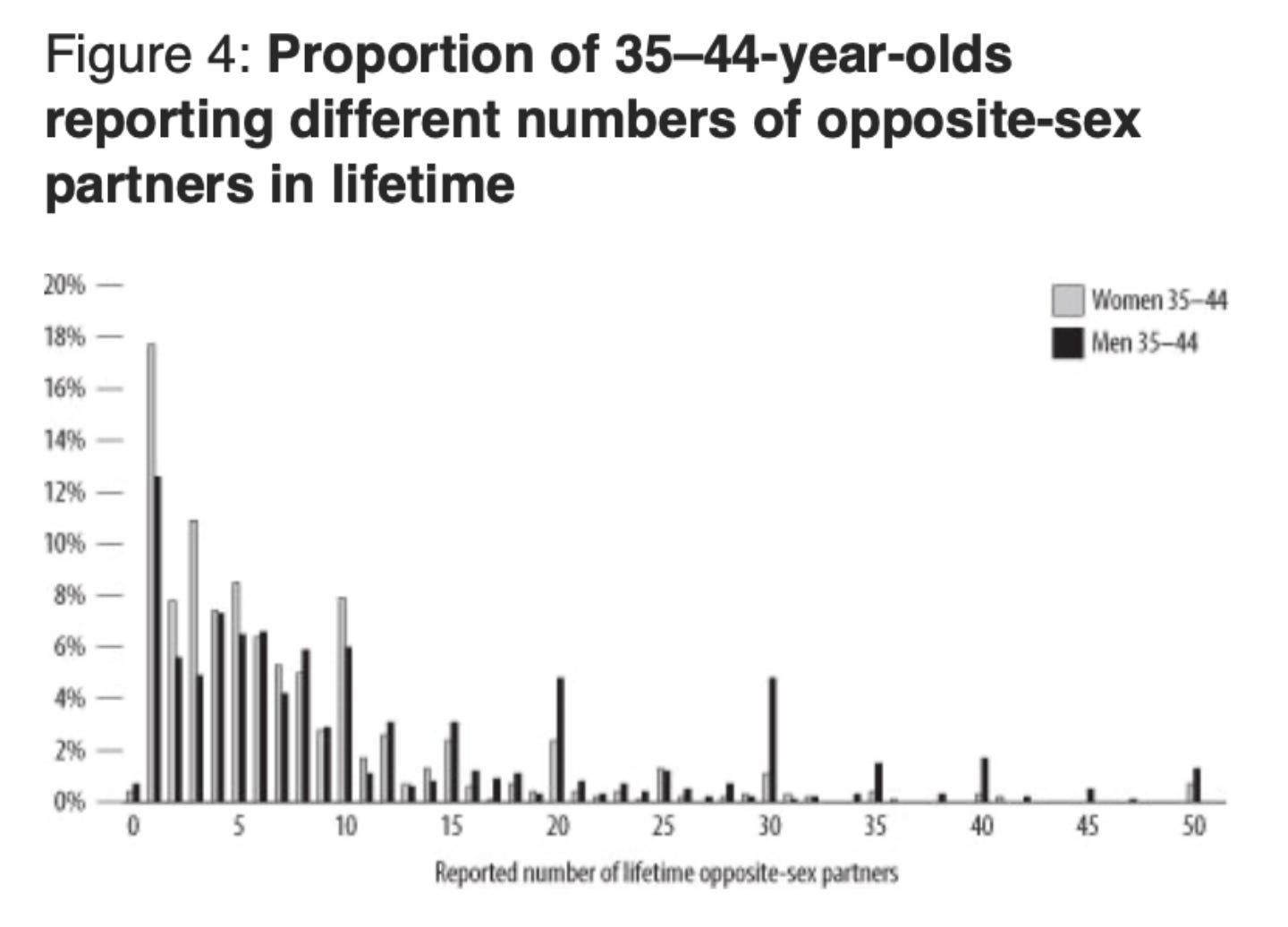
As we can see, the graphs are heavily right skewed and demonstrate kurtosis, implying a Pareto distribution. It’s not quite 80/20 - if you break the data down and bin the buckets you can calculate the alpha and Gini inequality measures. The alpha is ~1.45, whereas you need an alpha of 1.16 to be a true 80/20 distribution. But do you know what an alpha of 1.45 means in this particular (capped) distribution? It means the top ~37% take 80%. I think we hit our 33/66!
Second, let’s consider by sexual incidence per unit time. The first one was akin to “lifetime wealth,” and this one is more akin to monthly flow, or income. This is sexual frequency over the last 4 weeks:
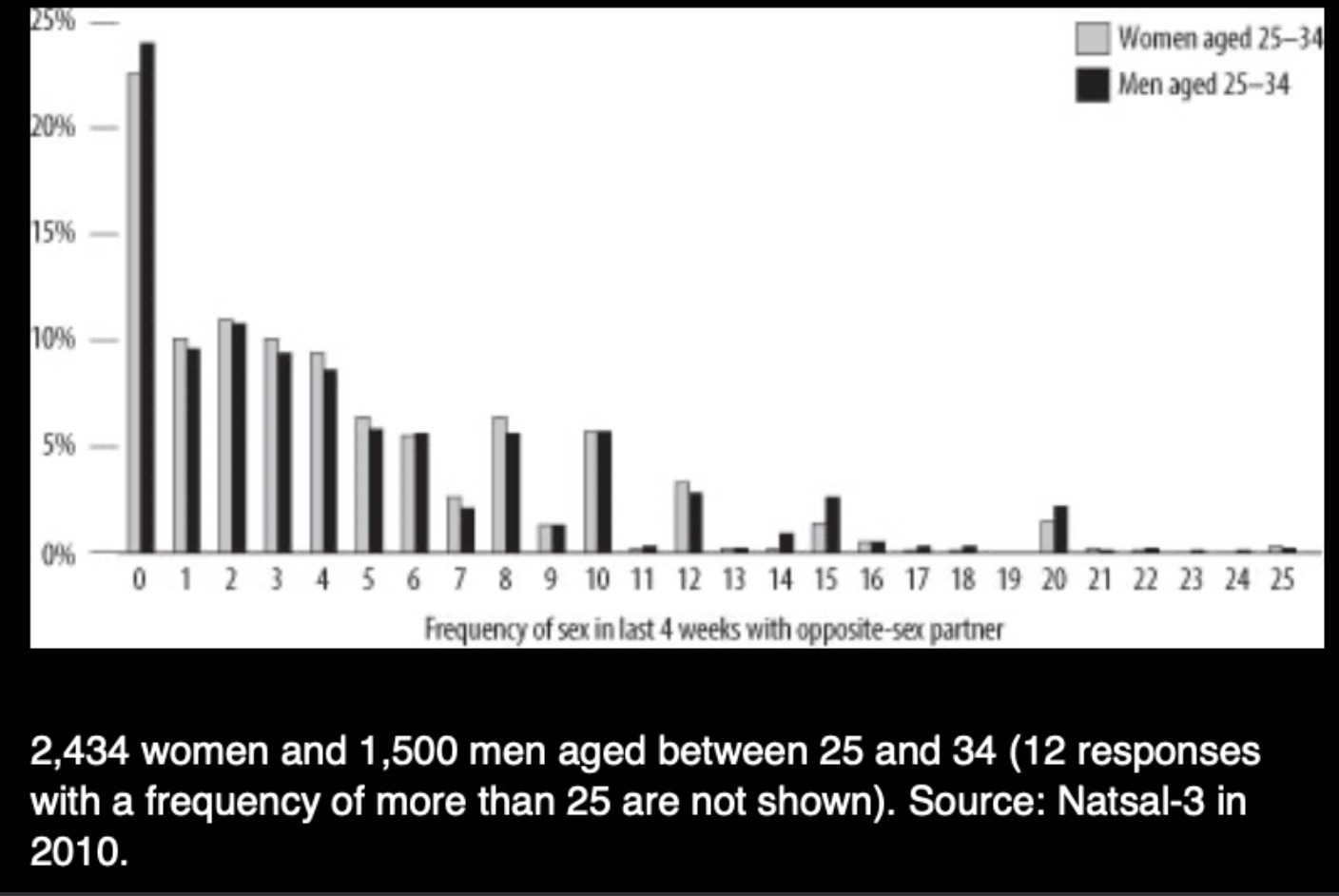
Shockingly, the modal frequency here is ZERO. People just plain aren’t having sex, or at least the bottom quintile isn’t.
So this graph actually has the long tail truncated here visually - the data itself goes out to one guy who said he’s having sex 100 times a month, in a 1500 guy (~2500 girl) sample.
We can bin the numbers again, and we find the cutoffs and alpha for this distribution too:
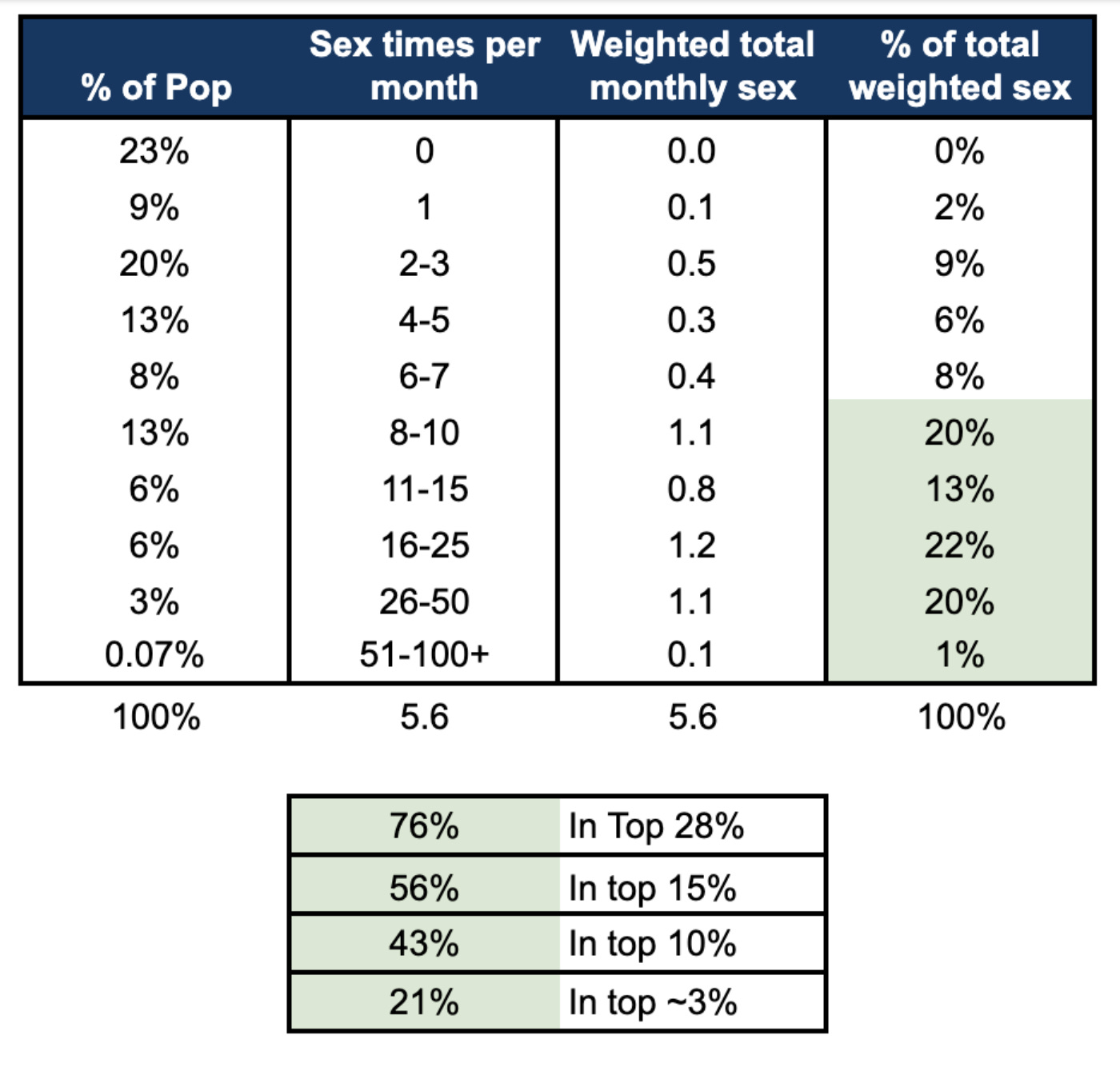
And we find that the top ~31% are getting 80% of all the sex by frequency! This handily beats our 33/66 threshold. In this case, the top 20% are having roughly 66% of the sex by frequency.
And actually, if you go back to the first “lifetime partners” graph - the top 20% are getting ~64.5% in that one! Close enough to 20/66 for me!
And lo! The Chadopoly is born!
Either by lifetime partners (wealth) or by monthly sexual frequency (income), the top 20% of men are having ~2/3 of all the sex!

Objection! Have you used your Mark 1 eyeballs?
Reader Jason Hubbard has a reasonable rebuttal, and opines:
On the Chadopoly— again I think these numbers don’t prove Chad, in the incel sense. They don’t say anything about high frequency men’s actual identity, in terms of income/wealth and/or attractiveness.
A large segment of the high frequency hetero men are likely to be:
-men patronizing sex workers
-men cheating on a partner
-polyamorous men
-swingers
-bdsm kinksters
And these are all populations where the men involved tend to be— well, pretty statistically normal otherwise. Like it’s not the case that low-income men are less likely to cheat than high income men. The poly, swing, and bdsm lifestyle communities are all pretty diverse in terms of income and attractiveness. It may be the case that there is some wealth/income threshold in terms of who can afford to patronize sex workers, but I’d be suspicious if it turned out to be the case that say, upper middle class men were more likely to be patrons than wealthy men.
The better explanation for this data is actually just that libido is not evenly distributed among men. Men may culturally claim and even believe themselves to be high libido as a matter of masculine social status, but in practice male libido in terms of action would appear to be much lower on average than reported.
So first, thank you, Jason! Great comment, solid heuristics, I applaud both your instincts and analysis.
Indeed, libido is obviously comically deficient in most men, going by all the numbers Speigelhalter and the post went over.
And your argument is “now consider the top 10% or so men with actual libidos - they’re not really segmented by anything, because you see people of all fitness / income / status levels here in the various subcultures you can observe them at work.”
And yes, top marks, great callout and world model.
But I will still beg to differ. We are not considering here just “the universe of men with actual libidos,” we are instead considering the universe of men with high body and sex incidence counts, which of course overlaps, but also importantly differs.
To strive, to seek, to find, and not to yield
I think Jason is probably half right, in the sense that if we lined up all the men in the BDSM and swinging and ethical non-monogamy worlds, we wouldn’t necessarily be able to detect very strong signals on things remarkable or impressive about most of them.
But let me at least argue for a bigger picture.
My argument here will be an overall volume argument - specifically, we have to account for where all the female partners are coming from, because male sex drives are crazy high compared to what they actually get in real life (in the data, 2-4x higher total body count on average for homosexual men vs heterosexual men), so hetero sex is generally rate-limited by women to roughly 1/4 to 1/2 of what men demonstrate that they want when free to act without that rate limit.
Yes, libido is probably normally distributed, but for a heterosexual man to act successfully on a high libido will require passing quality filters, I argue. Moreover, it’s important to consider that our Chadopoly figures are definitionally top quintile men when it comes to sexual partners and incidence, so we have to account for a lot of female partners.
So where are the women coming from? Jason suggests they’re coming from hookers, cheaters, and kinky people - poly people, BDSM people, swingers, and so on.
I agree on cheaters, and we’ll get into that shortly. So for now, let’s consider the rest.
BDSM incidence is ~1% per Spiegelhalter, our epistemically virtuous godfather, and “monogamy” is dominant even in BDSM subcultures, with I’d swag at ~20% being open to swinging or poly.
But wait, Jason says - here’s an article about a Danish study that says a full 33% of people do BDSM! And didn’t 150M people buy Fifty Shades of Gray and fantasize that they didn’t have negligible, depressing sex lives? Obviously BDSM is on the rise and people are having tons of kinky sex!
Which is obviously a definitional thing - it’s all where you draw your definitions, and they’re drawing it at a maximally broad “has ever used a blindfold or ever had less than wholly respectful and modest sex” perimeter. And just as obviously, nowhere near 33% of women will consent to their partners swinging or being poly or otherwise ethically non-monogamous.
Can we triangulate a “true” BDSM and / or ethical non-monogamy number beyond Spiegelhalter’s Australian study?
We can! Hebernick et al 2017 did a nationally representative survey of a bunch of sexual behaviors, with an n~2k. Their explicit motivation was that societal and technological changes (phones, porn) have probably shaken stuff up, so let’s measure it!
Back to the non-depressing sex lives, Hebernick does take time to point out that “nearly one-third of women and nearly one-quarter of men had not engaged in sexual activity with anyone in the last year (consistent with NSSHB data)–and about 1 in 10 partnered Americans considered themselves monogamous but sexless,” which is always a cheering fact.
But they also touch on some of our topics of interest.
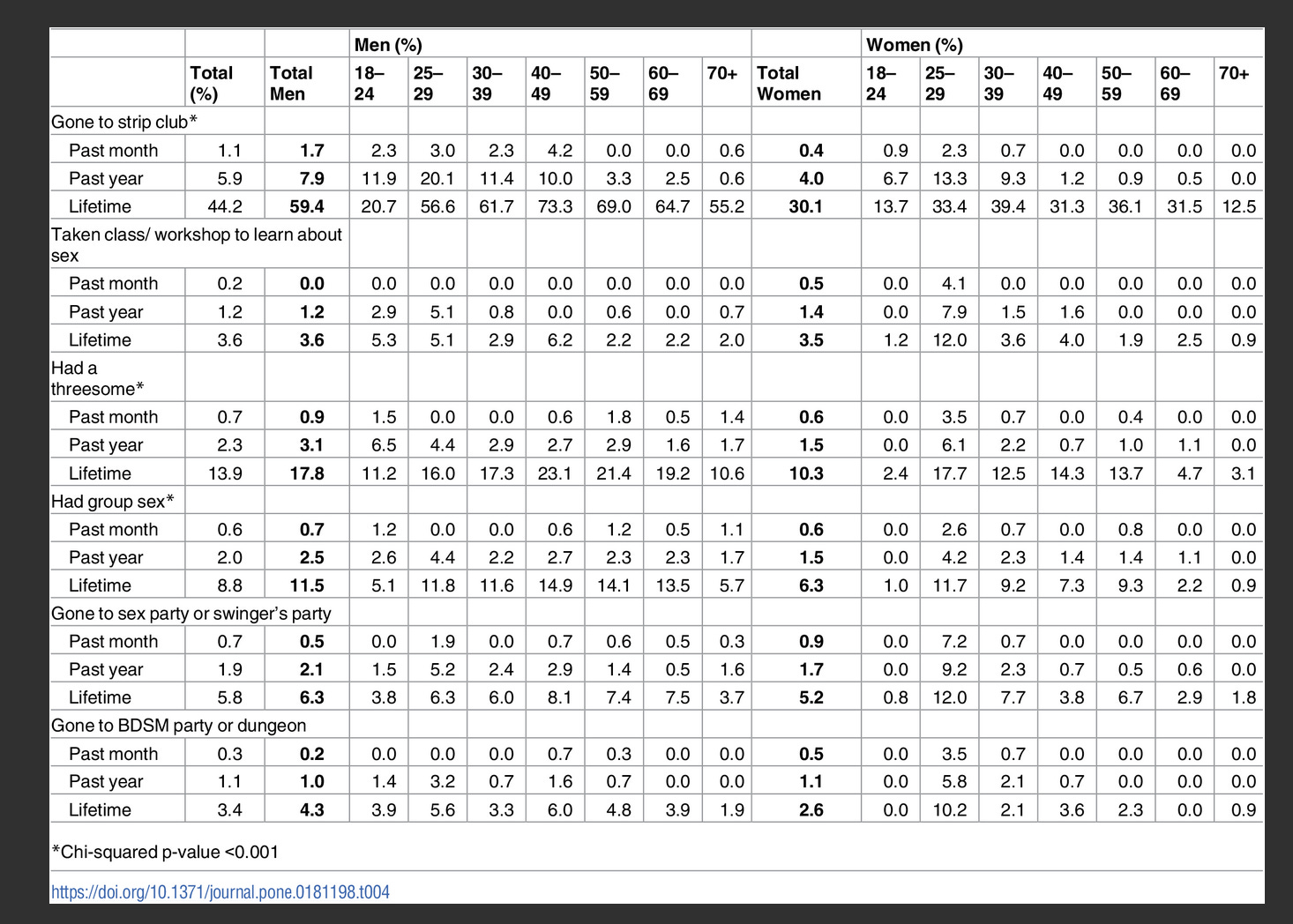
We find that 1.1% of women had gone to a BDSM party or dungeon in the last year, and a little under 1.7% had done so for swinging or group sex.
Let’s be generous and call it a full 50% of these core BDSM women being open to ethical non-monogamy / poly / swinging, and call it a half percent.
Poly and swinging incidence in women is 1.7%, per Hebernick. Levin et al 2012 studies open relationships and “nonconsensual nonmonogamy” and find that up to 4% of the US might engage in ethical non-monogamy, although they caution this relies on “nonprobability samples.” A probability sample finds a similar-to-Hebernick 1.6%. But why not just assume it’s twice as prevalent and give them the 4%?
Now prostitutes. In Natsal and various other sources, about 5-9% of men say they’ve ever paid for sex (lifetime figure), with it being 3.6% “in the past 5 years” in Natsal 3. Let’s calls this 4% - in any event, you see it’s not a huge amount. It’s also unlikely the majority of “ever visited a prostitute” guys are racking up big body counts via prostitution, it’s probably 10% of them at most. But lets say a full half of them do! I’m giving this one 2% at the end of the day.
.5% + 4% + 2% = 6.5%.
But our top 20% is STILL having 66% of all the sex! And we’ve only explained ~6% of their potential sources of willing female partners! We need to explain a full 90% of sexual partnering outside of these channels!
Even if we assume that each of these 6% of women have body counts 5 times higher than the median and their partners 100% came from this top 20% of men, we would still need to explain at least half of the remaining female partners for our top 20%.
And we would NOT expect those women to be so distributed - after all, BDSM and swinging and group sex were fairly evenly matched across men and women in incidence, with men maybe 1.5x higher for swinging and group (and obviously for that to be true, more threesomes were MMF), but still capping out around 2.5%, and probably averaging around 2% in the last year. 2% is 10% of our 20%, so again, we need to explain the sources of ~90% of our top men’s partners, because it manifestly isn’t these women!
Let it divide the waters from the waters
Let’s split flows and reservoirs.
So first we need to split our “incidence” and “lifetime partners” tracks to track and talk about each cleanly. One is a flow, like salary, and one is a reservoir, like savings.
So let’s take the reservoir first - lifetime partners.
We know from our previous Chadopoly math that 20% of the men need to pair up with 66% of the women. To be specific, the top quintile of men generally have 40 total lifetime partners. Our sex weirds and hookers (and I use the phrase “sex weird” in the most admiring, grateful-that-they-exist, and non-pejorative way) can only account for between 2-4 of those women (6-10% of 40) - so where do all the rest come from?
Of goofuses and gallants, knights and knaves, Chads and Chuds
This leaves two probable origins for our Chadopoly: serial cheaters, which I’ll call Chuds, and what we’ll call “true Chads” racking up big body counts before they honorably settle down and become boring suburban dads.
How to rack up a big body count in our modern day and age? Well THESE days, a lot of it is through dating apps:
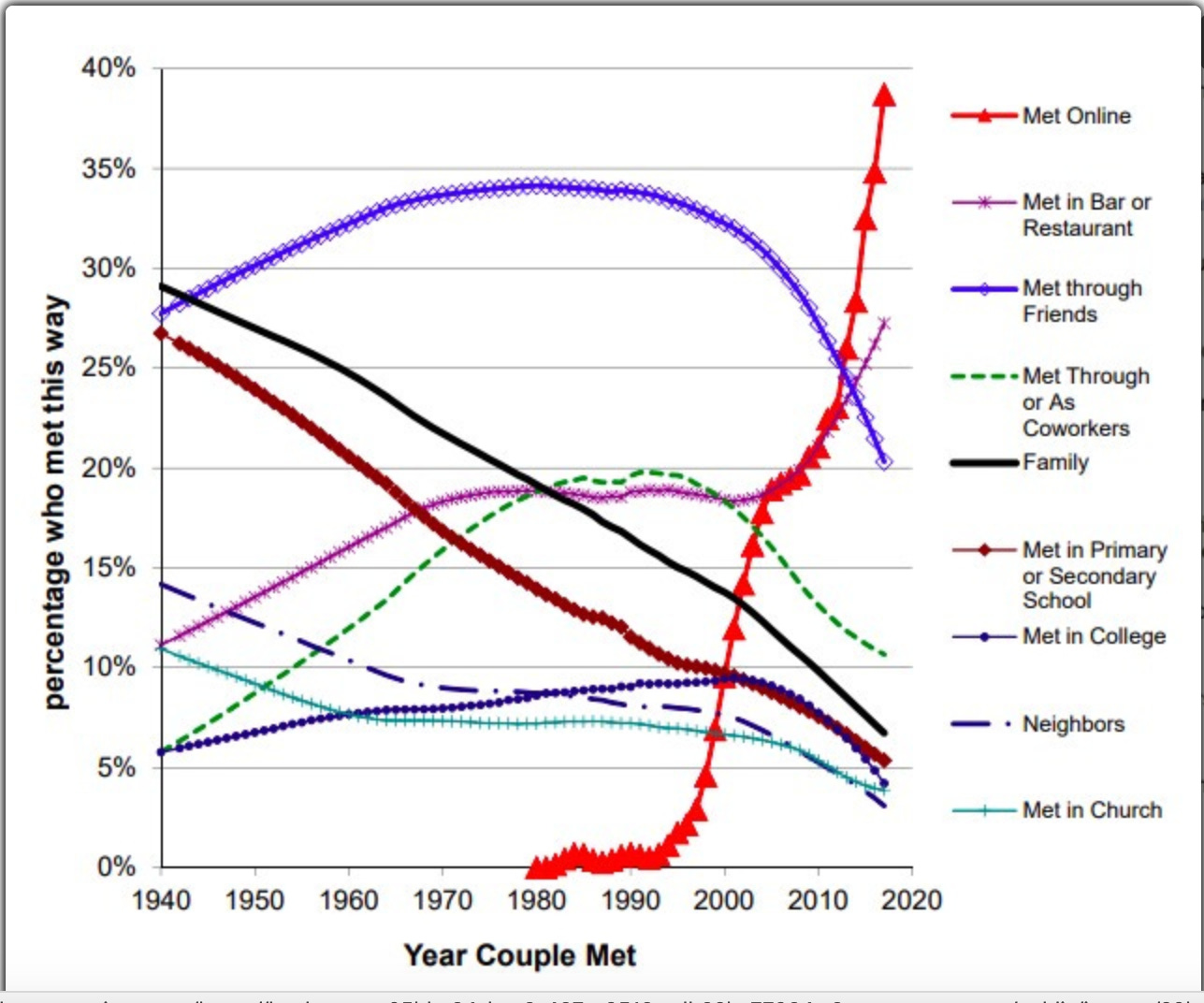
And of course, on dating apps, the top men enjoy an Empyrean sexual Valhalla of tens of thousands of women all competing for the top quintile-or-better.
So these are our Chads, right?
Except whoops - there’s an obvious confounder here - 30% of men on dating apps are already partnered (per David Buss in When Men Behave Badly, regarding Tinder specifically). Both Chads and Chuds abound on dating apps!
What about the rest of the world? The (ugh) REAL world, not the one we access by staring at glowing rectangles?
After all, we have some decent evidence that online isn’t quite so dominant as the one famous graph suggests, as the always-excellent Nuance Pill goes over here:
I will contend that having exhausted all the sex weird women and prostitutes, there are simply no further sources of enthusiastic and willing women for most high libido men, whether on apps or in the real world, unless those men start checking off some noticeable status and attractiveness markers.
In other words, I’m saying both Chads and Chuds have to be better than average, at least within their SES tier.
Of whose true fix'd and resting quality there is no fellow in the firmament
But what evidence do we have that this is true?
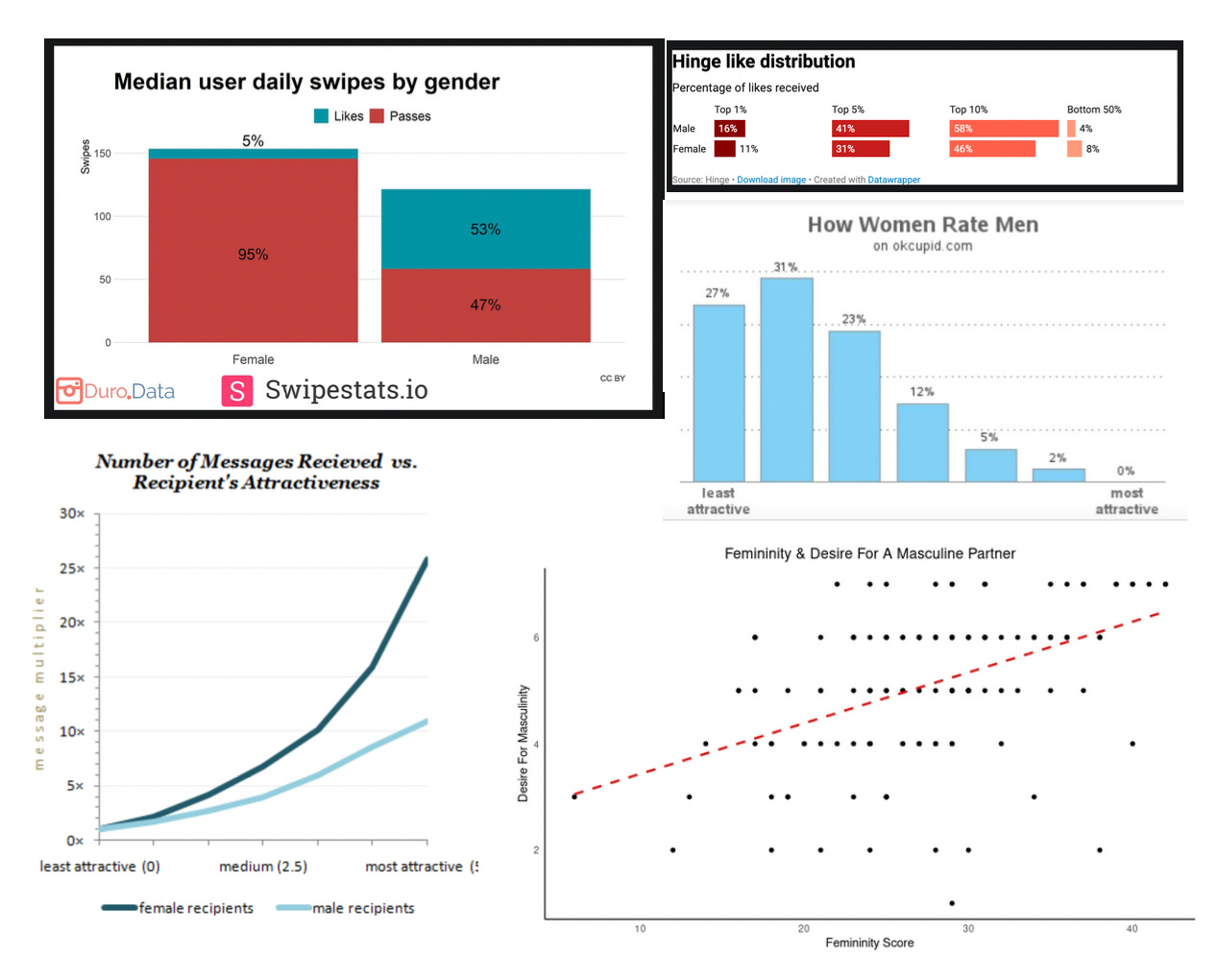
Well online dating is SUPER selective - just a selection here gesturing in that direction:
Only 5% of guys get swipes
Likes and replies are vastly concentrated in the top 10-20% of men
80% of men are rated “unattractive” by women
Attractive men get 11x the messages as unattractive men
The more feminine a woman is, the more masculine the partner she wants
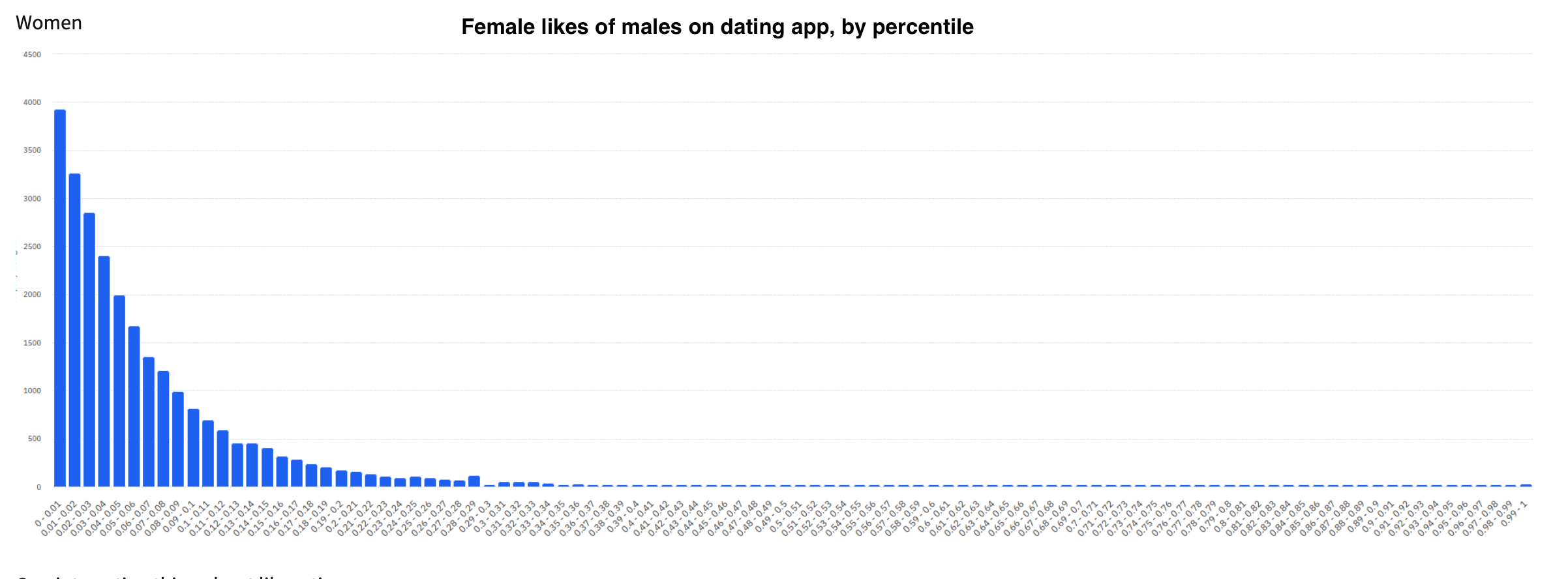
In fact, women’s likes follow a power law, with the top percentile of men getting the most, the 95% percentile getting half as much as the top percentile, and likes petering out entirely after the 80th percentile or so:
Moreover, we see other status / prestige signals in real life, outside of dating apps, that are extremely strong.
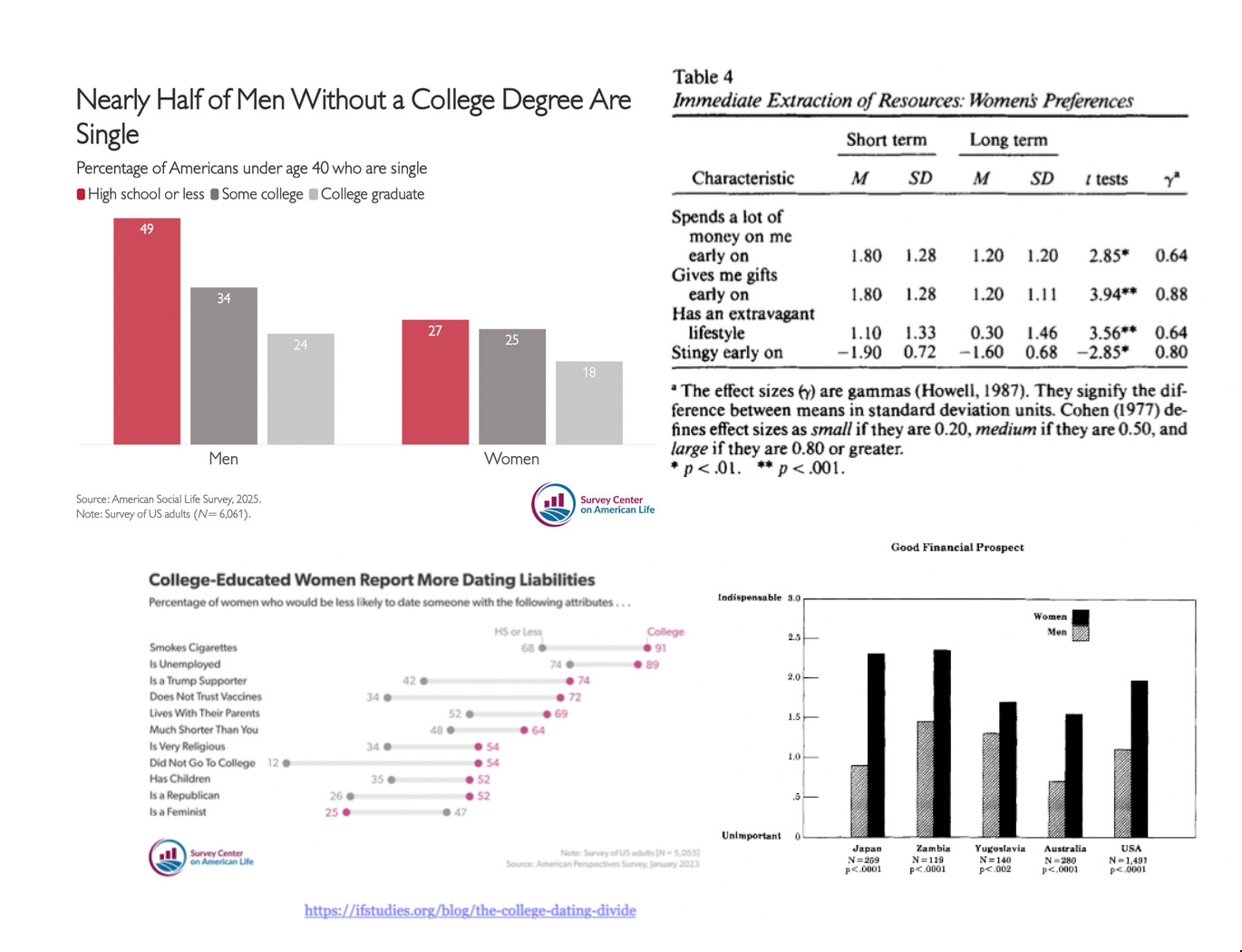
I feel like “women strongly consider quality when they choose dates and short term sexual partners” is such a relatively uncontroversial stance that I don’t need to support it much further, but studies along those lines available on request.
But “considering quality” doesn’t necessarily mean 7 foot Harvard-educated models, right? Because any given woman exists in a tier, and there’s a limit to high up she can reach. As the always-interesting SlutStack puts it:
“If you buy into the evolutionary psychology idea that we each have a particular “mate value” in the sexual marketplace, then it’s worth being pretty careful about where we are spending our points. If I go broke by splashing out on a gorgeous face, 99.9th percentile height, and abs… well I might regret that when there’s nothing left to spend on personality or intelligence or emotional availability.”

This also means that we’d expect any visible signals in the data to be attenuated - if you see an income or prestige buff in the aggregate, that was filtered across matching in every tier, and is a genuinely strong signal.1
So I agree we might not look with our Mark 1 eyeballs and be impressed by the strength of the signal by many of these cuts (half of the college graduates are still single, I know lots of ugly guys who do well in dating, sex weirds all seem non-filtered), but that’s because even a strong signal gets attenuated when aggregated across all tiers, if people match up within their tiers.
Ay there’s the rub
I think Jason definitely has a broader point - he phrased this much more charitably than I’m about to, but basically: “have you SEEN the people at swinging resorts and in BDSM dungeons?” OBVIOUSLY there’s no quality bar, they’re all gross, on average.
So, yes. Sadly, tragically, comically…yes. But that’s everyone, on average! Which is exactly his point - they’re not filtered.
But where I begin to diverge is that he points to the fact that the people we see demonstrating high libido among the sex weirds don’t seem like anything special, and therefore high libido is probably just normally distributed, and the Chadopoly isn’t real because high libido / body count / sex incidence is a relatively independent trait from “status.” I’ll dub this the “The people you’re pointing to are mostly just a bunch of sex weirds” hypothesis.
So I agree there is no VISIBLE quality filter among the sex weirds - it’s certainly not an “attractiveness” filter at all.
But again, people largely match up within their respective SMV / SES / looks /whatever tiers. Just because somebody is gross to you or I, does not mean they are gross to their partner.
Sure, those men may be ugly and / or gross, but what if within-their-tier, they’re high income, or high occupational prestige, or high charisma, or a magnificent conversational partner, or some other sterling personal quality that makes them a cut above the average partner? And indeed, I’d be willing to bet this is strongly true on average, even amongst the sex weirds. Sadly, we have neither the data nor the sample size to determine this, because they’re such a vanishingly small slice of people overall.
But that’s okay - as we’ve seen the majority (~90%!) of the partnering is happening via regular dating or infidelity. And we can see quality filters there.
Indeed, and key to the entire concept of short term sex (and infidelity), is that women would not be acting on these fronts if there wasn’t a noticeable quality differential in the men they are choosing.
So we’ve pointed at that differential, visible in the aggregates even through the stratification by whatever-tiers, for dating, both online and off with the last few graphs. Now what about infidelity?
Do cheaters prosper after all?
Most men above a certain threshold (probably 66%-tile) marry, and in the time they were doing this study, people generally married around age 28, so your body count is largely driven by what you rack up between let’s say 18 and 28, unless you cheat.
So our “true Chads” in this model will need to rack up a notably bigger than usual body count in this pre-marriage period.
We know roughly 50% of guys cheat, and 30-40% of women (lifetime rates), with “within this relationship” rates something like 25-30% men / 15-20% women.
I have a personal conceit that cheating is concentrated in serial cheaters, and I have seen (and will show you) data to this effect. So the population is roughly bimodal, split between serial monogamists and cheaters, and successful (not median) cheaters will necessarily have much higher body counts.
Even though we’d expect much higher partner counts in those ten years, even if cheaters only opportunistically cheat every few years from 28 to 58, that’s still an additional 5-15 partners. Since NATSAL-3 tells us the median partner count is 5-8, this implies average monogamists are probably around 2-6 and cheaters are probably around 8-12.
But these are at the medians, and we’re considering the top quintile.
He who brings out their starry host by number
What’s a top quintile body count? Around 40 partners, lifetime.
Top decile is around 50, both medians. This is roughly true by Natsal, by GSS, and probably other sources I don’t know about.
A top decile body count in the last year is only 4 women (median), surprisingly. But the math tracks! If men are generally sexually active and single between ages 18 and 28, 4 per year gets you your 40 person body count.
So our honorable Chads will need to rack up a body count of 30-39 before settling down (or need to rack up 5-15 in each single interval punctuated by each relationship), and our Chuds will need to rack up 20 or so before settling down, and then another 15-20 via cheating.
Okay, so of the 20% Chadopolists monopolizing most of the distinct partners, we can explain 6-10% of their partners as being sex weirds or hookers, so 2-4 out of a body count of around 40, and the rest will be regular women they convinced to sleep with them, either monogamously or while cheating.
How did they manage to convince so many to sleep with them? I maintain they have to be more attractive, better at social skills, richer, or have some other source of mate value to pull that off.
Do we see any signal by income or occupational prestige? Yeah, naturally.
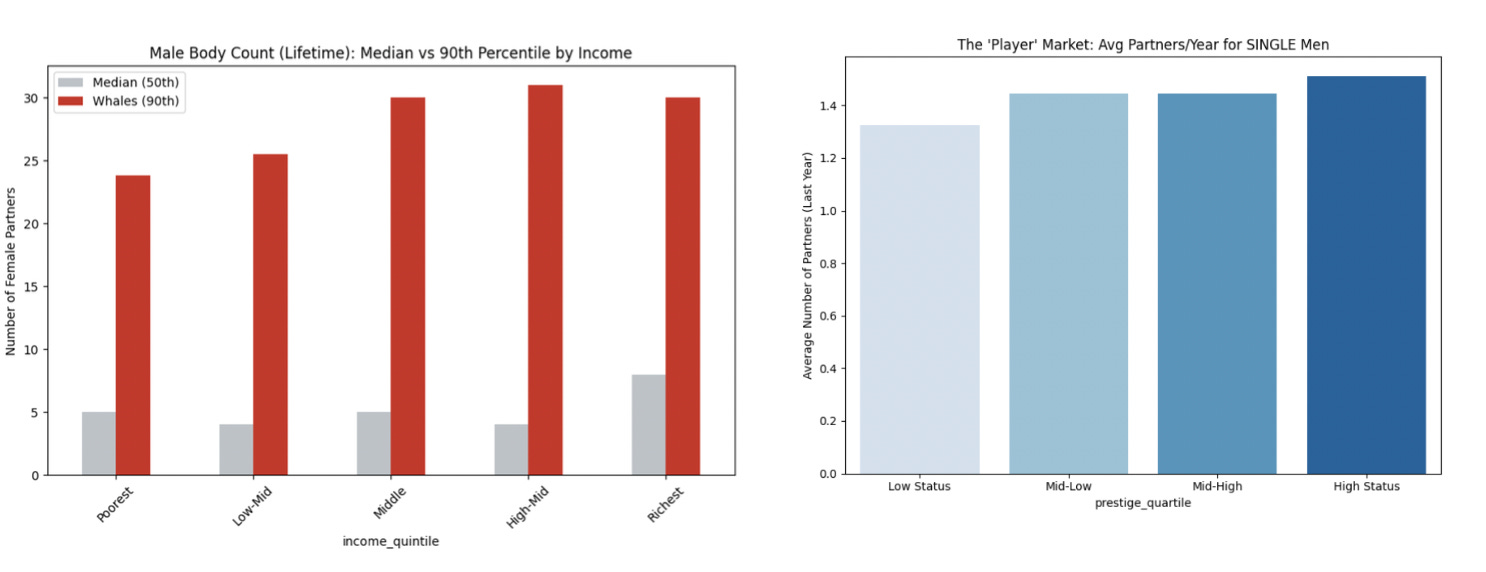
Now you can argue - look, plenty of people in the lower tiers still apparently rack up high body counts! And sure, they do - and I’d be willing to bet they’re more attractive, fitter, better at social skills, and whatever else than the rest of the men in their cohort. The data only has so much resolution though, and we can’t determine those things, and we DO see that there are positive multipliers as you go up the gradients we can see.
One more - let’s compare the top quintile of guys by body count with the next 4 quintiles, and let’s see if they’re different on a number of attributes. I’ll look at 20-35yo male bachelors here, to filter for “single guys on the prowl” so we’re not comparing a bunch of married old guys with young guys or anything like that.
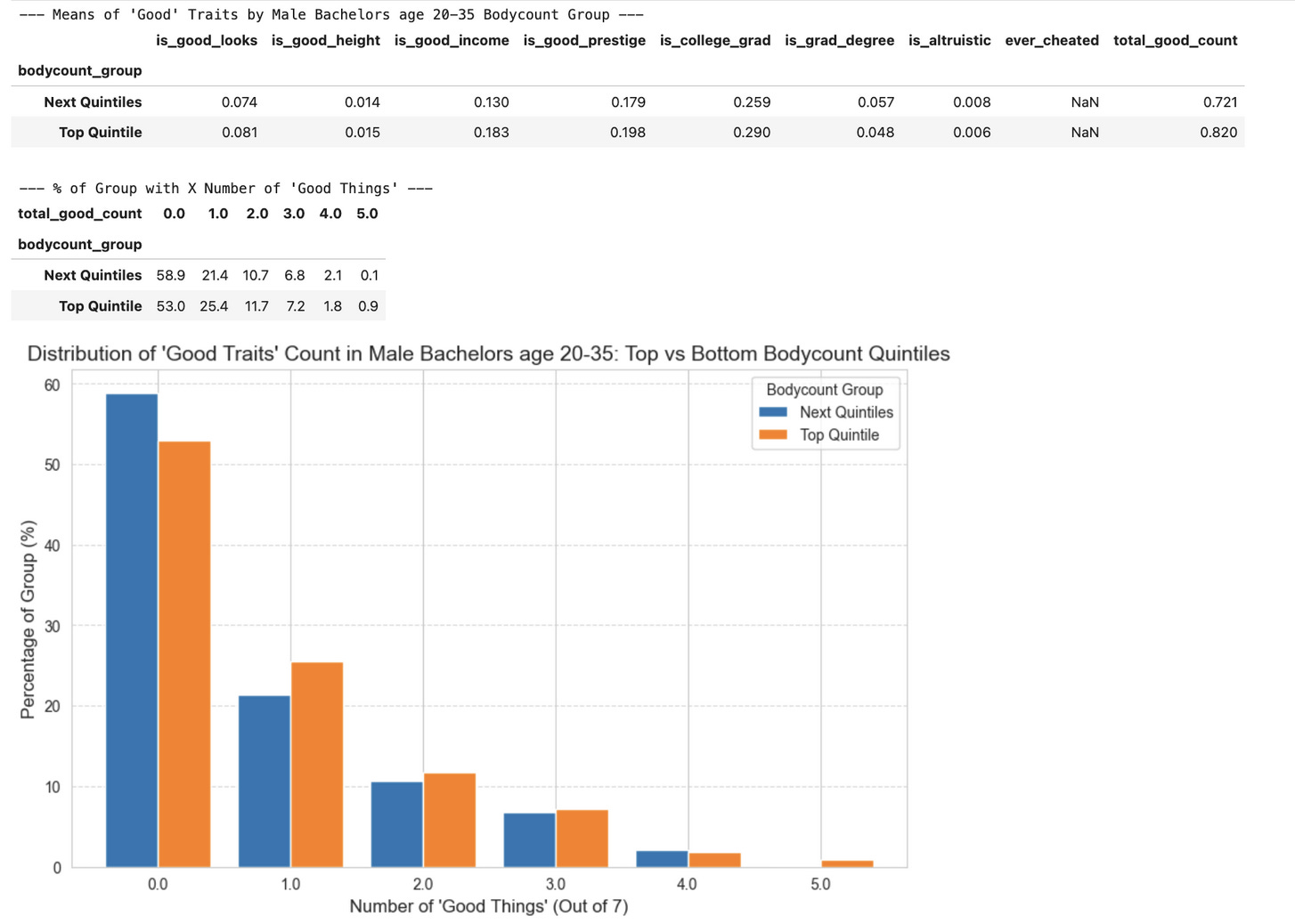
We see they’re more attractive, taller, higher income, higher prestige, and more college educated. Not just that, the combination of “good things” is more common in all of them compared to the next quintiles too. Once again, this isn’t “top quintile vs bottom,” this is “top quintile vs everybody else.” To see signals that strong across basically all the good things is an impossibly huge signal! The top bodycount Chads are Chads indeed, and are on average, taller, hotter, smarter, richer, and in better careers than approximately everyone else!
There is a tide in the affairs of women
And reiterating quality point, you have to consider why a woman would ever cheat, or sleep with a man she knows (or suspects) is partnered.
David Buss talks about male and female infidelity in his book When Men Behave Badly, and reports the following:
“Moreover, men who cheat do so with a larger number of sex partners. Men seeking sex on the side apparently are serial philanderers. Women are choosier even in this domain, typically having a single affair. And of those women, 70 percent cite love or emotional connection as the key reason for the affair.”
He suggests that the male desire to cheat is obvious from a reproductive standpoint, but female desire is more often driven by mate switching potential, and points to a study by Daniel Conroy-Beam and Cari Goetz suggesting that in addition to the “cheating for good genes in offspring” hypothesis, that women might also cheat when their infidelity partner has a large increment in value over their current partner and has demonstrated enough interest that mate switching might be possible.
So why might a woman cheat, or sleep with a man she knows or suspects is partnered? Well obviously, some of them were just lied to by the cheating men. But for the ones that weren’t, she’d do it for mate switching potential, or for better genes than her current partner offers. Either one requires a significant quality increment to be worth it, and this suggests that the males who cheat are selected to be more attractive, higher status, or notably better on some dimension.
Does this mean only 7 foot Harvard educated doctor+models with abs can cheat?
Of course not!
One thing that shows up repeatedly in the literature, in Scott Alexander’s posts, and in any analyses I’ve done is that people largely match up within their own tiers, and churn around in there looking for upgrades and better partners. All a male cheater has to be is relatively better than the woman’s current partner within their tier, or maybe one above it, to represent that big-enough-delta.
This argues there is probably cheating going on in every tier, however you cut that. And beyond cheating, it argues that partnering-in-general works the same way - you don’t have to be an “absolute” top man to rack up a big body count - you just have to be high-among-your cohort.
In fact, cheating is higher in the lower SES tiers, for both men and women! This shouldn’t be surprising, given that lower SES people generally have higher time preference, lower conscientiousness, and are seemingly less likely to be virtuous on any number of fronts, and there will always be men with other positive qualities like looks, fitness, social skills, or good drug hookups who can rack up partners even while poor.
Cheating in general follows a U-shaped curve, where there’s a big peak of cheating for low SES people, cheating hits a minimum for middle class people, and once you get back to the top decile or better on SES, cheating goes up again.
From Munsch 2015 - Her Support, His Support: Money, Masculinity, and Marital Infidelity:
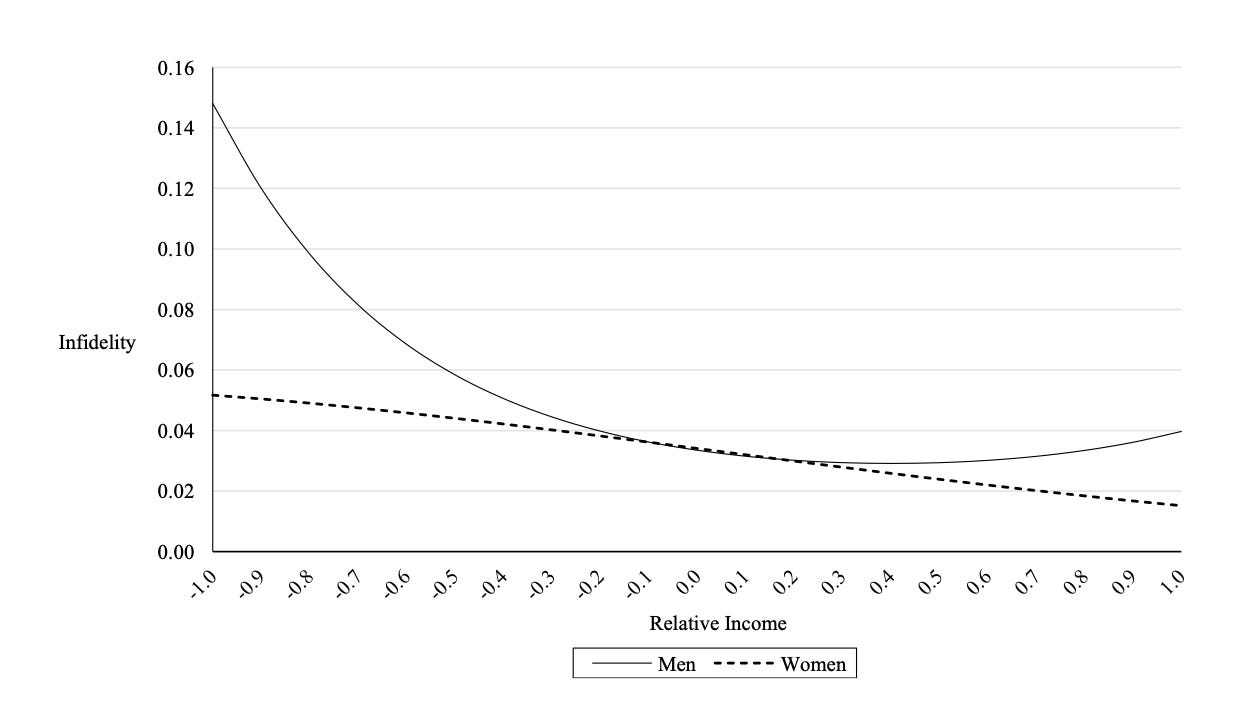
The funniest line in Munsch is the one where she points out that the men MOST likely to cheat are un/underemployed losers being supported by their female partner: “Hypothesis 2b states that the more economically dependent one is, the more likely one will be to engage in infidelity. Model 1 reveals that, for men, lower relative income—that is, economic dependency—is associated with higher odds of engaging in infidelity.”
Womp womp; women just can’t catch a break, can they?
So given all the above info - obviously the larger superset of cheaters is a long tail of sad opportunists who managed to talk somebody they worked or interacted closely with into cheating once, but it was nowhere near a systematic thing, and they racked up just one or two more in an overall small body count, and they’re broadly not relevant to our 20% Chadopoly math.
And indeed, do we see this in the data - this is exactly the “the bulk of cheating is concentrated in serial cheaters” data I teased earlier:
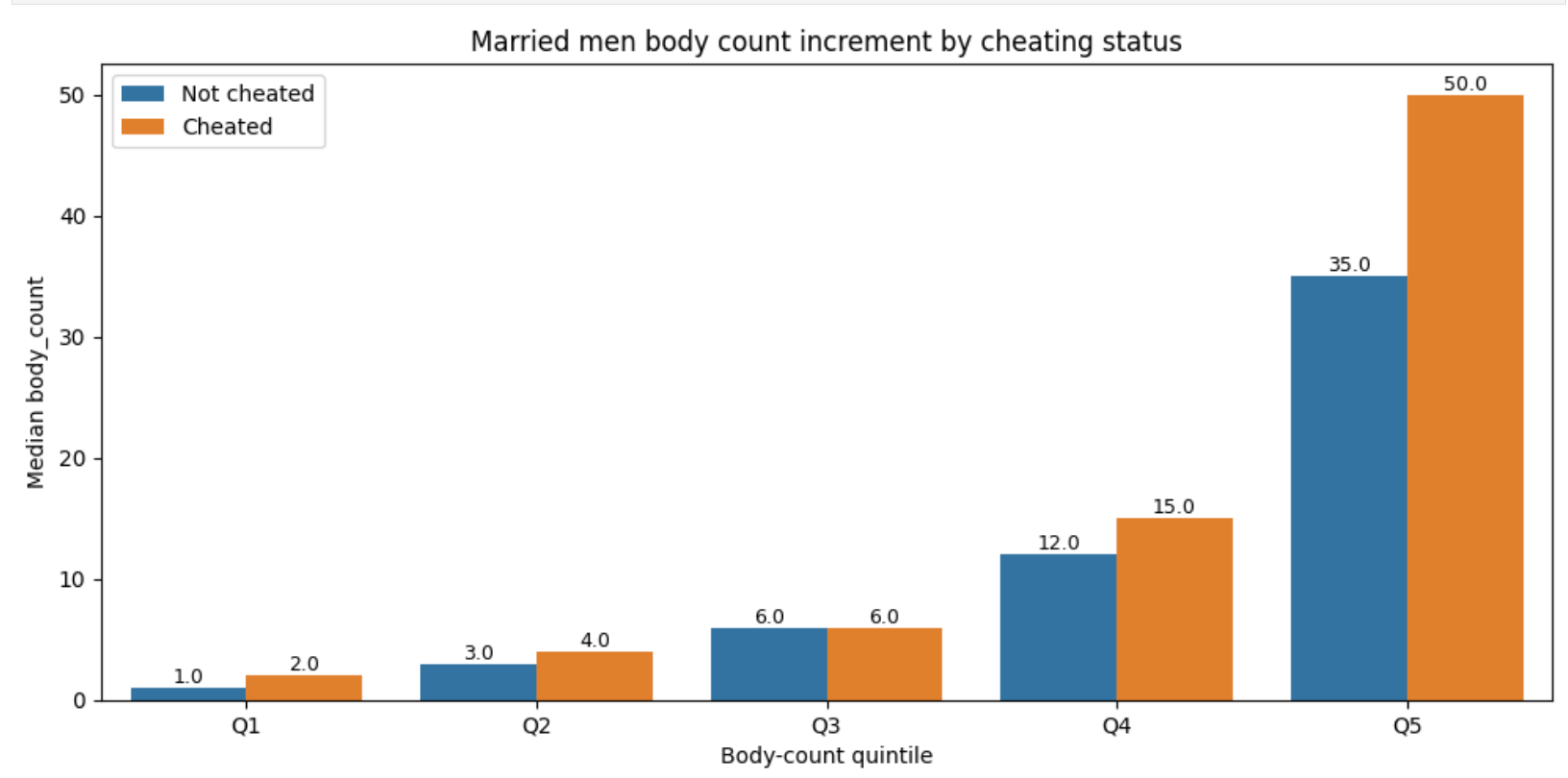
See how stratified “successful cheating” is? Cheating for 4/5 of all cheaters is largely a matter of adding a single body to their count over their entire lifetime, and a full 75% of all cheating sexual partners are concentrated in the top quintile. Power laws and Matthew Effects again.
Obviously this concentration implies that Chuds partake of enough dating market value to get the job done repeatedly, and so are more attractive, richer, more charismatic, or otherwise better than the average woman’s existing mate or prospects in whatever tier they’re in.
Rivers flow not past, but through us
Now let’s look at flow - sex incidence per month.
Okay, we’ve already established that the Chadopoly gets literally 5x - 8x the median number of lifetime partners, with 40-50 vs the typical 5-8.
Is it so hard to believe that they’re having more sex per month, too?
I guess it doesn’t necessarily need to be true - if you’re sleeping with 4 women a year, that could easily be 4 one night stands.
But I’d certainly BET on there being a decent correlation between “number of lifetime partners” and “monthly sex incidence.”
Sadly, I could not find one in any literature.
But I do have GSS at hand, so let us rejoice! In GSS, we see that they do indeed enjoy a relation - there’s a Cohen’s D of .45 difference in monthly sex frequency between the top and bottom quintiles by body count (and .31 of top vs all the rest), and for each additional doubling of body count, monthly sex frequency goes up by .74!
Or, to put it more simply, the top body count guys have between 1.2 - 1.6x more monthly sex than the next lowest, down to the lowest quintile by body count.
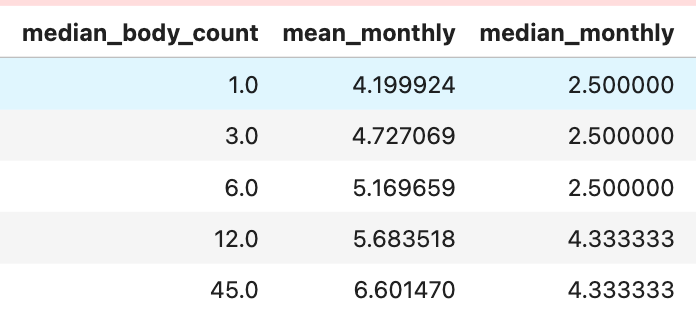
I aver that we’ve already established the top body count guys are probably better - more attractive, fitter, more social skills, richer, higher prestige, etc, at least within their SES tier.
What we are finding here is that this population also (unsurprisingly) has more sex overall, even in the “flow” or monthly incidence sense.
And indeed, if you do some reasonable bucketing by income and occupational prestige, you see that among 18-28yo men, unemployed men apparently have a ton of sex, and then for all the working people, there’s a monotonic rise in sex frequency the higher your income and / or occupational prestige are, whether you’re a college grad or non-college.
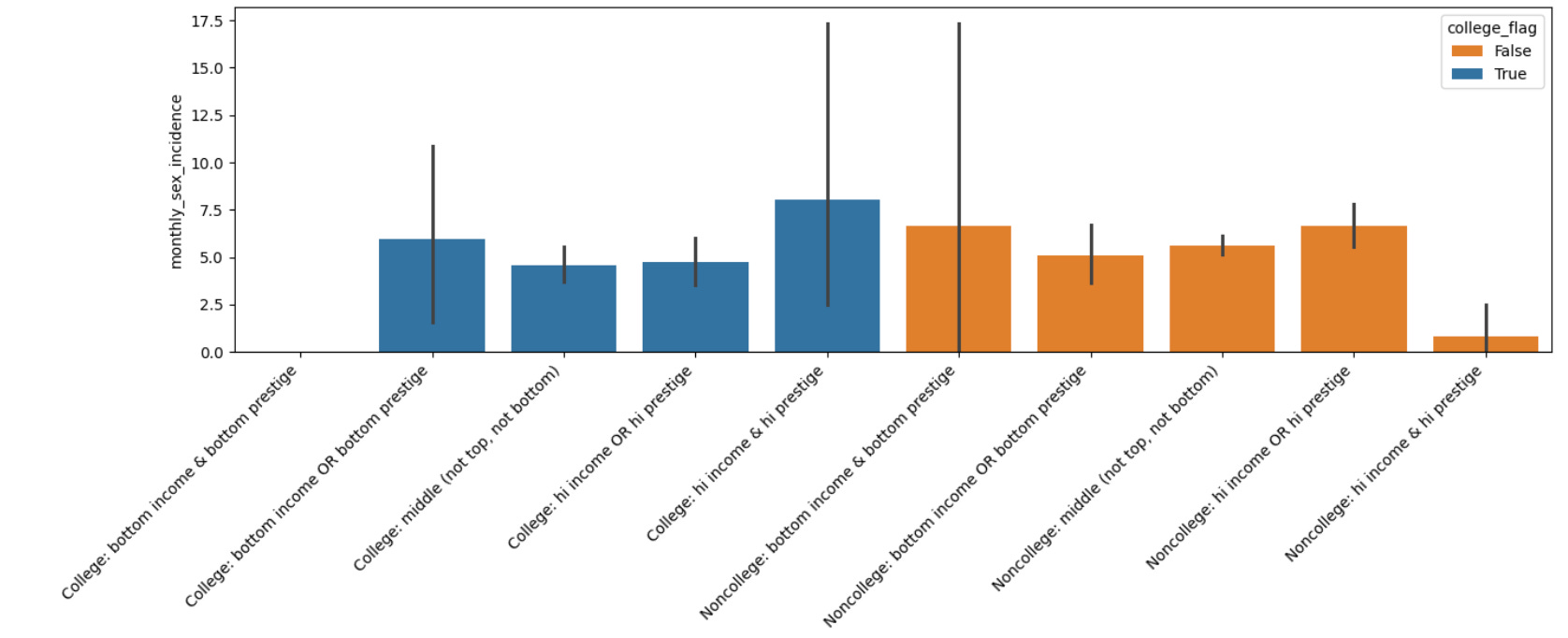
Sadly the resolution of GSS data doesn’t let us define much more than the top quintile of sex frequency, because it’s a categorical variable with the upper end capped at ~4 times a week. I’m disappointed because I was all set up to mock the top “sexual incidence” people, about which the tippy-top people in a 3k sample of 18-28yo men were having it only ~17x a month, before I remembered it’s an artifact of the data. But only 100 men out of 3k were at that peak, which is pretty hilarious itself! Apparently decent sex lives are 1/30 rare even in the young, and the rate is surprisingly consistent in 40-65yo. So “non-terrible amounts of monthly sex” is AT MOST ~3% incidence for men of all ages.
And do we see any stratification in sex-havers versus the base pop?
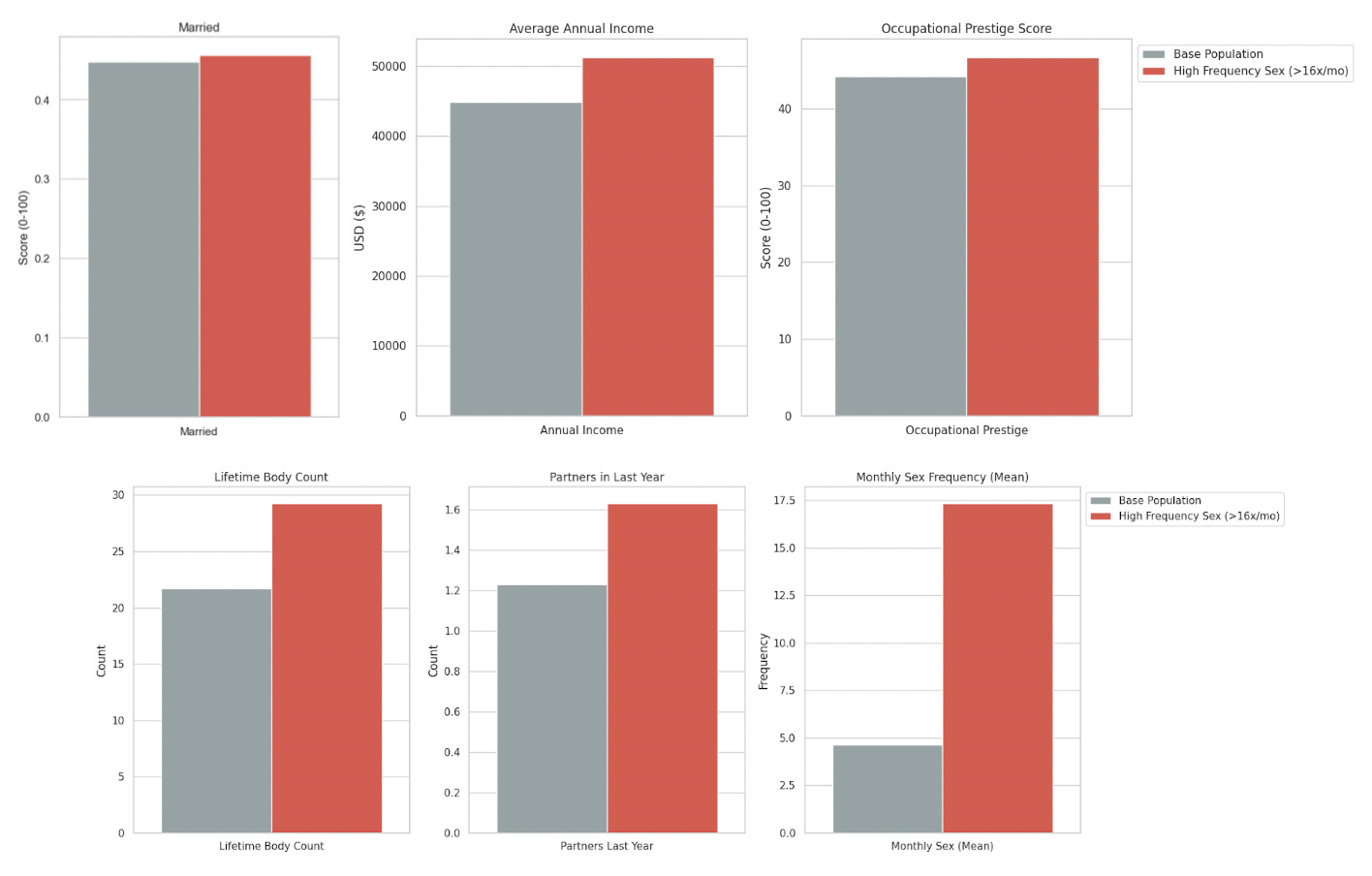
Unsurprisingly, we do - people who have a lot of sex are positively selected on the traits that we can see, and given all the other dating data we have, they’re probably even MORE positively selected than this on the attributes we can’t measure like attractiveness, fitness, and social skills (and very probably, “the ability to take good pictures”).
We’ve shown that the top body count guys are positively selected, and we’ve shown that they have 1.6x the sex frequency over the bottom. We’ve shown that sex frequency stratifies by income and occupational prestige, and that this is directly correlated with body count. My verdict?

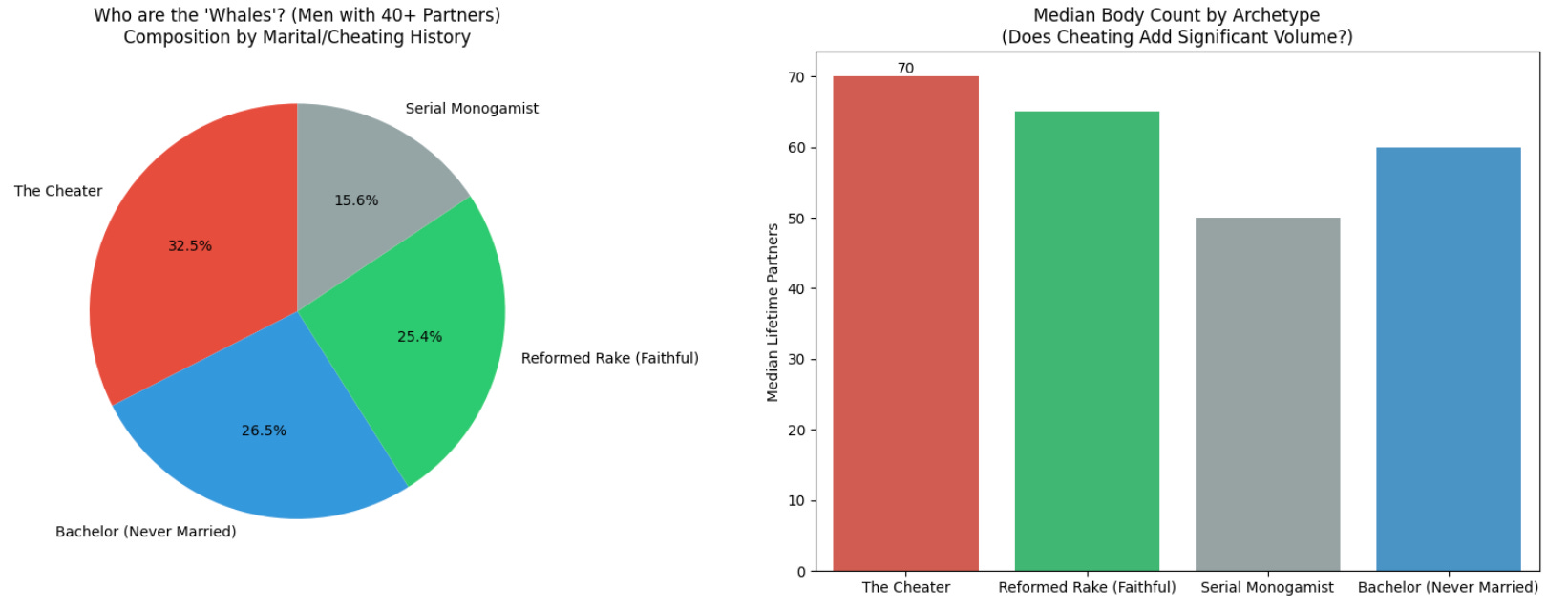
I will close with a rough Chad / Chud breakdown. Amazingly, Chads are mostly bros, and a solid 67% are faithful to their wives despite their high body counts - only around 33% of our Chads are Chuds and got there by cheating, although cheating does definitely bump the body count.
More anon
Finally, digging into the GSS data has surfaced a trove of spicy and fun info, so stay tuned for my next post, which is all about what we can see that separates the populations of cheaters versus noncheaters, including a detailed breakdown of exactly which risk factors are highest for cheating in men and women.
So subscribe now if you’re not already, to be sure to get the next article in the series: Cheating: much more than you wanted to know!
A quick sketch: say women choose only the top 50% of income guys in their respective tiers. For simplicity, we’ll have a median tier and a high tier, so women choose everyone above $50k in the median tier, and above $150k in the high tier. So people <$50k and <$150k were both rejected, and the selected pop has a $75k income on average. $75k doesn’t seem high if fully half the population averages $150k, does it? It’s barely 1.5x the median guys, when a full half of the population averages 3x the median guys! But fully half of the population has been rejected to get there!
Again, there seems to be some misunderstanding of what 'Chadopoly' denotes. It's not simply the observation that some men have more sex partners than others, which is unremarkable.
The Chadopoly refers to a monopolization effect: the idea that a small subset of men are monopolizing a disproportionately large share of women, creating an imbalance in the dating market and producing an incel underclass. If a similar ratio is seen among women, then this isn't what's happening.
https://nuancepill.substack.com/i/146920484/do-statistics-support-the-8020-rule-in-dating
Whether the ratio is 80/20, 66/33, or 90/10 is beside the point. If 10% of men have 90% of the sex partners within their group, but the same ratio holds for women, there is no Chadopoly any more than there is a Stacyopoly. The most you can say is that they're possibly monopolizing the casual sex encounters, and there are likely more men than women who would like to enter the promiscuous pool.
There's also a lot more to say on the dating app question.
>Only 5% of guys get swipes
There's an important distinction between individual women swiping right on only 5% of profiles and only 5% of male profiles getting swipes.
A recent study that analyzed the first swipes people made found that in terms of within-sex desirability, men tended to swipe up while women actually swiped down slightly - though they note there was lower variability in men's desirability. Actual matches were close in within-sex desirability.
https://journals.plos.org/plosone/article?id=10.1371/journal.pone.0327477
The relatively consistent finding that women’s aesthetic taste tends to be more varied could also be relevant here.
This result was a bit surprising to me because of how a good number of men seem to adopt a serial swiper strategy, doing any necessary filtering after the fact, but maybe this only comes into play after the first swipe or two.
>Likes and replies are vastly concentrated in the top 10-20% of men
Like with sex partners, this isn't sex-specific.
>80% of men are rated “unattractive” by women
This is only really interesting insofar as it influences behaviour, which brings us to the next graph.
>Attractive men get 11x the messages as unattractive men
The same graph shows that the most attractive women get 27x the initial messages of the least attractive women. This graph is slightly misleading though, as the lowest rating means something different for each sex. When you break it down by attractiveness percentile, the effect of attractiveness on message volume is comparable between men and women. The success rate of messages (i.e. replies received) also shows a similar pattern, perhaps being slightly stronger for women.
>In fact, women’s likes follow a power law, with the top percentile of men getting the most, the 95% percentile getting half as much as the top percentile, and likes petering out entirely after the 80th percentile or so
I noticed my Hinge like distribution chart there, which shows that the skew isn't that much stronger for men than women. The match skew on Tinder is also similar by sex. Between-sex inequality in swipes received is high due to men swiping on a lot more profiles on top of the skewed gender ratio of the user base, and women get more matches on average due again to the skewed gender ratio, but within-sex inequality is comparable between each sex.
All this aside, when we consider actual outcomes such as dates, sexual encounters, and relationships, we find no gender imbalance on a population level:
https://nuancepill.substack.com/i/144276579/actual-outcomes-through-online-dating
A similar proportion of heterosexual men and women report having had sex with someone they met online in the past year, a similar proportion have had a high number of first dates through online dating in the past year, etc.
So dating apps aren't facilitating Chadopolies, consistent with sexual behaviour data which shows no increasing concentration over time.
I appreciate the link though, and the entertaining post as usual.
Don’t know if I missed something in your essay — but what if everyone is simply lying?
The blokes exaggerate, and the birds are coy?