

Hold onto your hats friends, this is a long one.
I genuinely try to respect my readers’ time, but in this post, my usual 20min reading time soft cutoff, and even my 35 min reading time hard cutoff, has been trampled into unrecognizability and left in the dust, like so many steppe nomad opponents of yore.
Reading time sits currently at 66 minutes in the (frankly 1.5 - 2x over-estimating in my own opinion) Substack reading time estimation - if that’s too long for you, I urge you to bail out now and use that time more productively (or save the long read for a better time). You have been warned.
But what better historical topic to break the time cutoffs on?
There comes a time in every man’s life where his thoughts turn away from such comforting and well ordered historical topics as Rome and the Age of Sail, and towards steppe nomads.
Why steppe nomads?
We basically all have steppe nomad in our ancestry
They’re unstoppable superweapons in war for more than 4,000 years
They’ve materially shaped history - even the greatest empires have risen or fallen due to them, or been ruled by their descendants
Nearly every major empire you’ve heard of, historically or today, was either destroyed or taken over and ruled by steppe nomads at some point - Rome, Byzantium, Persia, China, the Caliphate, and more
Ever heard of the Yamnaya? The speakers of Proto-Indo-European who became the founding populations culturally and genetically for most of Eurasia? Steppe nomads.
I’ve read soooo many books on this. Everything from Genghis Khan and the Making of the Modern World to Kenneth Harl’s Empires of the Steppes, to Subotai the Valiant to Conn Iggulden’s fictionalized portrayals of Genghis Khans life, to Beckwith’s Empires of the Silk Road, countless wikipedia pages, and more beyond that in the past, those are all just in the last 2 months. Yes, that sounds pretty Mongol heavy, but the Mongols were awesome, and also one of the best historically attested steppe nomad conquerors, from multiple peoples. And as to however many thousands of pages that must be, well, when you’re trying to read and think about 6,000 years of history, it just sort of comes with the territory. What, LLM’s get to read a couple of petabytes of text, and I get funny looks for a few thousand pages?? We’re never going to “John Henry” this mother with that attitude! But I digress.
First, what is the steppe?
The steppe is an interior ocean of grass, spreading nearly from coast to coast in Eurasia.
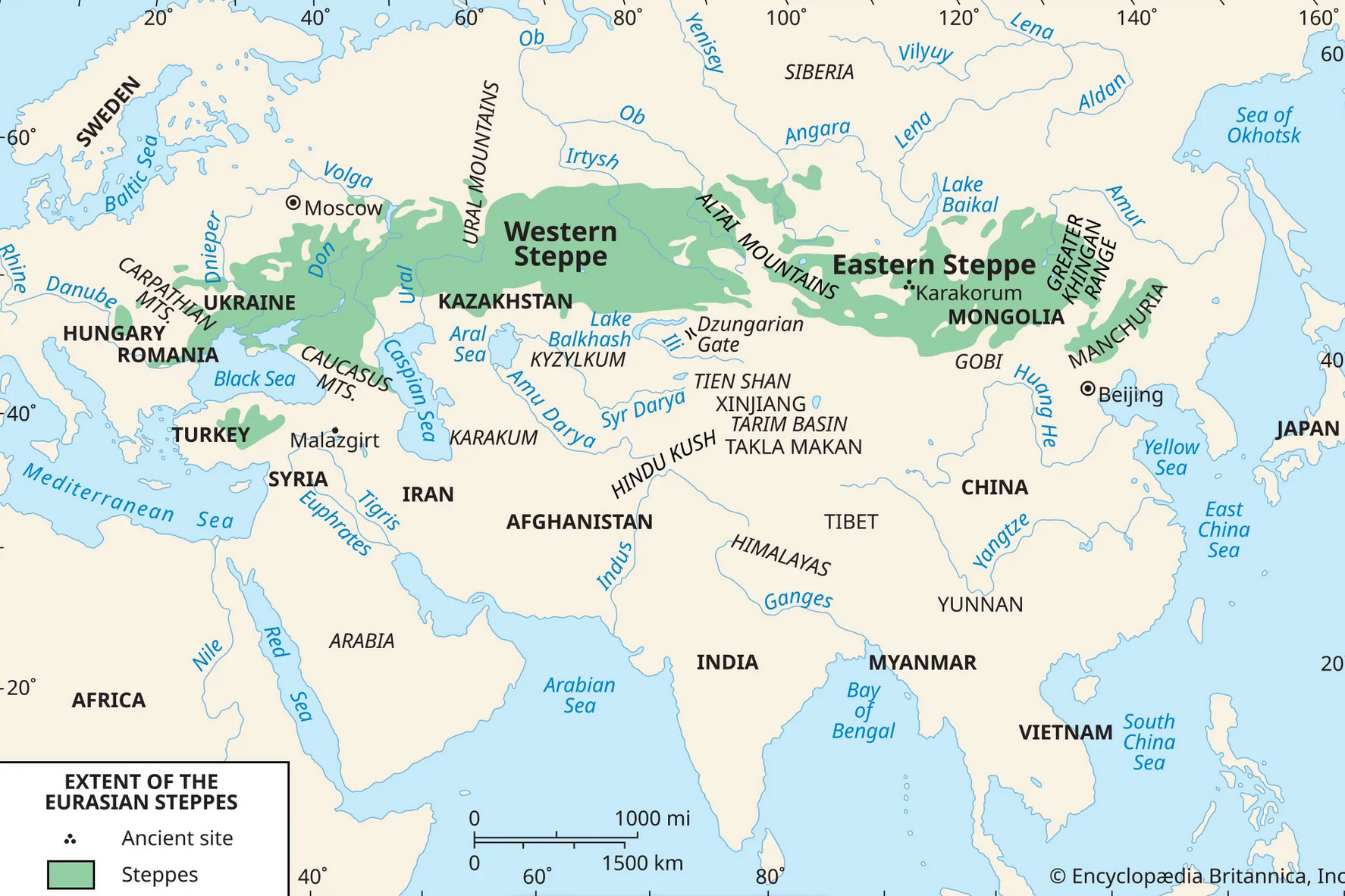
For our titular nomads, it’s a combination superhighway, food bank, logistics train, and hotel / home.
They’re pastoralists. Shepherds. They raise the “5 snouts” - yaks/cows, goats, sheep, camels, and horses - in those grasslands, and live off their meat, milk, and animal products. They live in tents, and travel on horses and cart their stuff around in wagons. From those little green swatches, various steppe nomads in various times erupted and they or their descendants conquered nearly everything you see on this map, with the sole exceptions of Japan, Sweden, and Africa, although they gave Japan a try twice (and got wiped out by typhoons twice, unfortunately they are much better at horse archery than boats).
Empires so fantastically rich that the tribute carts stretched continuously for months of travel from present day Beijing, going towards Mongolia.
Do you see Karakorum on the map, there in Mongolia? Think how far away that is from approximately everything else on the map. When various Great Khans were being ceremonially enthroned, royal representatives from all over this map would all come to Karakorum to pay tribute and personally be there, including from Western Europe, which is cut off at the far left.
That amount of travel is a real commitment back when the fastest means of travel are camels or horses! It’s months of hard living and traveling, for nobles and diplomats, just to go and kowtow to some far-off potentate in the icy ass end of nowhere, but they did it! That’s how big a deal steppe nomads were!
And you want to talk empires? Rome is an also-ran compared to them!
“In 25 years, the Mongol army subjugated more lands and people than the Romans conquered in 400 years.”
Steppe nomads came up to Western Europe’s door at least 3 times, and it was essentially a matter of blind luck and Europe being a lot poorer than China or the Middle East that most countries there didn’t become a tribute-paying vassals to steppe nomads (except for the modern day countries of Russia, Georgia, Ukraine, Romania, Poland, and Hungary, all of which did become vassals at some point).
The Ur-Steppe-Nomads
Back before there was even recorded history, the Yamnaya radiated outwards from the Pontic steppe and took over everybody else. This is basically Ukraine today, and it was their home:
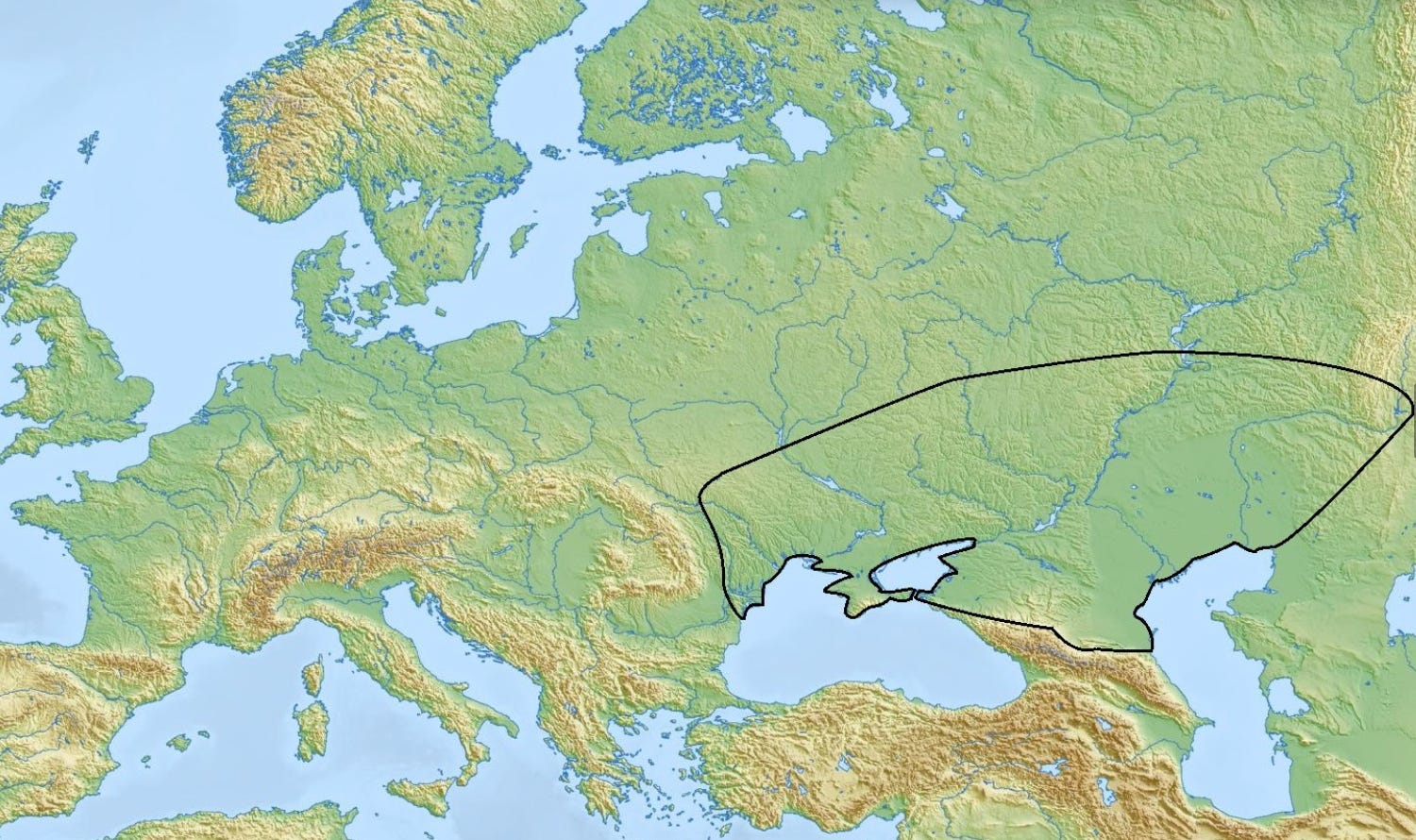
They were pastoralists who herded the 5 snouts for their livelihood, and they spoke Proto-Indo-European, the root language behind English and most European languages, and it is thanks to their successful radiation outwards that a lot of Eurasia speaks some variant of PIE today:
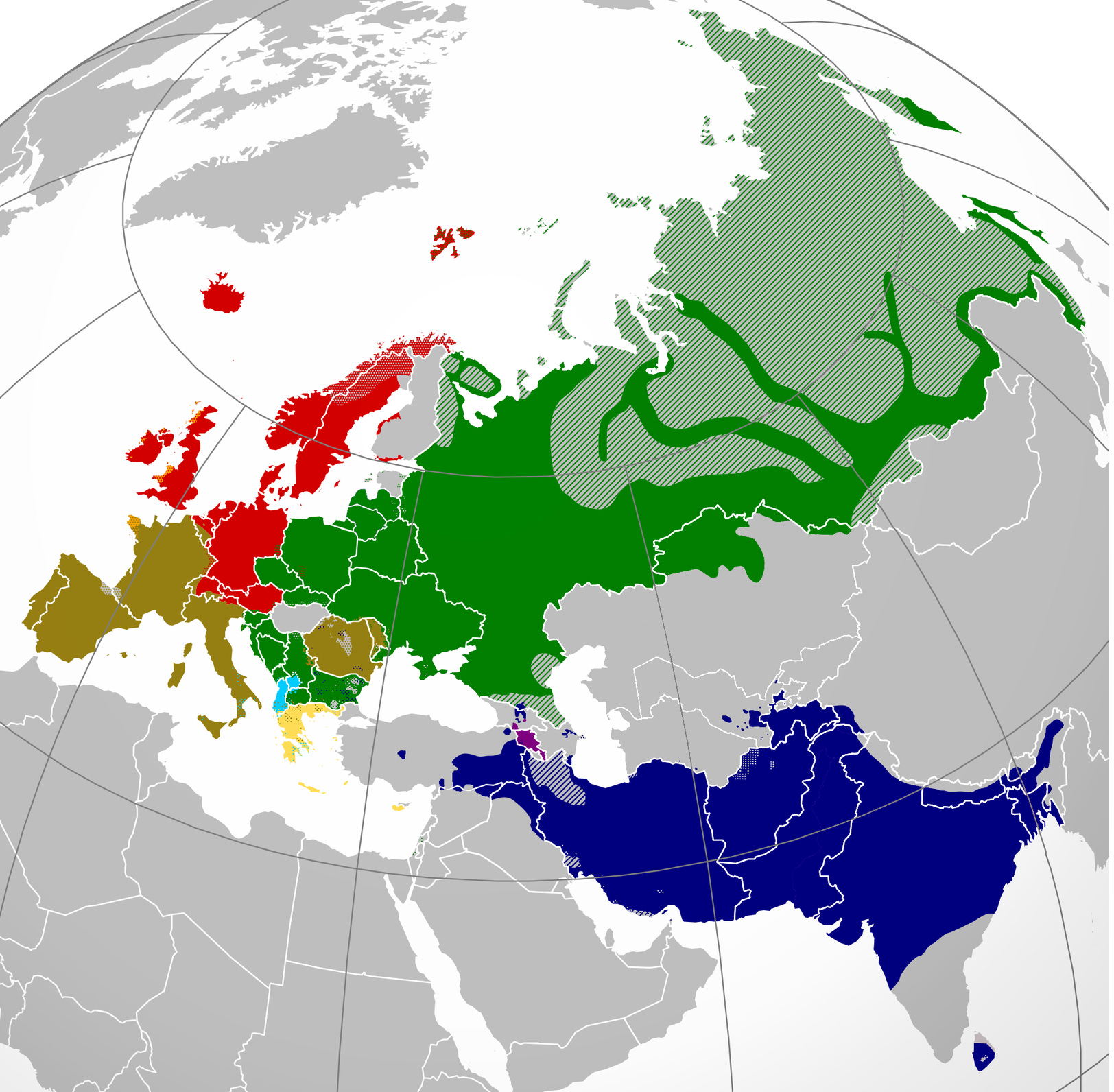
There are cultural continuities and commonalities across many of the cultures they seeded, that point back to various elements of the founding Yamnaya / Proto-Indo-European culture, typically labeled the Central Eurasian Culture Complex by Beckwith (the brilliant1 and opinionated author of 12 books and 60 papers on central Eurasian history, who must know 10 different ancient and modern languages and considers his remit to be “Eurasian History” in toto) as it diverges into the multiple lines of PIE peoples and cultures.
They include horses, wagons, hunting, felted clothes and tents, and the First Story, a recurring founding myth found across a wide array of people and cultures. In cultures as diverse and widespread as the Hittites, Scythians, Junghars, Manchus, the Shang and Zhou dynasties of China, the Wu-sun / Tocharians, the Hsiung-nu / Xiongnu, and even the Turks, Romans, and Mongols, we see elements of the First Story appearing in their founding myths.
The essential elements of the First Story, which may appear incompletely or in a slightly different order in the actual attested versions, are:
A maiden is impregnated by a heavenly spirit or god.
The rightful king is deposed unjustly.
The maiden gives birth to a marvelous baby boy.
The unjust king orders the baby to be exposed.
The wild beasts nurture the baby so he survives.
The baby is discovered in the wilderness and saved.
The boy grows up to be a skilled horseman and archer.
He is brought to court but put in a subservient position.
He is in danger of being put to death but escapes.
He acquires a following of oath-sworn warriors.
He overthrows the tyrant and reestablishes justice in the kingdom.
He founds a new city or dynasty.
Those last 5 points? Serving in a lowly position, growing a following, then overthrowing the tyrant and founding a new dynasty? Super common first story that ends up tracking a lot of founding myths of various PIE peoples, and indeed, generally tracks their narrative arc as a people in multiple countries.
Something else we see across a similar array of cultures is the comitatus, a highly trained warrior corps loyal to a leader personally (rather than a government), ranging from ten to ten thousand warriors, and who are literally bound to commit suicide or be ritually executed along with the leader when he dies, in order to be buried with him along with their horses, armor, weapons, and riches, to accompany him in the afterlife.
Steppe nomads were generally huge on this across many, many cultures, for many thousands of years - the measure of a lord’s greatness was how many horses and armed and armored soldiers that he was buried with. Seems wasteful to the modern eye, especially compared to the portion of wealth / GDP that must have represented to the much-poorer past, but you know what they say - the past was a different country.
The rewards of being in the comitatus were manifold - the leader was bound to consider them closer than brothers, to feed and support them, but also to gift them richly and frequently. When the spoils from successful war came, the leader always took a princely / kingly share of it, and this was shared liberally with his comitatus.
We see the comitatus cultural element across the <takes breath> Hittites, Achaemenid Persians, Scythians, Kwarizmians, the Xiongnu, the ancient and early Germanic peoples including Goths and Franks, the Sasanid Persians, the Huns, the Hepthalites, the Koguryo, the early dynastic Japanese, the Turks, Khazars, Uighurs, Sogdians, Tibetans, Slavs, Khitans, Mongols, Byzantines, Chinese, and Arabs. Whew!
Now I’ve heard of “bros before hoes” but you know what’s (apparently) REALLY Lindy? All your best buds, your most trusted confidantes that you’ll tackle anything the world can throw at you with, all killing themselves at the same time you die, so you can all pop up in the afterlife at the same time, fully armed and armored and horsed, and apparently go on an immediate celestial raid together. Bros before ophanim!
And as you can see, much like Proto-Indo-European the language family, some of these cultural practices had legs, and expanded even beyond PIE peoples, and essentially across the entire Eurasian continent.
So the Yamnaya successfully radiate outwards in a couple of migrations. One migration goes towards the Middle East, and gives birth to the Hittite / Anatolian language families, which is the farthest from any other PIE family. Later, another Tocharian speaking migration goes towards the far East, reaching as far as the Tarim Basin. Finally, the dialects we’re all more familiar with — Indic, Iranian, Latin, Greek, Italic, Germanic, and Armenian, come from an even later third outward migration wave.
What does this mean, to “successfully radiate outwards?”
And here I think it’s worth a moment of clarification, because this is basically the way all successful cultures worked in antiquity, and in various papers and books you’ll see academics tastefully eliding over this entirely, and even some pretending it was simply “cultural transmission,” although that happens largely before genetic studies.
Broadly, “successful radiation” typically means “y chromosome replacement,” which means “we done killed all your men and took all your women.”
Ever hear the factoid that Genghis Khan is the progenitor of something like 8% of the entire population of Asia today? That’s how this kind of thing happens, he had 160 wives, and many of his descendants ruled similarly large and rich areas and also had many wives and descendants, for something like 100 - 600 years, depending on the area.
This is broadly what warfare has been about since the dawn of time. We fight for status and group belonging, which are the high level labels that motivate us to fight to attain greater biological wealth like good pasture / hunting land and more and better mates. When two hunter gatherer tribes make war on each other, it’s largely about taking their women (or taking stolen women back) while also incidentally freeing up their land for use, and so it’s been for ~2M years of hominin existence that we know about.
Did you know that we had cities a thousand years before Uruk and Ur and Sumer / Mesopotamia? In fact, you might consider them better than Sumerian cities. As far back as 5k BC, strange conurbations of dwellings existed, all equal in size, which held up to 10-15k people, were periodically and intentionally razed, and seemed to indicate that utopian high density living without kings or elites was possible. Everyone did their share, nobody specialized, and there was no caste of parasitic nobles or priests or soldiers taxing everybody and living high on the hog without doing any work. They were even mostly vegetarian, if that pings your utopia-meter! You can’t find a better example of a fair and idyllic culture, all the best hunter gatherer cultural norms transplanted to the urban context, with all the benefits of greater density and few of the downsides.
This is the Cucuteni–Trypillia culture, and after the climate shifted in a way that made agriculture harder and less bountiful, they got pwned by the (very much hierarchical and patriarchal) Yamnaya, before the Yamnaya went on to successfully radiate outwards from that region and into all of Eurasia, where they continued the trend.
For whatever reasons, the steppe nomad cultural and technological package seems uniquely suited to be successful at this, and warfare in general. This means their culture + mores + language + technology + lifestyle package propagated much more successfully than other, more sedentary / agricultural cultural packages at the time, and that’s why we’re all speaking PIE languages today.
So the Yamnaya start radiating successfully outwards around 3k BC, replacing a bunch of the men in various settled agricultural societies of the time. We don’t know why they were so successful at this - although they had horses, they didn’t have horse archery, or even chariot warfare, at this point (horse domestication and capability uplift is surprisingly recent), and it’s a matter of widespread speculation (plague? A super-regional drought or famine? Cultural elements like the koryos?) on why they were able to radiate out so successfully in so many places.
Horse domestication itself is an extremely interesting topic - all living lines of horses, and all important lines of horses from 2k BC on, come from a single domesticated lineage, the DOM2 lineage, which began being domesticated slightly before Bronze Age chariot warfare first started becoming the world-dominating military technology around 2k BC. The steppe nomad Botai actually began domesticating an entirely different line of horses back in 3500BC, which ends up going extinct (they even have 66 chromosomes to the DOM2 line’s 64). So which horse did the Yamnaya initially have? Either the Botai horse initially, and later the DOM2 horse, or a DOM2 progenitor all along that gets progressively more capable and domesticated.
Horse breeding for successively more valuable traits drives the frontier of military technology, too. Initially, horses are only useful for milk, meat, and blood, and this is true for at least 1.5k years. They get more domesticated (ZFPM1 genetic variant), and bigger and more useful (GSDMC variant), due to steppe nomad domestication and breeding, and this capability unlock drives the unstoppable superweapon of chariot warfare. Horses are still too small and weak to do anything but pull the (very light, it was said you could lift them with one hand) Sintashta chariots, with only two people in them, behind them. But they’re bred over time for bigger size and speed, and can eventually pull bigger and heavier chariots with 3 people, and later they get big enough they can be ridden for cavalry purposes. Horse archery, the next impossible superweapon in military affairs when used well, becomes possible roughly a thousand years after chariots, at 1k BC, and horse archery remains an important frontier of military dominance until roughly 1400-1500 AD.
But you know who was there at every step of the way? Guiding the horse breeding, perfecting the techniques, and figuring all this stuff out? Steppe nomads!
Steppe nomads have a unique cultural connection going back clear to the Yamnaya with horses, and their breeding, domestication, and applications in warfare, and frequently define the frontier of military capability for an army of a given size.
This is a theme with steppe nomads. Life and warfare for thousands of years is VERY much “how efficient and good overall is this culture overall at producing soldiers, technology, and practices that reliably win military engagements?”
Steppe nomads basically break the “agricultural density advantage” frame entirely, and this is why all cities after the Yamnaya had elites and inequality and professional armies. Inequality is seemingly one of the fundamental cornerstones (and inevitable results) of settled civilizations that last.
Have you tried “having a bigger army?”
If you think back to hunter gatherers, which exist in a Hobbesian state of “warre of all against all” and where a full third of men generally died by violence, “having more men” was pretty much the answer.
Even after we started cultivating and domesticating crops for free in the hunter-gathering-with-bonus-free-crops Natufian age, this was still the answer, and remained so clear through settled agriculture’s firm establishment. If you can show up with more men than the next group over, your group generally wins.
So that means that mostly the answer throughout history was “get good at agriculture, then you can overwhelm them with sheer numbers!” This is because the amount of people you can support with agriculture is hugely larger than hunter gathering (100x - 1000x), or pastoralism (10x - 100x).
Broadly, it’s a 10x change at each step in “number of people you can support per acre” moving from hunter gathering (maybe 20k - 100k acres for 100 people), to pastoralism (around 2k to 10k acres per 100 people), to agriculture (around 200 to 1k acres per 100 people for ancient agriculture, then we get another factor of 10 for modern agriculture). So it seems in the dueling game of lifestyles, pastoralists should beat HG and agriculturalists should beat pastoralists, right?
Well, the reason steppe nomads were so feared is that they fundamentally break this framing, and routinely pillage or even take over MUCH larger empires and armies than themselves.
In the Yamnaya-descended / PIE peoples (broadly labeled the Central Eurasian Culture Complex by Beckwith, henceforth “CECC”), after diverging into several peoples who still shared common cultural elements (this is roughly 2000 - 1500 BC), this turned out to be driven not by horse archers intially, but by chariot warfare during the Bronze Age, which became the unstoppable next tier of warfare that needed to be widely adopted by essentially every state, to survive.
Surprisingly, it was mostly or entirely CECC people who were the charioteers, generally hiring themselves out as mercenaries in many cases, or simply conquering countries and becoming the new leadership in others, as they did in the case of the Mycenean Greeks, the Persians and Medes, the Indic-speaking leadership caste of the Mittani, and eventually as the Hittites overthrowing the Hatti. The Medes (with chariots and settled people armies) later overthrow the (gigantic) Assyrian empire in partnership with the Babylonians. As far out as Shang Dynasty China, we see comitatus burials with CECC chariot warriors! It apparently took a long time for various non-CECC cultures to copy and master chariot warfare.
On the “beating larger armies point” and taking it back to the Mongols for a specific example, they beat armies from the Middle East and China that were 2-10x larger than their armies. The Mongols at their peak were maybe ~1M people total including women and children, fighting against empires with ~15M (Khwarzem) and ~50M (Jin Dynasty) people, and who end up ruling 100M people total.
Generally, an agricultural society will muster maybe ~0.5% - 2% of its people for their army. So that’s 75k - 300k armies for Khwarazem and ~250k - 1M armies for the Jin, and indeed, the upper ranges are the total sizes of armies that the Mongols beat when conquering them, with total mustered forces of ~100k Mongols. So even being 50M strong won’t save you.
And this is the general steppe nomad pattern, vastly outsized military capability versus their population size.
Why do steppe nomads routinely dominate?
A couple of factors:
They muster ~10% of their population as direct soldiers, with in the limits every able bodied man between something like 15-50yo participating
They train in cavalry skills and archery from toddlerhood, so by the time they’re fighting they have 1-2 decades of experience minimum and are noticeably more skilled than most opposing soldiers (and chariots are just horse archery plus wheels)
They are typically all cavalry or mostly cavalry, whereas most settled militaries are largely infantry (you can’t afford to give peasants horses, and they wouldn’t know how to ride or fight from them anyways)
Back to the “all cavalry” point, as nomads qua nomads they have impossibly strong advantages in logistics, because they can live off the land, or off their horses (in terms of eating blood and milk from their horses) while traveling, and so can cover much more ground (70-250 miles per day), MUCH faster than any settled army, which can only move at slower-than-walking speed
They are “hard men” trained to fight since birth, who in the best cases can shoot a bird on the wing from a galloping horse at 300 yards (an unbeatable range + accuracy), whereas most settled armies are largely peasant conscripts who don’t really want to be there and don’t have much if any training, with maybe a ~10% cream of military-trained nobility on top
Back to this point, they spend a lot of optimization energy on their arms and armor for each soldier, and their routine successes mean they can pull the best arms and armors from the best that civilization has to offer, so they’re generally fairly well equipped
The “wolf to tiny floofy dog” pipeline
History is broadly defined by the continual clash of memetics and cultures and technologies over time. Who is able to carve out empires and rule them, and for how long?
This is nearly always achieved via agriculture, as our above population density heuristics pointed out. But because the steppe nomad package was so puissant, it served as a goad and challenge to most settled empires throughout history.
But there’s another recurring sub-pattern here - because the “steppe nomad package” requires hard men training in outlands since birth to militarily dominate, any time they conquer an empire and decide to settle down and become the nobility in it, they follow the inevitable pattern:
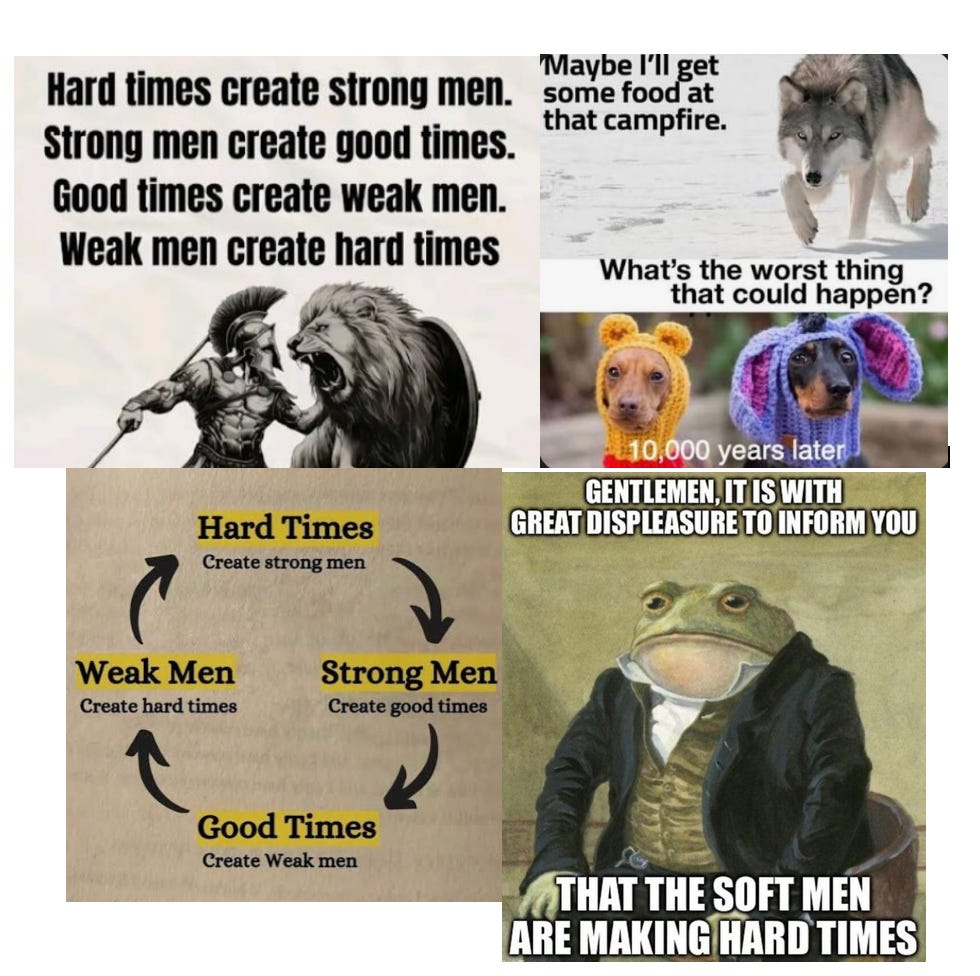
This isn’t pre-ordained. Mostly steppe nomads aren’t organized enough to want to establish or administer an empire, and largely just re-establish territory or trade rights, take some stuff, and leave.
Even if they want to administer an empire, they can just take a bunch of tribute and remain in the outlands, raising their children in the traditional way, like Genghis did. His grandson Kublai Khan tried this in the literal center of the Forbidden City in Beijing, with a nice lake and nature preserve in the center dotted with the Mongol felt tents called gers, where he and his wives and the cream of the Mongol nobility could maintain the traditional way of life for their kids. But it never works for more than one generation or so - the grandkids are going to be as soft and effete as any urban nobility, Kublai himself already definitely was (and was likely the smartest as well as most urban / civilized of the grandkids) , despite his efforts.
So, that’s the basic tradeoff. If you want some of the nice things and the settled life of urban civilization (baths, sophisticated cooking, hot and cold running slaves, markets, having a reliable address for tribute and / or empire communications, plays and other entertainments, being surrounded by people kowtowing to you all day), your grandkids and further descendants are going to be pampered urban softies.
A huge amount of cultural optimization went into trying to ameliorate this trend over thousands of years, attempting to end at an equilibrium where you could have cities and nice things, but still have a hard and effective nobility and army. The Greeks tried several times, including with the Spartan culture.
Sadly, none of the Greek polities were large enough to succeed at this, and you need the scale and administrative acumen of Rome to really pull this off. So the Roman Republic package, as I understand it, is something like a strong culture honoring virtue, including the martial virtues, and duty to Rome itself, along with the military being the default path to higher status and political success (the cursus honorum). So your highborn sons who are ambitious and motivated will inculcate the virtues, train hard, take the field, and come back with conquests if they really want to succeed at status and politics and leadership overall. Also, crucially, your society isn’t identified with one race or ethnic group, and can expand its circle of identity in a cohesive way, which also allows you to identify and elevate talent and skill in your broader body of people, which is also key to cultural and societal longevity.
The Manchu / Qing came up with something similar, the banner system. This is basically state supported hereditary military households who are forbidden to trade or farm, whose entire duty is to preserve the old “Manchu way” and train in horse skills and archery, and to speak only in the Manchu language (instead of Chinese), to become a permanent warrior caste, in other words.
Sadly, although it can be stretched out longer than the typical “your grandkids are going to go soft and ruin everything” epicycle of ~100 years, lasting around 200-400 years, even this societal construct contains the seeds of its own defeat - in Rome, this led to Sulla and then Caesar, and in the Qing dynasty, the great-or-gg-grandsons and beyond still went soft and no longer knew archery or horseback riding, just on a slightly longer cycle.
This “bigger picture cultural cohesiveness” outcome was difficult for most steppe-nomads-turned-urban-elites to do, likely because they were a tiny culturally heterogenous elite who had simply displaced the existing elite strata, and had more loyalty to their people / family than their adopted countries as a whole.
What is the real enduring solution?
So far, I think history indicates on the “leadership” end having clear leadership succession rules and expectations, and on the “broader society” end being big and setting up self-sustaining systems to expand identity culturally, identify and elevate talent, and maintain the various structural needs of an empire (administration, military, etc), with China or Imperial Rome being the ancient archetypical examples of this. After first being unified, China fell into disunity many times, but always moved back towards coherence. The keju / test-based meritocracy system has been in use successfully for at least 2,000 years (and I feel I should note, it’s not an elites-only thing, past the Song keju expansion ~57%+ of administrators were people whose fathers or grandfathers hadn’t been placed by the test before), with the various dynasties underneath lasting 200-500 years. The big cost here is that you remain vulnerable to hard men / steppe nomads, and indeed that’s what how the Yuan and Qing dynasties happened (the Mongols and Manchu took over and established the respective dynasties).
Imperial Rome followed a similar pattern, and crucially, wasn’t large enough to survive intact when harrowed by steppe nomads! First the Western, then the Eastern half both eventually fall, largely due to steppe nomads.
You can’t marry civic and military virtue without it devolving into empire / monarchy long term, and you can’t have merit-based succession in a “nobility rules the systems” arrangement without it devolving into civil wars and empire-fracturing whenever the top dog dies. And if you have a monarchical dynasty in a “nobility rules the systems” arrangement, you will remain vulnerable to hard men and successor quality decay. It’s the basic conundrum of civilization, and one we’ve never solved. Any solution only lasts up to 400-500 years.
I’ll note that our current arrangement, of elected politicians, independent bureaucracy, and relatively impartial merit-based educational and economic systems, is notably less proven (at 250 years) than any of the arrangements we’ve just talked about, all of which have proven they can last at least 400-500 years.
And from the highest point of view, we might even need the empire fracturing and squabbling. The only frame breaking instance in human history that finally got us out of the “taking” socioeconomic paradigm basically relied on a patchwork of tiny backwoods pugilists (Europe) squabbling for a thousand years, and incidentally inventing the world-beating social and economic technology package of time-shifting financialization, capital building and deployment, and social structures incentivizing technological innovation and deployment that the Dutch and UK perfected right before the Age of Sail and the Industrial Revolution.
Because after all, what was THE defining difference between Europe and China? China was the better bet for a thousand years! It fed more people, had more stability, reached many key technologies first, had much bigger armies and public works projects, was more stable, and was more “civilized” at the top. But ultimately it was Europe who went and conquered the known world, and China that suffered the century of humiliation.
The difference was “making” vs “taking.” “Making” involves building a bigger pie for everyone, versus simply setting up a stable system where the 1-10% of elites and nobles or merchants take from the bottom 90%, or where you make war successfully and take from outsiders. And that’s how you end up with a tiny maritime empire, Britain, eventually dominating the entire known world - their geography may be tiny, but their economic and industrial capacity wasn’t.
Taking it back to steppe nomads, as Scheidel would tell us, the only reason we’re not all eating rice in well ordered civilizations under a Chinese emperor is because Europe mostly lacked steppe nomads, and China had them.
That unstoppable “enemy at the gate” through all of Chinese history is what led to empire and unification and “valuing stability over innovation” being the main stable attractor on the sociopolitical landscape, because the alternative was getting pwned by steppe nomads and tens of millions of your people slaughtered over and over again. I wrote about the “making vs taking” dynamic and that overall story here.
Prehistory to recorded history
So the Yamnaya were the ur-steppe-nomads about 4k BC, and their initial expansion, and their descendants’ PIE / CECC expansion, leads to a 35 century penetration of most of Eurasia, and features them materially shaping, enabling, or taking over many people and empires you’ve probably heard of, from the Assyrians to the Scythians and Cimmerians and Tocharians and Cyprus the Great’s Achaemenid Persian empire, and the Phrygians, Hittites, Medes, various Greeks / Hellenic peoples, and more. We largely know this via linguistics, genetics, and archaeology, with some writing and other records on the civilized and urban sides through this period.
“In 500 BC, over the course of thirty-five centuries, Indo-European nomads had spread their languages from Europe to India. Those who peopled the central and eastern Eurasian steppes propagated a pastoral way of life based on the horse and the wheel. They transformed the steppes into a great land corridor, which would be traversed by future generations of merchants and missionaries, immigrants and conquerors. Those nomads such as the Anatolians, Tocharians, Indo-Aryans, and Persians who eventually settled new lands outside of the steppes exchanged their nomadic way of life for a settled one, based on agriculture and cities. They altered the linguistic and cultural map of Europe, the Middle East, and India. In so doing, they enriched, and even defined, the classic civilizations of Greece, the Middle East, and India.”
One of Herodotus’ nine books in his history of the entire world was dedicated to the steppe nomad Scythians, which highlights their importance and prominence. The Scythians (and their immediate descendant people, the Sarmatians) were described as tall, with european features, fair complexions, gray eyes, and reddish hair.
Mirroring the numeric mismatches we see with the Mongols and many others, they defeated Cyrus the Great, ruler of an empire of 40M people, and defined his empire’s Northeastern border. Cyrus and similar Persian kings routinely fielded armies of 250k - 750k size, with cavalry of 50k and impeccable logistics - “no state in the Western tradition ever again mobilized such large field armies until Napoleon’s invasion of Russia.” Yet the Scythians held them off with only 500k - 1M total people, and armies of only 50k - 100k. Darius of Persia, the first Darius, sent a 700k strong army out into the steppe to defeat the Scythians, and failed.
Alexander the Great, when he defeated Persia / Darius III, had the same problem as Cyrus. Wisely, he didn’t even attempt to defeat them, and instead lured a small amount (maybe 1k) of Scythian soldiers into a trap, slaughtering them, just to bloody their nose and get their attention and / or fealty, which worked wonderfully - he granted them clemency and trade rights and recruited a contingent of their horse archers for his invasion of India.
When AtG encountered the Getae, with a body of 14k horse archers who had learned their way of life from the Scythians, he had no choice but to defeat them. Fortunately, he was one of the greatest military geniuses in history, so he figured it out and it gets written about, to the benefit of countless Greeks and Romans after him.
But in classic military genius style, he first won with effort and trickery:
“Alexander reasoned that he could not secure his northern frontier unless he punished the nomads and imposed a treaty on them. At night, he led a daring crossing of one thousand five hundred cavalry and four thousand infantry, who swam across the river assisted by their leather knapsacks stuffed with straw. The Macedonians concealed themselves in a wheat field. At dawn, when the Getae descended from their camp to the northern banks of the Danube, the main Macedonian army on the river’s opposite bank greeted them with a barrage of missiles from their artillery. The Macedonians then began to cross the river in force. The Getae, with their attention fixed on the obvious threat, were thrown into confusion when Alexander and his detachment suddenly arose from among the wheat stalks and charged the Getae in the flank and rear. Audacity and surprise delivered to Alexander his first victory over nomads. The Getae submitted, and, for a generation, dared not cross the Danube.”
As an aside, the number of times that relatively simple trickery works in standout ways in military history is certainly interesting - often it seems like the old “but no, are you really trying?” and all the greats (Alexander, Genghis, Napoleon, Eugene of Savoy, etc) routinely try and try hard, and all the much-larger armies they end up routing just sort of showed up. Surely on most battlefields, the amount of places that your enemies could be forking or tricking you is so finite and enumerable that any sane scouting policy should basically eliminate trickery like this as a threat most of the time, but apparently not. But I’m sure showing up with an outnumbered army has a great way of concentrating one’s mind and motivations.
He eventually works out the tactics that inform Roman steppe nomad mitigation tactics for hundreds of years. In Roman Senator and historian Arrian’s tactical manual on how to fight steppe nomads, he stressed the importance of cavalry guarding infantry flanks and rear, large numbers of ranged weapon soldiers, and when possible, field artillery.
“Until the advent of firearms, it is no accident that every army that defeated nomadic horsemen either adapted or independently devised the tactics first used by Alexander. Chinese generals of the Han and Tang dynasties came up with comparable formations against their nomadic foes, the Xiongnu and the Gök Turks. “
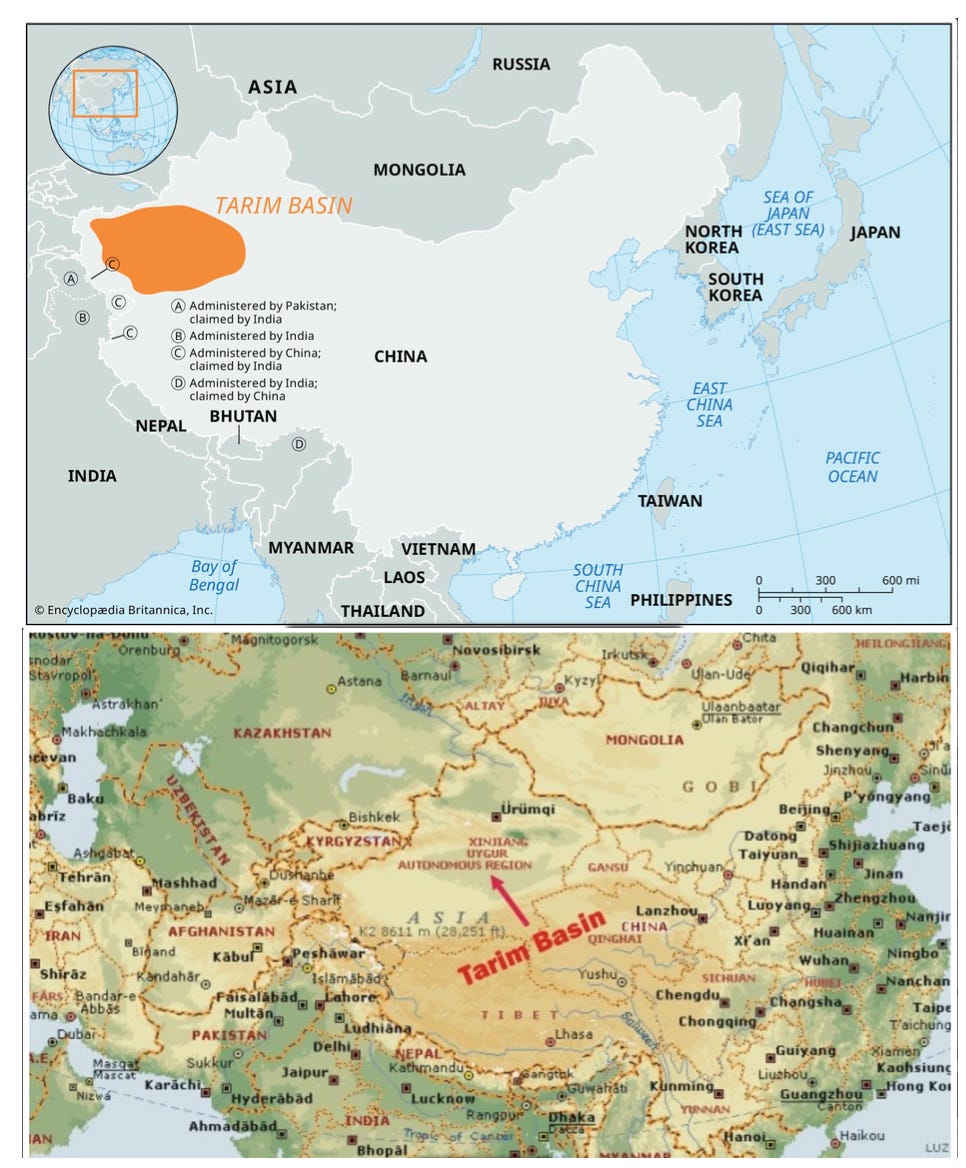
Let’s hop a few thousand miles over to the Tarim basin, and the East Asian side of the steppe nomad story.
Always bet team “floofy dog”

This is a Pekingese dog. They were specifically bred for Chinese nobility around 1400 years ago, to be tiny and floofy and cute and loving indoor dogs - as adults, they’re typically 5-15 pounds. Smaller ones were literally kept in the sleeves of nobles, and my favorite breed standard and care and feeding manual, written by a Qing empress, urges you to feed them throstle eggs and clarified leopard fat when ailing, and shark fins and antelope’s milk when well.
If you think of the distance between wolves and modern dogs, this is about as far as it gets - in domestication, in size and appearance, in physical capability, in personality and temperament, in what it eats, in how it lives, every possible dimension.
Everything is connected and there are no coincidences.
One of the more fun dynamics in Chinese history is how you have these incredibly militarily skilled and hardy tribes of steppe nomads right on their doorstep, wolves of the steppe, and you have the Chinese nobility, as effete and pampered and peak urban “floofy dog” as you can get, and they actually routinely interact with each other, with Chinese gentlemen-scholar nobles making the diplomatic trek (borne in lacquered boxes by teams of slaves) out into the steppe, to drink barbaric salted tea and eat half-raw meat in their (to the Chinese) impossibly stinking and loud and uncivilized tents / camps. Conn Iggulden does a great job portraying this in his (more “vibe and feel” than strict accuracy) books.
It’s very much “tiny floofy dog” surrounded by wolves, and yet the floofy dogs rarely get torn to shreds, and indeed, if you were going to bet on who’s winning societally at any randomly selected point in time, you should essentially always bet team floofy dog.
Peak military skills are fine and all, but have you tried having an empire of ~50M people you can tax and conscript from? Sometimes quantity has a quality all its own as the man said, and that definitely plays out in history.
Why does team floofy dog usually win? They’ve got the sheer population size to survive ups and downs, and have worked out a stable attractor in “civilized empire space” that is strong enough to keep coming back to. So even if one empire gets reaved or overthrown, the next will come up, find the historical attractor, and have the time and space over deep time to work out a solution that works. The Chinese were smart enough to eventually figure out a policy of subtly and carefully sowing dissent and bestowing tribute / favor in carefully tuned and rotating ways to keep the steppe nomads at each other’s throats at all times. It largely works, for hundreds of years at a stretch!
In fact, it is exactly the realization that the Chinese have been deliberately doing this for centuries that sets a fire in Genghis Khan’s heart, with the world-dominating results we all know about today.
But that is still in the future - for now, we are going back to Qin Shi Huang Di and the very birth / unification of China.
Modu Chanyu was the OG steppe khan
So Qin Shi Huang Di is the first emperor of China, the terra cotta warrior guy, who finally unifies it around 221BC, and has the first Great Wall built at the northern border between China and Mongolia (it’s not stone at this time, it’s rammed earth). This is a formidable undertaking that takes the equivalent in logistics of fielding a 100k strong army.
So his guys build the wall. But there’s a wrinkle - there are existing steppe nomads in the verdant grasslands of northern China, the Hsiung-nu / Xiongnu (“honnu”) and others, and they would much rather be there where it’s nice, than Outer Mongolia, where it’s cold and less verdant. Nevertheless, they get poked and prodded and herded by his armies (each 300k strong!) into the steppes of Outer Mongolia, and then the wall gets staffed with many tens of thousands of peasant soldiers to prevent anyone coming back.
That’s not good enough for old QSHD / 秦始皇帝 - he then has his top general lead ridiculous 300k and 200k sized armies in succession, many hundreds of miles into the Gobi desert, to try to reave the Xiongnu and eliminate them entirely as a threat. In a brobdingnagian example of satiric understatement, we are informed “In crossing the Gobi, [general] Meng Tian encountered grueling logistical problems, and his army sustained high casualties due to dehydration, disease, and desertion.”
Of course, the steppe nomads can see (and probably smell) armies that size coming from many days away, and they are, just like it says on the tin, “nomads,” so this doesn’t go well, because they just send their home camps a little farther out, then turn around and harry the armies to death. Multiple armies in the hundreds of thousands of soldiers are lost in these efforts.
This pattern has been repeated a few times throughout history in different geographies. Some clever pants leader gets the idea “you know, the army is just sitting around this year, maybe I should finally eliminate the steppe nomad threat” and sends their armies out into the steppe, who spoiler alert, never eliminate the steppe nomad threat (they usually get eliminated instead).
QSHD’s successor decides there has to be a better way, because while he has nigh infinite supplies of peasants/soldiers, it feels like if you keep losing 300k of them at a time, along with all their training, armor, weapons, livestock, and the food and logistics trains it took to get them out there, you might eventually run out.
He comes up with “the five baits,” which is basically “screw it, just send them a bunch of nice stuff and treasure and make sure they agree to be our friends and allies.” Certainly cheaper than throwing away a half million trained, kitted, and provisioned soldiers every few years! Basically, just for agreeing to be an ally and a token submission to the emperor, the Xiongnu get silk, gold, jewelry, weapons, food, and spices (and noble Chinese wives for the top guy). Not a bad deal!
As an aside, this is likely necessary. By pushing them outwards, past the confines of the Great Wall, they pushed them into an environment with lower carrying capacity. The steppe of outer Mongolia, and the adjacent Tarim Basin areas, are not a generous environment, and in drier years, which happens often enough to be problematic, won’t produce enough grass, and thereby food, for everyone to live, particularly when the Chinese empire tries to cut off trade with the steppe nomads, which they are prone to doing. So with no trade, the steppe nomads will try to get that food (and trade rights reinstated) from the civilized urban people near them, one way or another - either by raiding and taking it, or having it gifted in tribute.
So this leads directly to the first unified confederacy of steppe nomads. Modu Chanyu is the top guy in the Xiongnu, and gets all the tribute and wives and good stuff, and then is able to pass it out to whoever he likes. Obviously, lots of other formerly divided tribes take an interest in buddying up to the guy / tribe with the pipeline of riches. With his expanded peoples / armies, he can also conquer anyone else who doesn’t go along, and, along with the fact they were all recently kicked out of northern China into the harsher environment of outer Mongolia, which many are still disgruntled about, he unifies the steppe for the first time. And he does it right! He has administrators and writing and communication lines and reforms and trains the army so it operates like a holistic unit instead of a divided rabble of tribes.
For a time, both parties prosper - Modu Chanyu is living fat and high on the hog, trade is possible from the Tarim basin and beyond, the tribute is way cheaper than throwing away giant armies like used tissue paper, everyone’s happy.
But what if, you know, you soft and effete urban floof dogs gave us even MORE? Because we steppe nomads are as hard as wolves, and we’re doing you guys this great favor of guarding your frontier and all. And indeed, “Modu Chanyu waged three decades of victorious campaigns against the Han Empire, to extort ever greater sums of tribute, or against rival nomadic tribes, who were either subjected or expelled.”
And so, the fundamental China v Steppe dynamic was born!
Maybe 500 years later, the Xiongnu Khan sacks the Chinese capital, Luoyang, and kills the emperor and disunifies China. The Xianbei, steppe nomads and former vassals of the Xiongnu, end up unifying northern China and establish a sort of “mixed” nobility culture in some areas (the northern Wei), where you need to be good at calligraphy and Confucian classics and drinking tea but ALSO good at riding and archery. Which you know, baby steps! You guys are like halfway to Heinlein’s standard of manhood / leadership! Now just learn a lot of bullshit like “conning a ship” and “programming a computer,” whatever those mean, and you’re well on your way to manhood!2
From here on, China is under the steppe-nomad established northern Wei or in warring states periods before it unifies again under the Tang Dynasty (whose elites are part Xianbei and part Han), when China gets smarter and starts doing the whole “foment divison and discord” thing so that the steppe nomads don’t unify and start milking them again, which lasts through the Liao and Jin Dynasties, both steppe nomad founded (Khitan and Jurchen respectively, with the Jurchen partially steppe nomads and partially settled people), who keep the practice up, until finally Genghis Khan unifies the Mongols and they conquer both the Jin and later the Song dynasties, becoming the Yuan dynasty. So that’s, uh, more than a thousand years(!) of various flavors of steppe nomad establishing / leading the biggest unifying dynasties in China, and keeping the rest of the steppe nomads out in the steppe squabbling with each other via diplomacy.
And just as obviously, given the turnover, the “wolf to tiny floof dog” pipeline is doing its work all along, and establishing your empire with steppe nomads doesn’t keep it hard or immune to other steppe nomads doing the same thing to you 100-200 years or so later when you go soft (the times in between the dynasties were warring states times with no big unifier).
Back in Europe
Back in Europe, around the time of the grifter-founded Han Dynasty3 which rises after QSHD’s Qin dynasty falls a mere 3 emperors later, we have the Roman Republic turning into empire, China and Rome tentatively ‘meeting’ for the first time,4 and eventually the steppe nomad Yizhie / Tocharians taking over the various Silk Road Greek cities AtG founded all over the Middle East.
But Rome is big and keeps buffer kingdoms between them and any steppe nomads, and has a history of working tactics against them, so isn’t troubled overmuch, until they fall, which is (inevitably) due to steppe nomads and decayed state capacity.
Specifically, Western Rome basically falls because of Atilla the Hun, steppe nomad, and around a thousand years later, the Eastern Empire finally falls due to the Ottoman Turks, descendants of steppe nomads.
Atilla the hun - gentleman, scholar, feminist
Atilla and his huns live large in Western memory, because they are a steppe nomad people that punched above their weight, challenging (and ultimately toppling) Rome itself.
They were so puissant they received nearly 20 thousand pounds of gold as tribute over the years from the Roman empire!
So Atilla is usually called “the Scourge of God” or some similar self-congratulatory title, because he united a steppe nomad people into an empire and then scourged the Roman empire in the early 400’s AD, extracting tribute and ultimately leading to its fall by driving hundreds of thousands of Goth and other refugees into the empire (who eventually overthrew it a few years later, after being rapaciously milked and / or randomly sold into slavery by corrupt Roman administrators), but let’s have a little fun here.
So for one, he personally knew probably 4-5 languages, and had his people transacting business and diplomacy in that many on his behalf. Alone among barbarian armies facing Rome, he knew how to sucessfully siege cities, and manage supply lines and logistics sufficient to campaign in winter.
For another, he had a great eye for talent, and like most world-conquering emperors, he got there by recognizing and rewarding talent and skill, and putting it exactly where it would benefit his aims most. This is explicitly against the model nearly all elites follow throughout all of history, which is to cram whatever random dumbass family members you have anywhere you can fit them, so your family unit as a whole can pump the most wealth and status from whatever extractive engine you’ve managed to straddle. Needless to say, this isn’t a great recipe for long term success (indeed, it basically nukes nearly every empire throughout history, is THE fundamental problem with monarchy and generational wealth, and has only been ameliorated in a handful of empires that create meritocratic systems to identify and elevate non family talent at scale).
As an example, Viminacium, a formerly wealthy Roman citizen was found in Atilla’s service, dressed in the Scythian style and speaking perfect Greek. He was originally taken in a raid, but his skills led to his freedom, a Hun wife, and admission into the ranks of Atilla’s comitatus. When asked why he was aligning himself with Atilla when he could have gone back to Rome, he points out that Atilla administers the law fairly and impartially (another steppe nomad v “civilization” trend), unlike Rome, so lol, touché. Atilla’s Roman secretary Orestes was from an aristocratic family in Pannonia (modern day Hungary) and his son eventually ends up becoming the last Roman emperor, through Orestes’ direct efforts, so also a fair amount of talent there.
And as to feminist? Surprisingly, steppe nomads overall are much more feminist than the settled agricultural societies that so fear them. In many of them, some women fight alongside men, women occasionally lead, and women definitely administer empires, with all the power that entails. Alexander the Great encounters an Amazon queen (Thalestris), who leads hundreds of female Scythian warriors. It is likely that the Greek legends about the race of Amazons are based on the real-life Sarmatian (the Scythian successor people) women warriors. So do Genghis Khan’s Mongols, they subjugate a steppe / forest people led by a female warrior queen. The wives of the Mongol empire administered so much that they became true centers of power, to the degree that it ended up being them politically infighting and struggling over which of their sons would be the next Great Khan after Ogedai, Genghis’ named heir, died.
But one more fun one, on that front, for Atilla specifically:
“The empress Honoria, the older sister of Valentinian, was forced into a marriage with a boring elderly senator after she was allegedly caught in a scandalous sexual liaison with her chamberlain. She sent her signet ring and a message to Attila, imploring him to rescue her.”
He interpeted it as a marriage proposal, immediately accepted, and demanded Gaul and Spain as his dowry, then made war when everyone tried to backpedal. Because what gentleman ignores a plea for rescue from a damsel in distress??
Also, completely reasonable of him to expect high born princesses in marriage from allies, for all that it horrified the Romans - the Chinese have been doing that for hundreds of years, it happens in the Middle East, it’s been happening for Atilla himself already, it’s very much the done thing. So accepting it and then going to rescue her was a completely reasonable move on his part! Because again, what gentleman or feminist ignores a literal call to action from a damsel in distress?
So there you go - that’s Atilla the Hun, scholar, gentleman, feminist. Historically everyone admires and wants to claim descent from Atilla! Germans, Hungarians, Bavarians, the Habsburgs(!), and even the Ottoman sultans. So you know, obviously doing something right, “Scourge of God” notwithstanding.
Atilla dies early, in his forties, by inadvertently drinking himself to death, so his empire building is cut prematurely short (celebrating his most recent marriage to a particularly hot princess, Ildico, offered by one of the peoples he conquered, once again, totally standard practice).
Death by intemperance is one of the more common means of dying for steppe nomads. It got at least 2 of Genghis Khan’s sons, including son Tolui, son and named successor Ogedai, grandson Guyuk, great grandson Abagha, numerous Mongol princes in the family tree from there, non-Mongol Atilla, and many more. Genghis Khan anticipated this, and wrote into his laws that a man shouldn’t get sloppy drunk more than 3 times a month, and ideally zero, “but where shall we find such a man?” Obviously that particular law was honored more in the breach than the observance, so where shall we find such a man, indeed.
We’re to about 400-500AD here, and there’s a lot more on the steppe nomad front, like the Magyars, who eventually take over Hungary, and the Rus, who are Swedes who came down to trade, got rich and then began emulating steppe nomad royalty and court manners, and who go on to fight the steppe nomad Pechenegs (vikings vs steppe nomads!!) and go on to found Kiev.
The next important thing that happens in this period of history is the Turks, who migrate from the Asian region and get big slightly after this, and dominate European and central steppe military capability for 500-600 years or so.
Turks
So remember the Chinese strategy of keeping a patchwork of tribes squabbling with each other? After Atilla puts the fear of god into Rome and Constantinople, particularly the surviving Byzantine / Eastern half of the empire, they do much the same.
“Foremost, successive emperors repeatedly signed and broke a bewildering web of alliances with the Avars, Khazars, Magyars, Pechenegs, and Cumans. They thereby saved Constantinople from facing a mighty nomadic confederacy under a new Scourge of God.”
But there’s no permanent solution to anything in the affairs of men, so they’re still ultimately conquered and toppled by another steppe nomad people - the Turks.
So the Turks are interesting. They start off in the Mongolia and Tarim basin areas, and overthrow the Rouran (another steppe nomad people) and scuffle with the Tang Chinese empire, and then they spread widely and split into various flavors of Turks in their respective geographies (Seljuk, Gok, Oghuz, Ottoman, etc), some of which settle down and become agricultural empires.
They invent better saddles and, crucially, better stirrups. The tech upgrade lets them be much better horse archers and heavy cavalry, and Turkish horse archers come to dominate warfare in Europe and the Middle East basically from 600 to 1200, including pwning the Byzantine empire in the battle of Manzikert, the foothold that Turks need to flood into the West.
“they were superb metallurgists, manufacturing superior helmets, chain or lamellar armor, and edged weapons. The Turks, experts in a pastoral way of life, bred the finest of Eurasian horses for endurance and speed. Henceforth, Turkish horse archers were seldom defeated by armies of the urban, literate civilizations until the advent of handheld firearms.”
Now we finally get to turn to the steppe nomad big bad in the 1200’s, the Mongols, which prior to Genghis Khan were a carefully Chinese-tuned patchwork of ever-warring small tribes.
Starving and abandoned in an icy void
So imagine you’re born to a particularly small, poor, and irrelevant tribe in this patchwork, located up higher at the edge of the steppe where the grazing is worse and everything is colder. You’re born to a poor tribe but the most prosperous family within that tribe, your dad is the khan of the tribe, and has two wives and 7 kids. BUT then your dad dies (poisoned by Tatar enemies), and life is hard enough that the new leader of your tribe casts out the two women and seven children of your family, because it’s a lean year and ain’t nobody got time or food for that many nonproductive mouths! (It was also probably partly political too.) Oh also, they take all your stuff - your sheep, your horses, your tents, your weapons. It’s all wasted on people who are going to die anyways.
So that’s your starting point. You’re abandoned as a child in the freezing void of Outer Mongolia along with 6 other kids and 2 women, with no tools or weapons or animals between you, not even a tent. Your mission is to unify the centuries-of-warring tribes into a nation and conquer the entire known world, and this is your starting point. Godspeed, and good luck!
The fact that Temujin (not Genghis yet) and his siblings survived at all is a real tribute to his moms’ and family’s grit and determination in the face of adversity (as well as his own). This is also famously thought to be part of the origins of his contempt for tribal orientation and concerns and his willingness to elevate people to leadership and responsibility without regard to their backgrounds.
But anyways, obviously he survives, and even survives being enslaved for several years and then manhunted-to-death by his former tribe after that inauspicious starting point (years later the tribe sends some men back to see if they survived, who are met with a hail of arrows from Temujin and his brothers, then they kidnap and enslave Temujin), and comes back as a nobody from nowhere at the absolute bottom of the status ladder to unify the many tribes of Mongolia into a nation.
From there, it’s the usual story - stunning feats of military acumen, conquering the entire known world, riches beyond belief or counting, systematically exterminating nests of assassins like cockroaches, all the usual stuff.
As one of the historians puts it, it’s as though America was founded by an illiterate slaves, who by the sheer force of personality, charisma, and determination, liberates America from foreign rule, unites the people, creates an alphabet and constitution, establishes universal religious freedom, invents a new form of warfare, and then conquers and governs over everything from Canada to Brazil.
Interestingly, literally nobody knew any of the details of Genghis’ childhood and rise until recently. The Soviets, who had taken over outer Mongolia, harshly and repeatedly suppressed all research into Genghis Khan’s life, including suppressing anything celebrating him or Mongolian culture in general. Even a postal stamp in the sixties got cracked down on. The Secret History of the Mongols, a book written near Genghis’ lifetime in Chinese script used orthographically to indicate old Mongolian pronunciation, was just a legend that had not been translated at all - it wouldn’t be translated until the 1940’s, and not put into English until the 80’s, with the authoritative English translation published only in 2003!
This goes some way towards explaining the recent spate of books on Genghis and the Mongols, there’s a primary and authoritative new information source for English speaking scholars, and that’s why everyone is excited and writing secondary books about the topic. As an aside, it’s certainly fun to read all these tweedy academics fanboying the greatest conqueror in history, their love and admiration for the man definitely peeks through their writing. For all that we are tiny urban floof dogs, we can dream of being wolves!
Okay, so Genghis unifies the tribes, conquers the Xi Xia / Tanguts (a sort of outer-Chinese urban people who aren’t considered proper Chinese by the bigger Jin and Song empires), then conquers the 50M strong Jin dynasty, including their capital Yenking / Zhongdu / Beijing, and then retires to Mongolia, rich and replete, to enjoy the good life.
I’m eliding all the fun parts here. The impossibly larger armies they beat with clever and difficult to execute tactics, accidentally flooding themselves while trying to flood a sieged capital city, 50k young maidens dressed in white plummeting to their doom from the city walls rather than submitting to Mongol ravaging, clever tactics to break through an extremely fortified wall in the Chabchiyal cliff pass that is the only way into the riches of China, and much more. Read any of the books I mentioned above for the more detailed and fun stories.
But anyways, he came, he conquered, he got mind-boggling amounts of tribute, and now he’s gone back to Mongolia to enjoy the good life.
“Being rich” in steppe nomad terms
This is another interesting thing. What use does a steppe nomad have for gold, palaces, fancy furniture, a thousand outfits or pairs of shoes, or the other hallmarks of urban wealth?
Genghis Khan subjugates the mightiest and richest empires in the world, gets staggering amounts of tribute, much of which recurs annually, but what does that mean? For a nomadic people, wealth has a different meaning than for urban people. For one thing, whatever “stuff” you bring into your life then needs to be carted around forever, and so adds direct friction to your lifestyle (as any modern day nomads can sympathize with). Genghis and the Mongols had literal cartloads of gold laying around, which were only instrumentally useful because other settled civilizations and traders valued it. He himself always lived simply, although various descendants go on to become urban elites.
The main thing that the Mongols valued from their tribute for themselves was silk, better armor, and better steel and weapons. Also people - women of many races as wives, of course, as well as settled people with skills (doctors, musicians, engineers, etc), lots of slaves, and additional soldiers to shore up their numbers (because they always take losses while conquering, and are only ~1M people, if they didn’t keep shoring up soldiers their army would dwindle to nothing).
So the main change post-wealth for the Mongol day to day is basically more wives and slaves, better clothes and textiles, and better armor and steel implements and weapons. On that front, the Mongol women in particular got upgrades in life - from having to do much of the day to day food prep and textiles and child rearing and other “women’s work,” to having slaves do most of that, as well as getting better wardrobes, more jewelry, and so on. I wonder how many modern women might sign up for a multiple wives scheme if their lives got way easier and richer? You know what they say, happy wives, happy lives! And Genghis ends up with ~160 wives, and is the father of his nation and responsible for keeping all the 1M Mongols flush and happy, so you know, probably a good idea to keep the silks and slaves coming.
Anyways, he’s retired to the steppe, rich and replete, and is enjoying life. But then, inevitably, a call to action occurs.
An Islamic governor’s no good very bad decision
Part of what Genghis has done after conquering and getting rich is sending out teams of diplomats and merchants to establish trade and relations with far flung cities.
This is another big “steppe nomad in general” thing. They love trade! They live by it! Remember all that comitatus stuff? That shit was expensive! To be constantly gifting tens, hundreds, thousands of warriors good enough stuff they’ll literally die for you? Takes a lot of plunder, or a lot of trade, or both. Genghis’ comitatus is ten thousand warriors, by the way, or 10% of their armed forces, his own personal tuman. So anywhere steppe nomads win or set up empires, they generally encourage trade. And one of the continual “steppe vs settled” dynamics is the urban people expanding into steppe territory, and cutting off trade. Most steppe raids, incursions, or wars with settled cities or empires was more about this than plunder! Even the much feared Huns generally had really solid reasons for every military sortie they engaged in against Rome or other settled people. But I digress.
So these Mongol diplomats typically come with the standard “world beating conqueror” messages familiar to anyone who’s ever played the Civilization franchise, that typically go something like “our great leader, emperor of an impossibly large and rich and puissant empire, bids you greetings and good tidings! If you will simply acknowledge his greatness, we would love to open peaceful relations and trade.”
The governor of Otrar, a city in the Khwarazem empire, isn’t having any of this. He kills the diplomats and traders and takes their trade goods. Genghis is nothing if not reasonable, so he complains to the Sultan / Shah directly, and says “hey, your guy over there is being a dick, I’m sure you didn’t know about or condone this, so please pay us for the stuff he stole and punish him.” The Sultan isn’t about to punish his uncle, who was probably acting on his behalf, so he then kills these Mongol envoys, and brands or mutilates the remaining one’s faces and sends them back.
This is a particularly unpropitious thing to do in Mongol culture - the head is generally regarded as sacred and the seat of the soul, so anything that involves branding or altering it, or desecrating it after death, is maximally offensive and a source of great umbrage.
As Juvaini puts it “the whirlwind of anger cast dust into the eyes of patience and clemency while the fire of wrath flared up with such a flame that it drove the water from his eyes and could be quenched only by the shedding of blood.”
We would portray this in modern times as Genghis receiving an urgent note on paper whilst in an important meeting and then crumpling the note in his fist and staring fixedly into the distance, so you know, game set and match to Juvaini’s portrayal.
The Sultan / Shah of Khwarazem, the nephew of the governor of Otrar, has gigantic armies of 200k - 400k and is the local unstoppable big bad of a mighty and puissant empire spanning a good chunk of Eurasia, from the Caspian sea to the eastern borders of the Tarim basin.
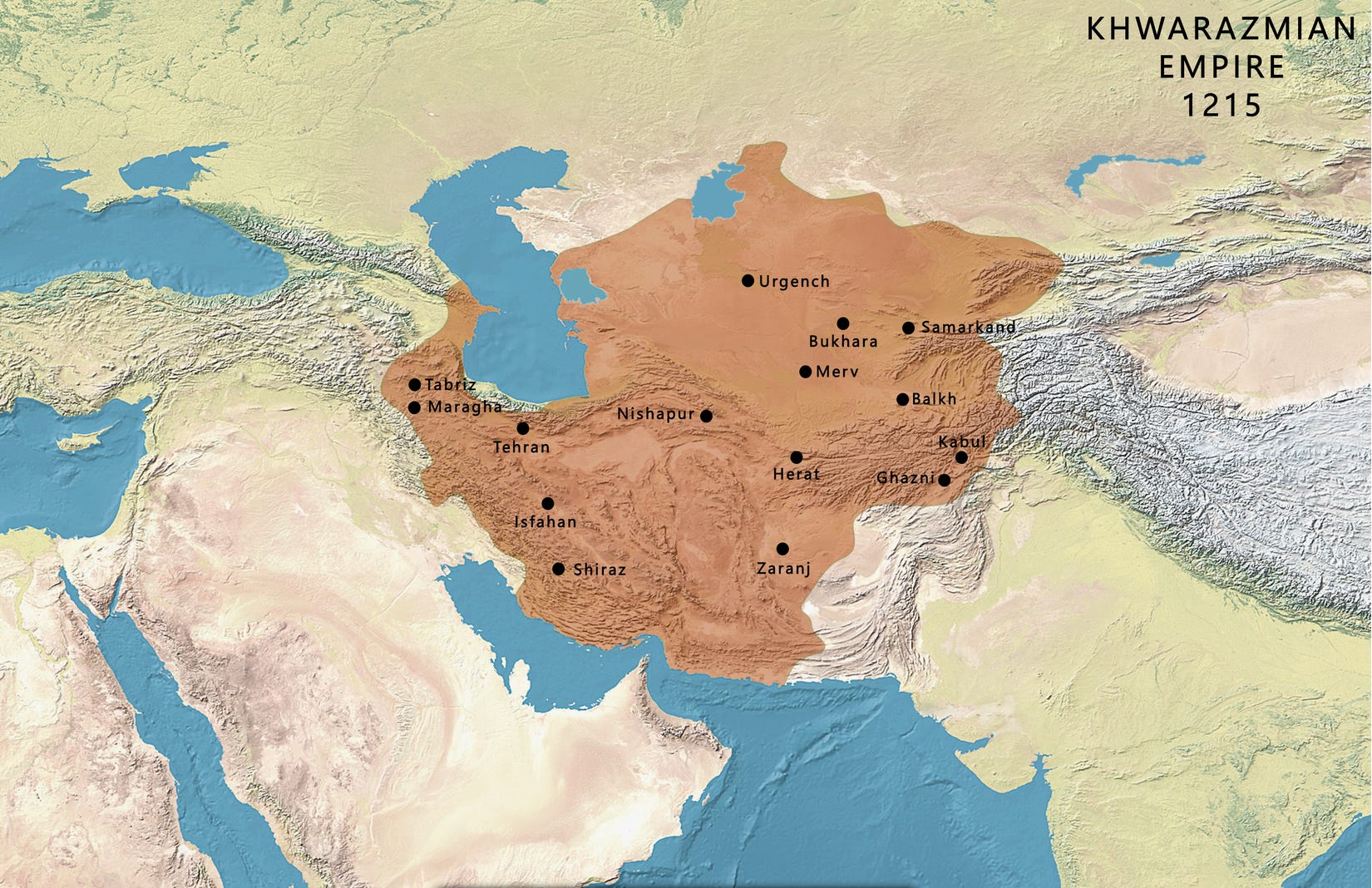
So the governor’s reaction, although definitely a dick move, is relatively reasonable by his standards. Here’s some complete unknowns coming in to tell you they represent some far off king you’ve never heard of, and he wants you to acknowledge and trade with him, lest you be scourged by his mighty armies. Pffft! Get lost, we’ve got huge armies and impossible riches right here, we don’t need any of what you’re selling. And given the Sultan / Shah apparently felt the same, obviously he’s aligned with the overall vibe.
Well, it turns out to be a bad idea, because they’ve pissed Genghis off, and now he’s going to come out of retirement to roflstomp the Middle East and eventually a good chunk of the European world, right up to Hungary.
And so it goes!
As one sign of how quickly the Mongols could move, this is a particularly complex campaign that requires a good deal of planning to pull off. But Genghis does all the planning, musters his army, and teleports them ~3,000 miles from Karakorum to the Jaxartes river on the Shah’s border before the Shah is even able to mobilize his own ponderous army. From the Shah’s point of view, he executes some upstart diplomats, starts mustering his army, and before he can even get that done, the opposing army is there, on his doorstep already.
The Mongols come in, siege Otrar, turn around and destroy the Shah’s much-larger armies, siege and conquer and destroy various cities, and eventually subjugate the entire Khwarizmian empire, showing them what REAL god-kinging is all about. Genghis even has rivers diverted to entirely obliterate the birth places of the Shah and his family, which I suppose is a globe-straddling god-emperor wolf’s way of marking his territory and showing contempt for his enemies.
Once again, leaving all the fun parts out - sieging Otrar, fighting war elephants for the first time, having to sacrifice 5k Mongols as a rearguard to prevent some of the Otrar forces flanking and attacking the Mongols from the back while they destroy the Shah’s much larger army, harrying the Shah and his sons for months and hundreds of miles as they continually flee until the Shah finally dies on a tiny desert island in the Caspian sea, and much more.
They also siege and systematically level the infamous Order of Assassin’s Alamut castle stronghold in the mountains of Iran, probably because the Shah or one of the Khwarazem royals paid for an unsuccessful assassin’s contract on Genghis’ head, which remains unsuccessful because he goes and kills them all and levels their fortress. You can just do things, or so they say in our debased and fallen (and entirely steppe-nomadless) modern times. Famously, not even Saladin could take on the assassins.
Genghis’ descendants (notably Hulegu and Batu) then go on to conquer more of this part of the world including the Persian empire and much of Eastern Europe, much like other descendants extend his Jin dynasty subjugation to the Song dynasty in the south, eventually conquering and unifying all of China, creating the Yuan dynasty.
“Whether measured by the total number of people defeated, the sum of the countries annexed, or by the total area occupied, Genghis Khan conquered more than twice as much as any man in history.”
Mongols did line up against (and completely obliterate) several armies-worth of the cream of Christian knighthood, by the way. So heavily armored knights on giant horses is no answer (as Crécy and Agincourt show the Europeans 100 and 200 years later), for all that it was the dominant warfare modality in Europe for so many years.
Ultimately the Mongols conquered all of Eastern Europe and intruded as far as the Austria-Hungary region. They largely left off because the Europeans were so poor relative to the Middle Eastern and Chinese cities they were hardly worth conquering, and the steppe runs out past Hungary, so it was becoming more trouble than it was worth.
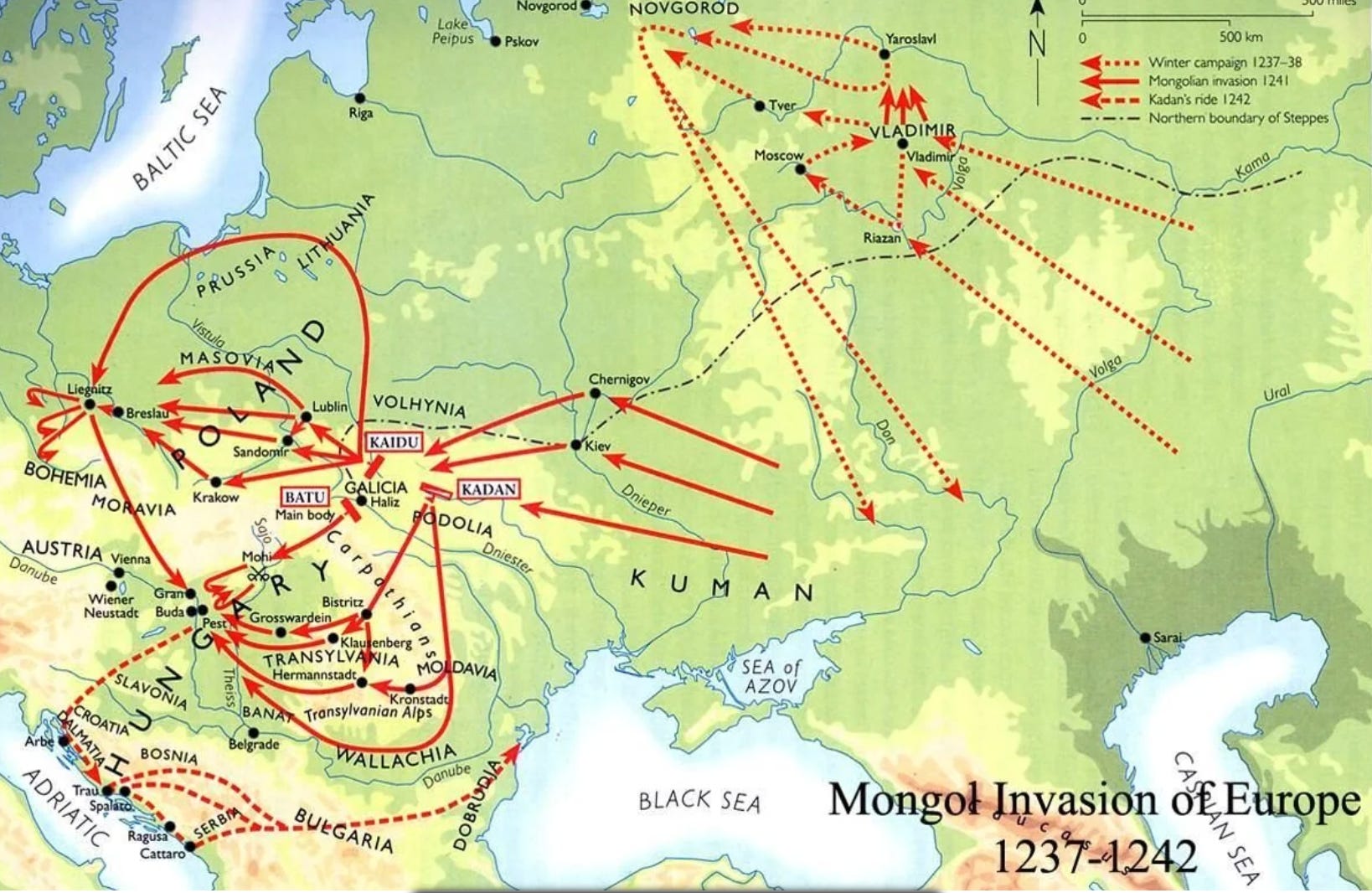
“European knighthood never recovered from the blow of losing nearly one hundred thousand soldiers in Hungary and Poland, what the Europeans mourned as ‘the flower’ of their knighthood and aristocracy. Walled cities and heavily armored knights were finished, and in the smoke and gunpowder of that Easter season of 1241, the Mongol triumph portended the coming total destruction of European feudalism and the Middle Ages.”
What it means to be conquered by the Mongols
It was actually a pretty great deal!
The Pax Mongolica ensured that nobody wasted resources and efforts on militaries and wars (any word of any force of soldiers moving anywhere in the empire would have 10,000 / a tuman of Mongol soldiers show up quickly) and enjoyed widespread peace and trade across the huge region that the Mongolian Empire covered. You know what economists say, it’s either guns or butter, and when you can’t make any guns, I guess that means you become rich in butter.
If you survived the conquering, generally your taxes went down, you were free to practice your religion no matter what it was, no minorities got pogrommed, trade and prosperity goes up, various foodstuffs and technologies transfer across the region, the enforcement of the law is more even and impartial, and you get plugged into a Eurasia-spanning trade network continually pipelining exotic and valuable things back and forth.
“In nearly every country touched by the Mongols, the initial destruction and shock of conquest by an unknown and barbaric tribe yielded quickly to an unprecendented rise in cultural communication, expanded trade, and improved civilization.”
This is one of the most interesting things about Genghis Khan. I’ve written about “making” versus “taking” before. He wasn’t a “maker” by most definitions. His primary skillset revolved around destroying armies, cities, and empires, and he was the best in the world at that, arguably the best in all of history. And yet, unlike most other steppe conquerors, he didn’t just take booty and run back to the steppe to enjoy it, leaving urban destruction in his wake. He twigged onto the basic dynamic and flaw behind doing this really early - of what use is taking a year or three to siege and conquer one city, if the rest of the empire is just going to raise more soldiers and repopulate that city as soon as you turn around? It’s a self-perpetuating threat at your back, and the Chinese had already proved that they are more than adept enough to disunify the steppe people and keep them internally warring. The nation that he’d unified and created would surely decay and disappear, and then what was all of the work even FOR? A bunch of physical stuff he didn’t even want or value that highly? Cartloads of gold? Of what use has a Mongol for cartloads of gold? It won’t make weapons, you can’t eat it, or feed sheep or cows or horses with it. No, if your work’s primary threat is an empire, the only solution is creating an empire yourself, to preserve the work and your nation and people.
And so:
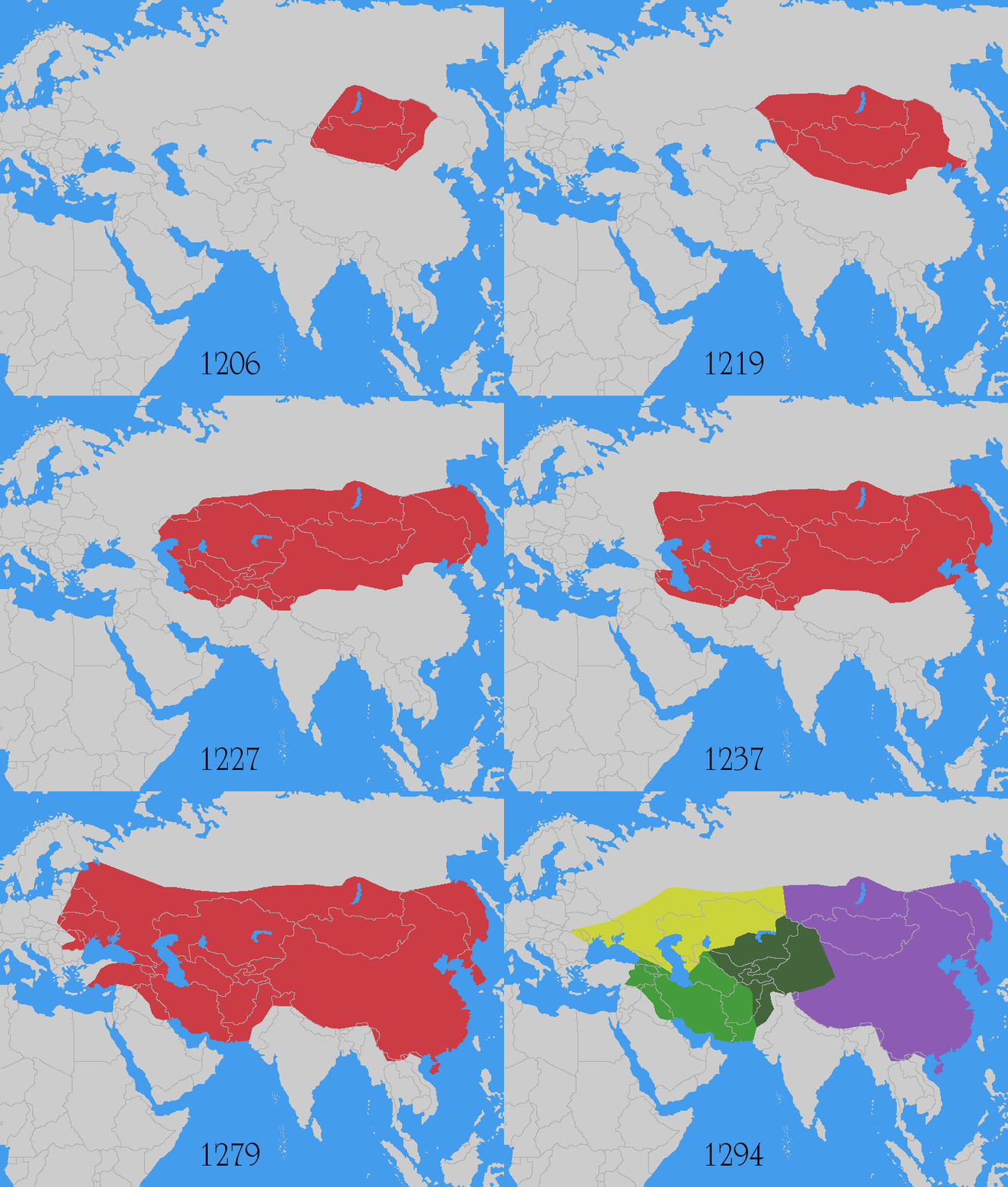
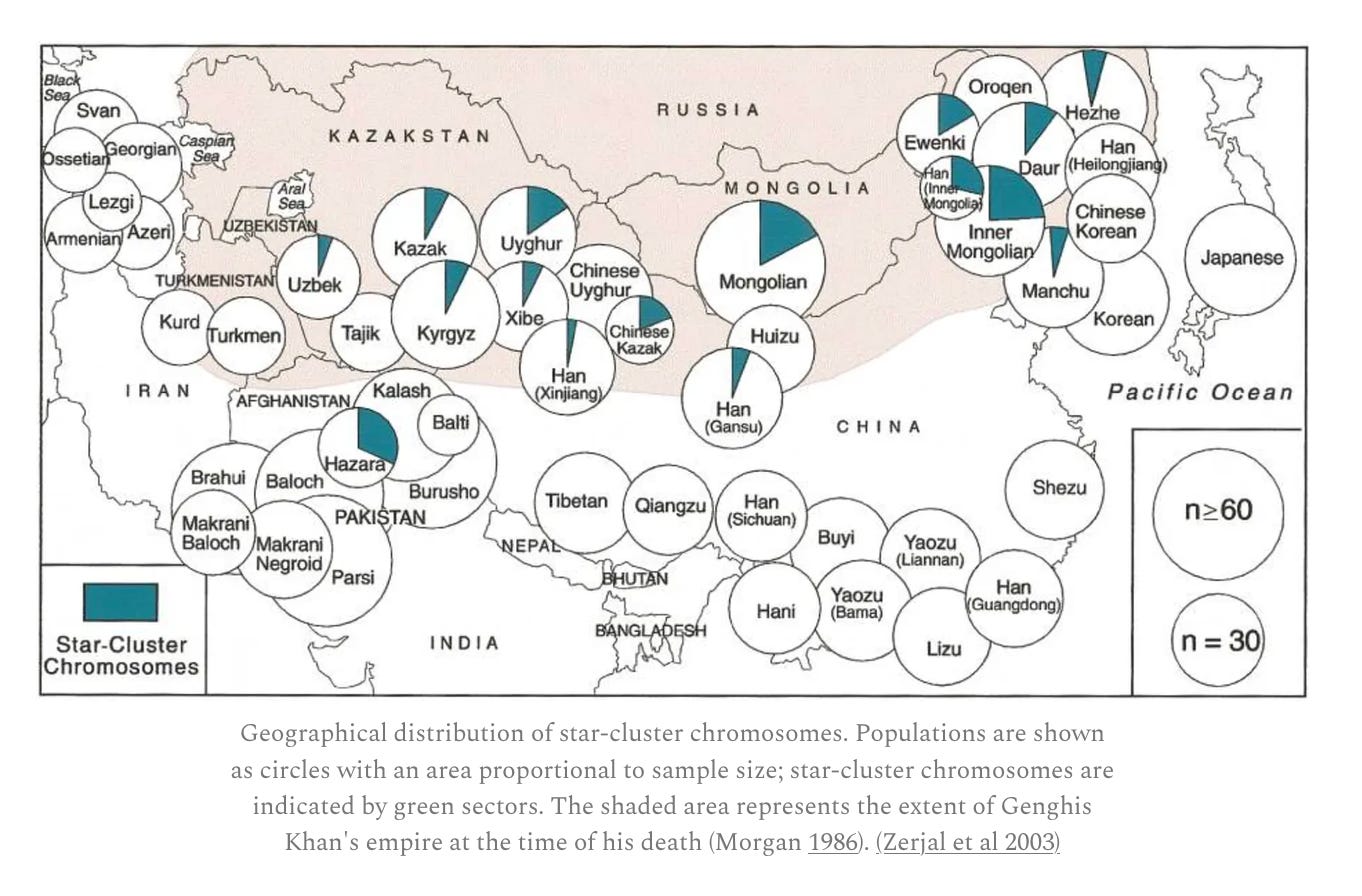
He unified the Mongols into one people and country, he created a bigger empire than anyone before or since, he encouraged and established trade and technology flows across all of Eurasia, he administered the law impartially and fairly, he was the most religiously tolerant leaders at his scale ever, and living under the Mongols was generally a better deal for the people of an empire than under their own elites, because those elites would consider themselves above the law and have more extractive taxes and less rights for their people, as well as constantly pushing them into a bunch of pointless religious wars. He left such an indelible mark on the societies of the world that he left numerous descendants across all of Eurasia to this very day.
One last little lagniappe that Genghis left for Western civilization:
“In the twentieth century, Arab politicians even assured their followers that Muslims would have invented the atomic bomb before the Americans if only the Mongols had not burned the Arabs’ magnificent libraries and leveled their cities.”
Lol. Thanks GK, you da real MVP!
So yes, Baghdad, and the Islamic Ilkhanate area in general, was indeed the world’s center of learning and scholarship at the time, and the famous libraries of Bagdhad did burn when conquered by the Mongols, and it was likely a greater loss than the Library of Alexandria burning. A great tragedy indeed, but c’mon guys, that doesn’t mean you speedrun nukes before Oppehnheimer and Szilard and von Neumann and the unique concentration of genius and wealth and state capacity and motivation that led to the Manhattan Project succeeding when it did.
But all told, not a bad legacy for anyone, and certainly a better record even on the “human flourishing” metric than many conquerors and kings.
So SURE the Mongols killed something like 10% of the entire world’s population at the time, and if anyone deserves to to be called the “Scourge of God,” it’s probably Genghis (who did indeed point to his conquests as signs of god’s favor). But for the people remaining in the empire, everyone got way better off for several generations at least, AND those 10% weren’t exactly likely to die a peaceful death in old age in the counterfactual scenario, because the alternative was warring and squabbling with lesser enemies that will still attrite your forces and peoples, continually getting into religious wars, and whose elites will be more extractive after any conquering anyways.
So maybe a case of not being able to make omelettes without breaking a few eggs, who knows?
The post Genghis world
So you’ve got this impossibly rich and well-running empire, what do you do now?
“Succession” is THE killer of empires, after all, because what always happens is a bunch of much-less-talented also-ran kids and grandkids all get into their heads that they should be the next great big bad, so screw you Uncle Jimmy and cousin Timmy, and definitely screw Aunt Caroline, she shouldn’t be in charge of a kebab shop, much less an empire! Give me that crown! And so it always goes, with the descendants descending into internecine squabbling, civil war, and division and mistrust.
After Genghis and his named heir Ogedai’s death, the empire splits up into 4 main regions, with descendants from different branches of the family taking over and leading each region.
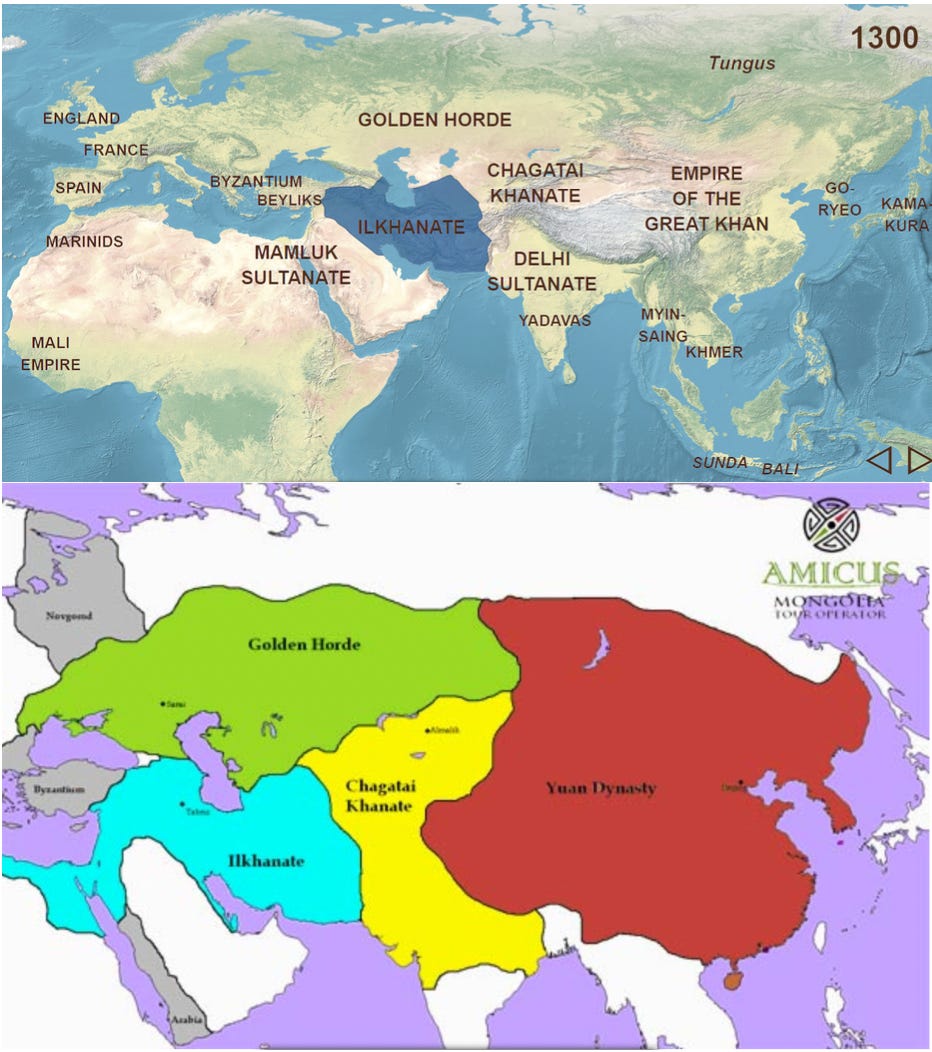
Interestingly, the Golden Family, as they’re known, have a system worked out where each one is basically a shareholder in the empire overall, with each one entitled to and getting various goods from across the empire. So this would be something like being entitled to a certain amount of cattle and sheep from the steppe, and sables and other furs from Eastern Europe, silks and rice and rice wine from China, and wine and Damascus steel from the Middle East. So just to accomplish that division of goods, they need robust trade and communication networks, even if they’ve hunkered down in their respective fiefs to keep Uncle Jimmy’s and Aunt Caroline’s meddlings away.
This works for about a hundred years, when the Black Death erupts onto the scene like a medieval kool-aid man / grim reaper hybrid and disrupts everything, leading to 20-33% of people across the entire empire dying, massive civil and urban disunion and turmoil, and the communication and trade lines breaking up. Whoops.
As a fun aside, one of the things Christopher Columbus was pitching was finding far-off Cathay, the “Xanadu of Kublai Khan” as spoken of in Marco Polo’s famous missive, because they assumed that famously tolerant and open-to-foreigners-and-trade empire was still rolling along and Europe just hadn’t heard anything about them because the Black Death had disrupted trade and communication. It was neither tolerant nor open to Europeans and other outsiders any more, the Ming explicitly turned strongly inward, which ultimately leads to the century of humiliation, but thems the breaks. Hardly matters when he discovers the Americas instead.
The Mongols and Genghis in general were extremely well regarded by Europe at the time of Chaucer and later in the Renaissance (and at the time of Colombus), and it was only when Voltaire started using them as a foil to complain about the French king and nobility that they began their slide in public opinion towards “a bunch of godless, bloodthirsty heathens,” which was the Enlightenment-and-later consensus on them, to the extent that Down’s syndrome kids were known as “Mongoloids” within living memory, literally like they are another race entirely, ie surprise Mongols showing up as throwbacks due to the Mongol rapine and bloodline introgression into fine European stock so long ago. Lol, and that’s “doctoring” for you, isn’t it?
Anyways, direct descendants of Genghis’ line largely lose their mojo after the black death kills everybody, and although some of them hold on clear through 1944(!) in various tiny principalities, the heyday of the Mongol empire / unification only lasts around 100 years.
We’re approaching the tail end of the steppe nomad story, so let’s just briefly hit two more high points.
Tamerlane’s dinner party advice
Tamerlane / Timur the Lame is briefly worth a mention because he conquers a lot of people after the Black Death and subsequent rebound, with the explicit end of restoring the Mongol empire, ultimately the greatest and most peaceful empire throughout history, and he does it in particularly sadistic and bloodthirsty ways.
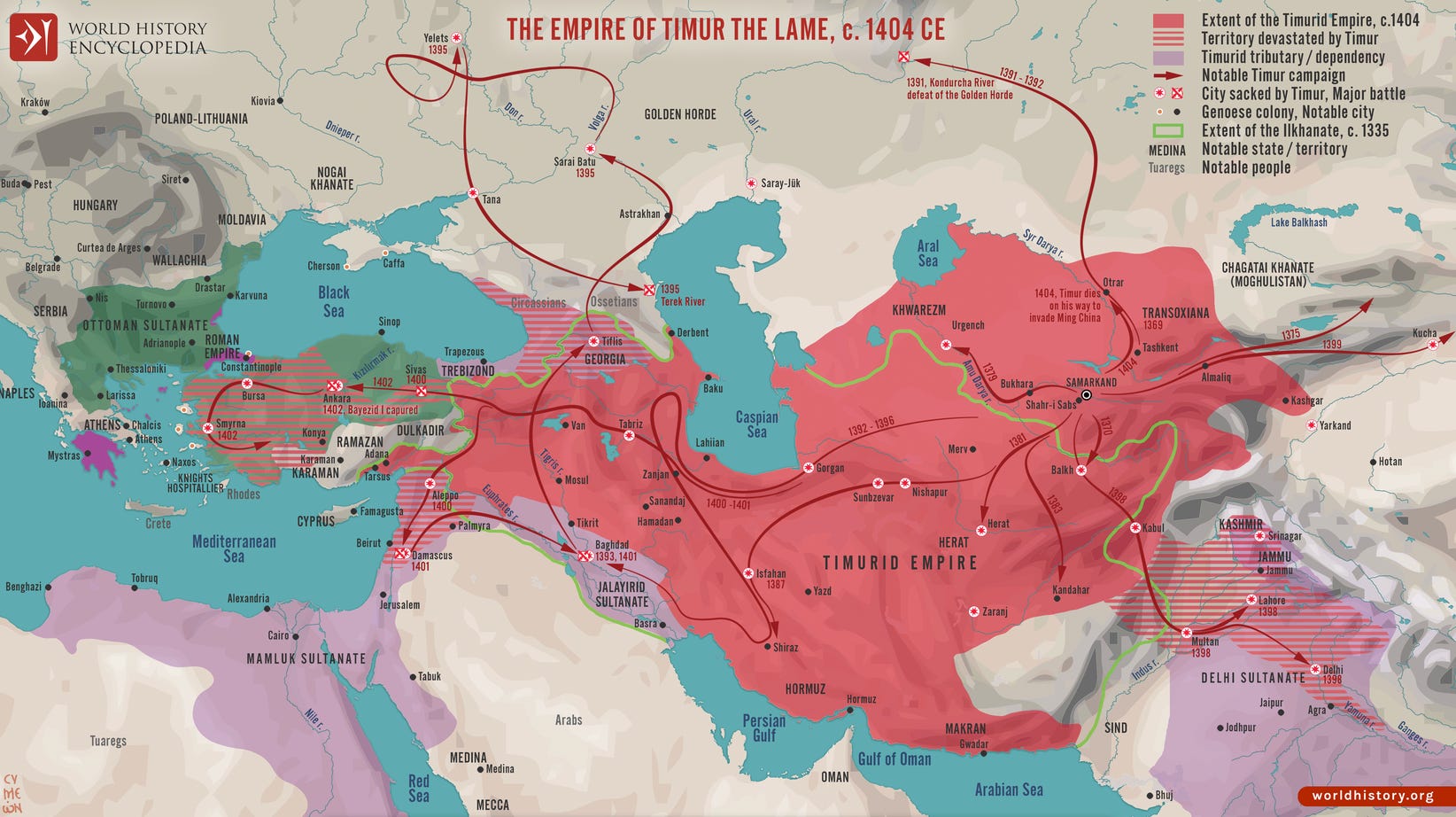
Mongols were pretty progressive, at least for a people that killed 10% of the world’s population. They didn’t believe in torture, unlike many of the settled societies they conquered, and did away with various punishments like torture, branding, cutting off limbs, tattoing criminal’s faces and necks, and more in the places they ruled. Largely, Genghis truly did seem to scourge cities and kill their inhabitants as a genuine communication and propaganda effort, because he believed it would ultimately save Mongol lives and make his conquering easier by encouraging future surrender, and this incidentally ultimately saved urban lives as well.
So the infamous (and likely apocryphal) “3 tent” system: the white tent goes up, and that means you can surrender now and everything will be fine, your leaders get to keep leading, and they’ll just have to pay some tribute. The red tent goes up next, and means all your leaders and soldiers and men will be killed, but your women and children spared (but enslaved). Finally, if the black tent goes up, everyone in the city is going to die, women and children included. I’d note that the bare reputation of completely exterminating a nearby city is probably at least as effective as the literal tents, if they were apocryphal, and on the "white tent” side, he did nearly always offer submission and tribute as an option (not to Otrar though, don’t piss off a steppe wolf god king).
So the handful of times Genghis black-tented / killed everyone, it was generally a genuine attempt “pour encourager les autres,” to make future cities more eager and willing to surrender immediately. And it worked! Cities would generally start immediately rolling over after the Mongols kill everyone in a holdout city, to their great benefit. It’s also a stirring testament to the overweening greed and general dickery of the various elites, with how often they would refuse submission, literally risking every inhabitant of the city’s lives just to get out of paying some tribute, but that’s royalty everywhere for you, isn’t it?
Tamerlane is another kettle of fish. He publically tortures enemies, piles up pyramids of skulls outside conquered cities, and gets up to various hijinks, like harnessing a conquered sultan like an animal to pull his royal chariot, exhibiting enemies in cages, or forcing conquered leaders to watch as his wives and daughters “served Timur naked at dinner, and in some reports, satisfied his sexual demands.” OH, it’s one of those dinner parties, lol.
This actually contributes to the decline of Mongol reputation. As a Mongol explicitly trying to restore the Mongol empire, and marrying into Genghis’ lines as he conquers the world, this is perhaps not surprising, but a lot of these sorts of sadistic hijinks get retroactively credited to Genghis Khan’s Mongols, too.
Although, just like Genghis, his empire doesn’t remain unified past his death, Tamerlane’s 3rd-g-grandson (and Genghis Khan’s 13th-g-grandson) Babur DID establish the Moghul empire in India in the 1520’s, which reaches an artistic and cultural peak in the early 1600’s (the Taj Mahal guy was Mughal), and a geographic peak in the early 1700’s covering most of India, and goes on to reign until 1857(!), when the British displace them.
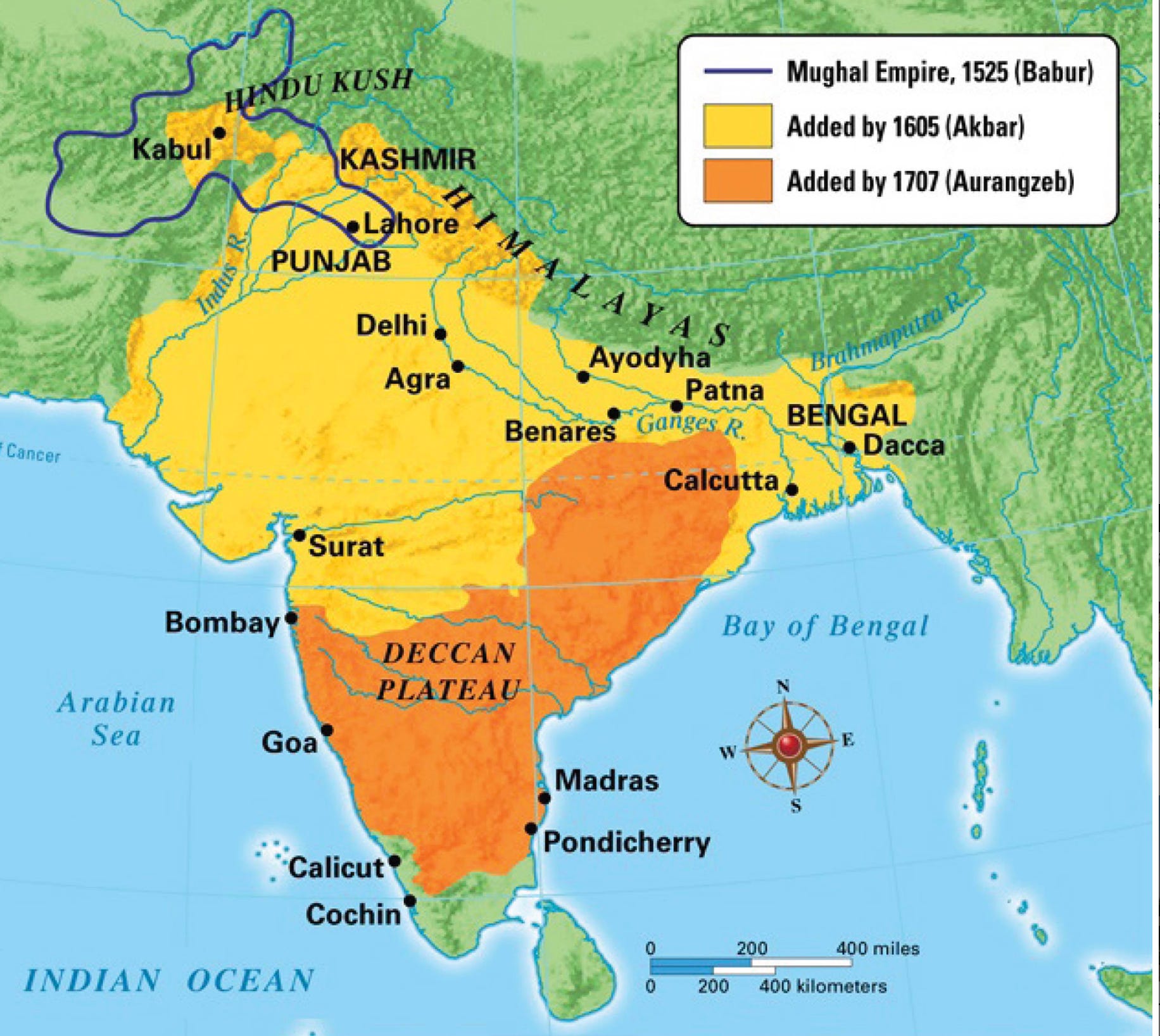
Like the title says - steppe nomads (or their urban descendants) rule nearly everything in Eurasia at some point!
Combined with Kublai Khan and his descendants’ expansion into Southeast Asia, steppe nomads or their urban descendants basically get all of Eurasia except for the core western EU region and Japan.
The Ottomans
So remember Turks being the frontier of warfare in Europe until 1200 or so? They’re dominated by the Mongols, who are truly unstoppable under Genghis, but once the Mongol empire dissolves after the Black Death, the Turks are the hardiest wolves on the steppe.
Various Turks conquer and hold pretty sizeable areas out in the steppe for a while, including becoming the major players in the Golden Horde khanate after the Black Death, but because they practice lateral succession, every time the main guy dies, their khaganates descend into civil war and fracture, so they’re largely too busy squabbling with themselves to unify enough to accomplish or hold anything significant. More importantly, most countries at the time are smart enough to hire various Turks as mercenaries in their armies, so nobody has an overwhelming advantage.
But eventually the Ottoman Turks settle and grow and skill up enough to take Constantinople, leading to the ultimate end of the Eastern Roman / Byzantine empire, in the mid 1400’s. Steppe nomads apparently come for us all, even if they have to settle and get big on a diet of agriculture for a while to do so (and indeed the Ottomans were particularly known for their cataphracti cavalry, and for having or partnering with horse archers).
After that, the Ottomans, like the Mongols before them, are one of the people that came within inches of conquering Western Europe, as recently as 1683(!), which I’ve written about before here.
The end of an era
So steppe nomads are an impossible superweapon for millenia, but then gradually become irrelevant as the age of gunpowder, the Age of Sail, and industrialization really takes off. Horse archers, impressive though they may be, just don’t measure up against muskets, artillery, and eventual ICBM’s, and land empires gradually give way to maritime empires as the naval trade and military capabilities of the European countries reshapes the world.
I will note that for hundreds of years, muskets and artillery and cannons existed and were used on the battlefield along with horses and jousting / heavy cavalry! Pizarro conquers Peru in the 1500’s mainly by the expedient of jousting on horseback, even though he also has muskets and cannons.
It might also be noted that contrary to most people’s images of them, the Mongols themselves had gunpowder and grenades, and even proto-cannons, and are the ones who first brought those things to European warfare!
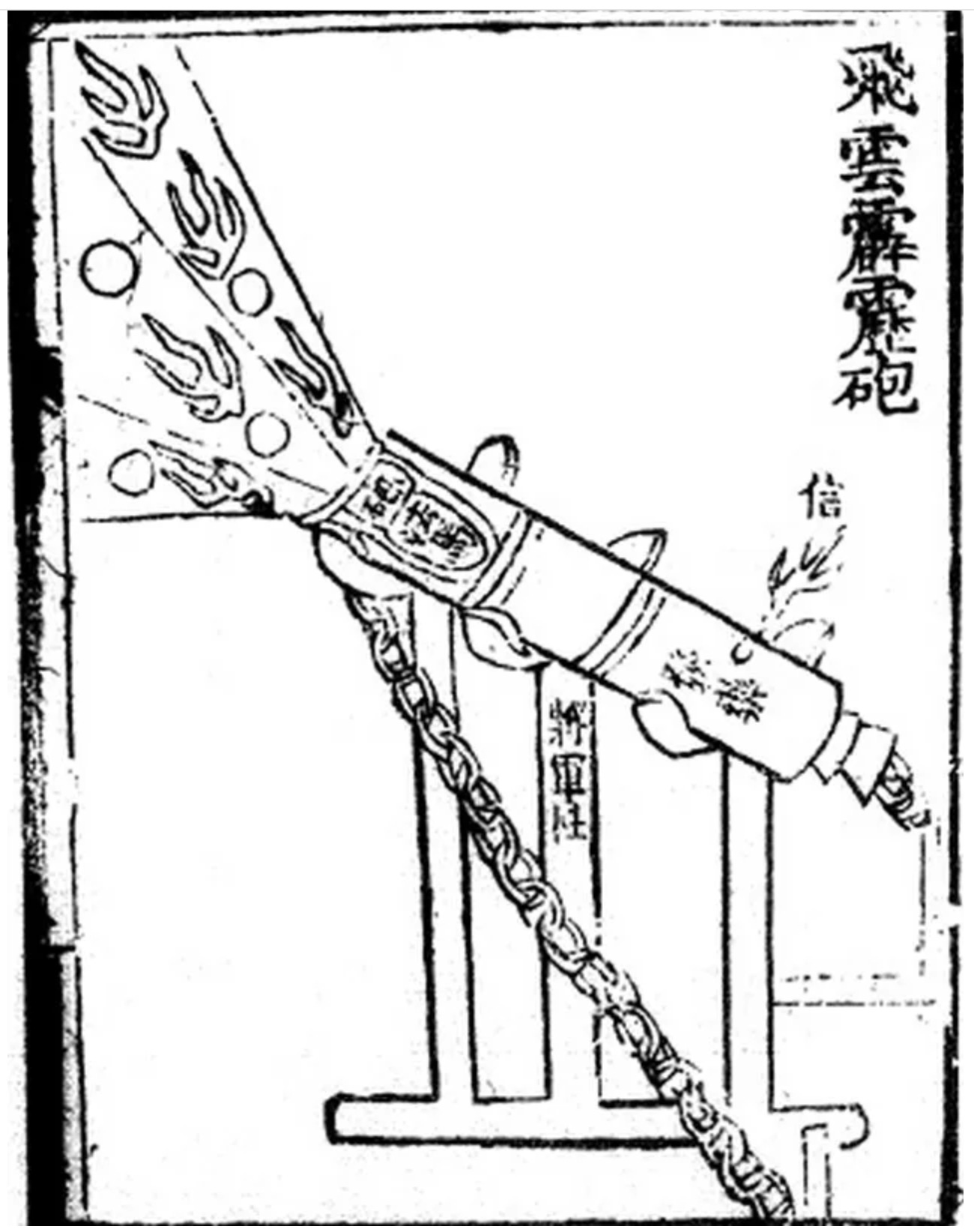
“The Mongols had changed the formula of gunpowder to provide enough oxygen to make it ignite in one rapid blast rather than in the traditional slow burn of the firelance or of rockets. Such instantaneous burning produced an explosion rather than a fire, and the Mongols harnessed these explosions to hurl a variety of projectiles.”
The evolution of gunpowder technology and tactics takes many hundreds of years (and the Industrial Revolution) to really dominate warfare, but it does get there eventually, at which point steppe nomads and horse archers are no longer a relevant military force worldwide.

I will briefly note that the Pontic steppe is once more giving birth to an unstoppable tier of war technology allowing smaller nations with more mobile tactics to dominate 3-6x larger ones, as the drone warfare in Ukraine has led to a complete change in strategy and tactics and technologies that will (once again) need to be adopted by every country in the world to remain militarily relevant, so even if history doesn’t strictly repeat, we can at least notice it rhyming in fun ways!
We also might wonder a bit more about the Pontic Steppe environment and the types of people it shapes / produces such that it keeps reliably doing this.
The last true steppe nomad khan is the leader of the Dzungar Khanate (Western Mongols) in the mid 1700’s. The Dzungar fight a massive, multi-decade war against the Khazaks and the Qing Dynasty for control of the Eurasian steppe, but the Qing ally with Russia and go and wipe them all out when they (sigh) descend into internecine squabbling over who should lead after the last khan dies.
The long reign of pastoralists who can punch hugely above their weight finally passes, and the urban floof dogs of the world all breathe a collective sigh of relief - our time of trials has passed at last! No more shall the steppe wolves pace ominously at our door, emperiling our quiet and civilized lifestyles!
Now where are those throstle eggs?
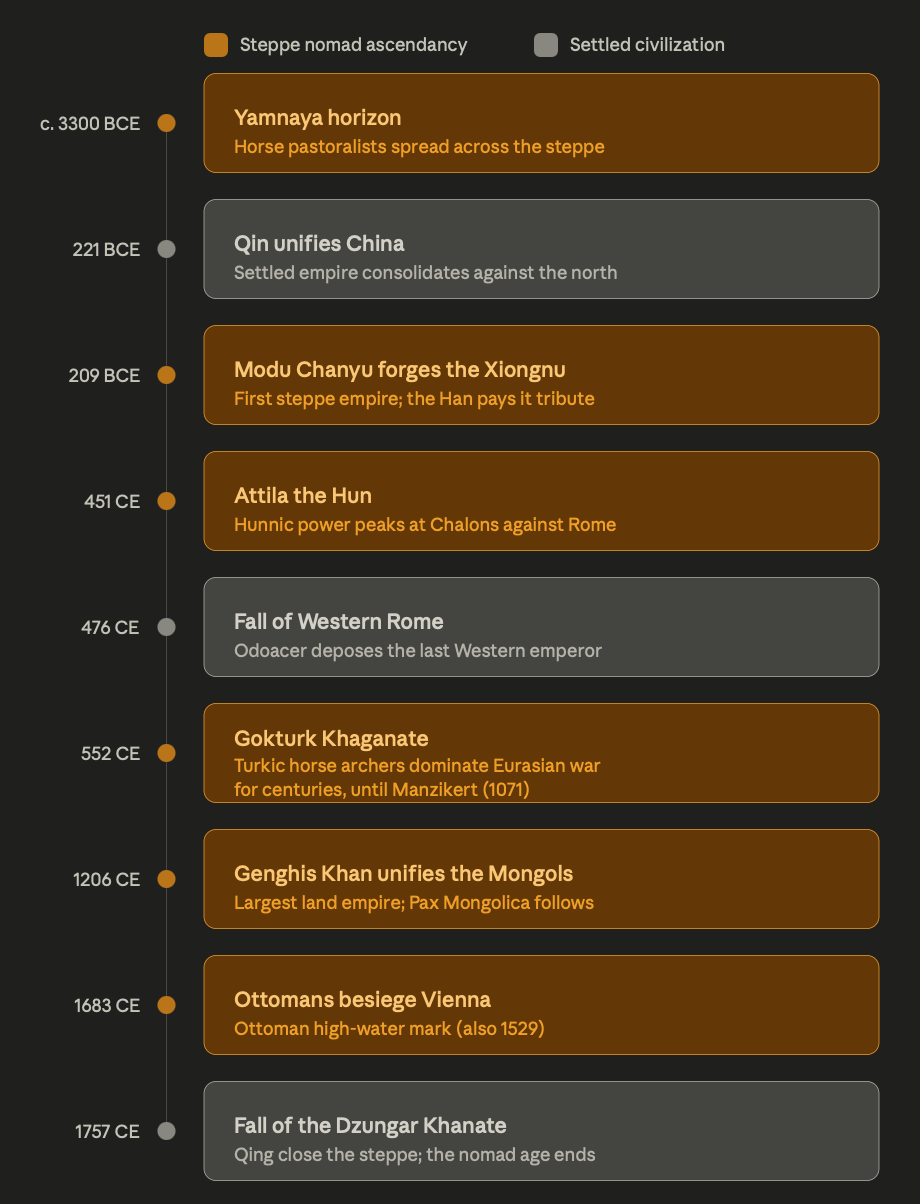
Okay, Beckwith’s h-index is really low, especially for his volume of papers and the quality of his writing and scholarship. But he’s plainly brilliant.
So this was a puzzle! When I dug into it, it’s basically because he is a polymath of the “oh, I guess I need to learn middle Persian / Old Chinese / Ancient Tibetan now” and then goes and does it, then goes to primary and original sources. As I said, he considers his remit “Eurasian history” which is laughably, impossibly broad. He’s also a systematizer, who has this picture in his head of ALL of Eurasian history, and combined with being very smart and very opinionated, this leads to him stepping on a lot of smaller-scope historian’s toes. And there’s a looooootttt of smaller scope historians in a topic as big as “Eurasian history.” So basically, he’s in the habit of stepping on lesser scholar’s toes, who then refuse to cite him.
So why do I think Beckwith is brilliant? Multiple times, not just once, he took a bold, counter-consensus stand, against the whole field, and later turned out to be right. Some examples are the PIE language family migration patterns, the Old Tibetan empire as a superpower, steppe nomad raids or wars as usually justified responses to direct offenses by urban civilizations, ie taking territory or cutting off trade, and the comitatus as the essential engine of the state for many peoples and countries for a thousand plus years.
In addition to that, he extremely frequently updates his views based on new information, and his footnotes are full of things like “I have since read a paper or source that says XYZ and have updated this view to so and so.”
I do think it’s funny that “programming a computer” is going the way of “darning a sock” or “turning milk into cheese” or “tending a fire” as our technological pyramid puts us at ever higher and more removed levels of abstraction. Oh, and on the ridiculous manhood standard, here’s Heinlein.
"A Man should be able to change a diaper, plan an invasion, butcher a hog, conn a ship, design a building, write a sonnet, balance accounts, build a wall, set a bone, comfort the dying, take orders, give orders, cooperate, act alone, solve equations, analyze a new problem, pitch manure, program a computer, cook a tasty meal, fight efficiently and die gallantly. Specialization is for insects."
All he needs is “unify a patchwork of barbarian peoples” and “establish a world-straddling empire!”
The Han dynasty is established by the impossibly charismatic peasant grifter-turned-emperor Liu Bang, who among other things was constantly in trouble for minor crimes and “uninterested in work or education,” but who was so charismatic he not only befriended various officials well enough to get an appointment as a local sheriff, but also talked his way into a “thousand coin per plate” banquet for free, then charmed the wealthy and influential nobleman who was throwing the banquet so much that he offered him his daughter in marriage(!!!). And he married her, natch.
And obviously, that’s just the bare beginnings of his exploits given he becomes the first Han emperor, it’s well worth reading that wikipedia page, it’s tons of fun.
The Chinese report back on Rome:
The historians of the Hou Hanshu summarized the report as follows:
Their kings are not permanent. They select and appoint the most worthy man. If there are unexpected calamities in the kingdom, such as frequent extraordinary winds or rains, he is unceremoniously rejected and replaced. The one who has been dismissed quietly accepts his demotion, and is not angry. The people of this country are all tall and honest. They resemble the people of the Middle Kingdom and that is why this kingdom is called Da Qin [or “Great China”]. This country produces plenty of gold [and] silver, [and of] rare and precious [things] they have luminous jade, “bright moon pearls,” Haiji rhinoceroses, coral, yellow amber, opaque glass, whitish chalcedony, red cinnabar, green gemstones, gold thread embroideries, rugs woven with gold thread, delicate polychrome silks painted with gold, and asbestos cloth. They also have a fine cloth which some people say is made from the down of “water sheep,” but which is made, in fact, from the cocoons of wild silkworms. They blend all sorts of fragrances, and by boiling the juice, make a compound perfume. [They have] all the precious and rare things that come from the various foreign kingdoms. They make gold and silver coins. Ten silver coins are worth one gold coin. They trade with Anxi [Parthia] and Tianzhu [Northwest India] by sea. The profit margin is ten to one... The king of this country always wanted to send envoys to Han, but Anxi [Parthia], wishing to control the trade in multi-colored Chinese silks, blocked the route to prevent [the Romans] getting through [to China].
Every so often one comes across something that makes being on Substack eminently worth it. This is one such piece. Thanks for writing it!
“In 25 years, the Mongol army subjugated more lands and people than the Romans conquered in 400 years.”
Quite a difference between passing through and conquering a place for a few decades and methodically incorporating a place into an enduring empire for millennia.