
Ottomonomania

Friends, today I would like to talk to you about the Ottoman empire.
Far more people know about Roman, medieval, or British history than about the Ottomans, but the Ottoman empire was the very heart of what Europe thought of as ‘the Orient,’ as opposed to ‘the Occident,’ for centuries.
Evil viziers, seraglios, harems, Janissaries, Islamic warriors putting the world to the “convert or die” sword, all that stuff? Ottoman!
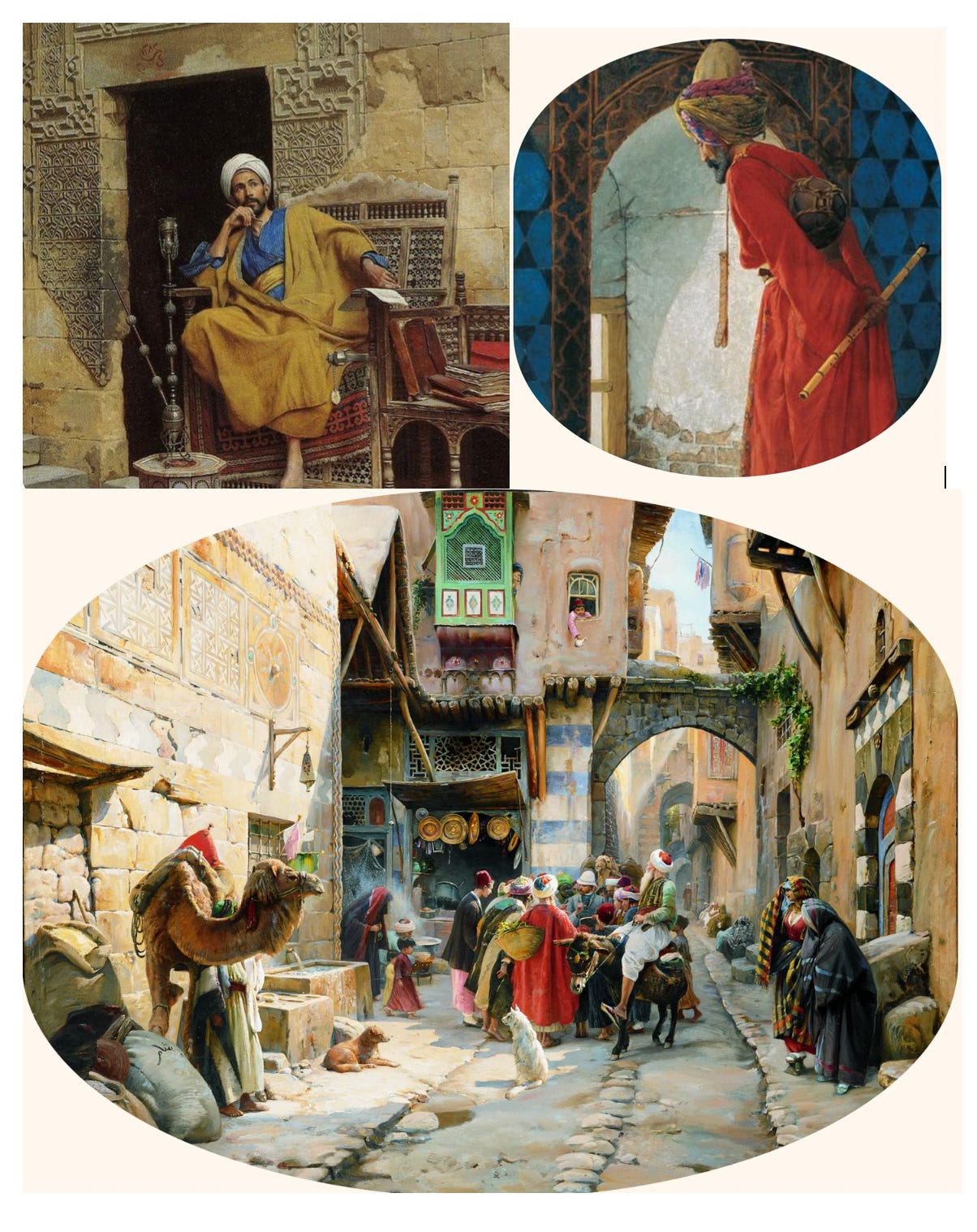
At its peak, the Ottoman empire covered 2M square miles and had 24M subjects. This is gigantic - as big as Alexander the Great’s empire. It was incredibly rich, which we’ll get into later, and also incredibly Islamic. It lasted from ~1300 to ~1900, and was one of the best war machines for its time, routinely fielding armies into the 100k soldiers, a feat unmatched since the Roman empire (which had 3x the population), and unmatchable by all of Europe over that time period.
We’re going to zoom in on a time in the late 1600’s where the Ottomans almost managed to roll over Europe, and this is prevented by the barest of margins, with teetering towers of luck, unbelievable timing, strong social skills, and obsessive tunnel vision all coming together to save the West.
I’m talking about the siege of Vienna in 1683, and the primary source for any quotes here is Andrew Wheatcroft’s The Enemy at the Gate.
The Ottomans were indeed the ‘enemy at the gate’ for Europe, and steadily chipped away at the far Eastern boundary (ie the Balkans and Eastern Europe and Hungary) for a century or two. They were seen as unstoppably depraved and fiendish by Europeans, for no real reason other than that they were a different faith, dressed differently, and did the same stuff that Europeans also routinely did in war (ie killed people, razed villages, enslaved the survivors, etc).
Wither Ottomania?
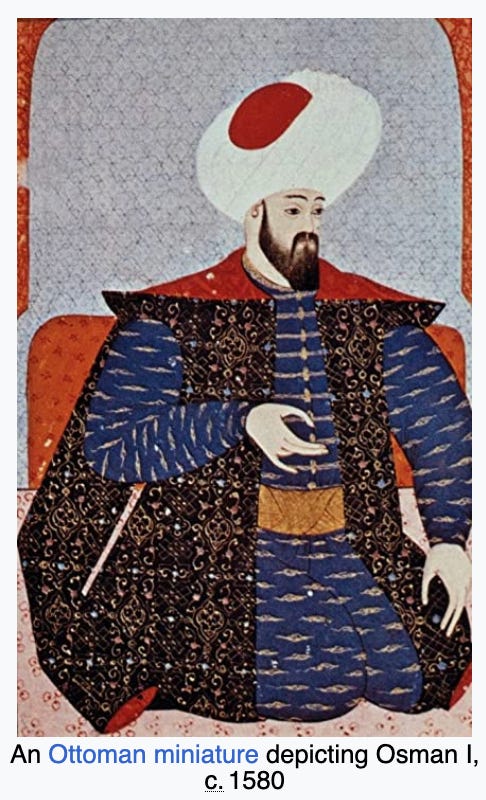
Osman I founded the empire in 1299. “Ottoman” derives from his name, and follows the pattern of names like Johnson or Clarkson - Ottoman simply means “of Osman.”
Interestingly, for the numerologically (or maybe nominologically) inclined, his original name in Turkish was “Atman,” and was translated as Osman in Arabic. Atman, of course being the Hindu and Buddhist concept of the truest and innermost self, or soul.
So Osman was king of an Anatolian beylik / province starting in 1281, and started launching raids against the Byzantine empire, increasing his domain into Byzantium, like so:
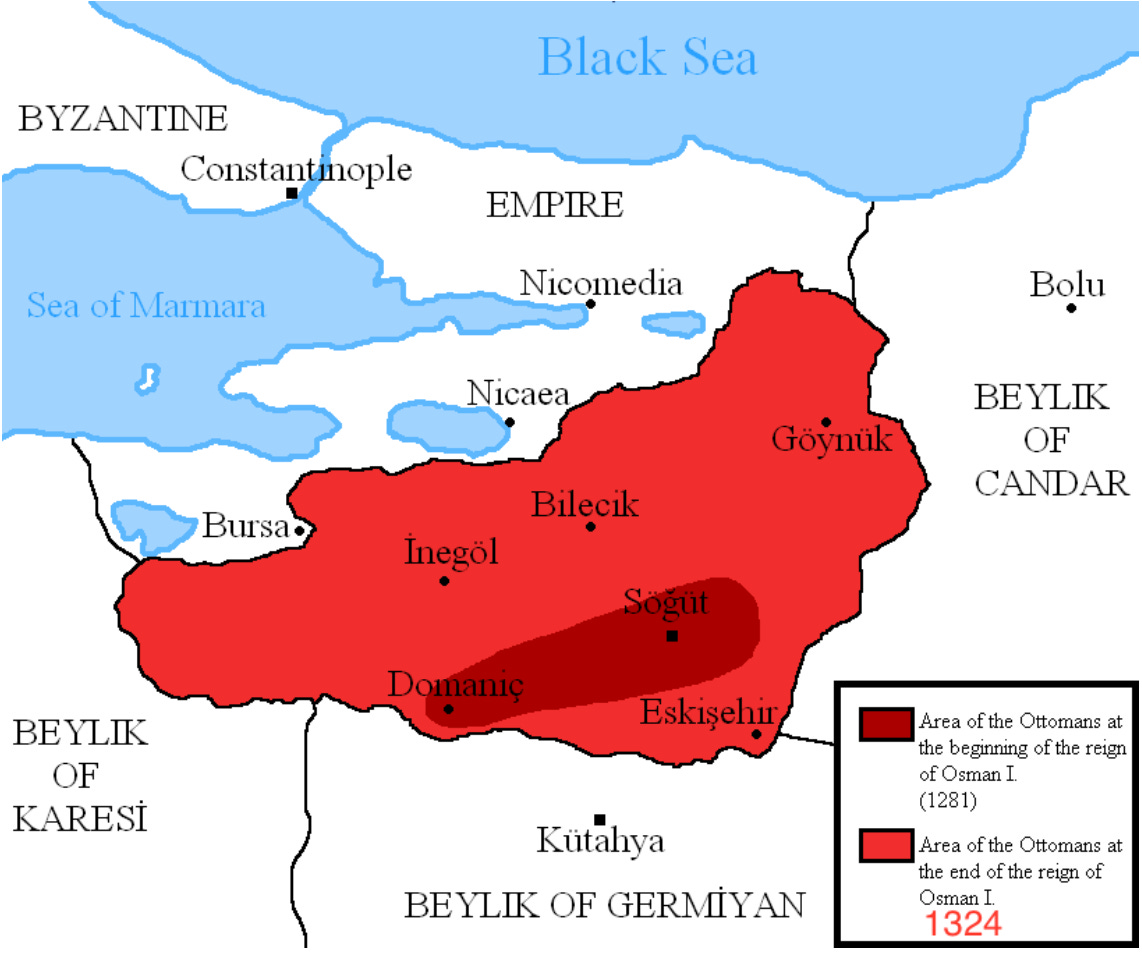
Obviously, our boy does well, and founds an empire that lives in infamy to this very day!
From here, various subsequent Ottoman sultans such as Mehmed II and Sulemain the Magnificent undertake a centuries-long expansion of the empire, taking Constantinople, Greece, the Balkans, big chunks of Eastern Europe, and finally taking Hungary, leaving us in the 1680’s, where the Ottoman empire is a gigantic all-of-Europe sized monster that looks like this:
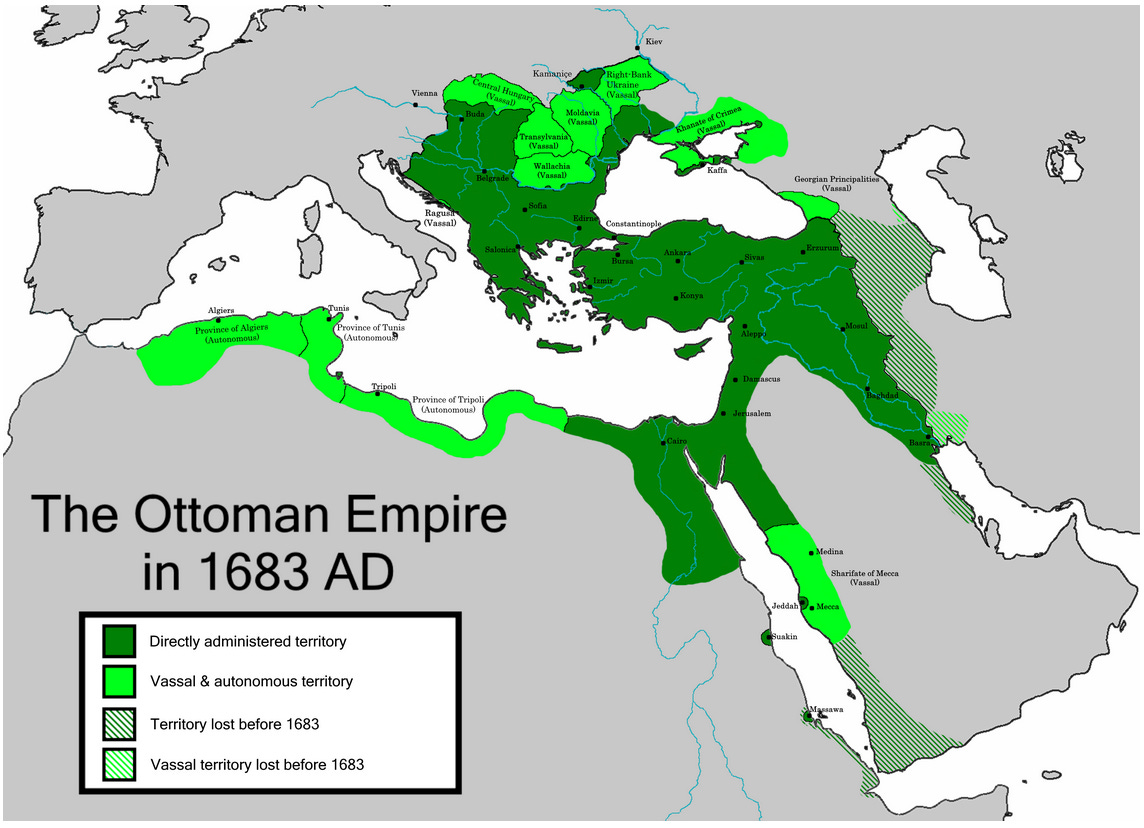
It is now up to sultan Mehmet IV to make a final push, and capture Vienna, establishing a foothold in Europe that can then be used to conquer Germany, Austria, and more.
Europe at this time is a divided rabble licking their wounds and trying to recuperate, with the largest “empire” under the Holy Roman Emperor Leopold. Leopold is broke and can’t raise large armies. This is at that time of European history that’s just seen the end of the Thirty Years War, one of the most destructive conflicts in European history, and people are openly joking that the “Holy Roman Empire” is none of the three.
So Europe is weak and war-ravaged, and Leopold barely an emperor. How is Mehmet IV doing?
A portrait of Ottoman efficiency and might
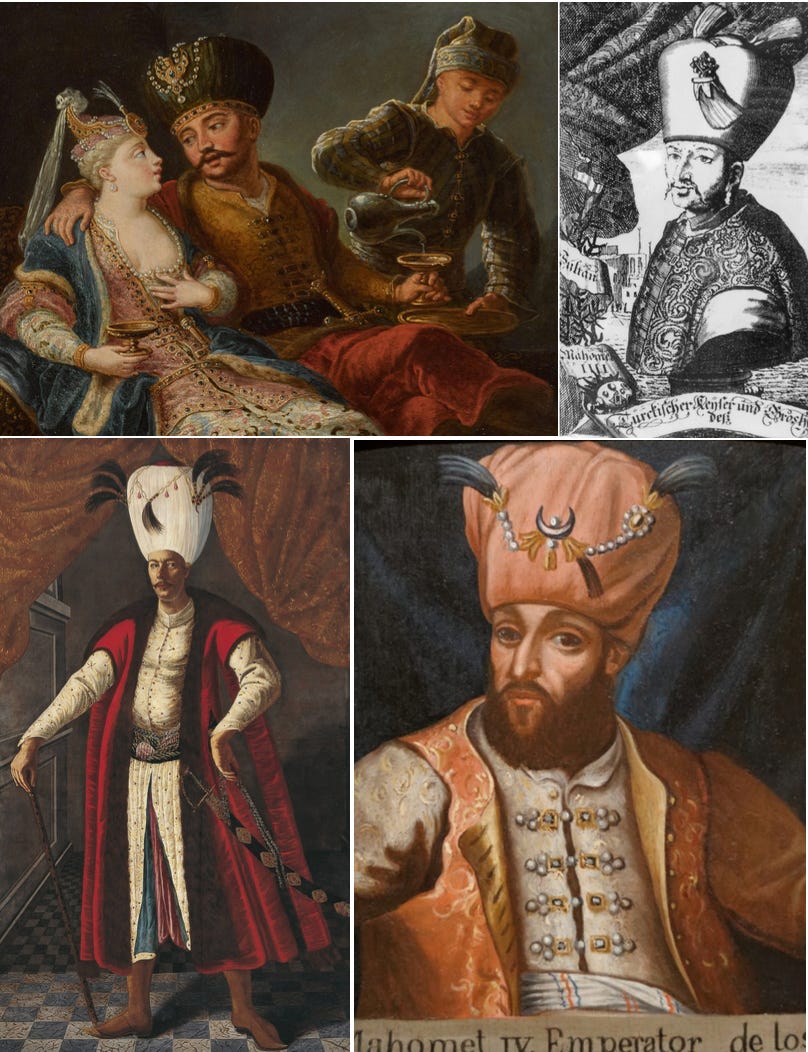
He’s doing great! Giant empire, lots of riches, the best war machine in Eurasia, European slaves and courtesans, what more does a man need, really?
And to give you an idea of the wealth and riches he has, his armies are routinely skirmishing somewhere every year, and are fabulously provisioned:
“To any westerner, a war camp suggested a dirty, disorderly collection of rudimentary bivouacs hastily erected on the line of march, peopled by raucous and dangerous ruffians. An Ottoman encampment, by contrast, was a perfect model city, but made of broadcloth, canvas, silk, brocade and embroidery rather than brick and stone.”
Camps were well ordered and are essentially cities made of tents, with designated latrines and garbage areas, and “silence and tranquility.” There’s a royal tent-pitching corps of more than a thousand men! The sultans own area of the tent city is around 60 tents, and did not skimp on the luxury:
“It consisted of almost sixty tents, and in the largest of them was ‘a throne studded with gems and on which lay rich needlework, and on the floor – as in the other tents – were luxuriant carpets, and the interior was covered with rich fabrics. The fourth tent, entered through a corridor, was the personal tent of the sultan. Here was a bed, at the head of which stood a Qur’an stand.’
Even the common soldiers had waterproof felted wool tents, like steppe nomads, complete with a sheepskin for each soldier to sleep on, and with officers having carpets, embroidered hangings, and furniture.
Moreover, they move with their own food supply. This is how they are able to campaign a thousand plus kilometers from their capitol cities.
It’s a formidable logistical operation, that they are much better at than Europeans, both in scale, and in execution.
Now what about the warriors themselves?
Ottomans were famed for their warriors, and justifiably so.
They had 3 elite corps - a heavy cavalry knight contingent, elite range + melee fighters, and elite light cavalry.
These were the Sipahis, Janissaries, and Tartars, respectively.
Sipahis
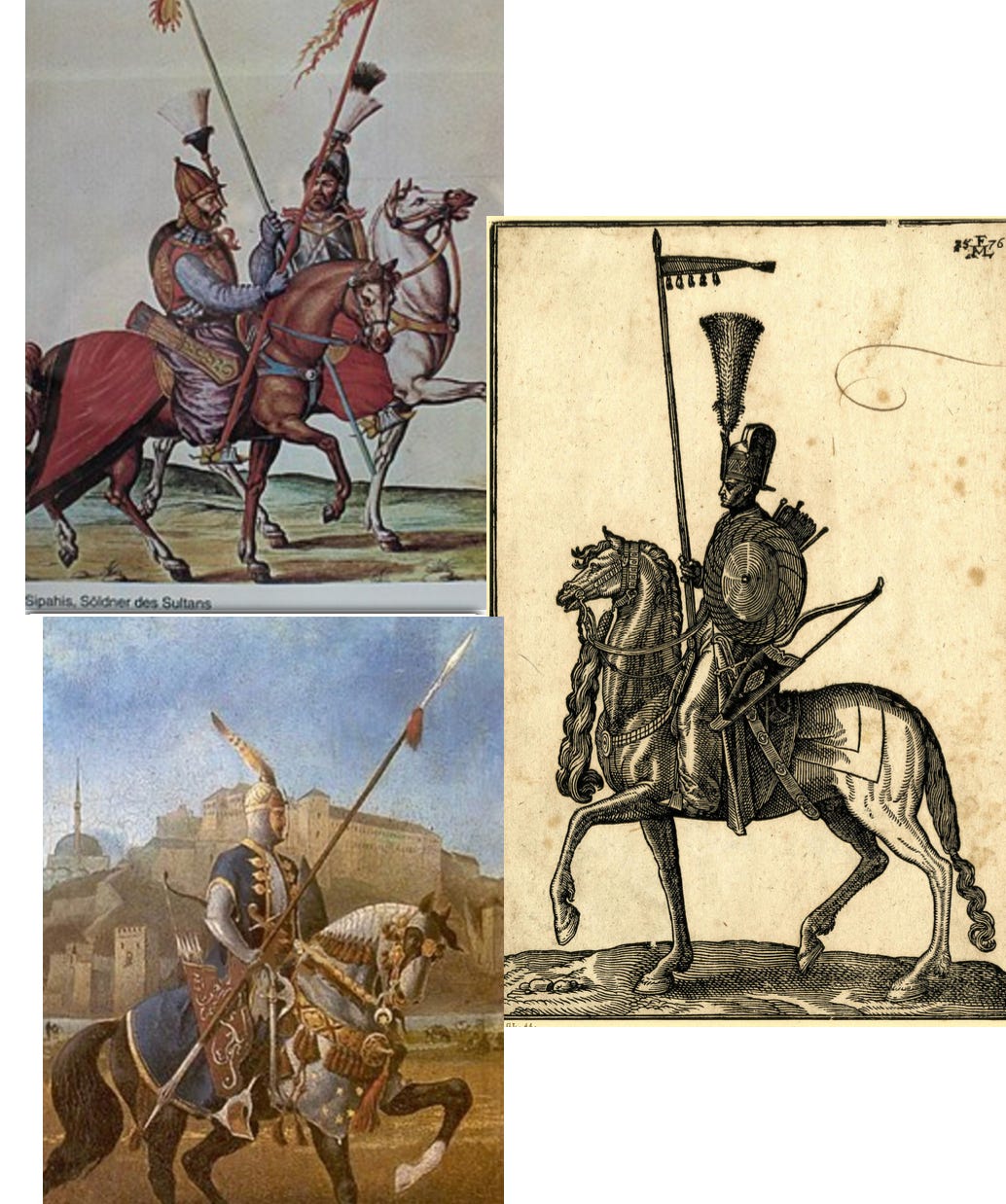
An “inspiring sight in their silks and brocades, heron’s plumes and chain mail,” these were the Ottoman knight equivalents, skilled with sword, mace, or battle axe. But unlike European knights, they were also archers, and had powerful recurved bows that they could fire at a full gallop. They were armored, and sometimes their horses were armored, so they’re heavy cavalry, requiring large horses, lots of fodder and water, and robust supply lines and logistics to support in the field.
The Tartars are also horse archers, literal steppe nomads, “superb raiders and the terror of the west,” led by the Khan of the Crimea, an ally of Mehmet IV.
Tartars
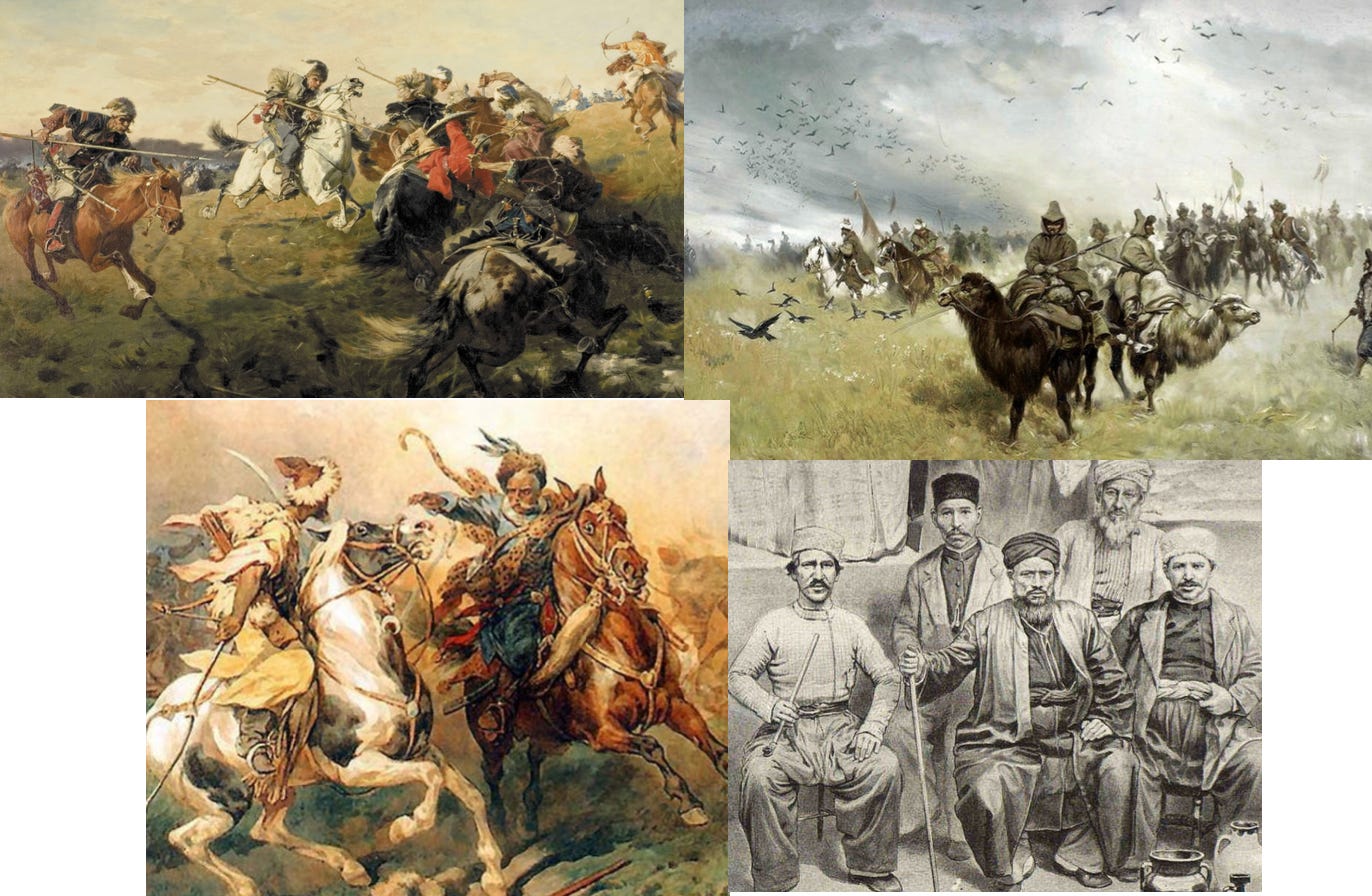
Why are steppe nomads unstoppable?
They can fire extremely powerful recurved bows from horseback at a gallop with deadly cadence and accuracy, and have all the advantages of cavalry with none of the downsides. They need no supply lines, as their horses and themselves feed on the run (famously, steppe nomads drink the blood of their horses while on the gallop), and this is an impossibly huge deal, because it means they are more mobile and faster than any other contingent of soldiers or cavalry.
Tartars were famously so-called because of Tartarus, basically “hell warriors.”
If the Sultan’s armies inspired terror in the west, it was the Tartars who evoked the deepest and most visceral fear.
“In the popular mythology of the frontier, Tartars were the creatures of hell. They lived on plunder and from the sale of human flesh, taking their reward not so much in money as in slaves whom they led home, roped together in long coffles (from the Arabic word kafila) to the markets of the Crimea.”
Broadly, they’re unstoppable death machines that can show up on your door with zero warning, and once they do, they’re 100% going to murder or enslave everyone you know. That’s why they’re “hell warriors.”
Now what about our elite foot soldiers?
Janissaries
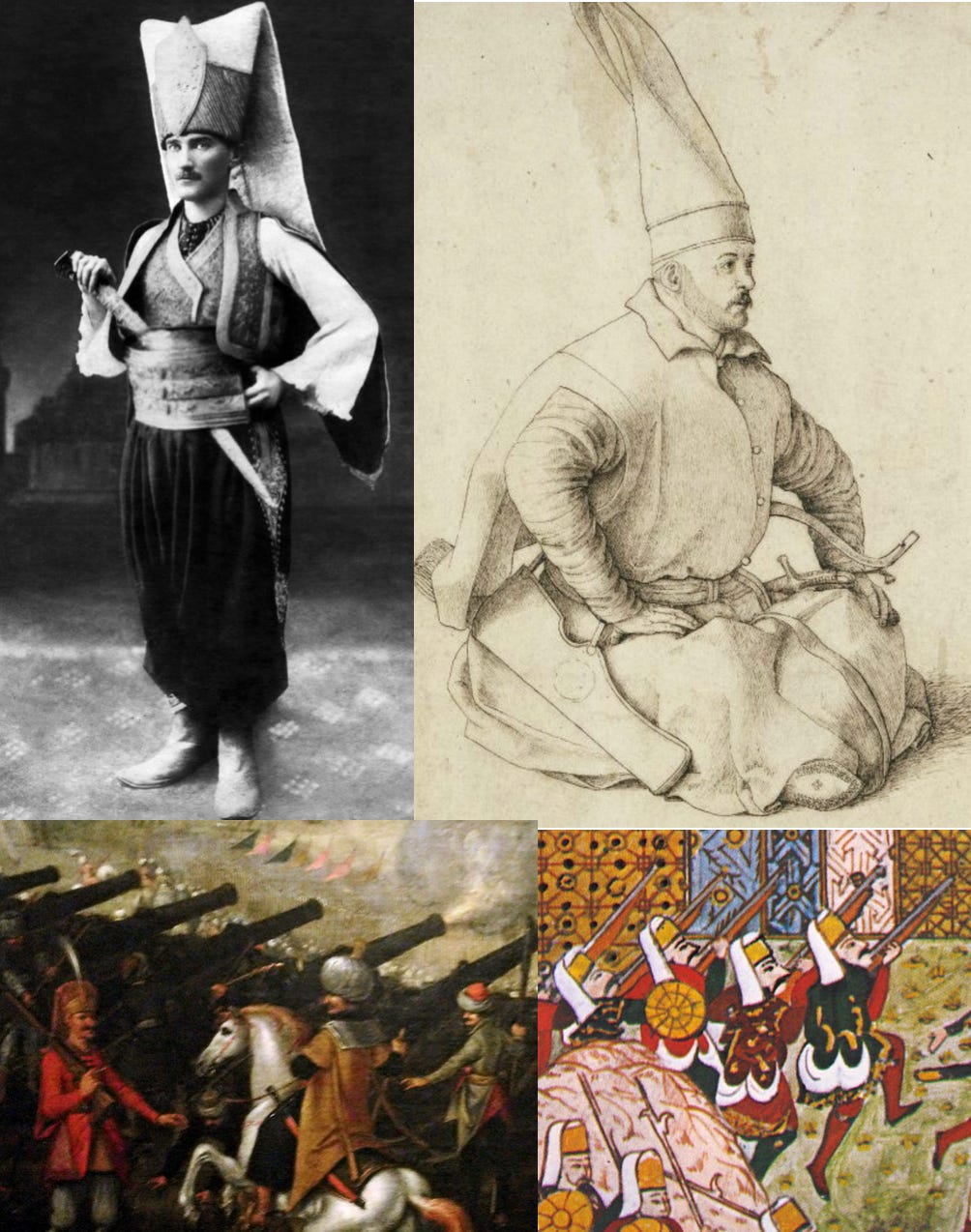
“For many in the west, the mere name was sufficient to inspire terror.”
Janissaries were Christian children taken in various campaigns who were converted to Islam and trained since childhood in the arts of war. Their regiments became their family, and loyalty to the sultan was paramount, as he was considered their father.
Their whole purpose was to be elite soldiers, so they trained and drilled every day, and were skilled at both ranged and melee attacks:
“Rushes, sudden mass attacks, sword play and archery became second nature, but they also trained with the heavy Turkish flintlock trench muskets, more like the wall-mounted guns on a fortress than lighter weapons used in western armies. Many janissaries were trained as sharpshooters: with the powerful powder charge and much greater range and killing power of their weapons, considerably more accurate than European matchlock firearms, they were a devastating weapon.”
They had extremely high esprit du corps, and could be counted on to storm any battlement or launch attacks even against great odds. There was also an enduring practice of richly rewarding any Janissary that did that and succeeded - if you’re one of the first over the wall and you survive, you’re wealthy for life. Super smart policy.
For this particular battle, the Ottomans had something like 20k sipahis and 20k Janissaries, and an unknown number, probably around 5k, of Tartars, and the rest were irregular less skilled light horse or foot soldiers.
So if you’re anything like me, you’re thinking “damn, all this sounds crazy expensive, what was the Ottoman economy like?” How did they afford all these tens of thousands of elite soldiers? How did they afford all that heavy cavalry?? Do know how much food and water that takes?
What made the Ottoman empire tick?
“Westerners often talked wonderingly about the warlike qualities of ‘the Turks’ and their natural bellicosity. But as the war camp made clear to all who saw it, the real power of the Turks was the seriousness and extraordinary invention with which they approached the business of a great war.”
How did the Ottomans support this warmaking capacity, economically?
This is what I was most interested in. The ability to field 100k soldiers with basically medieval agricultural technology was impressive, unmatched since Rome, and still more with the degree of provisioning and logistics that the Ottomans displayed, all with only a third the population of the Roman empire.
How did they do this? Broadly, the Ottoman economy was surprisingly liberal. They encouraged merchants in their cities, had free trade within the empire, were connected to both the Silk Road trade and the Mediterranean (which was the heart of European trade), and even freely invited Jews that were being persecuted and kicked out of Europe to settle and prosper. All of these were huge deals - most of the Ottoman revenue came from customs duty on trade, and after Spain and Portugal kicked out all their Jews in 1492 (Spanish Inquisition), no European country would take them, and tens of thousands ended up in the Ottoman empire, where they were welcomed. There is even a potentially apocryphal quote here about this Jewish exodus - Sultan Bayezid II reportedly remarked of Spain's Ferdinand: "You venture to call Ferdinand a wise ruler — he who has impoverished his own country and enriched mine!"
The Ottomans were actually notably more egalitarian and progressive than Rome - Rome had very high Gini indexes, essentially the highest you could have at their level of technology, and was 70M people with ~1k families fantastically rich families on top. In terms of a middle class, only ~10% were above subsistence. So there’s an out of sight rich .01%, a 10% middle-or-equestrian class, and then 90% of people living near subsistence (specifically under 1.5 - 2x subsistence).
In the Ottoman empire, things were more equal. Roman wealth Gini’s were .7 - .8, and Ottoman were .4 - .5. The Ottoman middle class is difficult to find numbers for, but just the sipahi families were ~1% of the population, and if you Fermi estimate it two ways based on likely income Ginis and soldiers-to-populace levels, you get that the Ottomans probably had a 15-18% middle class above subsistence, which also tracks with their higher urbanization percentage vs Rome. That may not sound large to us today, but it was a 1.5x larger middle class than Rome had!
This is in line with (or even a little higher than) the ~15% middle class percentage in the European countries in the Holy Roman Empire, PLUS they could actually field giant armies and weren’t persecuting their Jews.
The Ottomans are legitimately impressive here - they are fielding 100k armies with 1/3 the population of Rome, with broadly similar agricultural technology, achieved largely through better institutions and economics.
In terms of sociopolitics, they had a feudalistic structure just like Europe, but they actually stuck the landing. The big problem in Europe was that a king needs to raise an army, so he gives land or revenues to various nobles so that they supply him with soldiers.
What kings want to do is give the revenue from the land to the nobles, and keep ownership of the land. What the nobles want is to own the land themself, so they can pass it to their descendants. In Europe, the nobles usually won - they eventually owned the land a generation or two down, often as part of negotiating that for a particularly important war or battle where the king was against the wall and needed their soldiers. Because the medieval era was one where defensive technology temporarily outstripped offensive, and kings give land grants to nobles, it ended in a dynamic where in one generation the king rewards his allies and subordinates, in the next generation they make that land grant hereditary and build a castle, and soon after that, they stop paying taxes entirely. Because what will the king do after you stop? He would have to go and round up an army again and literally lay siege to your castle for a year or so, and that would cost him far more than he’d ever recover. He was barely able to net positive rounding up a few hundred knights and conquering a whole other country! Castles were literally strongholds, that the offensive power of the time wasn’t competent to overcome.
But the Ottomans? They didn’t fall into that trap. The Sultan granted his knights (sipahi) the revenue from the land, not the land itself, and was rich enough from trade and other revenues he never needed to grant ownership to fractious nobles. Every Ottoman knight could have his revenue stream taken away, so he was sure to bring all his soldiers to any battle the Ottoman Sultan wanted to engage in.
Why Vienna?
Now why did Mehmet IV want to capture Vienna? Well first, just look at the map of the empire, somewhere in Europe was obviously the next move. Logistically, Vienna is nice, because you can use rivers to transport a lot of your food and supplies while you’re campaigning, which is much faster and cheaper than land-based transport.
Second, his 4-greats grand-pappy Sulemain I (the Magnificent)1 had (among many other wars) conquered Hungary and then sieged Vienna back in 1529, and almost succeeded, but ultimately had to lift the siege due to an early winter.
Third, Europe overall was weak and war ravaged at this time, and there was no better time to make a run at it. This was the culmination of ~150 years of military tension between the Habsburgs (the ruling family of the Holy Roman Empire in Europe, some notable members of which include Maximilian I, Charles V, and Ferdinand I) and the Ottomans.
If there was any time to make a push into Europe, it was now, with Holy Roman Emperor Leopold broke, and every European country licking their wounds and recuperating.
Elite etiolation
Now this is the time of Louis XIV and Charles II of Spain, the time where all the big bads get so baroque and so far up their own asses that they lived in worlds composed entirely of luxury and simulacra level 4 interactions, and are completely disconnected from the lives of even a wealthy burgher or merchant in their kingdoms, much less a peasant or artisan. And our big bads here, Holy Roman Emperor Leopold, and Ottoman Sultan Mehmet IV, are no exceptions.
“By the late seventeenth century, both the Habsburg court in Vienna and the Ottoman court in Istanbul had become detached from the real, external world. This isolation had a considerable effect on the events of 1682–3.”
Both rulers – the Emperor Leopold I and Sultan Mehmed IV – shared a number of traits. In theory they were all-powerful, but both had made themselves utterly dependent on the courtiers around them.
They both led entirely cloistered lives, only interacting with their closest nobles / confidantes. They both came to power as minors, both spent most of their time either hunting or reading books and manuscripts. They’re pretty detached from realities on the ground, in other words, and this comes back to bite them.
Mehmet IV doesn’t listen to anyone who is actually close to Vienna in terms of how hard it might be to siege, and Leopold has been unintentionally(?) Inquisitioning all his subjects in Hungary because they’re the wrong flavor of Christian, so the ones that survived the earlier Ottoman conquering of Hungary are not exactly eager to go and do glorious battle in Leopold’s name.
A part of Mehmet IV’s detachment is that he’s too grand and mighty to actually take the field, so he does a big handoff ceremony and formally hands off his despotic, life-or-death power to his Grand Vizier, Kara Mustafa, which you know, I’m sure that always goes well. Who doesn’t want to hand off absolute life or death power and a giant army to their (probably evil) Grand Viziers??
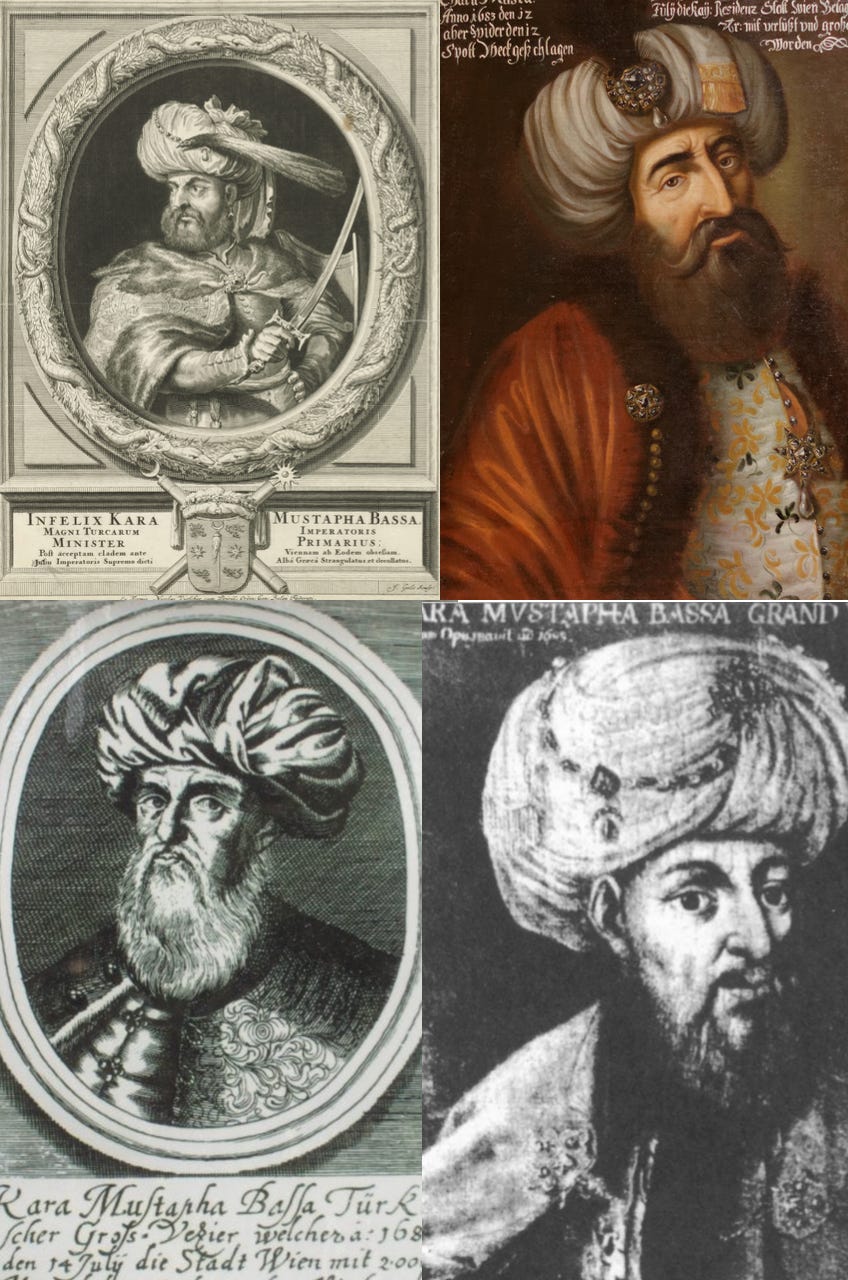
So it’s actually the Grand Vizier that goes and makes war against Vienna, eventually overseeing 100k+ soldiers and a “huge arc of tents, extending over fifteen miles around the city” as he lays siege.
Leopold is actually in Vienna while the Ottomans are gearing up and is so oblivious that the Tartar frontrunners of the Ottoman army basically show up on his doorstep before he realizes what’s happening, and he and 60k of Vienna’s finest and richest quickly skedaddle. Leopold makes it, but a lot of the other ones get pwned by the Tartars, so, uh, good luck being pillaged and enslaved, former rich people and nobility of Vienna?
Needless to say, neither morale nor courage is high in Vienna after seeing everyone who is able scuttle like rats from a sinking ship. All their richest and most looked-up-to have made the strongest vote of “no confidence” possible and left them at the mercy of an ocean of Turks and hell warriors.
The siege
Sieges follow a basic formula. By this point of warfare, with cannons and muskets and grenades and mines, the walls are resistant to cannon fire, and the best way to get in is to dig underneath the walls, set off a bunch of mines, collapse the walls, then storm in with your army. It’s been like this for a few hundred years, and Sulemain’s siege of Vienna back in the 1500’s followed the same pattern.
So, this is exactly what the Ottomans do - they have good intelligence about where the weak spots are in Vienna’s walls, and go right to the biggest weak spot, and start digging. The Viennese are obviously trying to hold them off by shooting at them and making various heroic sorties outside of the walls, but this is pretty ineffective. Roughly forty days in, the Ottomans blow a small hole in the wall.
Right away, Janissaries start charging up the hill to the place this has happened, and the defenders hurl bricks and stones and continuously fire muskets at them as they furiously try to make an improvised redoubt with beams and sandbags. They manhandle some small cannons to fire down into the Turks, and drop hundreds of grenades. The fighting is so jam packed that it’s standing room only, to the extent that corpses are held upright by the press of soldiers around them.
“The whole platform of the bastion was filled with fighting men, struggling to repel the Turks’ onslaught, which seemed to swell from almost every direction. The defenders were so tightly packed that the bodies of the dead were held up by the crush around them. ‘While I was holding a soldier by his scarf, his head was knocked off by a cannonball. Blood and brains were splattered on to my nose and right into my mouth, which was open because of the day’s great heat . . . This incident caused me great suffering afterward, above all violent palpitations and vomiting.’"
They just barely fight the Ottomans off, and the attack abates as night draws near.
The next day the Ottoman sappers explode three more mines, destroying most of a retaining wall, making “such a breach that a great part of the bastion, at least twenty feet thick, being of brick and stone, was quite thrown down from the top to the very bottom leaving a gap of thirty-six feet broad, and our men quite uncovered.”
This is it! This is the end of everything.
The Janissaries storm uphill to the breach, making a furious assault, but are slowed down by all the debris and smoldering ruins. The defenders scramble to stand shoulder to shoulder in the breach, a frail human wall to replace the missing stone one, and are raked with Turkish arrows and cannon fire. The Janissaries and now the sipahis repeatedly charge, wave after wave, and are barely held off. The defenders scramble to get some cheveux de frises in front of them (think a log with a bunch of spears attached all around it so it’s like a hairbrush, car-sized longitudinal caltrops), which can stop the sipahis, who would surely have shattered that human wall of defenders without them.
Finally, night falls, and the Turks retreat again. The defenders held the line, by the skin of their teeth. Vienna still stands!
And now there is no rest for the defenders - they need to shore up this giant hole in their defenses! They spend all night preparing new redoubts, setting up improvised wooden barriers (palanka) that defenders can take cover behind, dragging artillery pieces into place, and setting up lines of fire.
The Ottoman troops are also making their preparations for the final assault. Fresh reserve troops are called in, along with a stream of carts filled with fresh supplies of powder, weapons and food. Strategy and attack orders are discussed. There was little doubt that they would breach the wall, and once in, they were sure to win, by force of numbers if nothing else.
Tomorrow is going to see the end of this.
Meanwhile outside of Vienna
Holy Roman Emperor Leopold has been busy, and begging, borrowing, and stealing whatever he can to get a supporting army lined up. At the tail end of the Thirty Years War, he is personally broke, and cannot borrow, because he’s pulled that trick once too often. As a Habsburg, he’s from a long line of spendthrifts, who always spend their annual incomes well before receiving them, typically on ill-conceived wars, and have a bad history of repaying their creditors - he spends some time getting laughed out of various rich people’s offices.
But the Pope is not broke! And the Pope is always interested in fighting the infidel (or preserving the infidel, as the case may be). The Pope spends liberally, borrows against church lands and revenues, and helps fund the Vienna relief army.
They round up 30-40k German and Polish soldiers 3k and 7k at a time from various principalities, most of them from the areas of Germany / Poland that would immediately be at risk from further Ottoman encroachment if they took Vienna, and send them towards the front.
Once they get there, there are now 4-5 different armies, all with different commanders, none of whom know the local area well, and all of whom need to coordinate to have any chance against the 2-3x larger Ottoman army.
Oh, also they only took a few days of food - they have ZERO logistics or supplies, and the entire countryside is ravaged and impossible to glean food from, because the massive Ottoman army has already been doing that for months.
So that’s your mission, boys - go fight a 2-3x larger legendary war machine while you have no main commander or even a chain of command, and while you have no food or supplies. Also, they could (for all we know) have already taken Vienna and be safely fortified behind its walls. Good luck, and godspeed!
Final Salvation
As the book puts it, at this point for the relief army “the danger was a chaotic assembly of ill-coordinated soldiers, each section led towards glory by a self-obsessed commander.”
I personally think the bigger danger was the whole “you are going into a months-long warzone with no food or supplies” thing, where even one or two days of fighting leaves you at a serious, likely fatal disadvantage, but I guess I’m the crazy one.
Enter Charles de Lorraine.
Lorraine had a small force outside of Vienna, and had been scouting and rounding up and facilitating repeated (and much needed) supply runs for the sieged city while trying not to get roflstomped by the larger Ottoman forces. He was the Duke of Lorraine, born and raised in Vienna, a deeply experienced and well liked commander who was broadly known among his peers for dressing very poorly but being a solid dude.
Since he knew the local terrain and the disposition of forces better than anyone, it falls to Lorraine to come up with a battle plan, and convince all the other commanders that it’s a good one and they should follow him. He cannot order them, either now or in battle - he is at best a peer, and often of lower rank than them. This is a game of skillful diplomacy, that could easily go wrong.
“Lorraine managed his fellow commanders with the greatest skill. The problem was not new to him. The Habsburg corps of officers had for more than seventy years been a hotchpotch of Italians, Germans, Scots, Irish, English and French. Charles of Lorraine, himself a distant descendant of the ancient Kings of Lotharingia, a Prince of the Empire and a son-in-law of the Emperor, had long before learned the art of winning the confidence of those with whom he served. He also had the knack of winning over almost everyone he met, from bluff, self-opinionated fighting soldiers to conniving courtiers. He had no great ambitions, but he wanted to succeed against the Turks; above all he was determined to save Vienna. Yet time was short.”
They come up with a plan to descend the hills behind the Ottoman army in a large arc, attacking the entire western face of the vast Ottoman camp encircling Vienna.
Right away, there are several nearly fatal problems. Their plan reflected the map’s portrayal of easy lines of sight and travel - the reality was clefts and ridges, steep hills, woods, and a moraine of boulders and smaller rocks. There are small wine-making villages interspersed here and there. The ground vastly favors the Ottoman defenders, who can hide behind rocks and ravines and pick off Christian soldiers at leisure, and who can fortify the villages and hold off the relief army at will.
The hill is too steep to descend on horseback, and anyone descending will be sitting ducks for any Ottoman archers.
They confer and decide they basically have to yolo it. They’re going to slowly make their way into perilous terrain totally exposed, with massive defender advantages, and just hope it works out.
Amazingly, they succeed - they descend the hills and ravines “like a flood of black pitch” fighting and burning tents as they go, and are able to take a few advance Ottoman positions without rousing a coherent response from the larger army. The Ottomans had no scouts, no lookouts, zero defenses. It is a huge lapse of basic camp discipline and military practice. By this point, Turkish morale and sanitation was low and doing much worse than usual,2 which probably speaks to the relief army being able to do this.
The barest effort in obstacles or scouting or defensive measures at this point would have almost certainly seen the defenders held up, and seen Vienna fall.
“Nowhere did the Turks attempt to construct any kind of defensive wall, even if made only from gabions and rough timber. Marsigli, watching the events take place, was mystified. He wrote admiringly of the way in which the Ottomans had managed their siege of the city, but wondered why with all those skills they made no attempt to provide protection for the infantry and cavalry as the relief army approached.”
The relief army is able to descend without major losses, line up, and array themselves on an open plain to join battle with the Turks, and to do so in two positions.
NOW Ottoman Grand Vizier Kara Mustafa finally turns from the ongoing siege and decides something needs to be done. Due to their position, the Polish cavalry can travel fast enough to block their retreat through Hungary, and they are facing relief army soldiers from two sides.
He moves towards that front and makes some troop dispositions, but as he is doing so, a division of Polish hussars, heavy cavalry that are gloriously kitted out and look majestic in their heavy armor, lances, and warhorses, but are something of an antiquated joke in this age of cannons and musketeers, charge gloriously into battle. Thundering towards the Ottoman line and slamming into them with a resonating crack, they spear two Ottomans per Hussar at a time. Few of the husaria ride out alive from that initial engagement, but the Polish king considers it a great success and has thousands more, and starts lining up another charge.
Kara Mustafa flees this front back to his main command tent, carrying the Standard of the Prophet (a precious religious artifact he was specifically instructed by the Sultan not to let fall into enemy hands). He plans to regroup and lead a response from his main command tent. The Ottomans however, seeing their leader flee, rout, fleeing back to the road towards Hungary, and the Polish heartily pursue, killing thousands of them.
From this tiny seed, the entire mass of the Ottoman army, which vastly outnumbered the defenders? Useless, leaderless, spirit broken. Battles hinge on resolve and spirit as much as soldiers and armaments, and literally on the brink of victory, with incredibly deep reserves, the Ottoman spirit is broken, and their numbers are for nought.
“The Turks left behind watched his departure, then abandoned their own positions on the bluff and began to flee. Soon thousands of Turks were riding or running back, not into the battle between the Poles and the Ottomans for possession of the camp, but past the line of tents and beyond the struggle, towards the high road into Hungary.”
Christianity, and the West, is saved!
Snatching defeat from the jaws of victory
Vienna surviving the 1683 siege is generally marked as the beginning of the decline of the Ottoman Empire, which still lasts into the 1900’s. A mighty, unstoppable army that outnumbered and outskilled the Christian defenders in every possible respect was held off, and then broken, fleeing like whimpering dogs with tucked tails.
If Vienna had been conquered, it would very likely have been a different story. With new plunder and a new frontier to invade, with weak and disordered enemies still recovering from internal wars, the Ottomans could have likely encroached into much of Germany and Austria, and possibly Italy.
And they had great institutions! A robust economy, respect for specialization and skilled labor, a heavy focus on trade, a large middle class - if anyone were capable of incorporating and prospering with a bunch of additional European subjects, it was the Ottomans.
Our Grand Vizier Kara Mustafa really snatched defeat from the jaws of victory here, didn’t he?
“Kara has been monomanaically focused, Kara Mustafa had to look to the morale of his own troops. Feared rather than respected, he lacked the skill to deal with his own men. Successful Ottoman commanders met constantly with their soldiers, offered them rewards for their courage, spoke to them of the great prospects that victory offered them, of the richness of the prize that lay before them; they even instructed the preachers attached to each unit to remind them of their duty before God. Parades, reviews, awards for bravery in the face of the enemy were both expected and valued by the key troops. But the serasker seems to have been better at chastising than encouraging. He handled his commanders badly; each one assigned a different sector on the battle front received only peremptory commands to push their men harder and make more progress. There was a single-mindedness to his approach that brooked neither argument nor discussion. His strategy was fixed immutably in the first days: Vienna would fall in accordance with the plan that he had decreed.”
I feel like Kara Mustafa made the archetypical “male” mistake here. As I put it in my article on dating power maxxing, I feel like guys are basically cavemen, in the sense that they want one big “I win” button that they can hammer, and they just want to spend all their time getting better at the one thing, so they can hit it REALLY hard, and thereby Win Forever. This is always a mistake, because reality (and our female half) grades holistically.
Kara Mustafa was monomanaically focused on conquering Vienna, and he had a little experience with siege warfare, but not much with other forms of warfare. An adoptee into the famously powerful Mustafa family, this was his chance to make good and prove that the family made a great call when adopting him. So he was overly focused on winning the siege, to the detriment of everything else, and to the extent that it literally cost him his goal.
He could have done any single thing differently - he could have had scouts out looking for other armies, like any reasonable (or more experienced) general would have done. He could have been drilling his troops, incentivizing them, and making sure they were all aligned with visions of glory and plunder, and either the siege or the relief army skirmish could have gone faster or better. If he had set up any defenses whatsoever on his flanks and outer perimeter, he would have won. If his assault had been faster by a single day, he would have won. He could have made a night time assault on Vienna while the defenders were busily shoring up the breach. He could have even set up defenses like palanka and cheveux de frises after he knew what was going on, to prevent the Christian army from being able to assemble and charge the Ottomans on an open field. He could have fought against the prevailing spirit and roused his much-larger army when a tiny division of Polish cavalry killed a mere handful of Ottoman foot soldiers, held the line or rallied, and defeated the relief army entirely, then finished the siege. Because the Ottoman spirit broke at such a localized point, it probably comes down to whether some individual soldier or three at the time of the Hussar charge had 20% better morale, in which case they might not have broken and routed.
For that matter, there are countless things on the Christian side that could have led to Vienna’s fall! If they had been delayed by a single day in any of the month-long relief army efforts, if they had been delayed in their dodgy river crossing the night before, if the defenders in Vienna hadn’t held the line when the wall breached either time, if Charles de Lorraine wasn’t as diplomatic and well-liked and able to coordinate a fractious group of noble leaders out for personal glory - any number of factors on that side could have led to Ottoman success!
Again, they had a strong economy, encouraged trade and artisans and technology, and had a larger middle class than any comparable empire. Turkey had 1.5x bigger coal reserves than Britain, and Poland and Germany 4-5x larger. In inferentially farther realities, Turkish might have been the language of commerce and learning as science and the Industrial Revolution took off, instead of French or English!
The Polish Hussars who routed the Turks were extremely vulnerable to any fortifications or defensive measures breaking up an open field - in fact, there is direct historical precedent in prior Ottoman sieges!
“Anything would do: wagons yoked together, a line of spiked palisades with muskets and artillery behind. This was the tactic that had destroyed the Hungarian chivalry at the Battle of Mohács in 1526 – the chivalry of Hungary was shot to pieces by the janissaries and the Turkish guns, protected by sharpened stakes from Hungarian swords and lances. But in the heat of the day on 12 September (‘for never was there a hotter day known than this’ ) no preparations had been made. The camp before Vienna was full of beams, gabions, wooden stakes and the like; yet none were put to use. This oversight, indolence or mere carelessness, cost the Turks dearly. They faced the Polish host out in the open, lined up before their tents.”
Alas for historical precedent, and alas for monomania. Sometimes not taking your eye off the ball isn’t enough - sometimes you should have taken your eye off the ball, because more than one thing matters!
One of my favorite things about Sulemain I is that his wife Hurrem is basically another Cleopatra or Livia Drusila. Enslaved by Tartars in Ruthenia, a part of present day Poland, she was sold as a slave in Constantinople, ended up in Sulemain’s harem, and then from there worked here way up to being his favorite harem girl, and then from there actually got him to marry her(!). This is obviously vastly against all precedent and tradition and horrified everybody. She fathers the next Ottoman sultan with him! They have six kids together and live happily ever after!
The sheer amount of talent and smarts and skill that must take is absolutely amazing! She sniped him so hard he overturned centuries of tradition, and not just to marry her, but in many other things as well (not sending her off to the provinces with their sons to govern, a longstanding practice, as one example). He was genuinely in love, and she helped him rule. “The correspondence between Suleiman and Hürrem, unavailable until the nineteenth century, along with Suleiman's own diaries, confirms her status as the Sultan's most trusted confidant and adviser. During his frequent absences, the pair exchanged passionate love letters. Hürrem included political information and warned of potential uprisings.”
Cleopatra, of course, is a similar story. Famously, Cleopatra was a capable, clear-eyed sovereign, who knew how to build a fleet, suppress an insurrection, control a currency, and alleviate a famine. An eminent Roman general vouched for her grasp of military affairs.
So she’s literally 16 when she meets Caesar. Julius Caesar is the most powerful man in the world at the time, and has slept with hundreds of women, he’s an infamous womanizer. So basically the most powerful, most sexually jaded dude in the world, and he’s meeting this wet behind the ears 16 year old who is in line to rule Egypt with her brother, and both of them are trying to kill each other to rule Egypt alone.
So with basically no experience of anything, through sheer will and guts and smarts, she snipes the most powerful and jaded man in the entire world so hard he not only elevates her to queen of Egypt, he has a son with her, makes her his queen in everything but name, and is trying to figure out a way to get Caesarion (their son) to succeed him when he’s assassinated.
Then Cleopatra does it AGAIN, with Marc Antony - the next most powerful, sexually jaded man in the world. Like it obviously wasn’t luck, it was skill! She did it twice! With two very different men, with very different personalities. Absolutely mind boggling.
Livia Drusila is a similar story with Augustus, but this footnote is too long at this point to go into the details.
“Their camp had turned into a cesspit of filth and human carcasses, quite unlike the traditional model of Ottoman good order and discipline. The commanders closer to the troops than Kara Mustafa sensed a rising tide of mutiny. No one dared voice what all of them feared: what would happen if they could not take the city in this final surge?”
Fantastic! One nit: the era of Louis XIV was not also the era of Marie Antoinette! Big difference in that century between.
Good read, and obligatory link to the saboton song about this battle: https://youtu.be/rcYhYO02f98?is=NmcjAnuiKvRJWXjp