

Let’s listen to a story about carbon.
Diamonds, coal, the graphite in our pencils, carbon fiber, carbon nanotubes and buckyballs, and graphene - all made of carbon atoms. The only difference is how the atoms are arranged in three dimensional space.
Understanding this - how the arrangement of atoms in 3d space affects the properties of matter, is the fundamental core of materials science, so let’s spend some time exploring this.
A carbon atom has six protons and six neutrons. Carbon with 8 neutrons, carbon 14, is unstable and decays at known rates, and that’s how we do carbon dating to peg the ages of ancient artifacts.1
Of those six electrons, two are in the inner core, and the remaining four determine how the carbon is networked with other atoms, and so whether it’s diamond or graphite or something else.
Diamonds
When each one of the four is shared with another carbon atom, it’s a crystal of carbon - a diamond. Diamonds were the hardest known material for a long time - the word “diamond” is derived from the ancient greek “adamas,” which means “unbreakable.” A diamond has about a million billion (10^15) carbon atoms arranged in a crystal structure:
“And it is this structure that accounts for its remarkable properties. In this formation, the electrons are locked into an extremely stable state, and this is what gives it its legendary strength. It is also transparent, but with an unusually high optical dispersion, which means that it splits light that enters it into its constituent colors, giving it its bright rainbow sparkle.”
Diamonds, of course, have been luxury signifiers for as long as they’ve been refined, which is probably around 6,000 years.2
But diamond hasn’t been the hardest substance in a while. It’s not even the hardest carbon compound - both lonsdaleite (meteor-struck graphite) and aggregated diamond nanorods are harder, and a substance called “carbyne” or a chain of carbon atoms arranged in alternating double and triple bonds, should also be theoretically harder, although we haven’t made it in large enough amounts to test it physically yet.
Another contender is Wurtzite boron nitride, which is boron and nitrogen in a diamond-like structure.
All of these are laboratory oddities that can only be created with great effort in tiny amounts, however. Diamond is still the hardest material people might actually interact with.
Lavoisier first found that when heated, diamonds don’t melt - they vaporize in air, or turn into graphite in a vacuum, which brings us to graphite.
Graphite
Graphite is actually more stable than diamond, and diamonds are in theory slowly turning into graphite over billions of years. Graphite is made of planes of carbon atoms in a hexagonal structure. Individually, within each plane, the bonds between the carbon atoms are stronger than in a diamond, but there’s no more bonds for linking between planes because they’re all used up within the planes - only the Van der Waals force keeps the planes together, and this is why graphite is weak enough to work as a lubricant and as the lead in pencils.
It’s called “lead” in pencils because it’s dark gray and shiny, like a metal, and was mistaken for a type of lead (another soft metal that’s dark gray and shiny).
“The reason why graphite is metallic while diamond is not is also its hexagonal atomic structure. As we have seen, in the diamond structure, all four electrons in each carbon atom are partnered up with a corresponding electron. In this way, all atoms in the lattice are strongly held in a bond, and there are no “free” electrons. This is the reason why diamonds do not conduct electricity, because there are no electrons free to move within the structure to carry the electric current.”
Being metallic, and unlike diamond, graphite is conductive - Edison trialed it as a lightbulb filament for a time due to its high melting point.
And ultimately, WE are made of carbon, too. All living matter that we know about is made of carbon - and you can convert this carbon into graphite by burning.
“wood turns into charcoal when heated; bread becomes burnt toast; we too become black and charred when exposed to a fire. None of these processes produce pure shiny graphite, since the hexagonal layers of carbon are not densely packed but are jumbled up. But there is a vast spectrum of black sooty materials, which all have one thing in common: they contain carbon in its most stable form—hexagonal sheets.”
Coal is made, not via burning, but by heat and pressure in the earth driving off volatile organics, becoming in the process a purer and purer form of carbon. As the pure hexagonal layers get formed, so the material takes on a more metallic shine, seen most clearly in the black mirror facets of some coals such as anthracite.
“The type of coal most revered for its aesthetic appeal is that derived from fossilized monkey puzzle trees. It is hard, can be carved and polished to a brilliant finish, and has a beautiful dark black luster. It is sometimes called black amber because it has similar triboelectric properties to amber: the ability to generate static charge and make hair stand on end. We know it more commonly as jet.”
Carbon Fiber
The structure of lonsdaleite inspired scientists to try to spin graphite into a fiber, and from this, carbon fiber was born.
“Carbon fiber, as they named it, was made by spinning graphite into a fiber. By rolling sheets of this material up, with the fibers running lengthwise, they could take advantage of the huge strength and stiffness within the sheets. The weakness, as with pure graphite, still lay in the material’s structural dependence on van der Waals forces, but this was overcome by encasing the fibers in an epoxy glue.”
And so everything from aircraft to tennis rackets to bikes to race cars got both stronger and lighter.
For anyone familiar with “The Hour,” the infamous pinnacle of “pain cave” athletic accomplishment, where athletes ride a bike for an hour to achieve the maximum distance possible, often ending so crippled by the effort they’re unable to get off their bikes or walk for a good while, carbon fiber bikes led to an Hour arms race in the 90’s before they changed the rules to eliminate them.3
Carbon fiber is used incredibly widely now - new aircraft from both Boeing and Airbus are majority carbon fiber. The famous Mclaren F1 was the first full carbon fiber bodied car. It’s used in everything from dentistry to musical instruments to archery and 3d printing, and costs keep coming down as manufacturing methods improve.
Lets hop briefly to the more exotic nanoscale carbon structures - buckyballs (discovered in a candle flame), carbon nanotubes, and graphene.
Buckyballs
An arrangement of 60 carbon atoms in a stellated icosahedron, they’re called “buckyballs” or “buckminsterfullerene” or “fullerenes” as homage to Buckminster Fuller’s geodesic domes. Although we’ve theorized buckyballs since the 60’s, and studied them since the 80’s, they haven’t found widespread use. One of the more interesting facts about them - there was a study on feeding rats buckyballs suspended in oil, and it served as a powerful antioxidant that greatly expanded their lives (“almost double” according to the study).4
But buckyballs are light sensitive, and light exposure makes them exceptionally toxic, leading to a massive increase in the risk of tumors and cancer if they’ve ever been exposed to light. So very much a sword of Damocles, with high potential negatives as well as potential positives. Probably why they haven’t been seized on by the nootropic crowd.
Carbon Nanotubes
Carbon nanotubes are a hexagonal tiling of carbon atoms wrapped into a tube, like this:
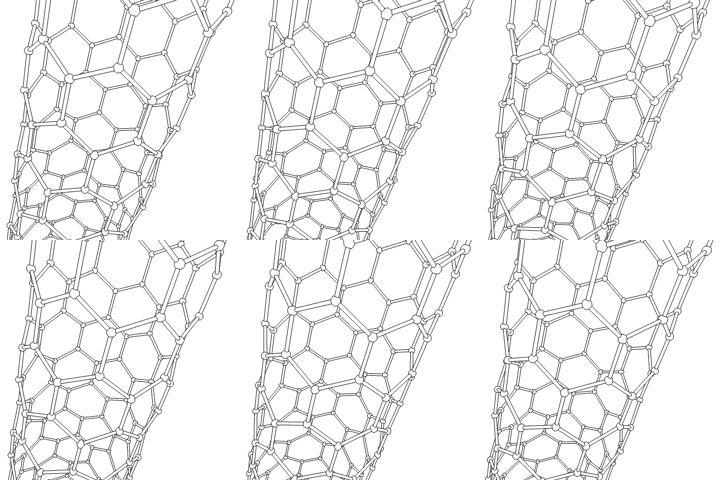
Amazingly, Russian scientists published clear pictures of carbon nanotubes in 1952, although we weren’t able to synthesize them until the mid 90’s.
They have fantastic properties - strength, thermal conductivity, conductivity ranging from “high” to “semiconductor” depending on layers of structure, and are used everywhere - some interesting uses are:
Artificial bone and organ scaffolds
As biological nanosensors (they can detect dna, neorottabsmitters, lipids, proteins, and sugars, and much more)
As a composite material even stronger than carbon fiber in windmill arms, marine paint, and more
In bike parts, skis, surfboards, boats, and aircraft
It’s used to make vantablack, the blackest black
You can buy carbon nanotube tape - gecko tape or nano tape is supposed to leave no residue
If we ever make a space elevator, they’ll be one of the primary components.
Making macro scale all-carbon or “living” devices will use them too.
Finally, graphene:
Graphene is like the hexagonal carbon tiling of the nanotubes, but cut open and laid flat, in a single layer.
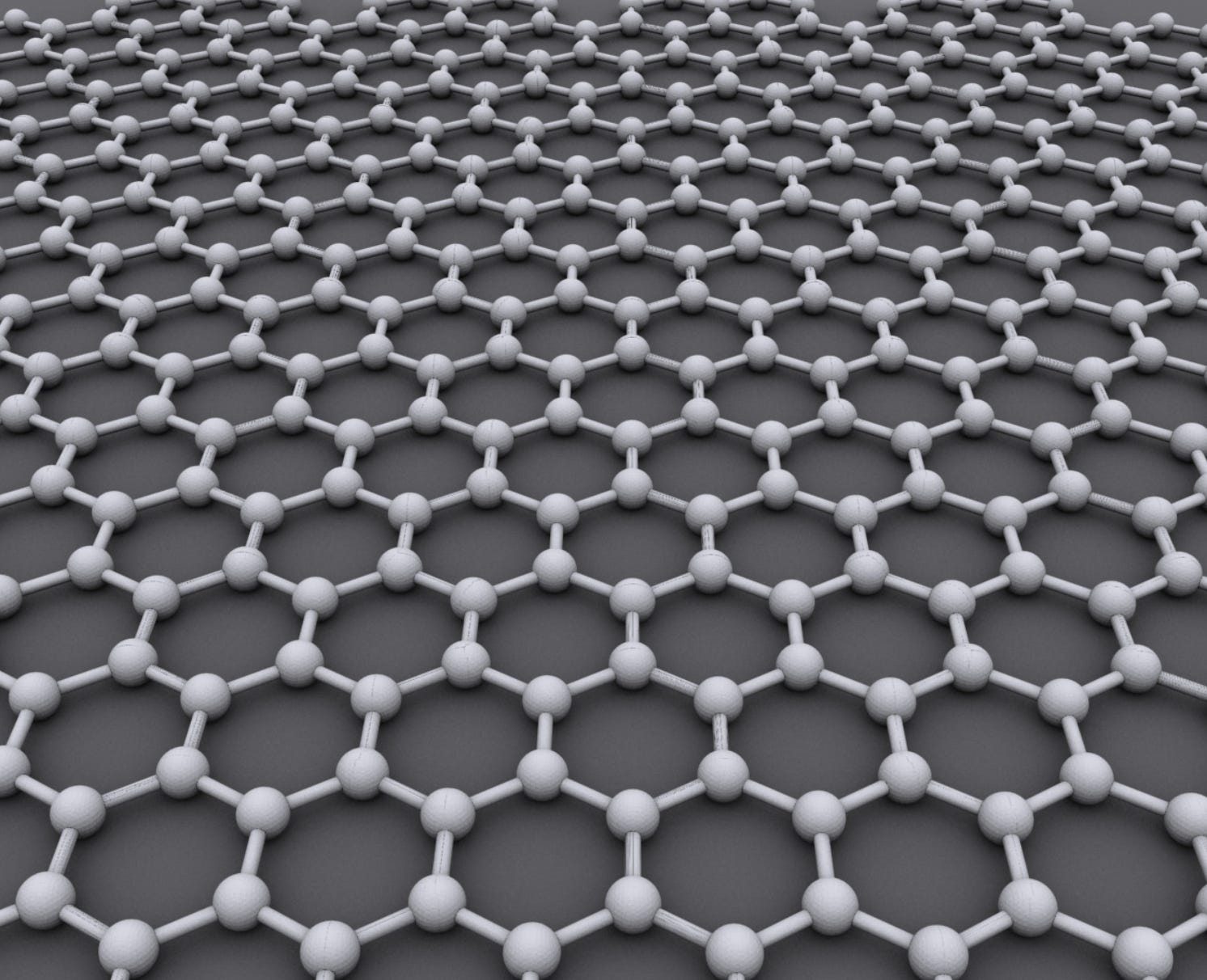
You can actually make graphene yourself if you get a pure sample of graphite (also called plumbago), and ordinary scotch tape. You stick the tape on the graphite, getting a film of graphite. Then stick another piece of tape to that film, and repeat the process 5 or 6 times. At the end, you’ll have a single-layer sheet of carbon atoms, graphene, which you can verify with a microscope.
“Just for starters, graphene is the thinnest, strongest, and stiffest material in the world; it conducts heat faster than any other known material; it can carry more electricity, faster and with less resistance, than any other material; it allows Klein tunneling, an exotic quantum effect in which electrons within the material can tunnel through barriers as if they were not there. All this means that the material has the potential to be an electronic powerhouse, possibly replacing silicon chips at the heart of all computation and communication. Its extreme thinness, transparency, strength, and electronic properties mean also that it may end up being the material of choice for touch interfaces of the future, not just the touch screens we are used to but perhaps bringing touch sensitivity to whole objects and even buildings. But its most intriguing claim to fame is that it is a two-dimensional material. This doesn’t mean it has no thickness, but rather that it cannot be made any thicker or thinner and be the same material. ”
Despite all these amazing properties, graphene per se isn’t used nearly as much as nanotubes in actual applications, although it’s an area of active research.
So we see that just considering a single atom - carbon - the different 3d arrangements that are possible lead to an incredibly wide array of physical, optical, electrical, thermal, and other properties.
But as we all know, carbon doesn’t just bond and form compounds with itself - it’s everywhere in our world.
Carbon as it pertains to chocolate and steel.
Steel pretty much defined warfare for thousands of years, and later, the Industrial Revolution.
Steel in armor and weapons was such an advantage it let a handful of conquistadors topple an empire of millions.
But we owe steel for everything from bridges and buildings to silverware that doesn’t taste like anything and razors that give us clean shaves.
Steel is both plastic and malleable at high temperatures, and hard, strong, and durable at every day temperatures. This makes it immensely useful, more useful than iron, it’s predecessor, and the element that brought us out of the Bronze Age.
And the way we create steel is with carbon.
“Our ancestors didn’t realize that steel was an alloy—that carbon, in the form of charcoal, was not just a fuel to be used for heating and reshaping iron but could also get inside the iron crystals in the process. Carbon doesn’t do this to copper during smelting, nor to tin or bronze, but it does to iron. It must have been incredibly mysterious—and only now with a knowledge of quantum mechanics can we truly explain why it happens (the carbon in steel doesn’t take the place of an iron atom in the crystal, but is able to squeeze in between the iron atoms, creating a stretched crystal).”
So carbon embedded within the crystalline matrix of iron, stretching the crystals, is what gives us steel.
But you need just the right amount of carbon. Too little, or if your forge runs too hot for too long, and you still have iron. Too much carbon, say 4% instead of 1%, and the steel becomes brittle, and breaks easily.
The processes that created good steel were forged from tacit practice and experimentation over lifetimes, and passed down from master to apprentice, and the quality of steel varied widely depending on that tacit knowledge. Some famous historical examples include Wootz steel (used to make Damascus steel weapons), and tamahagane samurai steel used in Japanese swordsmithing.
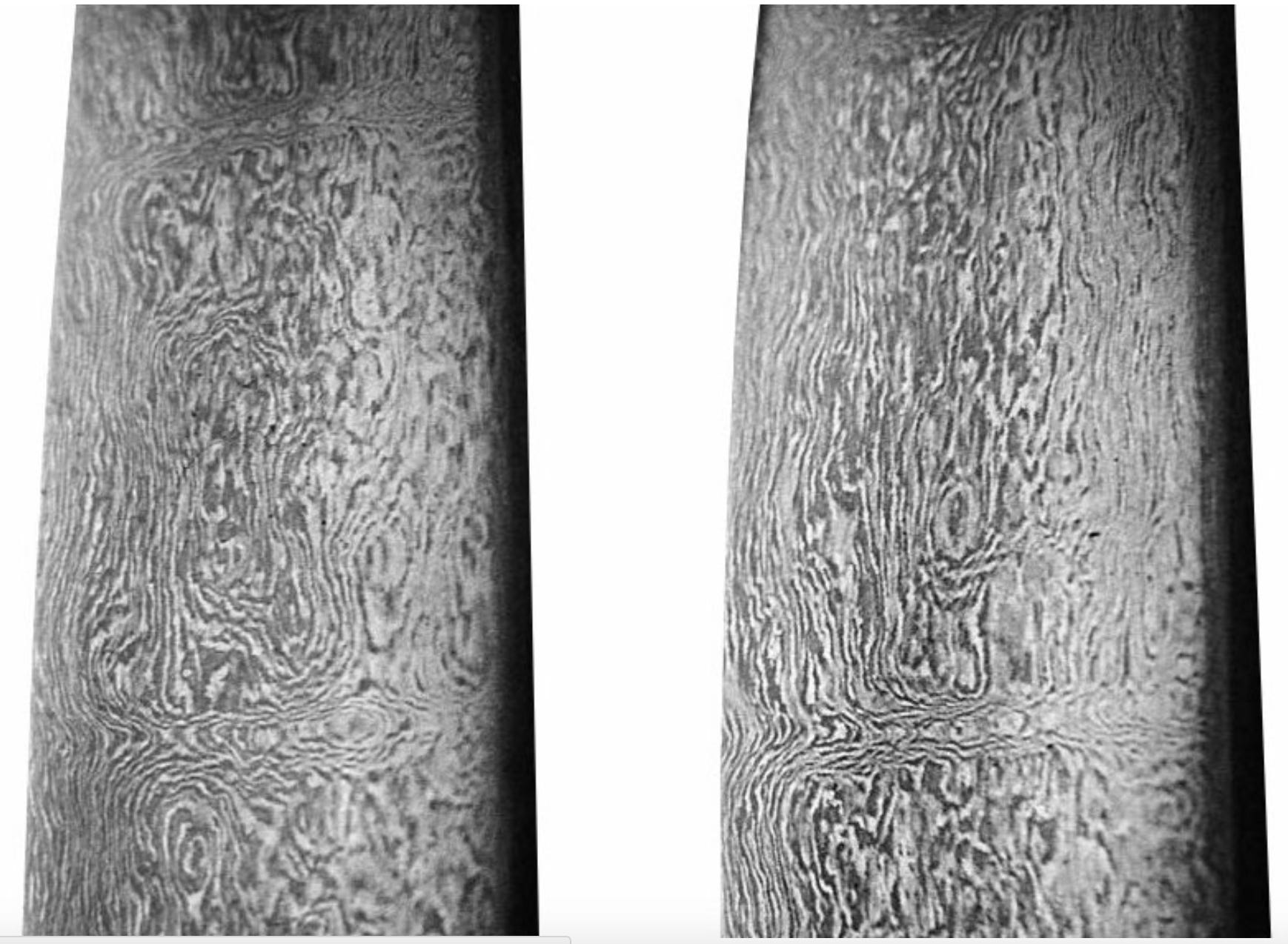
Metals are made of a field of clusters of crystals that have many dislocations between the clusters. Dislocations are what ultimately make metals useful - they allow the metal crystals to move and change shape, to be sharpened and form cutting edges, or be molded, hammered, or folded into different shapes.
“The melting point of a metal is an indicator of how tightly the metal atoms are stuck together and so also affects how easily the dislocations move. Lead has a low melting point and so dislocations move with consummate ease, making it a very soft metal. Copper has a higher melting point and is stronger.”
Alloys work by substituting different metals in the crystal structure, which changes the overall networks of crystals and the pattern of dislocations, and makes metals stronger.
Smelting tin and arsenic together with copper is what gave us the Bronze Age, and is also why the god Hephaistos is famously portrayed to be lame and / or deformed.5
“Alloys tend to be stronger than pure metals for one very simple reason: the alloy atoms have a different size and chemistry from the host metal’s atoms, so when they sit inside the host crystal they cause all sorts of mechanical and electrical disturbances that add up to one crucial thing: they make it more difficult for dislocations to move. And if dislocations find it difficult to move, then the metal is stronger”
This same effect gives us various colored gemstones - rubies, sapphires, and corundums are all aluminum oxide, with various different chemicals (iron or titanium for sapphires, chromium for rubies) in the crystalline matrix giving the different colors and optical properties.
Chromium (and carbon) gives us something else besides rubies too - stainless steel.
“In 1913, as the European powers were busily arming themselves for the First World War, Harry Brearley had the job of investigating metal alloys in order to create improved gun barrels. He was working in one of Sheffield, England’s metallurgy labs, adding different alloying elements to steel, casting specimens, and then mechanically testing them for hardness. Brearley knew that steel was an alloy of iron and carbon, and he also knew that lots of other elements could be added to steel to improve or destroy its properties. No one at the time knew why, so he proceeded by trial and error, melting steels and adding different ingredients in order to discover their effects. One day it was aluminum, the next it was nickel.
Brearley made no progress. If a new specimen turned out not to be hard, he chucked it in the corner.”
Later, amongst the heap of rust-red metal, he saw a piece that was still shiny - he had accidentally created stainless steel. It is made from chromium and carbon being inserted into the iron’s crystalline matrix. The chromium reacts with oxygen before the iron can, creating chromium oxide, and preventing rust and healing scratches.
“Chromium oxide is a transparent, hard mineral that sticks extremely well to steel. In other words, it doesn’t flake off and you don’t know it is there. Instead it creates an invisible, chemically protective layer over the whole surface of the steel. What’s more, we now know that the protective layer is self-healing; when you scratch stainless steel, even though you break the protective barrier, it re-forms.”
Brearley made silverware from it, and for the first time, average people were able to eat with a fork or spoon while imparting no additional taste to the dishes being eaten.
“it’s the transparent protective layer of chromium oxide that makes the spoon tasteless, since your tongue never actually touches the metal and your saliva cannot react with it; it has meant that we are one of the first generations who have not had to taste our cutlery. ”
On the subject of taste, let’s take one final detour into chocolate.
Chocolate
“I prefer to think it’s because I truly appreciate that chocolate is one of our greatest engineering creations. It is certainly no less remarkable and technically sophisticated than concrete or steel. Through sheer ingenuity, we have found a way to turn an unpromising tropical rainforest nut that tastes revolting into a cold, dark, brittle solid designed for one purpose only: to melt in your mouth, flood your senses with warm, fragrant, bittersweet flavors, and ignite the pleasure centers of the brain. Despite our scientific understanding, words or formulae are not enough to describe it. It is as close as we get, I would say, to a material poem, as complex and beautiful as a sonnet. Which is why the Linnaean name for the stuff, theobroma, is so appropriate. It means “the food of the gods.”
Chocolate, much like steel, and also like coffee, is a product of carbon and heat.
It’s also a product of fermentation! When chocolate is harvested, the pods are broken open and left in a heap for a while to ferment, and it is from this, much of the flavor and aromatic complexity of chocolate derives.
Much like wine, it is a complex process that can be affected by innumerable variables - the ratios of ingredients, the temperature and humidity, the amount of oxygen, and much else.
“This means that the taste of chocolate is highly dependent not just on the ripeness and species of the cocoa bean, but also on how high the rotting piles of beans are stacked, how long they are left to rot, and generally what the weather is like.
If all this makes you wonder why chocolate makers rarely talk about these subtleties, it is because they are a secret. On the face of it cocoa seems to be like other commodities: a basic ingredient, like sugar, that is bought and sold on world markets, fueling a billion-dollar industry in edible products. But what is much less talked about is that, just like coffee and tea, different varieties of bean and different techniques of preparation create vastly different tastes. A detailed understanding of both is required to buy the right beans”
Only after fermentation are the beans roasted, which carmelizes sugars and carbohydrates and initiates the Maillard reaction between sugars and proteins in the bean6, turning each bean into a complex chemical factory where several reactions take place. The reason anything turns brown when heated is carbon, of course. Being an organic molecule, carbon makes up the bulk of chocolate beans.
Then there are at least 5 different types of fat crystals within the chocolate as we eat it (created by cocao butter and chocolate forming different packing patterns), each with different physical properties and melting points. The most desirable is Type V crystals, the densest, and which gives chocolate a mirror-like finish and the characteristic “snap” when biting into it. They have to be created via tempering and the addition of preformed “seed” Type V crystals, and have a higher melting point.
“Now, in your mouth, they experience higher temperatures for the first time. This is the moment they have been created for. It is their first and last performance. As they warm up and reach the threshold of 34°C they start to melt.
This change from solid to liquid—a so-called transformation of state—requires energy to break the atomic bonds that are holding the molecules of a crystal together, thus freeing them to move around as a liquid. So as the chocolate reaches its melting point, it takes this extra energy that it needs from your body. The chocolate gets this energy in the form of latent heat, as it is called, from your tongue. You perceive it as a pleasant cooling effect, similar almost to sucking a mint.
“The genius of creating hot chocolate in the mouth is that the cocoa butter encapsulates the flavor molecules until the moment you eat it, and only then does it release its cocktail of more than six hundred exotic molecules into your mouth and up your nose.”
And then, you get the full panoply - hundreds of ester flavor notes, similar to ones that appear in beer, wine, and fruit, the carmelized sugars and carbohydrates from heating, the roasted and savory notes from the Maillard-effected proteins and sugars, and all the rich complexity derived from fermentation, roasting, and careful fat crystal engineering combine to give you the full chocolate experience.
Carbon has linked all of these threads, as well as differing arrangements of atoms and molecules in 3d space, and how that affects the properties of any given material.
Thoughts on materials science
Miodownik closes on some meta-level thoughts about materials, including what separates living and non-living structures, and the future of materials.
Materials science, after all, is about mastering the complexity of inner structures. The difference between diamond and graphite isn’t in the atoms - they’re made of the exact same atoms - the difference is in their three dimensional structure. You can’t create just *any* 3d arrangement of atoms, that’s limited by quantum mechanics, but the array that’s possible to be created is vast and we’ve barely scratched the surface of engineering things at this level.
“Some of these quantum structures create electrons that can move, and this results in a material that can conduct electricity. Graphite has such a structure, and so conducts electricity. Exactly the same atoms in a diamond but in a different structure do not allow the electrons to move so easily within the crystal, and so diamonds do not conduct electricity. It is also why they are transparent.
This apparent alchemy illustrates that even with a very restricted set of atomic ingredients you can create materials with wildly different material properties. Our bodies are very good examples of this: we are mostly made of carbon, hydrogen, oxygen, and nitrogen, and yet through subtle rearrangements of the molecular structure of these ingredients, and the sprinkling of a few minerals such as calcium and potassium, an immense diversity of biomaterials results, from hair, to bone, to skin.”
Things exist at many different scales - the atomic, the nanoscale, the microscopic, the macroscale, and the miniature scale.
We’ve already looked at the atomic scale quite a bit, with carbon’s various forms, with metallic crystals, and more.
The nanoscale (roughly a billion times smaller than us) includes the proteins and fats in our bodies, plastics, carbohydrates and sugars, and more. Things at this scale largely self-organize, because gravity at this scale is weak relative to electrostatic and tension forces.
The microscopic is the realm of biological cells, silicon chips, the crystals that dictate the taste and behavior of chocolate, and cellulose fibers in plants and paper.
“The macroscale binds together the atomic structures, the nanostructures, and the microstructures. It is just on the edge of what we can see. The touch screen of a smartphone is a good example of such a structure. It looks smooth and without detail, but if you put a drop of water on the screen it acts as a lens and allows you to see that it is in fact made of tiny individual pixels of red, green and blue.”
The miniature scale is just visible - the scale of a needle and thread, or strands of hair. Wood, ropes, blankets, and clothes are made at this scale, although their characteristic look and feel, and their strength, flexibility, and other properties result from their atomic, nano, micro, and macroscale properties.
"a thread of cotton may look superficially similar to a thread of silk or Kevlar, but it is the hidden detail of their atomic-, nano-, micro-, macro-, and miniature structures that makes the difference between something that can protect against a knife or feel as smooth as cream. It is at this scale that our sense of touch engages with materials.”
Finally, he points to a future of integrated engineering from the bottom up, giving us living materials, self-healing, and perhaps even self-assembling macro structures.
“Although designing structures at different scales has allowed us to design new materials, the real challenge of the twenty-first century is to link up designed structures at all of these scales into a macroscopic human-sized object. Although smartphones are an example of such integration, combining a macroscale touch-sensitive screen with nanoscale electronics, the possibility that whole objects might be wired up throughout, as if permeated by an entire nervous system, is now becoming conceivable. And if we can achieve this, then one day whole rooms, buildings, perhaps even bridges may generate their own energy, funnel it to where it is needed, detect damage, and self-heal. If this seems like science fiction, bear in mind that it is only what living materials do already.”
“living matter is, in some sense, no different conceptually from non-living matter. What dramatically distinguishes the two is that in living materials we find there is an extra degree of connectivity between the different scales: living materials actively organize their internal architecture. They do this by setting up communication between the different scales of the organism. In a non-living material, a mechanical stress imposed at the human scale has all sorts of effects at different scales, causing many internal mechanisms to react in response: as a result it might change shape or break or resonate or stiffen. A living material, on the other hand, can detect that such a stress is occurring and adopt a course of action in response: it might push back, or it might instruct the whole organism to run away. Obviously there is a vast range of such animated behaviors: the branch of a tree behaves passively, as if it were an inanimate material, most of the time, while the leg of a cat is most definitely animate most of the time. One of the biggest questions in science is whether communication between the scales combined with active responses is a sufficient explanation of what makes something alive.”
If you enjoyed this foray into the material world at all, you would probably enjoy Miodownik’s book, Stuff Matters, as well, where he dives into paper, glass, plastic, aerogel, porcelain, concrete, and other materials in a similarly engaging and wide-ranging way.
Some fun facts - carbon 14 is created constantly by cosmic rays hitting the atmosphere, creating C14, which then gets incorporated into living things via photosynthesis (and eating or making artifacts from said plants). The oldest you can use it for is ~50kya, because by then 99.8% will have decayed. Two modern processes mess with the ratio of C14 in the air - fossil fuels have no C14, so vehicle emissions reduce it, and atmospheric nuclear tests increase it - atmospheric C14 ~doubled after 1965.
With the earliest examples recorded in ancient Hindu writings, and with diamonds hailing from what is now India, which was the source of all diamonds in the world until diamonds were discovered in Brazil in 1726.
“[carbon fiber in] bikes probably reached its zenith in Chris Boardman’s classic sporting rivalry with Graeme Obree to beat “The Hour” record: the competition that seeks to determine the furthest a human being can travel in one hour under their own power. In the 1990s both cyclists were able to smash the world record and then each other’s records repeatedly with the help of ever more sophisticated carbon fiber bicycles. In 1996 Chris Boardman rode 56.375 kilometers in one hour and provoked an outcry from the International Cycling Union. They promptly banned the use of these new carbon fiber–inspired designs, so worried were they by how radically the bikes would change the nature of the sport.”
Baati et al, The prolongation of the lifespan of rats by repeated oral administration of [60]fullerene, (2012), DOI: 10.1016/j.biomaterials.2012.03.036
“Hephaistos, the Greek god of metals, fire, and volcanoes, whose classical image is that of a smith at a forge. Physically handicapped, he is misshapen, suffering probably from arsenicosis, an infliction common to smiths of the time, who were exposed to high levels of arsenic poisoning during the smelting of bronze, which resulted in lameness and skin cancers.”
Yes, chocolate beans contain proteins as well as sugars and carbohydrates. Seeds must contain all the proteins needed to get the cellular machinery of a plant up and running.
“When subjected to temperatures of 160°C and above, these proteins and carbohydrates start to undergo Maillard reactions, reacting with the acids and esters (produced by the earlier fermentation process) and resulting in a huge range of smaller flavor molecules. It is no exaggeration to say that without the Maillard reaction the world would be a much less delicious place: it is the Maillard reaction that is responsible for the flavor of bread crust, roasted vegetables, and many other roasted, savory flavors. In this case, the Maillard reaction is responsible for the nutty, meaty flavors of chocolate, while also reducing some of the astringency and bitterness.”