

This is the first Gigerenzer book I read, and I was just hate reading it the whole time, jumping to my notes and writing all sorts of double question-marked, ALL CAPS rejoinders, and wondering how I had gone so far astray as to read somebody this bad.
I entertained and rejected several hypotheses - he was doing it performatively, he was genuinely a moron, he was doing it purely to milk rubes for money, he was hopelessly blind on just this one topic…
So I hopped to two of his other books and quickly skimmed them - Risk Savvy (2014) and Gut Feelings (2007) - to see if he was ACTUALLY a moron, and to get a better sense of where he was coming from.
And those other books were actually decent! Old hat for somebody in the rationalist-sphere by now, all heavily trodden territory and cached ideas by now, but for the time they were published, they were well written, useful, and I would have admired them greatly if I’d read them within a few years of publication.
So what is going on?
Gigerenzer’s thesis in How to Stay Smart is that humans are not irrelevant in a world of algorithms and machine learning and AI, and they should “continue to be in charge of their decisions” whatever that means. He couches this in bland, populist platitudes:
“As these technologies become more widespread and dominant, I want to provide you with strategies and methods to stay in charge of your life rather than let yourself get steamrolled. Should we simply lean back and relax while software makes our personal decisions? Definitely not.”
“My deeply held conviction is that we human beings are not as stupid and incapable of functioning as is often claimed—so long as we continue to remain active and make use of our brains, which have developed in the intricate course of evolution. The danger of falling for the negative AI-beats-humans narrative and passively agreeing to let authorities or machines “optimize” our lives on their terms is growing by the day, and it has particularly motivated me to write this book. As in my previous books Gut Feelings and Risk Savvy, How to Stay Smart in a Smart World is ultimately a passionate call to keep the hard-fought legacies of personal liberty and democracy alive.”
Honestly, the whole book is full of boo-lights, woke bait, cherry picking, and vibes.
I mean, first, I would absolutely bet pretty serious money TODAY that if we had two populations of 18 year olds, one of them making their personal decisions according to their “personal liberty” and the other one strictly and conscientiously executing the advice that GPT-4 proffers when given a multi-polar goal like “I want to have a good career and a great spouse and happy relationship, what should I do to get there?” that the GPT-4 population is going to end up significantly better on every front.
And that’s not even getting into GPT-5 and higher minds, which I would give a totally blind estimate as doing noticeably better on that problem.
But it’s not just his unavoidable ignorance of GPT-4 (the book was published in 2022, so probably written in 2021, the most he could have seen and written about was GPT-3, coming out in 2020, but he did not mention any of GPT, Dall-E or any other 2020-2022 cutting edge platform at all), he has a full and completely unjustified disdain for algorithms and modeling driving better outcomes fully generally.
He posits the “Stable World Principle” as what will keep humans relevant:
“Complex algorithms work best in well-defined, stable situations where large amounts of data are available. Human intelligence has evolved to deal with uncertainty, independent of whether big or small data are available.”
Lol. Well, good luck with that.
He then pulls out some howlers:
“If you apply for a job, an algorithm may screen your application and recommend whether you should be invited for an interview. If you get arrested, the judge may consult a risk assessment tool to calculate the probability that you will reoffend before your court date, and then decide whether you should be bailed or jailed. If you get cancer, the hospital may rely on a big data algorithm to design personalized treatment for you. If you are a social worker, you might be sent to families in your community whom an algorithm deems to be at the highest risk. In all of these situations, there is a lack of good theory, reliable data, or a stable world. Hence, AI’s miraculous power is often a mirage.”
“In situations of uncertainty, in contrast, we cannot know all possible outcomes or their consequences ahead. That is the case when hiring an employee, forecasting an election, or predicting infection rates of the flu or COVID-19”
So…your solutions are that humans should read every one of the ten thousand applications per open position?
Or humans should completely ignore base rates and data, and just go by gut on whether you should be bailed or jailed? People complain the *models* are racist, when they’re explicitly made without race as a variable, imagine your method!
You think people will forecast an election BETTER, without computers?? Or that they’ll do better at predicting flu or COVID spread? What universe does this guy live in??
He seems to think that because algorithms aren’t literally flawless and are MERELY 10-10,000x better than humans at these tasks, that the computers are failing. But what is his point of reference?? The unaided humans are going to do MUCH WORSE, on every possible front.
Okay, okay. I’m slinging ALL CAPS words here at an alarming rate, so I’m gonna back off and cool down.
What is this guy’s problem? Is he being willfully obtuse, or what?
Going by his other books, I think Gigerenzer is A) a hopelessly blind optimist, and B) deeply commited and ossified in one particular paradigm of problem solving.
Hopelessly blind optimism
Repeatedly, he advocates for “better education” as solving our problems. He points to the following as his nemesis / antithesis:
“Human beings are fallible: lazy, stupid, greedy and weak,” an article in the Economist announced. We are said to be irrational slaves to our whims and appetites, addicted to sex, smoking, and electronic gadgets. Twenty-year-olds drive with their cell phones glued to their ears, oblivious to the fact that doing so lowers their reaction time to that of a seventy-year-old. A fifth of Americans believe that they are in the top 1 percent income group and just as many believe that they will soon be there. Bankers have little respect for people’s ability to invest money, and some doctors tell me that most of their patients lack intelligence, making it pointless to disclose health information that might be misunderstood in the first place.”
All of that seems very plainly and straightforwardly true. But no,
“This fatalistic message is not what you will read in this book. The problem is not simply individual stupidity, but the phenomenon of a risk-illiterate society.”
From Risk Savvy - his basic thesis is that if we just made people better at statistics, base rates, and risk evaluation, entirely ignoring his immediately following point that “Many doctors, financial advisers, and other risk experts themselves misunderstand risks or are unable to communicate them in an understandable way,” all will be well.
It is VERY obvious Gigerenzer is an academic and spends literally all his time around IQ 110+ academics and college kids.
Looking him up, he’s actually spent the last 30 years at the Max Planck Institute, which is a world class “elite of elites” operation, so he is probably spending all his time in an entirely 130+ IQ population.
Indeed, if your average interlocutor is a 110-140+ elite college student or academic, I completely agree, making them better at statistics and base rates is absolutely possible and a good thing to do, and will help them make better decisions.
But what are you supposed to do with the OTHER 75-98% of humanity??
Does he have any experience trying to “educate” median people at all?
“Weinberg and I joined forces and designed an experimental program in schools, where young people are not told what to do and what not to do but instead learn what the health risks are and how they will be lured by advertising and their peers into unhealthy behavior. The program teaches skills such as the joy of cooking, knowledge of how one’s body functions, healthy activities, basic scientific attitudes such as asking questions and finding out answers by doing experiments, and awareness of where to look up trustworthy information.”
This is the closest he comes. A typical pie-in-the-sky, maximal-dreamer plan, obviously crafted with the self-motivated IQ 110+ students he probably interacts with on a daily basis as his tacit model for what would work.
Needless to say, it did not survive contact with the enemy - the enemy in this case being administrators, who probably figured it wouldn’t survive contact with actual median children, for pretty good reasons.
“Instead he spoke about the promises of big data for curing cancer. Weinberg and I could not believe our ears. Afterward, we talked to him, but to no avail. The head of the society had been persuaded otherwise, not wanting to fall behind all the other organizations that fund big data research. That was the end of our project to make young people health literate. All the funding went to the industry.”
Don’t worry, base rates say you would have made extremely negligible impact anyways:
“Basic scientific attitudes” are theoretically a staple of all childhood education now, and have been for many decades. What’s that you say? It’s not working? Well guess what, that’s because it *doesn’t* work, fully generally. Any program to reach the 97% needs to work on average people, with average teachers. It can’t, that’s why it doesn’t happen. In fact, Greg Clark has pointed out that for all the hundreds of billions developed countries spend on equalizing educational access, across countries as diverse as Sweden, the UK, the US, and Japan, it has not affected intergenerational mobility one jot. As in, with or without public state funded education past the university level, it will not affect people’s chances of doing significantly better in income, educational attainment, or achieving a high prestige career. See my review for more.
“Learn what the health risks are.” Oh, like DARE - the program to “educate” kids about drugs, taught to 36M kids each year, about which “Scientific evaluation studies have consistently shown that DARE is ineffective in reducing the use of alcohol and drugs and is sometimes even counterproductive -- worse than doing nothing. That's the conclusion of the U.S. General Accounting Office, the U.S. Surgeon General, the National Academy of Sciences, and the U.S. Department of Education, among many others.”1
Or smoking? The biggest factors for smoking are parental smoking, peers, and SES. How are you going to “educate” yourself away from those things?
Teach them “healthy activities.” Do you know the very best exercise interventions studied, across hundreds of different interventions, increase physical activity by ~5 minutes per day? Most are actually much weaker in effect than that.
But again, he obviously designed this with his usual bright, conscientious and self-motivated students in mind, seemingly entirely ignorant that 90%+ of humanity is nothing like that.
“My deeply held conviction is that we human beings are not as stupid and incapable of functioning as is often claimed
How to Stay Smart. So yeah, you know, I’d probably think this too if I’d spent the last 30 years at Max Planck Institute surrounded by elites and nobel laureates all day every day.
“With this book, I invite you on a journey into a largely unknown land of rationality, populated by people just like us, who are partially ignorant, whose time is limited and whose future is uncertain. This land is not one many scholars write about. They prefer to describe a land where the sun of enlightenment shines down in beams of logic and probability, whereas the land we are visiting is shrouded in a mist of dim uncertainty. In my story, what seem to be “limitations” of the mind can actually be its strengths.”
Gut Feelings. So broadly, he is a severe optimist, who has only ever spent time around IQ 130+ academics and students, and who correspondingly thinks “more education” or worse, “listening to your gut,” is an appropriate and useful panacea for the median person.
And this brings us to his other defining characteristic - ossification:
“I have devoted much of my research to contributing to it in terms of mathematical models for decision making under uncertainty. This next step is what I call the “heuristic revolution.” It requires learning how to deal with uncertain worlds with the help of smart rules of thumb.”
THIS is why he’s so anti-algorithm.
He’s literally spent his entire career creating heuristics, rules of thumb, and sparse decision trees that IQ 110+ people can follow usefully to make better decisions. Additionally, he’s probably explicitly been called in to do this in multiple “the algorithms have failed” situations. Honestly, that’s a great and admirable thing - I’m glad he spent his time and brainpower on this, and I would bet he’s driven a lot of value in the world because of it. But I think he’s entirely missed the ML revolution, and has DEFINITELY missed the transformer / AI revolution going on as we speak, and is filtering the few things he’s heard of both through a rigid and antagonistic lens.
Not to mention the fact that he’s 77 years old now.
So, okay!
I think I see where he’s coming from.
He lives in a fantasy land of IQ 130+ people and has for the last 3 decades, and he’s dedicated his career to simple heuristics and decision trees smart people can follow,2 and has been called in to correct misbehaving algorithms his whole life.
If I were in those shoes, I’d probably be pretty skeptical of any ML or AI revolutions too.
But MAN has he missed the boat.
The entire corpus of How to Stay Smart is just one cherry-picked algorithmic failure after another, one totally biased and bone headed prediction after another (for instance, he asserts we will NEVER have self-driving cars).
But what does he think has been driving progress, economic growth, and scientific advance since roughly 2012?
I can tell you what HAS NOT been driving those things - simple heuristics used by unassisted humans.
I led data science teams for a good bit, and we drove many tens of millions of dollars in NPV value with ML every single year. And we were just one team in one company, imagine this scaled to all of humanity!
The world is more complex, data is bigger, and ML algorithms are good enough to drive trillions of dollars of value every year. GPT-4 TODAY is smarter than 90% of the population, and GPT-5 is going to be significantly smarter than that.
Gigerenzer’s book is the last gasp for human relevance, from an old man who can only see and perceive downsides and failures in machine learning and AI.
But, you know, maybe that can be interesting too.
What’s hilarious about Gigerenzer is he has this whole “people are smart, you just need to educate them!” conceit, but he’s great at digging up examples of widespread and collective stupidity:
“For instance, a study of 3,446 digital natives showed that 96 percent of them do not know how to check the trustworthiness of sites and posts.”
“Did you have to wait for a long time when calling a service hotline? It could be that your address or a prediction algorithm indicated that you are a low-value customer. Have you noticed that the first result in a Google search is not the most useful one for you? It is likely the one for which an advertiser paid the most. Are you aware that your beloved smart TV may record your personal conversations in your living room or bedroom?”
“If none of this is new to you, you might be surprised to learn that for most people it is. Few know that algorithms determine their waiting time or analyze what smart TVs record for the benefit of unnamed third parties. Studies report that about 50 percent of adult users do not understand that the marked top search entries are ads rather than the most relevant or popular results.”
“Similarly, when Mark Zuckerberg had to testify on Facebook’s latest privacy controversy to politicians from the US Senate and House, the most stunning revelation was not what he said in his rehearsed responses. It was how little US politicians seemed to know about the opaque ways in which social media companies operate.”
“When the largest credit scoring company submitted its algorithm, the authorities admitted to lacking the necessary expertise in IT and statistics to evaluate it. In the end, the company itself bailed them out by selecting the experts who wrote the report, even paying their fees. Ignorance appears to be the rule rather than the exception in our smart world. We need to change that quickly, not in the distant future.”
“There is also a more charitable but even more alarming explanation. Quite a few social scientists do not appear to understand that fitting is not prediction, a confusion that has a long history and has been documented in many other studies.”
“Based on this dismal view of the general public, a publication by Deutsche Bank Research features a list of errors that we “Homer Simpsons” commit against rationality. Popular books rehearse this message, portraying Homo sapiens as “predictably irrational” and in need of “nudges” into behaving sensibly by the few sane people on earth.”
“Many doctors, financial advisers, and other risk experts themselves misunderstand risks or are unable to communicate them in an understandable way.”
“AI will tell us what to do, and we should listen and follow. We just need to wait a bit until AI gets smarter. Oddly, the message is never that people need to become smarter as well.”
Gee, I wonder why people never assert that people need to become smarter after lists like this, when doctors, financial advisers, scientists, and Congressmen, who have been pre-selected for much higher IQ and significantly more education than the median person, are reliably bad in the same predictable ways?
It’s like he’s had zero contact not just with the rational sphere, but with Kanneman and Tversky’s ideas entirely, but we know that’s not true, because he explicitly decries Ariely and “nudges” up there. Which is funny, because “nudges” are exactly the kind of “fast, human understandable heuristics” that he should be a fan of!
What he really needs is a grounding in evo psyche. People are bad at reasoning and logic and decisions for a reason - the brain wasn’t created for those things.
As I went over in the Why We Fight review, the brain was created to persuade other people that you deserve a bigger share of mammoth meat and to convince other people to have sex with you.
Reasoning wasn’t selected for, it was an accident, a lagniappe we stumbled into by making our internal “PR firms” so good at their jobs they accidentally invented general intelligence.
Once you understand this, you understand that “educating” people, or exhorting them to be smarter, or believing that “being smarter” is even an option for any but the top 5-20%, is mistaken.
He really should have spent more time around Richard McElreath or Paabo Svante at Max Planck, maybe he would have picked up on some of this.
Let’s just pick out some howlers
“Given these uncertainties, the stable-world principle questions the widespread commercial fairy tales that self-driving cars are just down the road.”
Literally at the time he is writing this, end consumers have been able to book a fully autonomous self driving car for 2-3 years.
“There will be no self-driving cars (Level 5 automation). Rather, a fundamental change will happen: our cities and roads will be redesigned to create the stable and predictable environment that algorithms need (Level 4 automation), such as wired highways from which human drivers are banned”
Studies indicate that Waymo's autonomous cars experience 85% fewer injury-causing crashes and 57% fewer police-reported crashes per mile compared to human-driven vehicles.
The vast majority of those crashes were human-piloted cars plowing into the backs of the Waymos.
Think of how dumb and conscientious the average person is. Now put them behind the wheel of a 2 ton truck or SUV going 80mph, and let them text, eat whatever they want, listen to music at high volumes, yell at their crappy kids, and try to deep fry donuts. This is the median driver! It is NOT hard to beat that!

The median driver On Germany making terrible self driving rules:
“These include that human lives should have priority over animals’ lives and that discrimination by age, gender, or any other personal feature should be prohibited.”
Then he’s shocked, *shocked* that literally millions people across 200 countries disagree with him when surveyed.
“A study with millions of people in over 200 countries found that most disagreed with these ethical rules, apart from sacrificing dogs and cats instead of humans. For the scenario with the three elderly pedestrians, the far majority voted that the AI should be programmed to kill the pedestrians rather than the car occupants. After all, they are old and are disobeying the law by jaywalking. In general, the majority of people worldwide showed rampant discrimination and did not consider their fellow humans equally.”
“People would generally save the life of a human above a dog’s but not if the human was a criminal. Similarly, people of lower social status and homeless people were considered less worthy to be spared.”
Shocked dowager face. “My word! These scandalous unenlightened people, what SHALL we do with them, Mr. Moneypenny?”

Can you BELIEVE these people value their own and their in-car family’s lives over criminals, elderly jaywalkers and homeless people??
It’s a stupid thing to worry about anyways. Given that self driving cars are 7x safer than humans already, it will be able to save EVERYONE much more often. Also, consumers will obviously prefer cars that prioritize owner / passenger lives over people outside, so that is what car manufacturers will offer for sale unless directly legislated not to. When a menacing, torch-bearing mob is chasing you and wants to do you violence, you want your car freezing because it respects all life equally?
“But every analogy has its limits. If the mind were a computer, we could calculate the square root of 1,984 in a fraction of a second. If a computer were a mind, it could just as easily pass the CAPTCHA for proving that you are not an algorithm”
Guess which one of those is 100% solved, and on which side?
On neural net image recognition: “The network doesn’t know that a picture represents something in the real world; it has no concept of things.”
Guys, guys…this dude’s visual centers have no concept of things, all they have is stuff like edge detectors and contrast and color receptors! We can OBVIOUSLY say that Gigerenzer will never be able to “know” what a bus is!
“In the possible future where cars surveil their drivers and report traffic violations to the police”
“These two possible futures of autonomous driving illustrate a more general point. The question is how to make AI work in situations of uncertainty. One solution is 24-7 surveillance and behavior modification through immediate reward and punishment. This method makes humans more predictable. AI can more easily deal with people who follow rules and behave consistently”
Heavens! So now they’re not impossible and we’ll have self driving, but they’ll be reporting us to the police 24/7? The scandal! Now it’s AI fully generally as a panopticon police state. Have any other boo lights for us?
“Common sense is shared knowledge about people and the physical world enabled by the biological brain, and requires only limited experience.”
Limited experience?? It took 200M years of mammalian evolution at the least! Chimps have most of that stuff, and it took us an additional 7M years from chimps to get where we are today! Give OpenAI a million years. Hell, give them *5 years* and they’re gonna blow your socks off, full AGI or a reasonable facsimile.
“Without understanding, even a good translation system remains an idiot savant.”
There’s certainly an idiot and a savant here, but not sure it’s Google translate. I’ll estimate 1B+ distinct people have used Google translate and derived value from it. In lieu of that value, Gigerenzer would have us…what? Have the ~500 people who would have gone to those lengths hire full human translators “with understanding” at $50 an hour, instead of 1B people using Google Translate for free? That is not a better world, on any front.
He proudly points at flu infection clustering prediction, human matchmaking, weather prediction, and financial crises as instances when “machines fail.” “In situations of uncertainty, in contrast, we cannot know all possible outcomes or their consequences ahead. That is the case when hiring an employee, forecasting an election, or predicting infection rates of the flu or COVID-19”
So, what? You think unassisted humans will DO BETTER? These are inherently chaotic and / or self-reflective systems. You know what I WOULD predict, though?
I would absolutely bet on GPT-5 or Gemini doing better human matchmaking than the humans themselves swiping - he spends the whole first chapter on matchmaking and Tinder and websites, but he doesn’t seem to understand the concept of “revealed vs stated preferences,” which algorithms and AI will be *much* better at than humans swiping on profiles which are 50% lies.
The US actually sucks at weather prediction compared to Europe, explicitly because they use less computational power and don’t use the latest algorithms and techniques. Which way you gonna bet there?
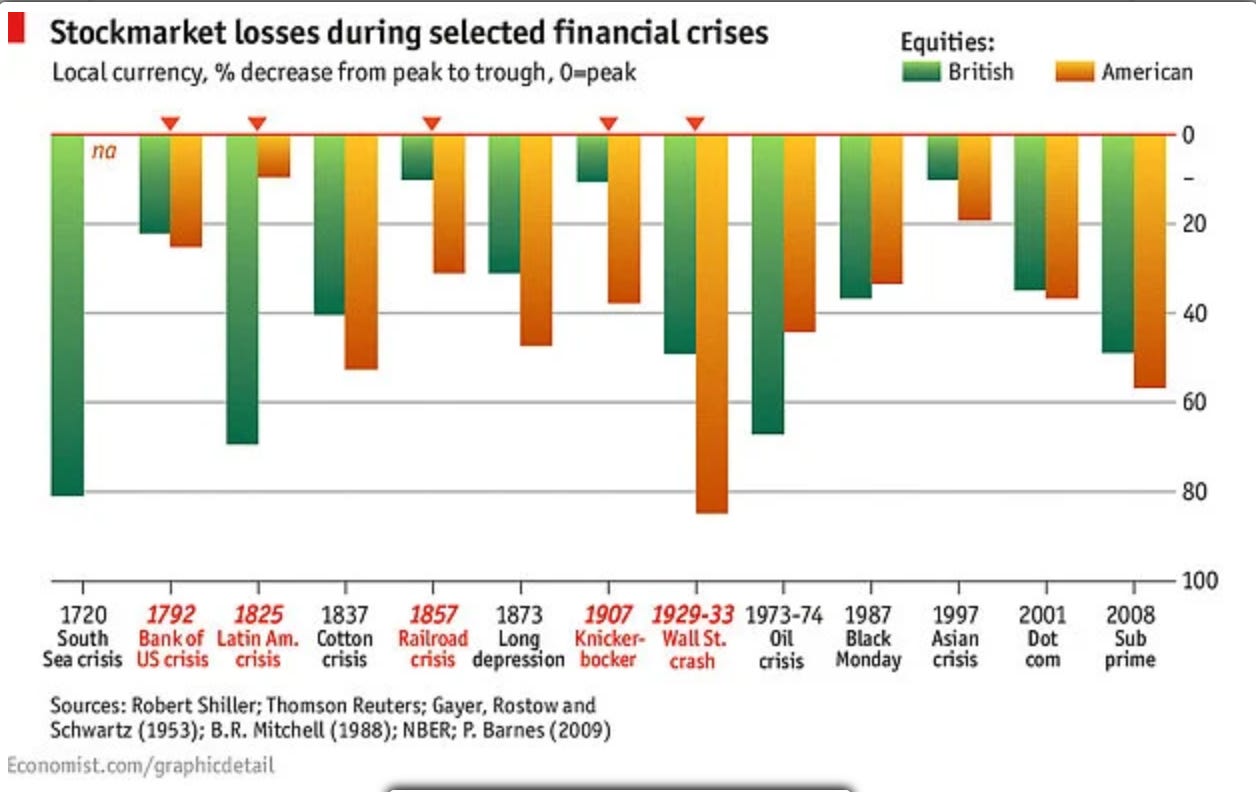
Does he think there were *fewer and less severe* financial panics, bubbles, and crashes back when it was good ole’ humans making REAL decisions, without those dastardly computers?
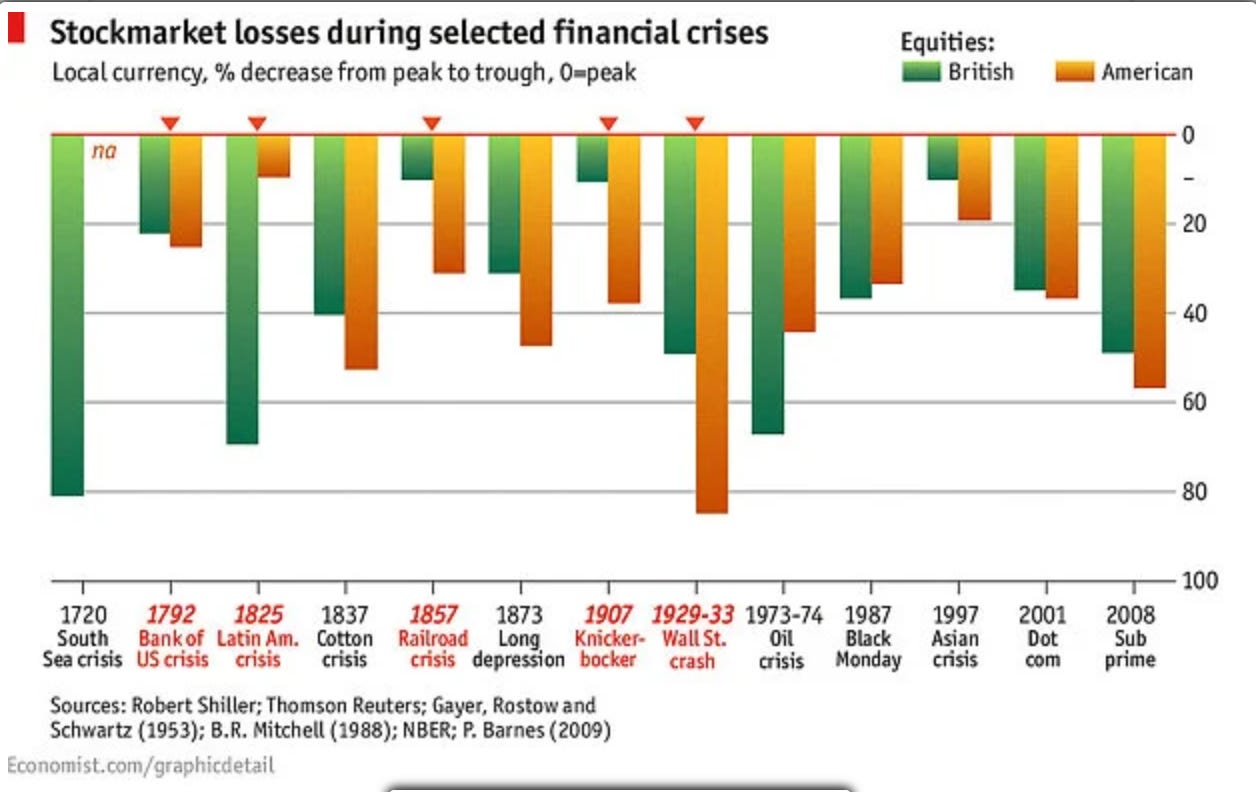
Not shown - the “crisis per capita” or “crisis per trade-volume” rates, which would shrink 2008 significantly
“The rate of Nobel laureates in a country can be “predicted” by its chocolate consumption. The more chocolate eaten, the more Nobel Prizes (figure 6.3). And the relation is extremely strong.”
Okay I love a good Tyler Vigen-esque spurious correlation as much as anybody, and he follows with four more directly from Vigen,3 but this is not a central example of “algorithms getting it wrong,” it’s a central example of “deliberately cherry picked to be funny” spurious correlations. It means nothing! Data scientists do cross validation, holdouts, out of time validation, dummy variables, factor analysis, and much else to avoid just these types of things!
Also, directly counter to his “people aren’t stupid” conceit, I bet if you showed people the Nobel-Chocolate graph, a good 10-30% would agree it was a good idea to try to increase chocolate consumption in their country, and be willing to vote for such a proposal!


All in all, I give it a solid F - flagrantly biased, riddled with boo lights, entire chapters full of woke bait and “racist algorithms,” and most importantly ZERO ADVICE OR USEFUL SOLUTIONS.
Not only does he not tell you how to “remain smart in a smart world,” or give you any insight at all into uniquely human value or behaviors in a world where computers have dominated chess, go, poetry, art, and essentially every other field of endeavor, the whole book is just “old man yells at cloud,” with cloud in this instance the AWS locations of various ML models.
It’s a real shame, because he actually brings up some salient points - AI and better technology DOES have the capacity to create un-revolutionable entrenched police states, we SHOULD make sure we’re smart about precision and recall and cross validation and domain understanding, we should try to find good heuristics wherever we can,4 but he’s exactly the wrong person to bring these up, because he’s so flagrantly biased, and so hopelessly optimistic and naive about workable solutions.
Sure, he can “educate” his 130+ IQ colleagues and students to be smarter about the decisions they make. What about the other ~97% of the population? Gigerenzer is silent, except for endless anecdotes and examples of profound collective stupidity, and except for bottomless, cherry-picked malice against algorithms.
https://alcoholfacts.org/DARE.html
And even THIS is extremely disengenuous, because the “fast, frugal heuristics” he’s generating in Gut Feelings and Risk Savvy are almost certainly created with the aid of computers!
One thing he never explains with his frugal rules is how you decide on the variables and cutoffs he bases his “take the best” rules on! Given the high number of variables, he’s almost certainly doing regressions or factor analysis with computers on the back end to decide on the “right” variables and cutoffs to produce his “take the best” rules. In any field where there’s not a screamingly naked-eye obvious top 2-3 variables, this is literally just “garden of forking paths “ hacking. How do you expect an average person to decide on the right criteria and cutoffs to generate fast heuristics like this? How do you expect even smart people without computers to do this well?? And if a smart person HAS a computer and the chops to do this in the first place, it’s *obviously* better to just xgboost or random forest the thing and get the *real* answer!
Who’s apparently added AI generated images to each spurious correlation now
Which frankly, great use case for GPT 5 or 6 - reducing the complexity of multipolar, complex problems to a simple ruleset that most humans can follow. Or just have a conversation with G5/6 about it. Highest value areas:
What job should I get?
Should I accept this particular job offer?
Who should I date of these options?
Would X make a good spouse?
I care about X, Y, and Z in a car, and the ordering is Y>Z>X, what cars should I consider?
What should I meal prep for the next week? I want to be at X calories a day and F,C,P macros.
I actually suspect the reason heuristics is “shamefully unexplored and under-studied” according to Gigerenzer is that it probably requires quite a high general intelligence to abstract useful heuristics from a complex domain in anywhere we care about, and is not something amenable to simple decision trees or automation, so you can’t just make a software package and let it loose on everything.