

Okay, so we all know about the Fertility Crisis, right? All the developed countries are going extinct, many consider this a bad or worrisome idea, etc.
Said crisis is happening for hundreds of interlocking reasons, but the big KPI people like to point to here seems to be marriage - marriage directly tracks fertility, and the decline in relationship formation and marriage drives most of the fertility gap since 2000.
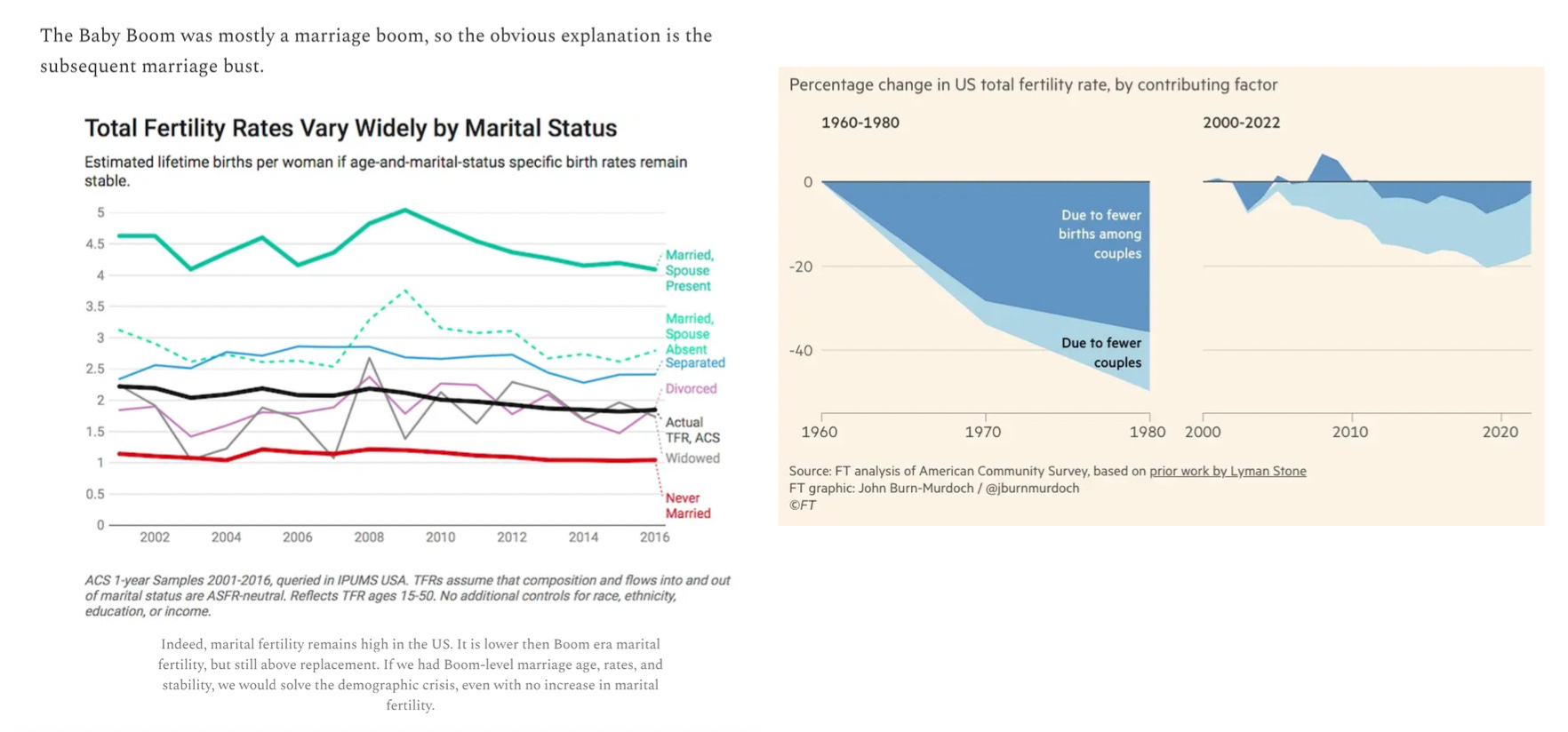
One of the main solutions to the Fertility Crisis that most folks seem to like is pro-marriage incentives and initiatives.
I am here to argue against this - these people are basically advocating for creating the Torment Nexus for megafolks of people to pump out a few incremental taxpayers.
My position? Let’s not create a Torment Nexus, please and thank you.
Aren’t I being totally histrionic and ridiculous here? Let’s see!
Secular marriage trends
First, they’re absolutely right that marriage is declining.
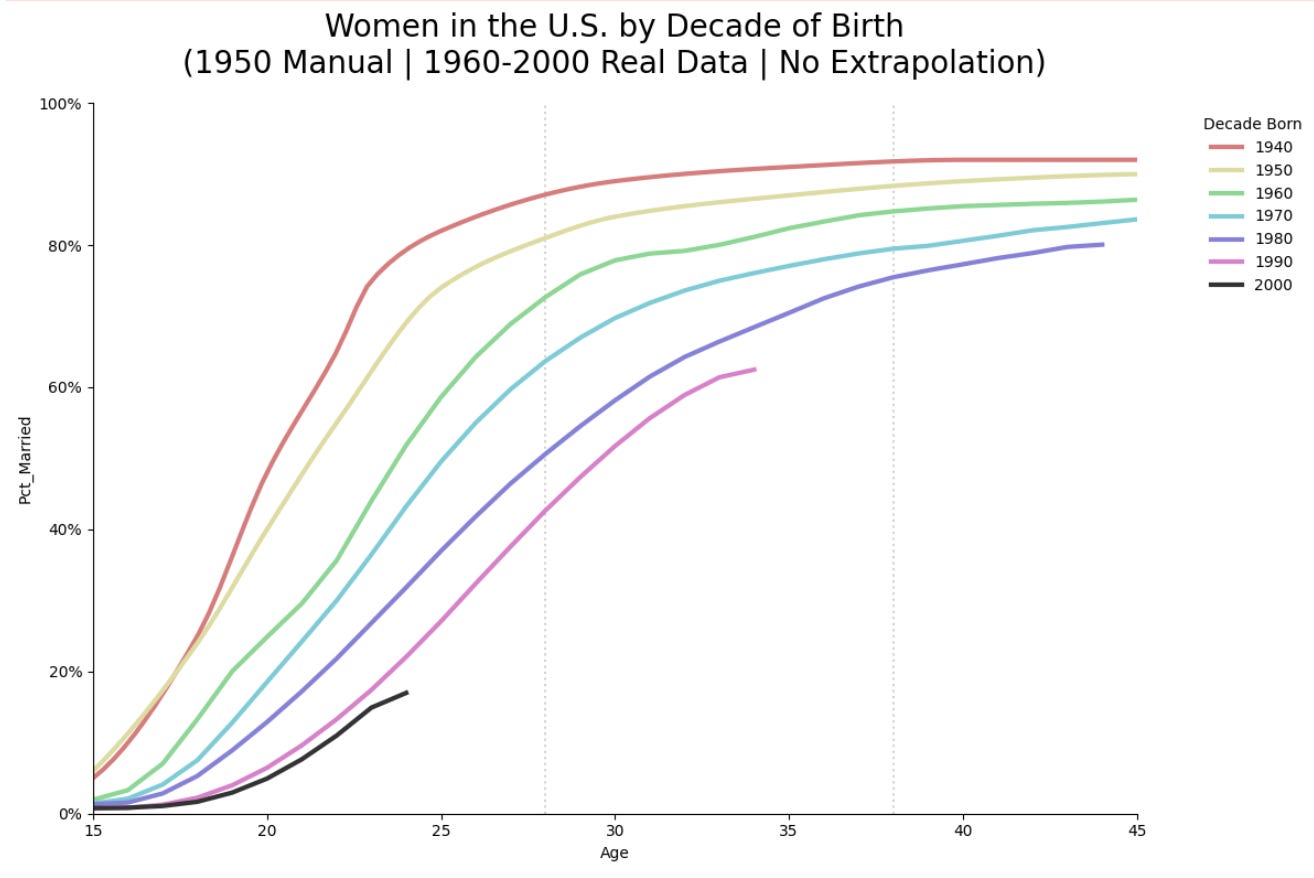
It has been declining every single generation since the 40’s, when we hit a local peak of ~90% marriage rates, which drove the Baby Boom.
Literally every single generation on generation since then, each cohort of women has looked out at the world, said “lol, nope” and opted out of marriage at higher rates than the one before:
And just as a note, I am framing this as primarily women’s choice, because 1) women are traditionally proposed to and say yes or no, 2) historically women are the sex that wants and pushes for marriage while in a relationship more often, 3) women getting educated and having jobs and careers of their own is a big part of “the fertility crisis” in the sense those things all reduce fertility when first introduced to a society, and in direct accordance with how broadly they’re ultimately adopted, and 4) women being able to have jobs and lives of their own gives them more options and is what enables them to opt out of marriage at ever-increasing rates.
I am here to argue that this gigantic reduction in marriage rates is an unambiguously good thing, and that the great majority of these ladies are genuinely making smart decisions.
Marriage is a bad idea in the great majority of cases
Broadly, people aren’t compatible, because people suck. When ~90% of women were married in the 40’s, it was an immense charnel house of suffering and wasted potential.
How do we know this? By just looking at actual outcomes, looking at revealed preferences and how people actually end up after marriage.
Obviously the “ever decreasing marriage rate for each generation of women” above is driven by something - what could that something be? I am here to argue that it is a genuine reaction to actual marriage quality and outcomes.
The empirical outcomes
Even *today,* when many fewer couples get married and marriage is significantly more selected, divorce base rates are ~42% for first marriages, and about half of the remaining marriages are net miserable for at least one party. That’s a roughly 2/3 failure + misery rate.
Think how net miserable those 90% of marriages were, that were not selected at all, and could NOT get divorced, back in the 50’s!
Moreover, of the marriages that stay together, all they predominantly do is make people fat and sexless and miserable.
Married weight gain is a strong effect seen in practically every country in the world, even after controlling for genes and personalities - for example, identical twins, one of whom marries and the other not, the married one typically gains significant weight.1
The Turnic et al (2024) meta-analysis surveys ~200k couples and ~100k matched singles across 18 countries, and surfaces a very strong effect size of marriage on obesity - 1.7 odds ratio, up to 2.5 odds ratio in economic downturns.
And the trend reverses! On divorce, both men and women lose weight.
Marriage has a ~70% failure rate
First, what do we know about marriage, from data and from observation? I’d say we know there are high divorce rates, high rates of one or the other party in a marriage being unhappy, high instances of sexual dissatisfaction, and high dead bedroom rates.
“High” is a fairly nebulous term, can we put any numbers to this, to really understand the base rates? We can.
ACS data tells us the “first marriage” divorce rate is ~42% (and for all marriages ~50%, because remarriages have higher divorce rates).
On “one or the other being net unhappy,” the National Survey of Family Health gives us data on this, by giving us a 1-7 Likert-like scale of marital satisfaction on both sides. I will argue in this footnote a decent cutoff is <=5 for “net unhappy,” based on the fact they have 2-5x higher divorce rates, 4-12x higher “serious problem” rates like people saying they’d be better off apart, and so on.2
55% of relationship have both parties rating their relationship 6-7 out of 7, which is an additional triangulation that this cutoff is probably reasonable. But that means 45%, or nearly half, of relationships have one or the other party net unhappy.

Maybe this isn’t fair, maybe all these people split up and leave only the happy marriages? You’d hope so, but no. Even in the rating tier with the highest divorce rates, 75-89% of them are still together 5 and 9 years later.3 The overwhelming majority of “one side net unhappy” relationships continue.
On dead bedrooms, as far as I can tell, a lot of sources consider <1 times a month to be basically a sexless marriage. In GSS, this ranges from 5-20% (and averages roughly 15%) across all marriages that have lasted at least 5 years, depending on how happy they are and how long they’ve been going. And obviously, there’s a giant survivor effect there, where the ~half of them that have been divorced were more likely to be sexless prior to divorce, so ~15% is the heavily survivor-biased portion of sexless marriages that already have a huge thumb on the scale in terms of upping the amount of sex. This is to say that I personally think some much larger portion of marriages attain sexlessness, it’s just that the majority of those end up divorced, leaving our relatively more modest ~15% remainder.
We can separate the independent fractions of all of these.
So let’s sum up the empirical results of marriage given all this info:
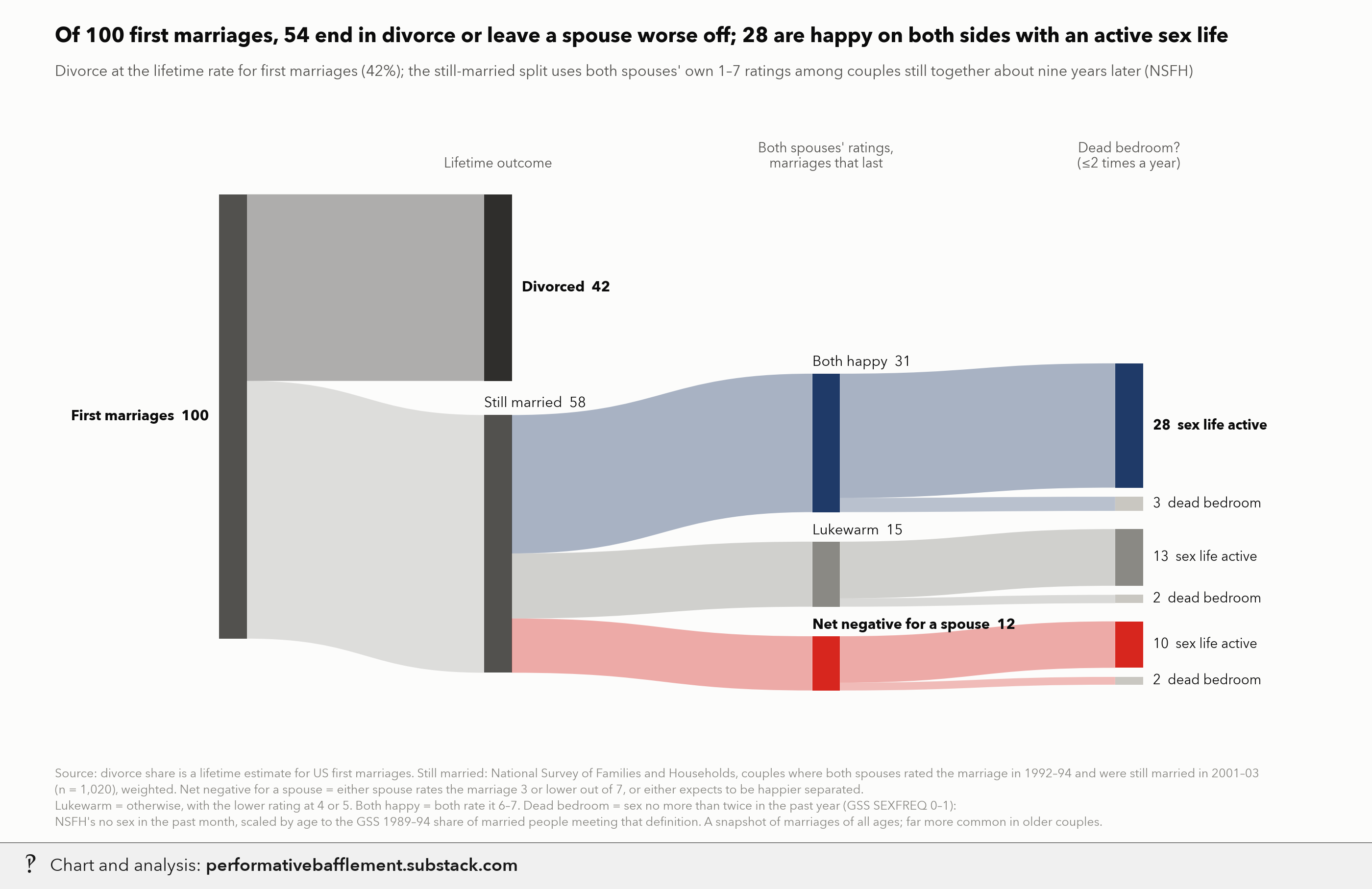
“Lukewarm” here is either spouse rating it 4-5 out of 7, which was our earlier cutoff, net negative is <=3 or thinks they’d be happier separated. Remember, the lukewarms have a ~4x-12x chance of high hazard problems (ie they give separation even odds or consider that they’d be happier apart), and ~2-4x+ chances of divorce over the “both happy” couples.
I would personally argue that in a fully informed counterfactual view, a lot of those people would have opted out of those marriages! At the most pessimistic, 72 out of a hundred.
And don’t think if you’re PMC, you’re immune.4
So I’ve just ignored the obesity effects in this chart, because that’s apparently almost every American’s fate, and nobody cares about this (at least, not enough to do anything about it).
For people who think that “dead bedroom” isn’t that bad, I’d argue that if you’d asked them back at the beginning, when they entered the marriage, whether they’d be happy if they were dead bedroom however many years later, the great majority of couples would say “no,” and they would not opt for that in a fully informed view if they’d been given that read.
Now you might say “hey, some portion of those people might actually decide it WAS worth it in that fully informed counterfactual view!” This is the “hey, maybe a few years of togetherness is worth years of sniping, then taking on two of the most stressful things people get up to (divorce and moving, 73 and 25 on the SRRS stress scale, with “death of a spouse” the highest at 100) after you blow up your lives and split” argument.
Okay. I look forward to your argument on how many couples that particular path nets positive in. But one thing I could argue on the other side - a lot of these so called 6-7 happy marriages are probably not all that happy!
Incorrigible optimism and lack of self awareness, thy name is “6-7:”
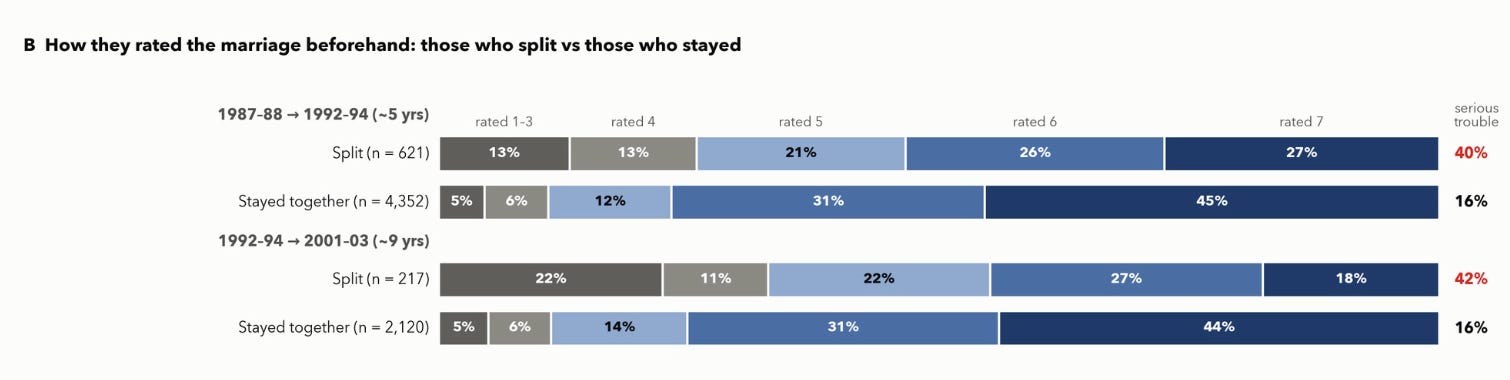
We see that 45% - 53% of couples who later divorced were rating themselves as 6-7 on a 7 point scale 5-9 years prior. Lol. How well calibrated are our 6-7 people?
Either by their own or by taking the lower of the two, the marriage rating overall has only a ~.65 AUC in terms of predicting whether a couple splits. .5 is chance.
Another fun one, as though we needed any more weight on GSS hapmar being bad - of the ~13% of people who have an affair and stayed together, nearly half of them (ie 6/13) rated themselves “very happy” with their marriage both before AND after!
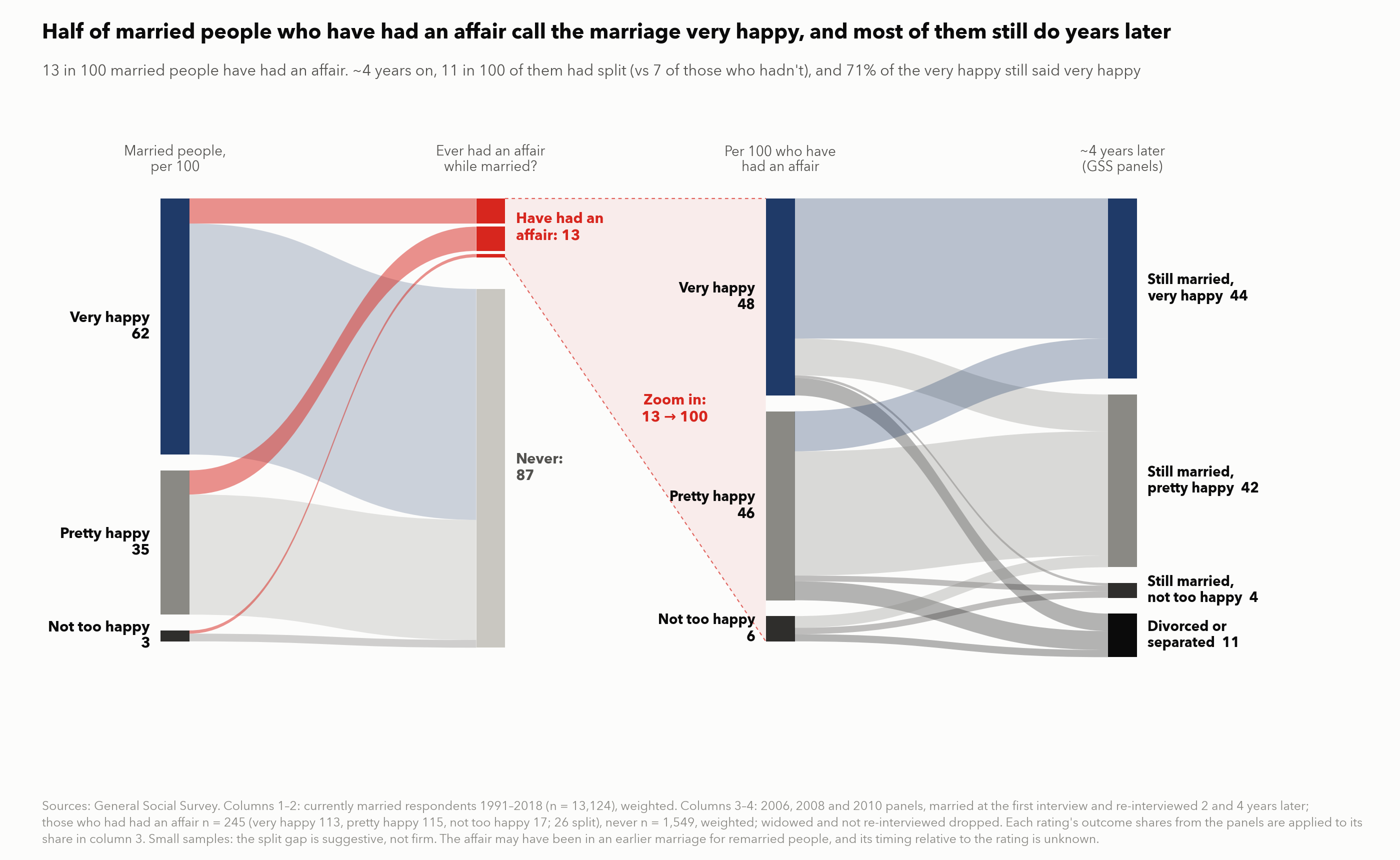
Either amazing powers of self-forgiveness or amazingly poor calibration, who knows?
So my rebuttal would be “that’s fine, but we’ll probably pick up some of the 6-7 people opting out in that fully informed counterfactual too, given what a noisy and poorly calibrated rating it is.” And both rating it 6-7 is 55% of people!
Where’s the balance? You tell me, I’d be interested in a triangulation. I don’t think you’d get fully informed “yes” much above ~50% across the population, though. Which is still 50% “opting out in a fully informed counterfactual view” at the aggregates.
And let’s not forget that most of the risk is concentrated in the medians and below. For top quintile SES people, marriage probably is net positive on both sides, but these people already marry at 80-90% rates. That means any marriage incentives are going to incentivize people primarily at the medians and below.
But if the question is “should we do marriage incentives pushing the marginal couple into more marriages,” the answer is clearly “no,” because of the giant failure rates.
That “50%+ would opt out in a fully informed view” rate becomes 60% or 70% really quickly as you go down the selectivity ladders. As a point of triangulation, in ACS grad degree people have ~25% divorce rates, versus ~50% for <=HS US natives. By income, the top quintile are “ever divorced” at ~25%, and the bottom quintile at ~55%. Problems are generally going to be twice as bad as you descend the SES ladder.
What’s the takeaway here?
So every woman opting out of marriage at higher and higher rates? Super smart! Definitely the right move!
If you track empirical outcomes, that’s definitely the way to bet!
And as an aside, I think this is kind of an amazing demonstration of the wisdom of crowds and invisible hands at work. Basically nobody knows these numbers - all anyone can do is look around at the relationships around them, and judge their quality and outcomes - it’s an exceptionally noisy information channel that’s highly selected and skewed for everyone. And even with all that noise, even with literally zero idea of the statistical ground truths, women in the aggregate have STILL arrived at a better, closer-to-the-truth answer in each subsequent decision round, over 80 years of cumulative decisions! That’s amazing!
And before everyone here jumps in and tries to argue that their spouse is Mother Theresa and Sydney Sweeney combined and was recently elected “best and also hottest human being who has ever or will ever exist” yes I’m not talking about you and me, friends. We all know my readers are notable exceptions whose spouses descended from heaven on gossamer wings, and whose very presence inspires involuntary outbursts of angelic hymns and paroxysms of joy.
I’m talking about everybody else, those who are less fortunate than we are - you know the ones I mean, you see the quality of your friends’, relatives’, and coworkers’ marriages.
As is usually the case with revealed preferences, it’s driven by huge effect sizes in the background, and is the right move given the incentive structures and outcomes.
Marriage is a bad idea even from a purely theoretical point of view
On top of the base rates indicating that it’s a bad idea empirically, the whole idea of being able to accurately predict how people are going to evolve or change over 20-70 years is silly to begin with. And 20 years is pretty much the minimum you have to consider if you want to have kids with that person.
How much have *you* changed, vs you 20 years ago? Why wouldn’t you expect your spouse to change that much, AND you to change that much, in the next 20-70 years? I promise, the great majority of everyone in that 82% were in love when they got married, and didn’t think they’d get divorced or be miserable.
It’s madness.
That’s a *really* bad bet! I mean, even with no money on it, I wouldn’t take the bet.
Now throw in the fact that 80-90% of divorced couples have to sell their house, because the only assets most couples have is “a little home equity” and “401k” (vehicles are typically net liabilities for average people), and the only way to split those in an equitable way is a house sale. That’s a recipe for a lot of disruption and misery, and many years at a lower standard of living!
But should you have to bet half your stuff and moving and several years of lower quality of life that you AND your spouse are *never* going to change enough to be incompatible over the next 20-70 years?? That’s crazy.
But that’s the only deal on offer, legally.
Where the supermajority, 80%+ outcome is your spouse getting fat, you having less sex, both of you changing and being miserable, and / or getting divorced and losing a ton of money while seeing your kids a lot less.
Good marriages are heaven, and bad marriages are hell
Here I’ll point out that a good relationship is one of the best things on earth, and a bad relationship one of the worst things on earth.
Being single is MUCH better than being in a bad relationship.
Anyone here who has ever personally been in both a good and a bad relationship at some point in their lives can attest to this, which is most of us.
But you know, we have lots of data points. Divorce is one of the most stressful life events that most people go through, typically a little under death of a spouse (87) or close family member (77) or being jailed (75), hitting ~70 on the renormed SRSS. And it usually comes coupled with things like moving (40) and a lot of arguing with your spouse (44).
Divorced versus married people have higher Odds Ratios of worse health (1.2 OR), diabetes (1.2), CVD (1.2), and std’s (2.5), and about 10% of divorced people get depression so bad it 2.5x’s their all cause mortality.
And of course, this is eliding the lived experience of daily life in a bad relationship, which is uniformly awful - the anxiety, the constantly having to be on the lookout for a meltdown or trigger for a fight, rehashing old arguments for the tenth or hundredth time, not giving a crap about anything else in life because your home life is in such tatters, and much more.
Once again, all these women opting out? Genius! Chef’s kiss! I can’t compliment their decision making ability any higher, they are making what is plainly and obviously the right move.
Because if we look at the “good vs bad” proportions, the data is showing us that a good marriage is ~4x rarer than a bad one!
What all this cashes out to
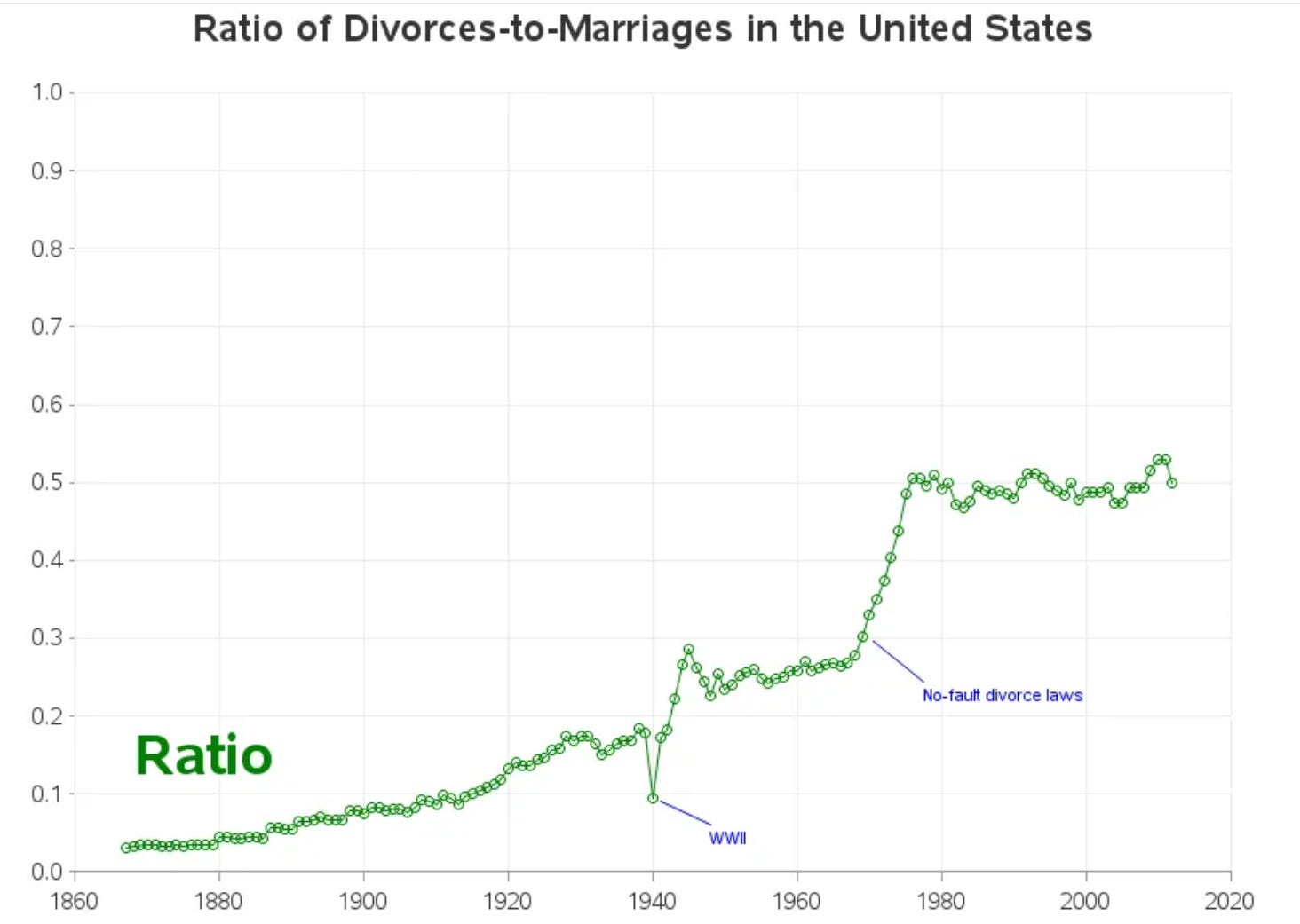
As soon as no fault divorce opened up in the late 60’s, divorces surged and that was a good thing - it was millions of soul-crushing relationships suddenly able to be dissolved! Not to mention that all the actual female talent that had been shackled to soul-crushing duds were now free to get careers of their own and open bank accounts and live more meaningful lives, which was also great for GDP.
So by extension, the fact that each subsequent generation of women has married at lower rates is a great thing! That’s millions of shitty relationships, not being entered into! It is very much a “that which should be destroyed by the truth, should be” sort of scenario, and we should rejoice that it’s happening.
Is this women getting all uppity?
So lots of guys think this is a female selectivity problem.
Indeed, if you do the math, ~80% of women are opting out of marriage at the bottom quintile of male SES, and nearly 2/3 are opting out at the medians-and-below. Marriage is increasingly a luxury good - the top quintile of SES men? Still have 85-90% marriage rates, just like all men in the 40’s!
And once again - look at the ground truth! This is just women being actually smart and reacting to actually huge effect sizes. What’s the percent of marriages that make it and were retroactively actually worth entering? Roughly 20%? Boy, if I were making that bet, I’d sure try to only do it with the top quintile of people! Because that maximizes your chances of actual success - when the base rate is literally “82% failure” only huge selection effects can even start to mitigate that!
And if you couldn’t land a top quintile person? Given that a bad relationship is worse than being single, it’s actually the smart move NOT to settle and get into a bad marriage. Full marks, ladies - you’ve effortfully teased increasingly better answers out of a very noisy channel, and are making the right decision at ever-higher rates.
But men? Men think these uppity ladies are leaving the noble red-blooded, hard-working median American men out in the cold for no reason! Obviously this is WOMEN sucking, not men sucking, when women are just rationally acting in an affirmative Lemon market, about which more later.
Let’s put any RETVRNs to bed for good
And this is largely why some of these men are the biggest proponents of RETVRN-ing to a regime where women are locked out of jobs and bank accounts and are stuck barefoot and pregnant in kitchens, shackled to duds. It’s seemingly the only way they see of actually marrying a woman nowadays, given the high and ever-growing opt out rates.
Clearly, that particular pig is not going to fly, and neither should it. In addition to the fact that women are human and deserving of the dignity and autonomy that all humans are entitled to, setting aside the fact that women get way more college degrees and are generally more functional and contribute more to society than men at the medians-and-below, including creating and raising the next round of humans - so if you want to privilege anyone it SHOULD be women at the societal level - even if we just handwaved all that away, there is no road to that RETVRN.
In only a single country in the world has the right to have bank accounts and jobs actually been taken away from women after they had it - it’s not post-Shah Iran, they can still have bank accounts and jobs, it’s post-Taliban Afghanistan. So that’s the “difficulty gradient” here - you can’t JUST have a totalitarian theocratic state (Iran), you have to go one step farther and literally have a full-warlord totalitarian theocratic state with essentially no functional economy to achieve that - which is obviously never happening in any democracy, nor in any developed country.
So good luck, Manosphere dudes! But you know, I will mention that it’s actually super easy to immigrate to a lot of developing SE Asian countries that have major muslim enclaves, and once you’re there, you can legally have multiple wives if you convert - so…good luck! Your ideal society exists, and is relatively easy to attain for most Western men. May you find your happiness somewhere.
So yes, women ARE more selective and opting out more, and as is usually the case with revealed preferences, they’re doing it for the most compelling of reasons. Let’s look at that.
Case study: what can a median woman get from marrying the median man?
Okay, so prospectively, the median woman can expect to snag a median man.
The median man is short and obese, only has a high school degree, and makes ~$50k a year.5 That can barely buy you groceries, much less a house anywhere.
Oh, also, when it comes to sex, the median inter-ejaculatory latency time is 9 minutes. NINE MINUTES.6 So every week or so, you’ll get 9 minutes of awful sex that approximately zero women could possibly get off to.
Man! Sounds….great. I can see why average women are just busting down the doors of median men to get married.
Another triangulation point - fully 35% of women lack interest in sex at all (and can you blame them??), and around 50% have at least one noticeable problem with the quality of the sex they’re getting:
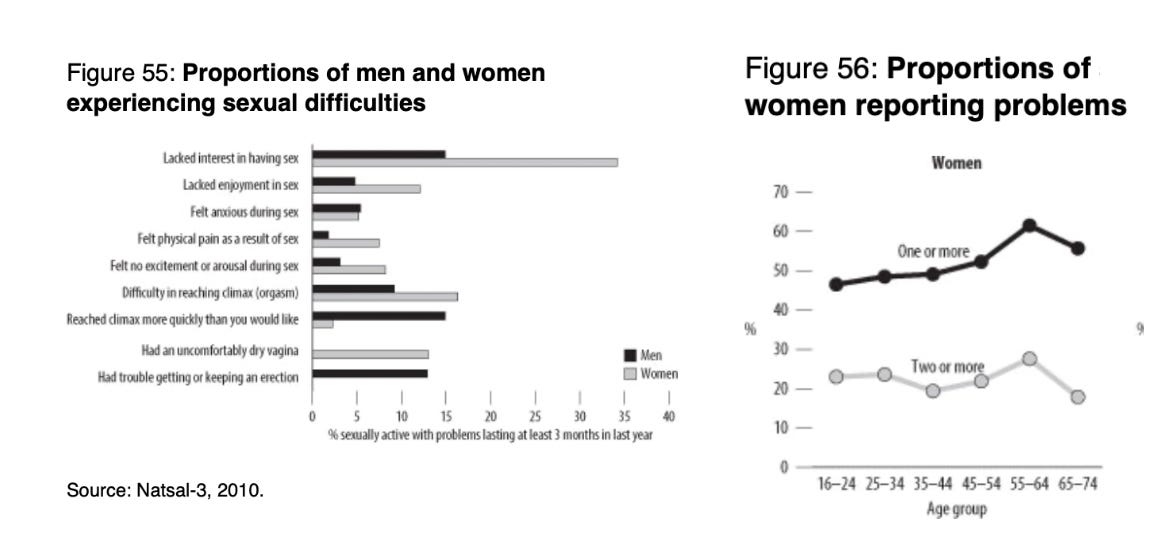
Want more context and flavor? Check here for actual comments from lots of women.
It’s pretty clear that having approximately any job and “pets and Netflix” and your own place is roughly 10x better than marrying the median man, who in addition to subjecting you to 9 minutes of terrible sex every week, will want you to do his laundry and dishes and cook for him, and spend all your free time raising his awful kids while also working full time, because he can’t afford anything and needs your income for you two to even survive.
I wrote a whole article on why women have a raw deal in general, and this section comes from there, click there for a more complete case.
So once again, all the women saying “lol, nope,” nearly all of which opt-outs are at the medians and below of male SES? Chef’s kiss! I’d be making the same decision in their shoes, a thousands times over.
All the positive effects of marriage are driven by selection effects anyways
But wait! You might say - aren’t married women happier? Don’t married guys make more money, and don’t married couples enjoy a variety of health and life satisfaction benefits from being married?
Lol, nope - it’s all selection effects.
Cremieux went over this in this excellent post:

I need to spend some time here, because this has apparently been one of the most contentious areas in terms of attracting comments and critique in this post, which has surprised me, because my take on the academic consensus is that it’s very clearly at “the positive effects of marriage are mostly (or all) driven by selection effects.”
But let’s take it a step at a time, to do it right and show that story.
So I absolutely agree you can look at the data and slice and dice it, and you’ll see married men have higher incomes, better health, better life satisfaction, and more, often at very significant effect sizes.
But these outcomes are substantially shaped and driven by selection - once you use designs that better address selection, the remaining causal effects tend to look smaller, more heterogeneous, and often transient or context-dependent rather than large and universal.
Take income - as I’ve pointed out before, women opt out of marriage to the bottom quintile of SES men at 80% rates, and at the medians-and-below at almost 2/3 rates. The top quintile of men have 85-90% marriage rates. Of COURSE married men have higher incomes if that’s true! We know there’s a giant selection effect here, it’s just hard to tease out and control.
A lot of the things being selected for in marriage are both important and unmeasurable.
For instance George Vaillant looked at the Harvard study of Adult Development and found that the biggest predictor of a good marriage at age 30 and age 70 was “how warm the respondent’s childhood was,” which is obviously selection effects. But what is it selecting? How do you control for that? SES probably, but that probably only partially controls! Maybe something else in terms of innate characteristics? Empathy? Conscientiousness? Maybe for once actual childhood parenting practices mattered a little too? It’s a ridiculously confounded mess you couldn’t even hope to *measure,* much less control for.
Now throw in the fact that that particular study is 1/3 Harvard students and 2/3 “disadvantaged youth,” and it started in a time (1938) that 90% of people got married. Confounds and selection so strong it’s difficult to say anything with confidence.
So what are the most sound ways, that could potentially control for impossible-to-measure selection? The best way to do this is with longitudinal, within-person studies. The second best way to do it is with twin studies. Both of them will likely still involve some residual selection (even MZ twins can differ in behavior and outcomes), and confounding secular chronological trends.
So what do we have on this front?
How about health?
Osler (2008) looks at 1175 twin pairs (52% MZ, 48% DZ), and finds that “marital differences in other health and behavioral outcomes are most consistent with selection effects related to genetic or rearing environmental factors.”
Horn (2012) Uses longitudinal data to look at never-married, cohabiting, and married young adults (excluding married individuals who have divorced), and compares n=3.2k individuals from the Add Health subsample with genetic and relatedness data (including MZ and DZ twins, full and half siblings, cousins, and genetically unrelated siblings) across these groups. They compare married to single, and married to cohabiting couples across this sample. Their findings?
“The relation between physical health and marriage was completely explained by nonrandom selection.”
They do find a positive effect on drinking and antisocial behavior for being married! So if you want to cut down on your drinking and petty crime, maybe consider it. Is that a positive effect for this crowd? It is not, it was only applicable to ~15-20% of the sample anyways, and we’re all PMC.
How about income?
Ludwig and Bruder (2018) use longitudinal NLSY data to look at this. Previous papers had found income effects of marriage, but only controlled for selection based on wage levels. Ludwig and Bruder look more broadly, and look for the potential for selection for higher-wage-growth in men who are still single, to see if they’re preferentially selected. Remember my bottom and top quintile marriage rate differentials above? Yup.
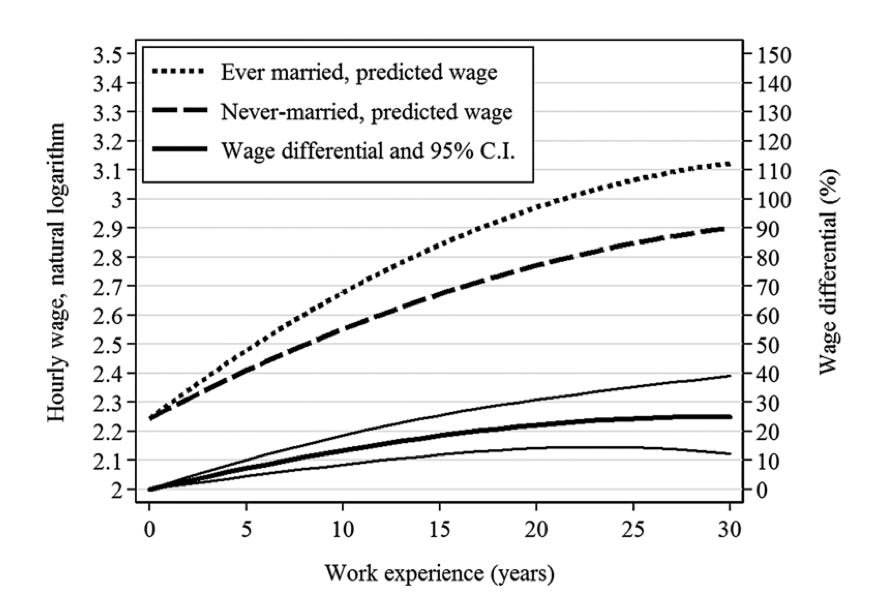
“The results show that married men earn more because selection into marriage operates not only on wage levels but also on wage growth. Hence, men on a steep career track are especially likely to marry. We conclude that arguments postulating a wage premium for married men should be discarded.”
How about happiness?
I give you Huntington (2021), which points out that if you use surveys to look at life satisfaction and health endpoints, they are indeed higher before marriage, and then stabilize and decline (particularly for women) after marriage! This shows very clearly that these are selection effects:
“some indicators of mental and physical health were improving up until the point of marriage, these indicators then stabilized or began to decline, with women experiencing these declines more than men. Findings are more consistent with selection effects (i.e., better-adjusted individuals are more likely to get married) than social causation effects (i.e., marriage causes improvements in mental and physical health).”
Marriage doesn’t improve anything, it might even detract a little.
Still not enough?
The German Socio-Economic Panel Study (SOEP) followed ~30k people over their lifetimes.
Lucas (2003) uses this data to look at 1) how much are happiness after marriage driven by selection effects? And 2) what is the before / after trend in happiness?
What do they find?
“First, people who get married and stay married are more satisfied than average long before the marriage has occurred. “
“Thus, these analyses suggest that people do adapt to marriage: On average, they are no happier in the years after marriage than they were in the years before marriage.”
So what’s the general consensus?
When you look at studies that methodologically control more for selection effects, like longitudinal within-individual studies and twin studies, nearly all the positive effects go away.
Aside from transient and short term effects, and some minor effects on mental health and “antisocial behavior,” all the large, strong effect size, noticeable differences in married vs unmarried couples are driven by selection effects.
This is WHY marriage is a luxury good now
The only people worth marrying are the top quintile people, basically.
The invisible hand of the marriage market is slowly approaching the actually correct solution, in other words. The rational equilibrium is that only the top quintile SHOULD marry, because they’re the only ones with a chance to pull it off.
Marriage is a deeply non-intuitive, unnatural institution to begin with. For the ~2M years of hominin existence of us as hunter gatherers, the usual relationship pattern was likely to be a serial monogamy along the lines of “pair, have a kid or kids, together for 3-7 years, separate, pair with somebody new.” We see this suggested in genetic data, ethnographies, and more. That dynamic is roughly what our hardware and software built-ins are likely to have been tuned around over those ~2M years. It was only with the advent of agriculture in the last ~6k - 10k years that modern “til death do you part” marriage really came into being as a social institution, and average duration of marriage for most of these millennia was much shorter than today due to much higher deaths from infection, war, and childbirth. If it goes against most built-in inclinations and drives, then only more self-aware, higher C people who think longer term and have good dispute resolution styles are likely to succeed at it, because you have to be constantly overriding those built-ins.
Marriage enjoys a bunch of positive buffs only when the top people select into it, and it took no fault divorce and every single additional generation of women since the 40’s each incrementally figuring this out to a greater extent to get here. Culture moves slowly, but it does move towards the equilibrium, and the equilibrium is that marriage sucks and is basically net negative for the vast majority of people. Revealed preferences are almost never WRONG, they’re often just not what we’d like to be true, and this is one of those cases.
Because what are the implications? If people (surprise!) actually mostly suck and are net negative for each other, if all the positive effects of marriage are purely driven by selection effects, it means that marriage is actually a bad idea for like 70-80% of people.
And indeed, do we see this to be true! It is exactly what the data is suggesting - as women CAN increasingly opt out of marriage, they do, all over the world. We see that marriage is empirically a bad idea both in the aggregate and ever-increasing “opting out of marriage” rates on womens’ parts, and in the divorce and “net miserable” rates in those who do get married even after those huge selection effects.
If you’re trying to incentivize a bunch of regular people to get married? All you’re going to get is the Torment Nexus, per the above points on marriage quality and selection. For every single incremental marriage your incentives create, there’s an 80%+ chance it will be net negative. And as we know, a bad relationship is worse than nothing - it’s better to be single than in a bad relationship, and better to be single than go through an awful divorce that nukes your life for years at a time, it’s a strictly net negative move to promote or encourage relationships that will fall into these outcomes, which again, is practically all of them.
The true proposal that the pronatalists are suggesting is basically: “let’s lock tens-to-hundreds of millions of people into decades of mutual misery so they unintentionally pump out some incremental taxpayers”
This is immoral and bad
Okay, so I’ll make the humble suggestion that any proposal that is basically suggesting to create decades of misery across tens-to-hundreds of millions of people to create a few incremental taxpayers is obviously bad and wrong, by pretty much any moral system, whether virtue, deontological, or even basic common sense and empathy.
We shouldn’t be trying to shackle hundreds of millions of women to duds with economic and social incentives any more than we should be trying to make them forced by law into being barefoot and pregnant in kitchens to please regressive Manosphere types who can’t get a woman any other way.
You reach the same, maximally immoral Torment Nexus outcome either way.
But we need taxpayers
C’mon PB, you might say - look around you! Dependency ratios! The big problem South Korea and Japan and China are headed for is an infinite, ever-growing array of old people tiling the sky to the horizon, like octogenarian celestial vampires, draining the economic and cultural life force out of their kids and grandkids, as each kid has to support a greater number of sky vampires. That’s going to suck for them, their entire economy is going to grind to a halt and everyone is going to hate their lives! And in the developing world, we are ALL on this same train, they’re just getting to that station first, so that’s ours and our kids’ fates too.
This big Ponzi scheme we like to call “the American economy” just isn’t going to make it without a bunch of kids cranked out en masse to keep the wheels spinning, right?
Well friends, I’ve got news for you here, too - the median taxpayer, isn’t.
This is to say no matter how you do the math, you do not approach net neutral in taxes paid vs consumed unless you’re in the top ~15-20% of income.
Let’s just show this at a super high level. Only about half of Americans work, the rest are kids, retirees, and layabouts. So you’ve got 162M workers. We spend $7T a year, mostly on old people / entitlements (from 52% to 69% depending on where you account for national debt interest and some other stuff). I personally allocate “debt” to “old people” because we specifically take on debt to pay for our outsized entitlement spend.
How much is $7T / 162M? It’s $43k in taxes paid per worker. You don’t hit that amount of taxes paid until a top ~5% income of $250k+ or so. But people pay SS and payroll taxes every paycheck!
Yeah, sure. It doesn’t matter. The median worker pays ~$6-7k in federal taxes, including all those. Still wayyyyy shy of $43k. I mean, even if you literally take out anything entitlement shaped entirely, just that $2.5T across all the workers is like $15k a year. The overwhelming majority of people can’t even cover the tab on National Defense and whatever non-entitlements the government provides, then you need to triple that.
You can model this with simple NPV methods. If you take into account the costs of education, people don’t hit net neutral until the ~82nd percentile. This graph below is men, who have higher incomes and shorter lifespans, and they hit net neutral at the 77th percentile.
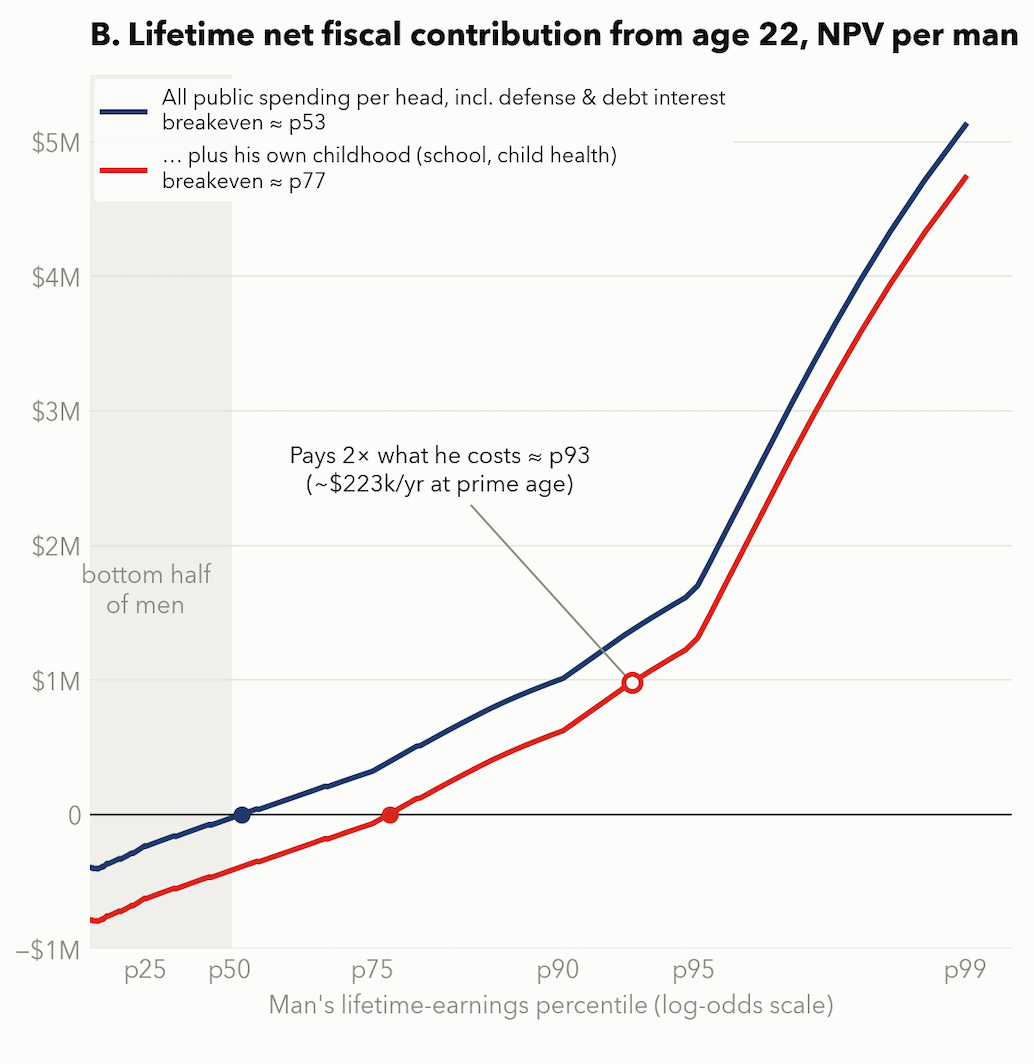
The overall argument that “the marginal additional kid is a net tax consumer for life” is definitely still true, and likely to be true up to the 80’s in income percentiles. For men, only 77th percentile and above break neutrality when you take education and fully loaded costs into account. With men and women included, it’s the ~82nd percentile.
Methodology here, for AI critique.
If you want another triangulation of this, I did that using only top level government reported figures and using simple arithmetic in a post here that I just double checked with Claude, who signed off on all of the figures being correct and accurately represented in the debt framing I chose, and also on being generally aligned with the model above showing NPV curves.
A commenter in an ACX Open Thread asked me to include income from corporate taxes and tariffs, and remove the $2T in defense and debt service, because they felt that was a more fair per capita accounting. It’s the “we can just ignore $2T of defense and interest expenditure instead of paying for it by the head” argument, which I really don’t get, but which multiple people, including Scott himself, tried to make the case for being more fair. But okay. Even in this scenario, where we literally eliminate $2T of spending by fiat and pretend we’re only spending $5T a year, you do not break even until the 73rd lifetime income percentile.
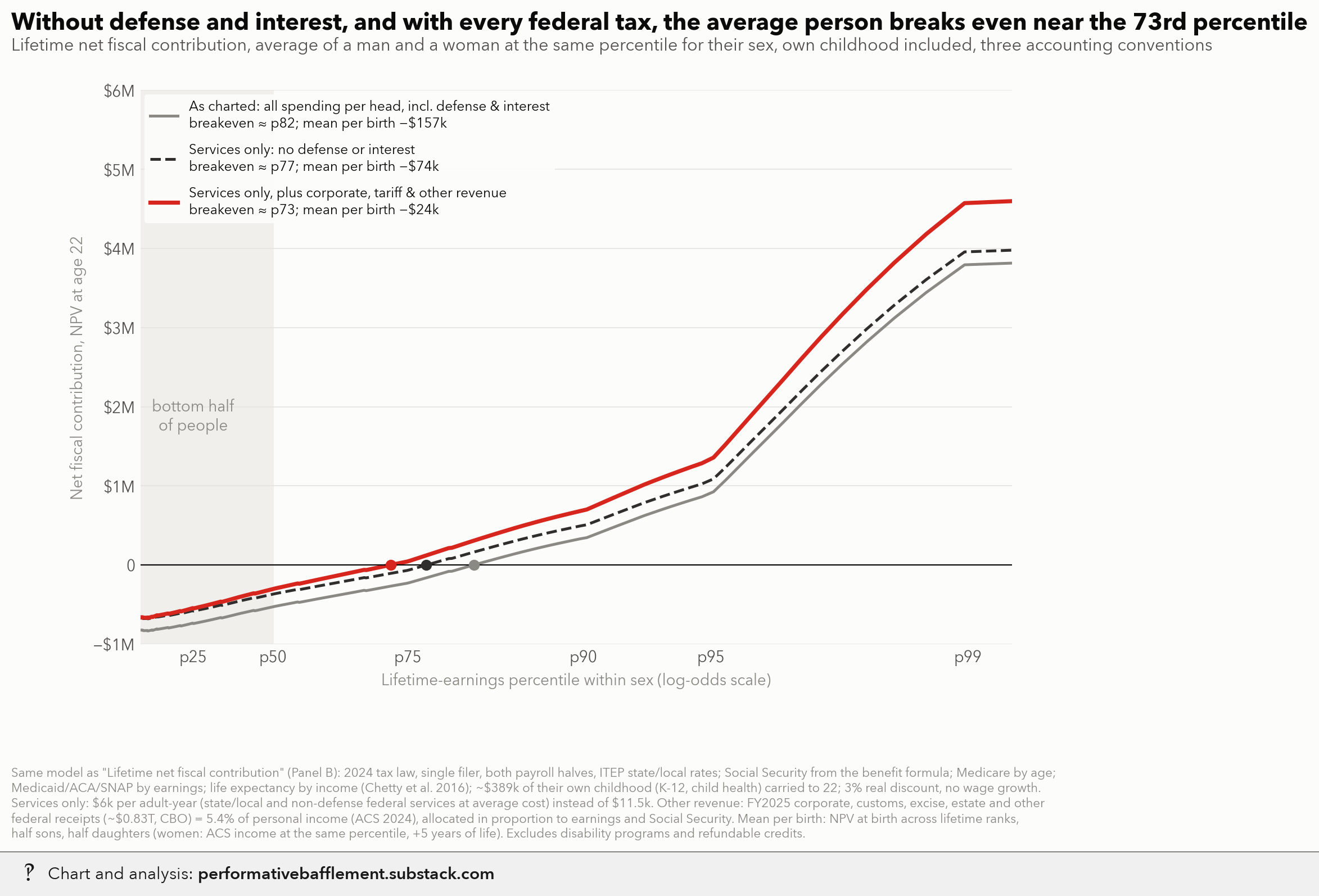
Incentivizing a bunch of marriages at the medians and below is still strongly net negative from a fiscal standpoint.
I’m not disparaging average people here, who are genuinely paying a big chunk of their income in taxes, I’m disparaging our maximally stupid government spending and policies, and pointing out there’s literally no way it can go on like this when the sky vampires hit. If we’re always and forever spending 6x more than we take in per person, adding more people isn’t going to help.
Worse still, we do our system in the maximally stupid way, and as an example, take in their widow’s mite of taxes (<$1k back then) in 1970 dollars, immediately spend it, then basically promise the person who paid those taxes in piddling 1970 dollars we’ll spend $40k+ per year on them in present day dollars when they’re old, which we’re doing. Versus if you were smart (hi Singapore!) you’d put those 1970 dollars into some financial instrument that also grew with time so by the time they were old their money had grown to offset some of that gap. Oh, and we also take on a huge amount of debt every year in tiny 1970 dollar equivalents, so we get hit both ways by that - none of the positive contributions grow, but the debt does grow with time. So today’s figure (if we were actually paying off that debt) would be more like $60k per year, but obviously we’re not paying it off, we’re racking up still more debt every single year.
The median taxpayer isn’t a taxpayer, they’re a net tax consumer. And not just the median - up to the 60th, 70th, 80th, 85th percentile, you only break even at somebody who averages a top 20% income over 40+ years, which generally cashes out to a higher income than 85th percentile in a spot measurement, because people’s income curves start low and grow with time. So once again, we’re at “only the top ~15% even approach net neutrality, much less net contribution.” Meaningful net contribution is into the 90th+ percentiles.
Still think we should Torment Nexus a hundred million people for some incremental kids? Because they’re not even incremental taxpayers, for the most part, the overwhelming majority are incremental tax consumers! It really is a “handful of taxpayers” if only the top <15% are going to be net positive to the budget we were worried about!
Not only was it maximally immoral, our putative positive outcome from pushing and incentivizing millions of additional mistaken marriages (and so getting more kids) is just digging our profoundly dumb system even deeper!
What about the kids?
We’re talking about them, specifically their nonexistence. Their lack is the Fertility Crisis.
Again, this is the best possible outcome, because kids are not actually better off in a pressure cooker household where both parents are miserable and fighting all the time, nor in recently-divorced households where stress is high and standards of living lower and schools often changed.
The pro-marriage types want to pretend that marriage is an only-positive soothing balm that improves all things, but that’s only as true as the quality of the marriage itself, and the majority are in fact negative, and this is why everyone has been opting out and marriage is a luxury good now.
And this holds true for kids too - sure, kids raised in loving, functional, high SES, two parent households do better. And I wholeheartedly agree with pronatalists that we should definitely start pouring serious incentives into these couples, to encourage them to have more kids. I’ve personally suggested giving them free 3,4,5 bedroom housing, giving $50k - $100k baby bonuses, free au pairs, and more. All of these would be rounding error in terms of the expense vs value created to society!
But what we shouldn’t do is artificially create a bunch of miserable couples pumping out incremental kids - if it’s the genuine truth that it would be a net negative move for ~80% of people, we shouldn’t try to push them into it, nor should we push to create more kids in miserable households! Once again, these policies would be immoral and have no upside!
And trying to incentivize some of the existing bad marriages to stay together longer isn’t going to do any favors for any existing (or future) kids either - it sucks to live in a high tension, constantly fighting household, and yes, your kids can definitely tell and are affected by that, and then everyone gets the divorce penalties shortly after.
A loving, highly functional and mutually positive 20 year relationship is just not a possibility on the menu for a full 66% - 80% of people, and that’s before you add on the “high SES” part that’s actually doing most of the selection / work, which also excludes ~80% again.
Our current trajectory is actually the best possible outcome - think of all the maladapted, terrible-relationship couples and parents you see out there. Them opting out of creating more kids together is a huge win, for everyone! For them, for us, for society, for the future federal budget - it’s all upsides!
One thing I like to ask people is “of all the relationships you’ve seen in your life well enough to judge, how many of them do you truthfully admire and envy?”
The answer is usually 0, sometimes 1. I’m old and / or social enough to have seen a couple hundred relationships, and my answer is 1. The overwhelming majority of relationships I’ve seen? Genuinely glad I’m not in them - and I’m sure the great majority of people feel the same way about mine! Now how many of those relationships would you bet on being mutually happy and loving and net positive for both people 5 or 10 years from now? Ha! That’s the really funny one - definitely the Parlor Game That Shall Not Be Played.
And I feel I should point out, you and me and anyone reading this lives in incredibly, mind-bogglingly selected social circles. Scott Alexanders’ infamous 10⁻⁴⁵ degree of filtration (on only one dimension at that) - so that’s a <1% success rate in an obscenely selected, already tippy top SES population. I mean, think about that.
Relationships are just genuinely hard, and most people, no matter how talented and nice, genuinely can’t pull them off well, hence my “it’s a bad idea to bet on only change in mutually reinforcing directions over 20-70 years” point. That’s ridiculous. It’s a dynamically unstable problem that has lots of vectors pushing things towards mutual unhappiness and dissolution, and lo do we see that in the outcomes.
Everyone opting out is actually making the plainly and obviously better decision, and them opting out from the kids those miserable relationships would have created is ALSO the better move, for everyone.
This is an argument about the marginal impact
We know the “marginal” couple a pro marriage policy nudges is at the medians, because 80-90% of top quintile SES people already marry. Only ~20% of men at the bottom quintile of SES are married in PSID data, and nearly 2/3 of marriage opt outs are at the medians and below.7
That means the expected outcome paths will be a little worse than the Sankey, given that this is measuring marriage outcomes after a good deal of selection has already come into being.
It also means the projected marginal kids are likelier to be net negative from a taxpayer perspective, because you don’t break even until the ~80th percentile by income.
What are the odds of median and below median people having 80th percentile income kids? Let’s see!
You get about a +.3 buff on TFR with marriage vs not. If anything that’s an upper bound - married women are selected for wanting kids, so the true causal bump is likely to be smaller, which only makes the fiscal case for marriage incentives weaker.
I decided to estimate it with both “reported income mobility” (Chetty) and Greg Clark “social competence” mobility, to bound the upper and lower bounds. Obviously in real life AI is going to render way more people net tax consumers, but hopefully the GDP growth overpowers our maximally bad overspending per person. Fingers crossed on “inventing God and asking Him for money!”
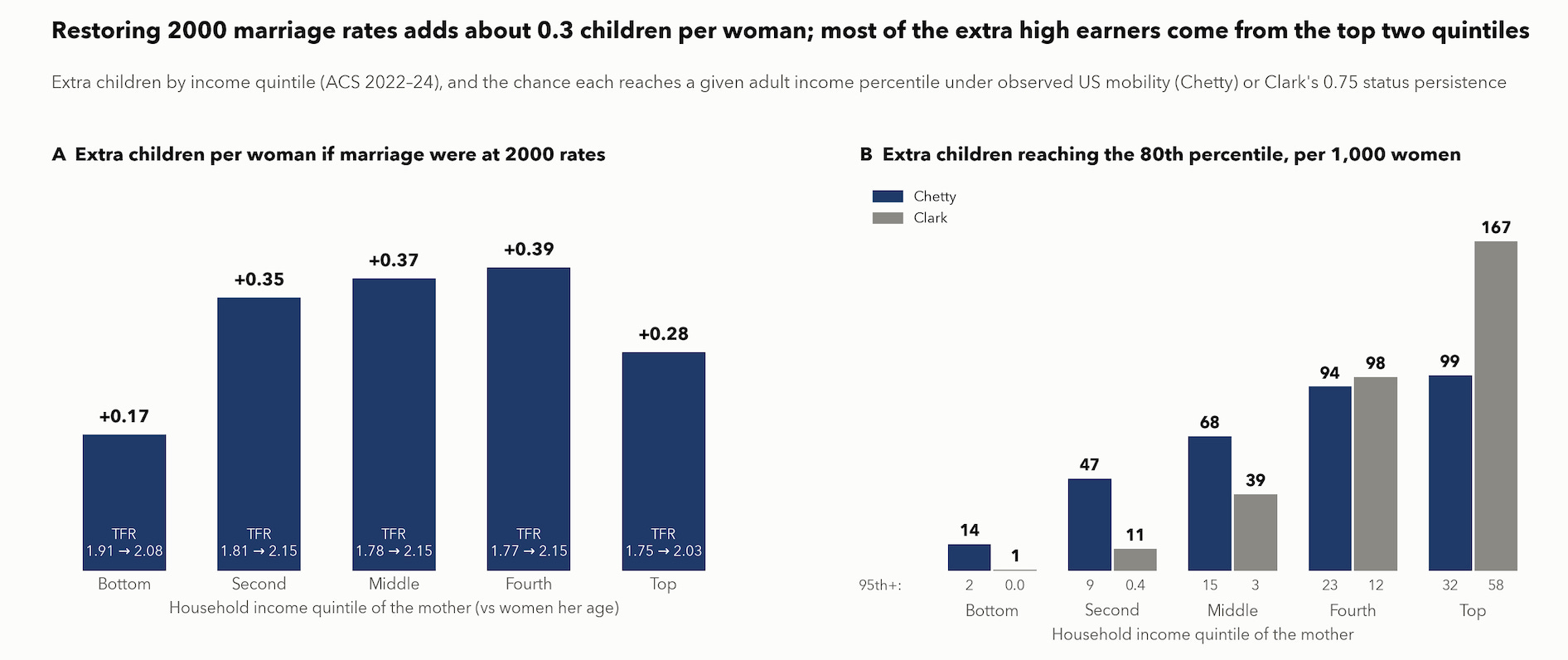
Broadly, at the medians and below, we can expect somewhere between 1/1k and 68/1k incremental net taxpayers per 1,000 women in the quintiles most likely to be affected in our marriage incentivization scheme.
So, let’s map that out.
For every 1,000 marginal marriages we incentivize, we get:
420 will end in divorce and moving at some point, a combined ~98 / 100 net stress combination in the SRRS over a few years (73 from divorce, 25 from moving)
Of the marriages remaining, 120 will be strongly net unhappy for one or both parties
Of the remaining marriages after that, 150 will be lukewarm, with 4-12x the serious problem incidence, ie people saying they would be better off apart
A final 30 of these marriages will be dead bedroom and none of the prior categories
That’s 720 / 1000 of these marriages where one or more of the participants is likely to have opted out in a counterfactual “full foreknowledge” situation
Of 1000 incremental kids created from these marriages, at the most optimistic Chetty numbers, 840 will be net fiscal costs, an additional 118 will be net neutral to slightly positive, and only ~40/1k will pay in at least twice what they cost
Does that sound good, or moral, or like something we should pursue at scale? Because that’s what “more marriage is the solution” people are arguing for.
Fertility isn’t actually a problem for another 100+ years anyways
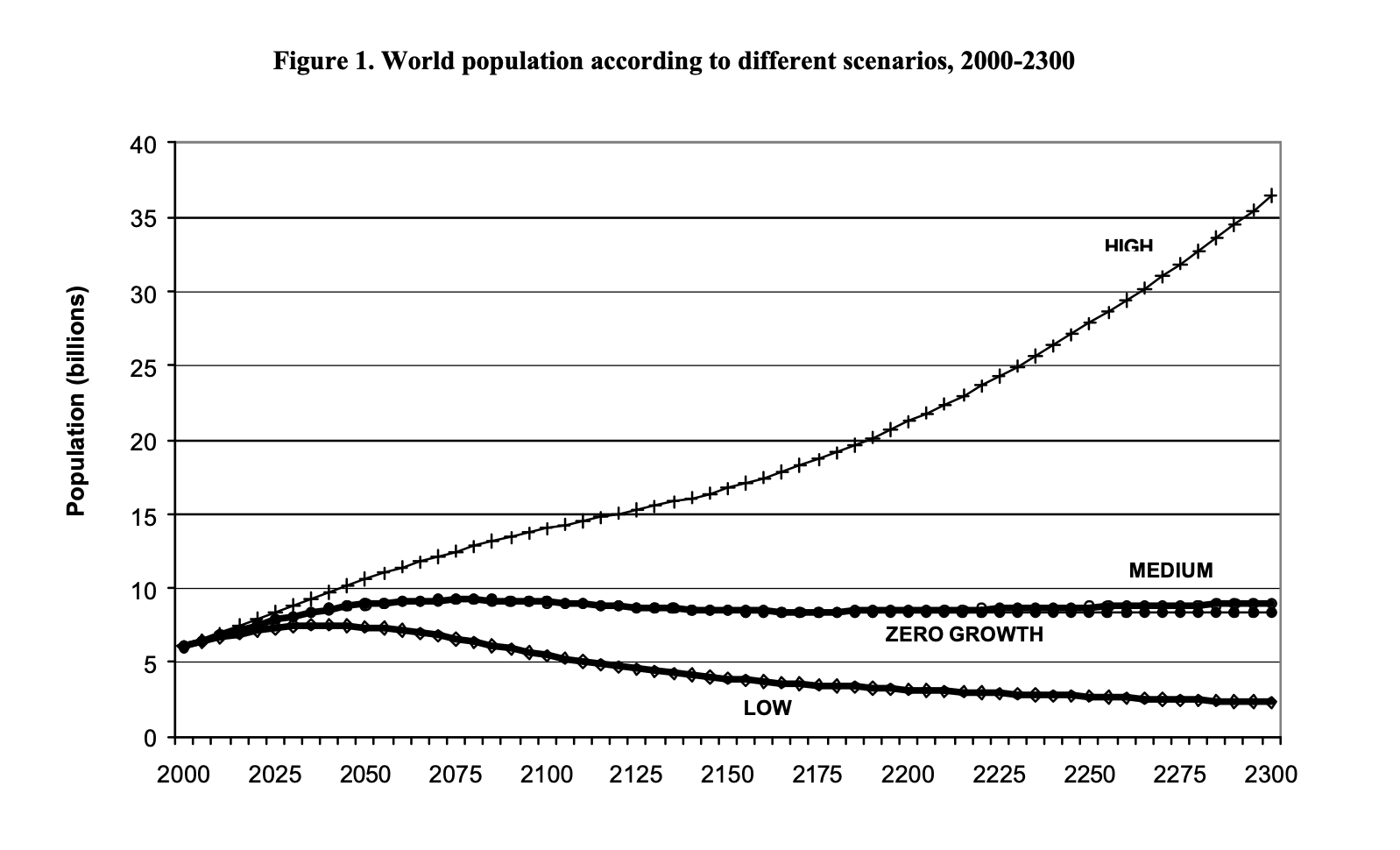
Even if entire world fertility drops to 1.85 for the next 100 years, we’re going to have 9B people through 2125. The “Low” bar here requires dropping down to ~1.5 world fertility for 100 years, and still leaves us with 5B at the end of that. We’re currently at ~2.25 world fertility, and it took 20 years to drop from 3 to 2.5, so we’re probably higher than 1.85 for the next 20 years, and are likely to end up around 8-9B people in 2125.
Fertility isn’t actually a problem for another 100-200 years, and this is plenty of time for us to come up with uterine replicators, transgenic pigs,8 or even for us to Singularity into post-technorapture transhumans living in fully automated luxury gay space communism, as the meme goes.
The pro-marriage group would be trying to incentivize a Torment Nexus’s worth of suffering over a billion plus people in those 100-200 years to pump out a few handfuls of incremental taxpayers. That lemon is not worth the squeeze, folks!
So let’s be nice, and let’s NOT Torment Nexus billions of people with fundamentally immoral and mistaken pro-marriage policies!
Liao, C., Gao, W., Cao, W., et al. (2018). Association of Educational Level and Marital Status With Obesity: A Study of Chinese Twins. Twin Research and Human Genetics, 21(2), 126-135. https://doi.org/10.1017/thg.2018.8 Cited by: 41
In this study, researchers analyzed a population of Chinese twins and found that married individuals had significantly higher body mass indices (BMIs) than their unmarried co-twins, effectively isolating marriage as a variable independent of shared genetic and early environmental factors. Specifically, the study found that married twins had increased odds of being overweight by 98% for males and 87% for females compared to their unmarried counterparts (Liao et al., 2018).
If you compare the 6-7 problems, divorce rates, and dead bedroom rates to lower ratings, you see a noticeable step up at 5, then increasing problems from there. To wit, 4-7x the “high hazard” problem rate including “would be happier apart” and “give separation even odds,” 2x - 4.5x divorce rates, and 1.3x - 2.2x dead bedroom rates.
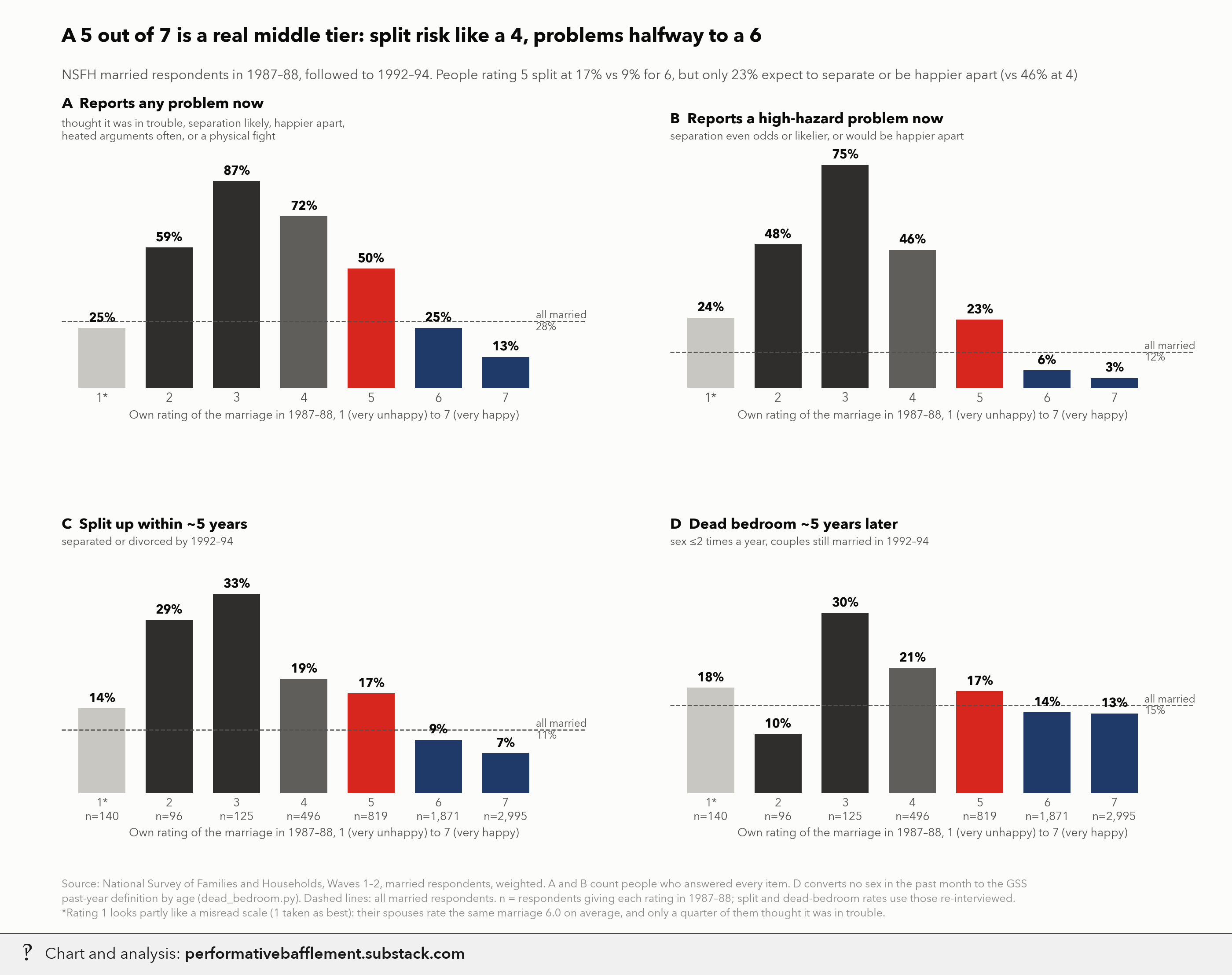
What do we see here? Although yes, 11-25% of people who rate their marriage <=5 split up in a 6-8 year span, we see that this isn’t terribly predictive. After all, that means 75-89% did NOT divorce over that time!
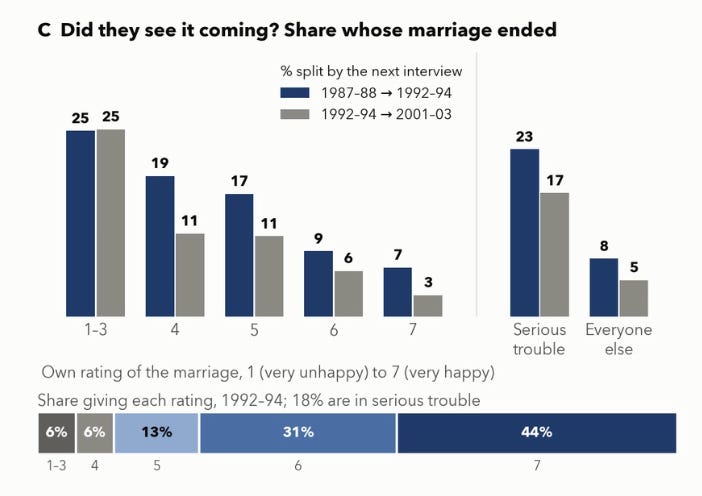
We also see that even in the two highest happiness categories, 3-9% had split up by the next 5-9 years. So people rating their marriage<=4 on a 7 point scale are ~3x likelier to split up, but in absolute terms are still 75-89% likely to stay together!
Yeah, yeah, I know - “teehee, I’m white or asian and have a college degree, my divorce rate is half as much!”
Your divorce rate might be lower, but your “dead bedroom or at least one party net miserable” rate is still pretty similar!
Baccalaureate or higher:
Divorced: 30%
Net miserable or dead bedroom: 43%
Good marriage: 27%
Baccaulaureate or higher AND top quintile income:
Divorced: 15%
Net miserable or dead bedroom: 50%
Good marriage: 35%
Literally 5’ 9” and 200lbs, so 30 BMI. Why can I say 5’ 9” is short when it’s the literal median? Because on dating apps, literally ~70% of women would filter that height out in their prospective partners, I’m making a demand based argument here.
From David Spiegelhalter’s Sex by Numbers, which I extract all the fun details from and go over in my review here. He’s taken the Waldinger 2005 study looking at 500 couples across 5 countries, which actually found a ~5 minute time(!) and then removed all premature ejaculation cases to try to be more generous. So the “actual on the ground” figure is the 5 minutes, to which, lol.
I personally think transgenic pigs are the way to bet if you wanted to actually solve the problem of “how to incubate a baby without ruining a particular woman’s body” in the next 10 years. I mean, for now, duh, use surrogates if you don’t want to ruin your wife’s perfect body, but that’s an expensive and limited option that doesn’t scale.
Technological uterine replicators are so far off that they’re essentially a pipe dream, but multiple species have been successfully incubated in fairly different species - Chinese scientists put cloned panda embroys in a cat, different camel species have been transferred into each others wombs, the same with goats/sheep, horses/donkies, ibex/goats and different mice.
Transgenic pigs could be produced at scale to serve as human surrogates, and it’s low hanging enough that if the will and funding are there, I think it’s a 10 year Manhattan-type project. Not that any government cares enough about ensuring future citizens to spend a Manhattan’s worth of effort on it, that money is MUCH better spent being shoveled by the trillion into the furnace that is the richest generation of old people ever, and running the entire society into a depenency ratio wall a few years down the line accordingly.
Your model seems to assume that women are turning down unappetizing marriage proposals like Lizzie Bennet left, right, and center.
This does not match my experience at all. Bottom 80% women absolutely dream of weddings and happily ever after. Some of the most profitable media in existence caters to these desires.
It’s just not available to them. Bottom 80% men are not typically offering marriage.
I agree with the basic premise that "more marriage" isn't a good policy or societal goal in and of itself, and its a good thing in general that a greater variety of relationship types and lifestyles are increasingly viewed as societally acceptable.
I do question the emperical evidence you bring up. It seems a bit hollow unless you really think hard about the counterfactual though, and I feel like your interpretation is overly negative.
Yes Huntington (2021) finds marriage itself (ie the transition from engaged to newly married) is associated with some negative mental and physical health indicators. But I don't think that's a reasonable baseline/control to decide whether 'marriage is good/bad' in general/long term. You can't use the counterfactual of being on the cusp of marriage to argue marriage is bad. The discussion says: "These findings do not support a social causation model as typically described—that marriage causes positive effects in such a time frame—but could be consistent with a view that the effects of the transition actually begin well before the timing of it. That is, perhaps positive changes occur more as a consequence of having found a partner and deciding to marry than from the fact of the transition into marriage, per se."
I'm a bit confused about "Rogers (2003)", it seems like your graph and quotations are from Lucas et al (2003) Reexamining Adaptation and the Set Point Model of Happiness: Reactions to Changes in Marital Status
But anyway, it definitely concludes that on average, an initial boost to life satisfaction dissipates over a few years, and there is lots of variation in this indicating that for many people marriage is probably negative (this fits my anecdotal observations). But I don't think the characterisation that "there’s a small sub-group with actually happy functional marriages dragging everyone up, and if you split the populations, marriage is net negative for most people" is justified. I suspect you are misinterpreting the graph? Where all the curves start (at ~0.6 on the graph) is not the pre-marriage baseline - it's the average life satisfaction level people are at when they are first married - after the initial boost.
I didn't look into Proulx (2007) or Robles (2013), but your outright dismissal seems kind of ridiculous, you just referred to a paper from 2003 to make a point and then claim papers from 2007 and 2013 are inherently 'Pre Replication Crisis garbage'. If there's some post replication crisis meta analysis which pointed out flaws in previous analyses and came to different conclusions, then go ahead and cite it. Otherwise it comes accross to me that you're just weaponising the replication crisis to selectively discredit papers with inconvenient conclusions for your argument.
Overall, it just seems like a really hard question whether 'more marriages' at the margin would increase or decrease happiness/life satisfaction and improve society. Maybe most marriages end in some kind of 'failure', but what are the failure modes for not marrying? You need that comparison before concluding there is an '80%+ chance it will be 'net' negative'.