
Vladimir Putin - the man, the myth, the dictator
Inspired by Philip Short's Putin

If we began in the purely theoretical and Platonic realm, and defined the ideal politician to lead an entire country through difficult times, what characteristics would they have?
They’d be highly capable and diligent and indisputably loyal to any superiors
They’d be non-corrupt, and not beholden to any big interests or factions
They’d be able to size up and relate to people at all levels
They wouldn’t be afraid of making tough decisions
They wouldn’t want to be leader, and would instead need leadership thrust upon them
As you can no doubt infer from the title, Putin is your man on all these fronts, and so serves as our “be careful what you wish for” cautionary tale on this particular front.
Background
For most of his life, Putin was a drab functionary toiling silently and faithfully for various superiors in various bureaucracies, a “state man” through and through, and only at age 46 was he catapulted to god-emperorhood, in a way that surprised approximately everyone, including himself.
This might sound controversial, particularly set against what many people might think and Scott’s own review of Man Without A Face, so let me at least gesture at the supporting data:
On the loyal, capable, and diligent front, when his boss Sobchak was being hounded by political enemies with potentially career-ending legal prosecutions, Sobchak claimed heart problems and holed up for 5 weeks at home. The next move from his opponents was tapping the Health Ministry to send a team of cardiologists to verify he was having genuine health problems (and due to the way Russia operated at the time, whatever conclusion they were going to make was probably going to be a political decision from on high rather than a medical one). Before they could arrive, and with his job and potential life at stake, Sobchak turned to Putin, who arranged a last-minute chartered medevac flight to Paris, on a Russian holiday when scrutiny was at a minimum.
“When Putin reappeared as usual in his Kremlin office on Monday morning, Yumashev remembered breathing ‘a huge sigh of relief’. It meant that he would not have to have a difficult conversation with Yeltsin, who, had the venture failed, would certainly have condemned it. Instead, when eventually he did tell the President what had happened, Yeltsin said nothing. Yumashev got the impression that ‘deep down, he sympathised with what Putin … had done’. Others were impressed, too. He had not been afraid to take a risk which, if it had gone wrong, would have ended his career. As Gleb Pavlovsky, Yeltsin’s political strategist, put it: ‘The stakes were extremely high for Putin. It was at this point that the people in the Kremlin started noticing him … There were a lot of windbags around, who were incapable of carrying out an actual project. And here was Putin – look at the logistics of what he did! He didn’t just declare his loyalty, he did [it] and he succeeded. It was a success … And to be honest, success was pretty rare in the Kremlin then.’”
This loyalty actually impressed Yeltsin so much that it was key in his future decision to elevate Putin to the Presidency.
On non-corruption, this is probably the biggest lift, but I think it’s broadly true. Now of course, Russian civil servant salaries post-Perestroika weren’t enough for anyone of their social standing to actually live on, so in one sense *everyone* at Putin’s level was corrupt in the sense that they were taking external money or favors of various sorts to even live and support their families at all. But there are very large differences of degree, both in the amounts and in the obligations those amounts entail. The difference between mzdoimstvo [donations] and likhoimstvo [extortion].1
“Most of the people who worked with Putin in St Petersburg have since maintained that he did not take bribes, at least not in the sense of likhoimstvo.”
Lots of politicians at his level were driving Mercedes cars and going abroad frequently and coming back with suitcases stuffed full of luxury goods. Let’s peg this at the “6-7 figures a year USD equivalent” corruption level. Putin, in a tiny minority, avoided taking amounts that would make him beholden to anyone. What’s the evidence?
Putin was second-in-command of St Petersburg, the second largest city in Russia and second-most prominent culturally behind Moscow. During that time:
An oligarch was helped by Putin to get the necessary approvals and permissions to open car dealerships throughout St Petersburg, and after they were opened, that oligarch (Berezovsky) had a brand new Zhiguli delivered to Putin’s house, which he immediately refused
His countryside dacha burned down in an electrical fire, and he literally risked his life to go in and try to save a suitcase that had his and his wife’s life savings in it, and it contained a mere ~$5k USD
By way of comparison, Putin’s boss Sobchak took $100k in cash USD outside the country on a monthly basis, had a special “sweetheart deal” bank account from a bank he’d helped that would pay him 1,000% (!) interest, doubling whatever he put in it every month, went on frequent personal trips abroad, and had a wife (and several mistresses) who adored designer clothes
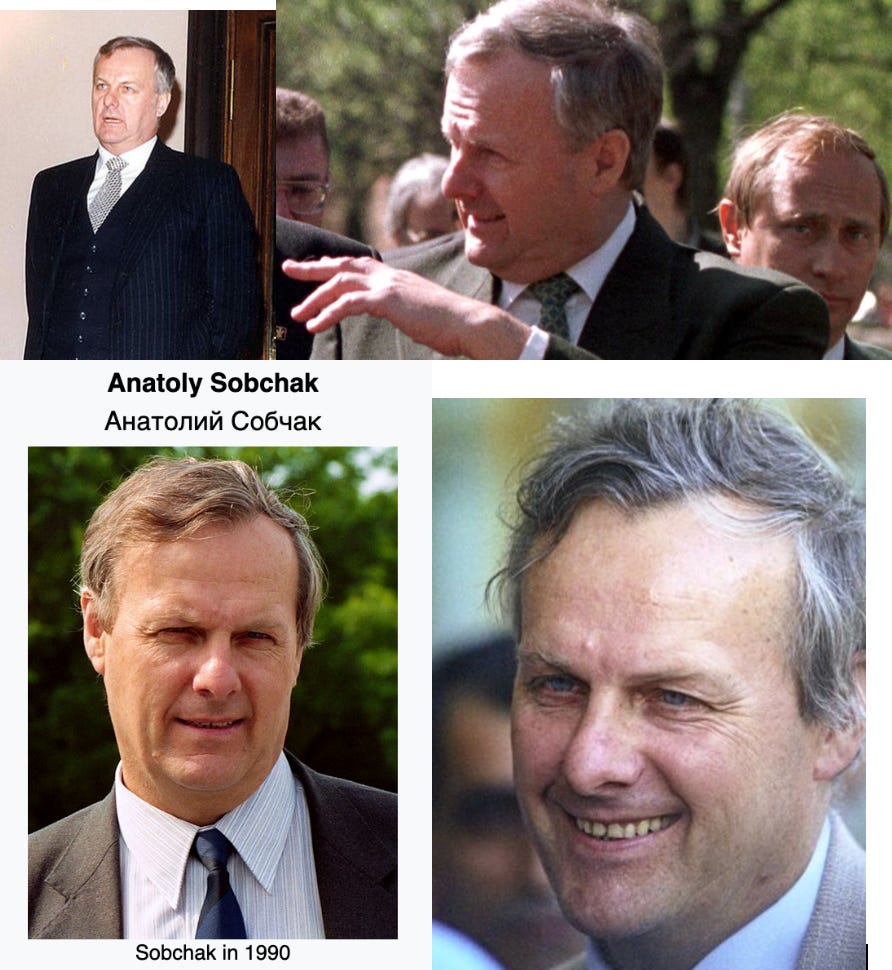
Sobchak is a fun aside for another reason - yet another of the examples of “why men go to all this trouble” in general. Sobchak, like many men, is your basic potato man, by which I mean he resembles, and is about as attractive as, a potato.
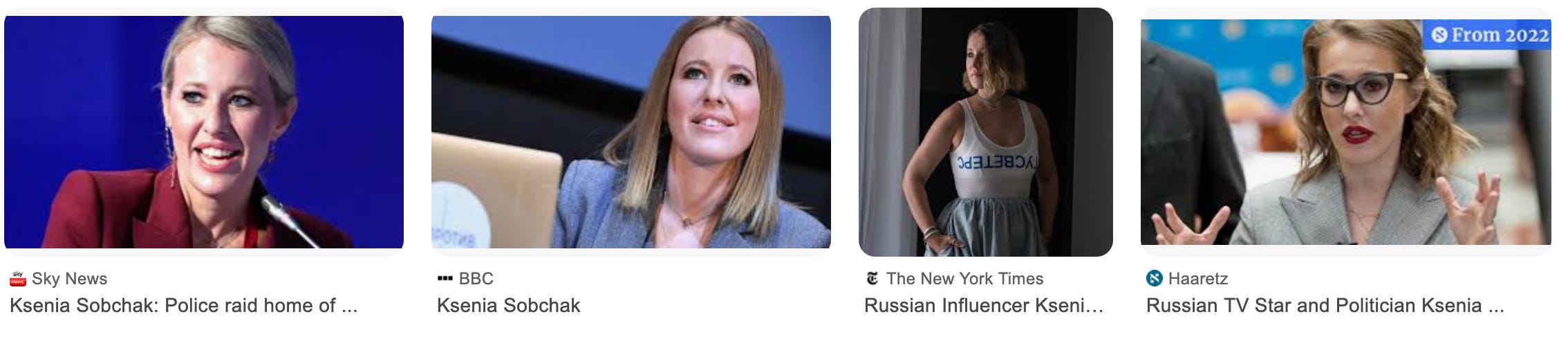
But he was able to have gorgeous and highly accomplished daughters (daughter Ksenia has been an influencer, business woman, and now politician), and that’s the benefit of achieving at that level (you know, in addition to the $100k suitcases, foreign trips, mistresses, etc).
Even post-ascendancy, Putin has been relatively non-corrupt personally. Sure, he has a billion dollar palace and I’m sure he has a few gigabucks stashed away here and there, but truly, this is nothing compared to the median oligarch or Russian politician. Just as a way of comparison, Medvedev was later accused of taking more than $1.2B(!) in bribes during his 4 years of presidency,2 and essentially every Russian oligarch is a billionaire through controlling oil and gas resources via life-and-death political and business maneuvers or rapaciously farming the Russian populace at large. Putin by comparison is a model of restraint and decorum.
Besides, why would Putin care about *money?* He has something none of the Musks and Bezos’ of the world can even dream of - he’s a sovereign nuclear power with a whole country at his beck and call. Money pales in comparison to that kind of power and influence, which can’t be bought.
And the other stuff in the '“ideal politician” list isn’t all that rare, except for “doesn’t want power,” so we’ll hit that point anon.
Russian background
To understand Putin’s (genuine) popularity in Russia, you have to understand the context. When communism collapsed, the transition to a non-communist economy was rough. There was hyperinflation, a serious lack of both resources and the logistics to get those resources anywhere, people literally starving, and more. Many areas reverted to barter economy principles, and GDP growth was strongly negative in the late 90’s for Russia - nobody knew what to do, or how to fix things, or how to even get basics like food and heating oil to enough people to avoid major problems.
This was (not coincidentally) also the time when many oligarchic fortunes were made - the governments at every level of Russia desperately needed foreign currency and resources, and were willing to sell ownership stakes in large enterprises for a song internally, and sell bulk commodities like oil, metals, and timber overseas for 1/1000 of their value, just to help solve these problems.
It’s here where you have your deals like Khodorkovsky buying a controlling stake in the massive oil company Yukos for ~$300M USD, which is a few years later worth billions,3 when Tyumen Oil, Norisk Nickel, Svyainvest telecom, and Sibirsky Aluminum all got privatized to various degrees, and when archetypical oligarch Berezovsky consolidated control of TV station ORT and Sibneft and Aeroflot for a mere $100M each.
Anyone who was able to put their hands on a couple hundred million in USD equivalent was able to buy billions of dollars worth in major enterprises built on serving either a ~150M strong country (telecom, airlines), or the entire world when it came to the commodities.
Not an ideal situation from the Russian government perspective, but again, people were literally starving and both the apparatus of the state and supply chains had broken down, so you do what you have to do.
And indeed, you can see this terrible period quite easily in aggregate GDP figures, which feature immense GDP dips in this time period (and again in the Great Recession when oil prices crashed):
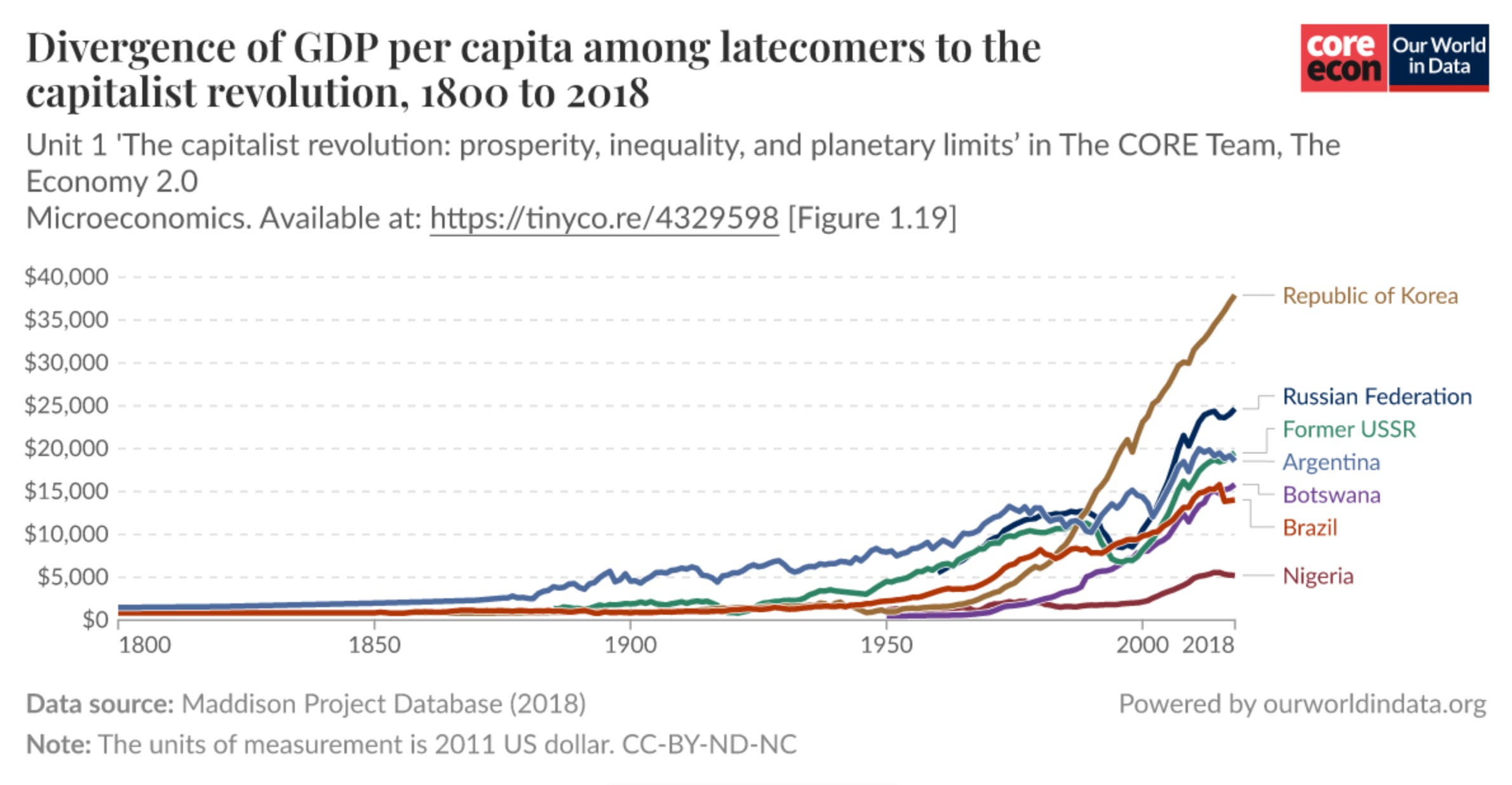
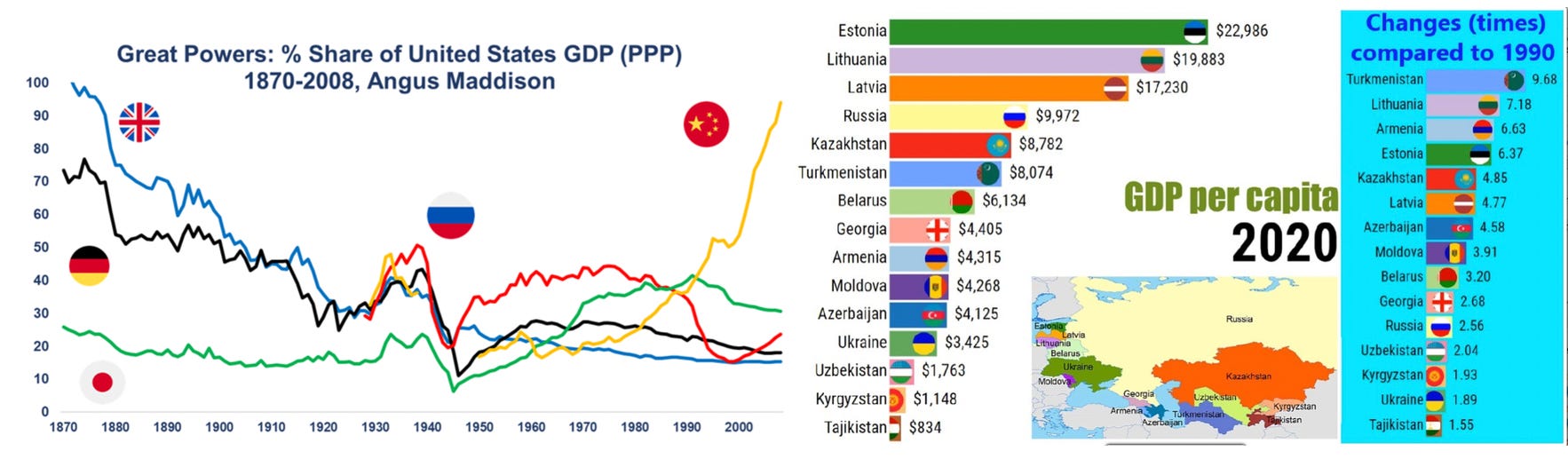
“GDP growth had been negative for a decade, bar a few months in 1998. The government was in a permanent budget crisis. Poverty had soared as life expectancy and incomes plummeted. Our “despair index” (the sum of the inflation and unemployment rates added to the share of people living in poverty) had hit the astronomical value of 1440 — ten times worse than any other country in the former socialist bloc.”
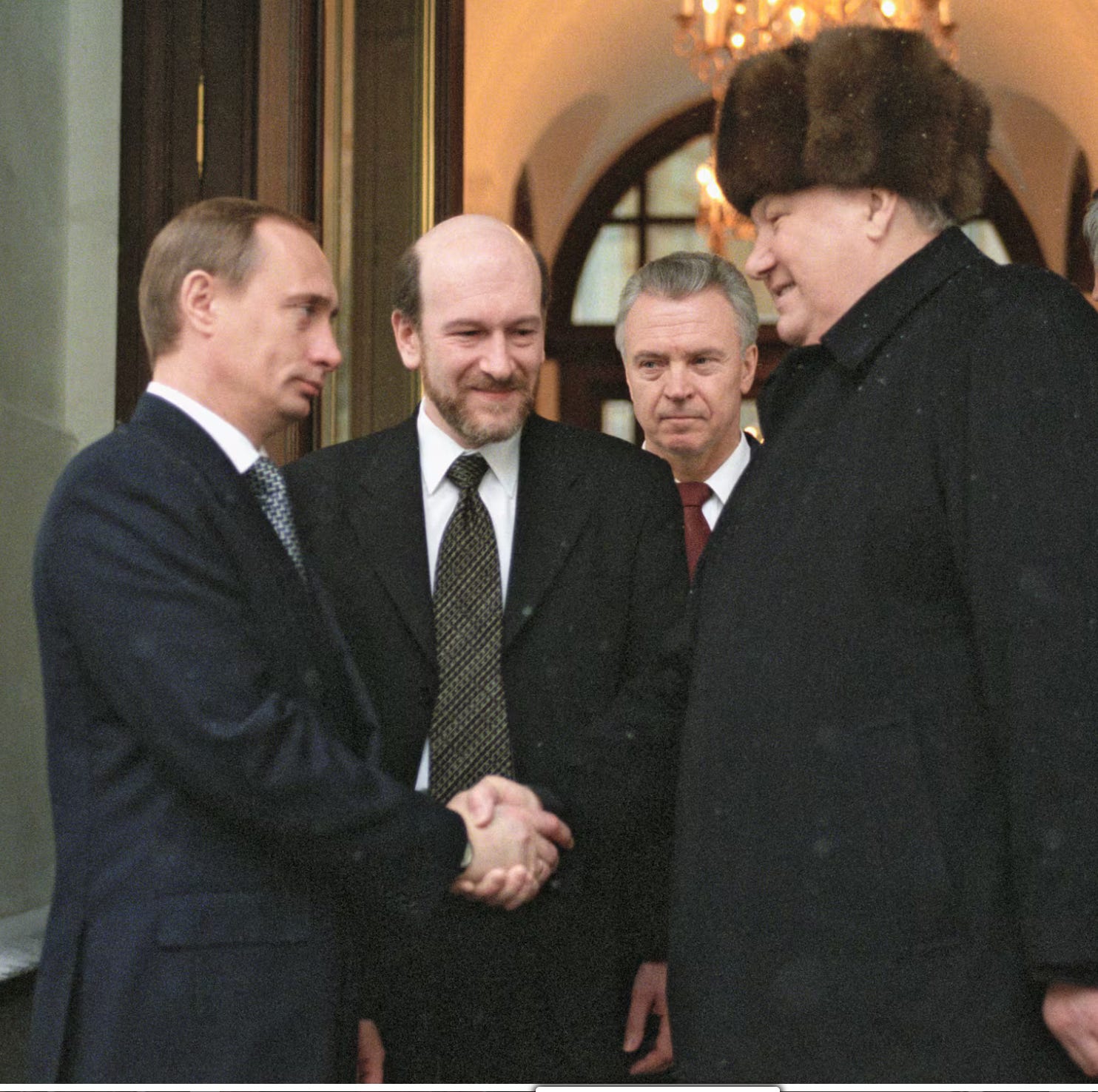
Enter Putin, at the time a scrawny functionary politically and physically dwarfed by Yeltsin, a more traditional “big man” in every respect:
Putin’s ascendancy
But first, maybe we should go over how Putin DID enter, how a bland functionary in the seeming twilight of a meagerly impactful bureaucratic career became a god-emperor.
Yeltsin, President of Russia from 1991 to 1999, was a big believer in “surprise moves” to keep your opponents off balance. He was 4 heart attacks into a long and tumultuous term during which communism had fallen and all this stuff had happened, and needed a successor. There were a number of high level candidates that had been loyal to Yeltsin and were well connected and more or less in the public eye, all of whom seemed vastly more likely than Putin, whose most prominent achievement at that point had been “being vice mayor for the 2nd largest city in Russia.”
But surprise! Putin turned out to be the guy elevated by Yeltsin to the Russian presidency.
Indeed, when Putin was first announced as Yeltsin’s successor, people within Russia and all around the world proceeded to do the equivalent of culturally-tailored spit takes and loud exclamations about the improbability of it all. It blindsided even Putin himself, who at least *pretended* hesitancy about assuming the office.4
It’s probably worth pointing out that Putin’s god-emperorhood and dictatorship over the last ~25 years was at least 2/3 % democratic. He was genuinely elected in landslides his first two terms, then did a completely legal switcheroo with Medvedev and became Prime Minister (and the true power behind the throne) while Medvedev was President, then in 2008 had some laws rewritten extending presidential terms and in 2020 resetting his own term limits, and as near as I can tell, only in 2024 was he finally doing something not allowed by the original Russian constitutional terms that were in place when he took office ~25 years ago.
Do the Russians stuff ballots, pay people to vote, neuter opposition parties, and do various other “get out the vote” stuff that made sure Putin got large majorities? Boy do they! But they seem to do that on general principles in almost every election, from local to national, and to do it whether or not it’s needed. It wasn’t needed for his first two elections, he would have won handily without them.
Okay, so enter Putin.
“There was no growth under Yeltsin. The economy contracted for a decade. But that changed suddenly and dramatically after Putin took over. One of the benefits of the 1998 crash and devaluation was it re-monetized the economy and killed off the “virtual economy.” As people went back to using cash and the petrodollars started to flood in the economy boomed. GDP growth in 2000 was 10% as the economy bounced back from the crash — a record yet to be beaten. The two crises in 2008 and 2014 were major shocks to the economy.”
Putin brought Russia from “starving and broken” to GDP growth. And although they haven’t kept pace in terms of growth rates compared to the other former Soviet satellite countries, (see second chart), that’s still better than the trajectory they were on before.
In fact, this growth and success was the genesis of various protests and Putin’s eventual turn to tightening the dictatorial screws!
Around 2011, the newly grown Russian middle class and knowledge workers (now roughly a quarter of the population), came out in force after the Medvedev-Putin switcheroo, with hundreds of thousands protesting the loss of democracy in the Bolotnaya protests. Needless to say, Putin arrested a couple of thousand of them, cracked down on tv and internet and NGO’s, increased fines for “illegal rallies” 150x, and calmed things down by making some procedural concessions like easier party registration and webcams at polling stations.
It might be apropos to point out here that Putin’s main support base has always been the honest Russian folk of the countryside, who generally have much more small “c” conservative mores, lower education and prosperity, and suspicion of all things newfangled, American / EU, or urban.
This might go some small way to explain things like the infamous “shirtless calendars” non-Russians like to make fun of - he’s pandering to his base! It’s basically the equivalent of Dub posing as a hunter for a photo op.
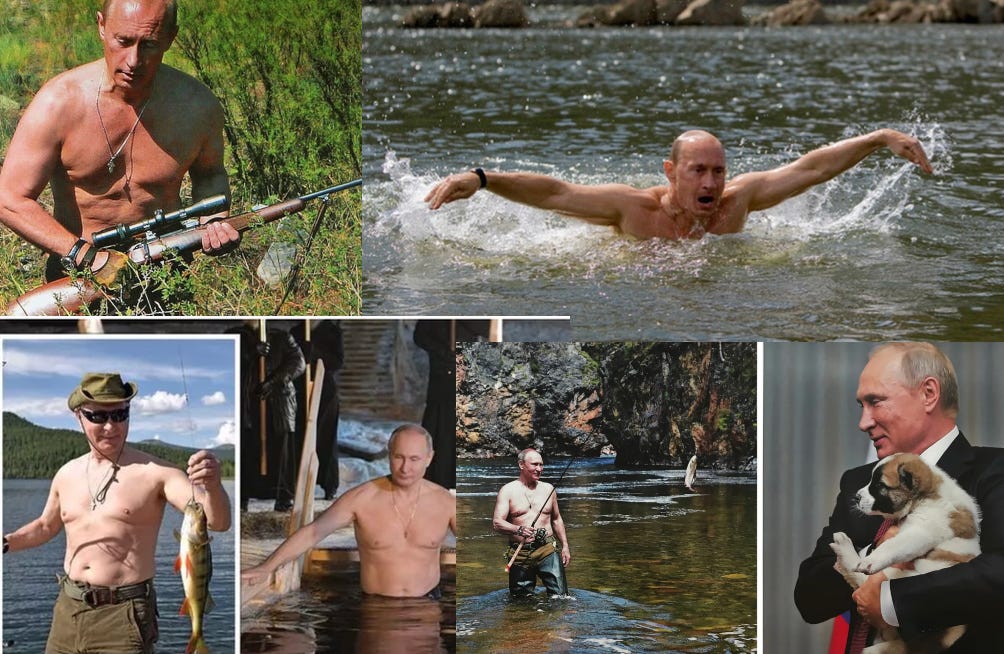
Okay, so enough about all these minutia and shirtless calendars featuring impressively fit 70 year olds, what we really want to know from reading about Putin is - WTF is going on with the Ukraine war??
Why are we seemingly closer to WWIII than ever before?
What possible win could Russia / Putin get from it?
Ukraine war motivations
So I want to highlight here, this is all basically unknowable, and this is just my best guess from reading the book and making inferences from some of Putin’s public statements.
Putin is really big on Russian history, and has become moreso as he’s aged, and is clearly thinking about “legacy” at this point of his career.
Ukraine is historically the gateway to Russia - most past occasions of Russia being invaded went either wholly or in part through Ukraine - Napoleon, Hitler, Sweden in the early 1700’s, the Tatars, and even the Mongols.
Second, after communism fell and the USSR broke up, both the USA and NATO promised Russia repeatedly to never expand eastward into the former Eastern bloc, and then aggressively and continually expanded eastwards, putting army and air force bases, missile stations, and more in a number of countries surrounding Russia (Estonia, Latvia, Lithuania, Poland, Romania, Bulgaria, Hungary).
To give a fuller idea:
“It had started well. US Secretary of State James Baker had told Gorbachev in February 1990, in the context of German reunification, that ‘not an inch of NATO’s present military jurisdiction will spread in an eastern direction’. When Gorbachev doubled down and insisted that there should not be ‘any extension of the zone of NATO’, Baker assured him that that would be the case. Although nothing was put in writing, from then on the State Department worked on the basis that there would be no eastward expansion of NATO and so did America’s allies. Helmut Kohl, François Mitterrand and Margaret Thatcher all reiterated Baker’s assurances at meetings with Soviet leaders. In March 1991, when the Soviet Defence Minister, Marshal Yazov, expressed his concern to Thatcher’s successor, John Major, about possible NATO enlargement, the British Prime Minister assured him that ‘nothing of the sort will happen’. Four months later, the NATO Secretary General, Manfred Wörner, told a Soviet delegation that he opposed NATO enlargement and so did most NATO members.”
So from this, to expansion into at least 7 former Eastern bloc countries.
From Russia’s point of view, their bulwark and belt between them and US / NATO / EU offensive capabilities kept getting tighter and tighter, despite assurances it wouldn’t happen.
Think of it from the broader viewpoint too - Russia went from being the Big Bad, the second World Power, a nuclear and technological colossus that terrified approximately everyone, to not being able to feed its own citizens. And it never gave up those nukes! So it turned around to deal with the whole “feeding citizens” thing, and the instant its back was turned, all these pissant NATO powers start chipping away at it, harrying it, slapping offensive bumper stickers on its locker, and more or less creating and polishing and installing giant “Russkinator 5000” guns everywhere.
From Putin himself:
“They have lied to us many times, made decisions behind our backs, placed us before a fait accompli. This happened with NATO’s expansion to the East [and] with the deployment of a missile defence system … In short, we have every reason to assume that the infamous policy of containment, carried out in the eighteenth, nineteeth and twentieth centuries, continues today. They are constantly trying to sweep us into a corner because we have an independent position … But there is a limit to everything. And with Ukraine, our Western partners have crossed the line … They must really have lacked … common sense not to foresee the consequences of their actions. They put Russia in a position which left it with no way out. If you compress a spring all the way to its limit, it will snap back hard.”
The Russian diaspora fits in here too - there were 25M Russians in various Eastern Bloc countries that got stranded after the Soviet Union fell, and they were generally treated pretty poorly by the new former Soviet countries’ governments. For instance, Russians were ~5% of the population in Estonia, and after the fall, Estonia instituted laws requiring Estonian language for citizenship, and banning anyone who’d served in the Soviet military from citizenship, and this ended up leaving the majority of those Russians stateless, with no citizenship. Latvia classed nearly 500k Russians as “non-citizens” in similar ways. This is directly relevant to the mostly Russian populations of Crimea, and separatist regions Donetsk and Luhansk in Ukraine.
Ambassador Burns to Condoleeza Rice:
“Ukrainian entry into NATO is the brightest of all red lines for the Russian elite (not just Putin). In my more than two-and-a-half years of conversations with key Russian players, from knuckle-draggers in the dark recesses of the Kremlin to Putin’s sharpest liberal critics, I have yet to find anyone who views Ukraine in NATO as anything other than a direct challenge to Russia’s interests. At this stage a MAP offer would be seen not as a technical step … but as throwing down the strategic gauntlet. Today’s Russia will respond.”
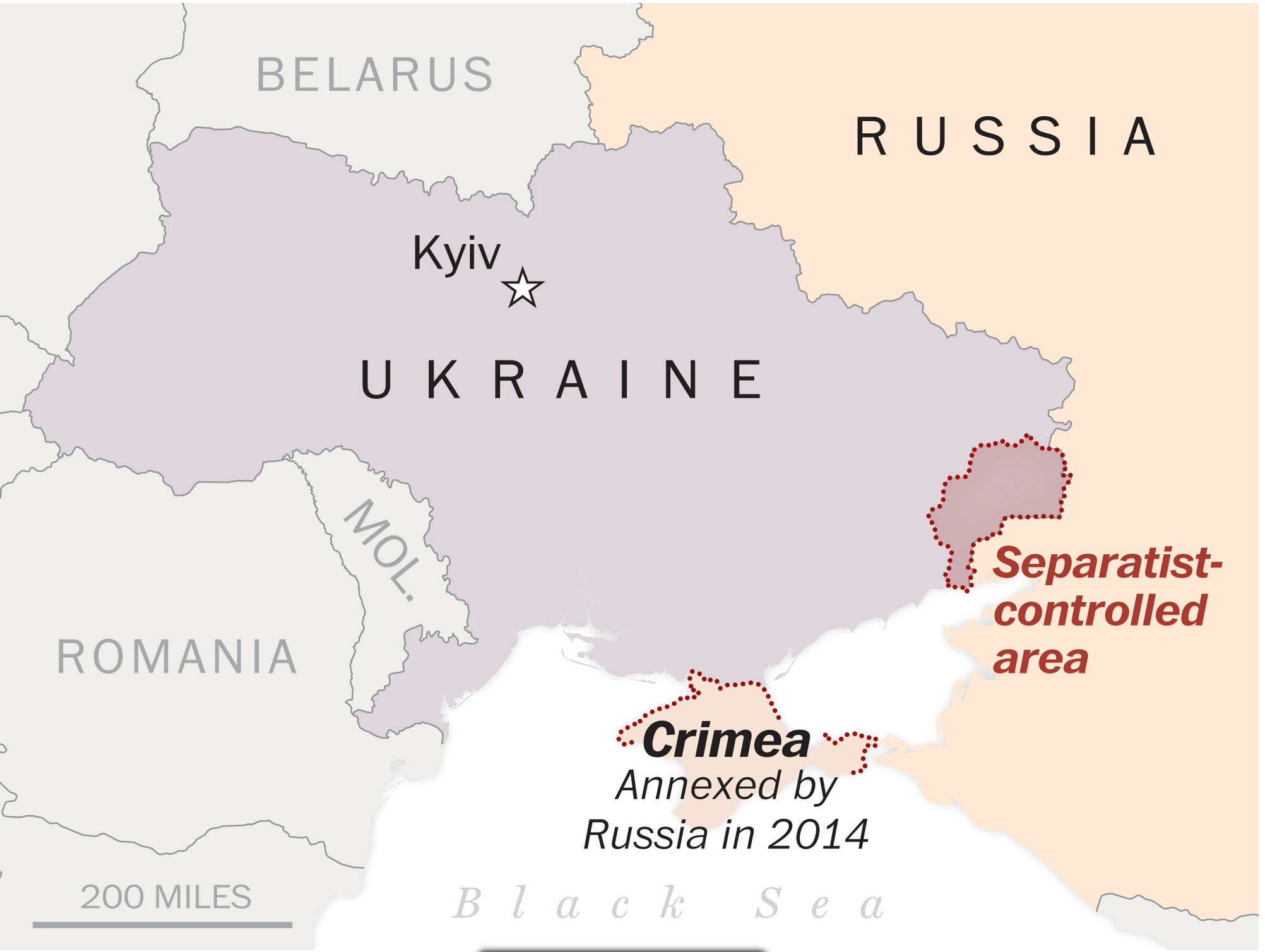
So when Russia forcefully annexed Crimea from Ukraine in 2014, there was an 80%+ approval by the Russian populace, due to these dynamics. It’s thought that Putin annexed Crimea for several reasons - not just because of the Russian diaspora there, and not just because it was popular to his base - strategically, it also blocked Ukraine from joining NATO, because historically they didn’t allow countries in the midst of a military dispute in. So Putin annexes Crimea in 2014 and thinks he’s safe on the “joining NATO / EU” front - lol, womp womp.
So essentially, Putin’s Russia is put in a position where an ever-tightening noose of offensive capability is being put around it by the EU and the USA, where good honest Russians are getting crapped on by former Eastern bloc countries, and where Ukraine’s attempts to enter NATO / the EU is the last straw in terms of compromising the historical gateway to Russia.
“What would America have done, Putin wondered, if it had been the other way round – ‘if Russia had placed missile systems on the US–Mexico border or the US–Canadian border?’ The answer was self-evident. When Khrushchev had attempted to install Soviet missiles in Cuba in 1962, the world had been brought to the brink of nuclear destruction and the issue remained so fraught that, 60 years later, the United States continued to subject the island to an economic blockade.”
Back to “legacy,” and Short’s own take:
“As Putin weighed his options that summer, there appeared to be a window of opportunity for one last push to bring Ukraine to heel. It would be a gamble. But if he could carry it off, correcting what he viewed as one of the cardinal sins of his predecessors, it would be the crowning achievement of his career – the last box to check before embarking on a political transition at home, allowing him to leave office on a high note.”
Hence, the Ukraine Russia War, largely seen as a mistake and tragedy for both sides at this point.
So how fucked is Russia, really?
So from one perspective, pissing off most of your trading partners and customers and immolating at least ~4M working years5 via deaths and disabilities of your working age men seems like a pretty bad idea for future economic growth and prosperity and relevance.
Is Putin’s legacy to destroy Russia as a relevant power on the world stage?
This is all just SWAGs and estimations, but I think you can expect negative impacts for Russian GDP and relevance on a number of fronts:
1. Deaths and brain drain - the Russian economy will lose a large chunk of its working age men from deaths and disabilities (~1M casualties estimated, with ~90-100k deaths and 900k injuries), and from emigration incurred during the war, and this will likely affect GDP and growth both from the loss of working hours, and from brain drain of capable people who generally serve as multipliers on economic activity who have left so they don’t get drafted into the war (IT and finance specialists, entrepreneurs, investors, other educated Russian workers), and there’s around ~650k of these who have emigrated so far.
2. Sanctions and restricted trade - sanctions and anti-Russian sentiment among the EU and USA may affect trade and Russian GDP. Russia’s economy relies on commodity exports, primarily oil and natural gas, and they’ve had to pivot to selling to China and discounting sales so middlemen can buy and resell to sanctioned markets for a profit.
3. Russian fertility - Russia is a “fertility crisis” country, clocking in at ~1.4 TFR before the Ukraine war (and famously offering $4-5k USD bonuses for each child past the first child, which has been recently supplemented with additional $1300 USD bonuses for female college students who get pregnant).
Historically, ie WWII and prior, there are post-war fertility rebounds after a war. However, this was in prior fertility regimes outside of the modern fertility decline driven by increased education and increased costs of raising children, and it’s not a given that Russia will enjoy a fertility rebound after this.
Contemporary examples of “fertility crisis” countries that have been in wars in the 90’s and beyond (the Balkans, Georgia, and Armenia) do not typically result in a significant post-war baby boom.6
To give you an idea of the relative magnitudes here, and why the “fertility crisis” is such a crisis: ~1M casualties (100k deaths and 900k injuries / disabilities) from the Ukraine war add up to a loss of ~4M working years from the Russian economy - but the fertility crisis and demographics means Russia will “lose approximately 800,000 working-age people from the demographic structure every year.”7 So every 5 years of “fertility crisis” baseline immolates as many working years from the Russian economy as a maximally blunderful and costly war does, and that trend is accelerating.
4. Crowding-out of future tech/health spending: Sustaining 6–8%-of-GDP spending on the military takes away money that could be used on education/health/innovation, and this will suppress total factor productivity and innovation.
6. Refining & logistics fragility: Ukrainian attacks on Russian oil and gas infrastructures drives persistent efficiency losses (insurance, routing, shutdown risk, production and shipping and contractual fulfillment uncertainty) even if'/when production recovers.
7. Worse corruption and social disruption: this may occur if Putin loses the “mandate of heaven,” as happened under Yeltsin, and this may severely impact the Russian economy (just see the GDP charts earlier during the fall of communism).
All together, if you do a sensitivity analysis of all this stuff, it looks like a median ~15% hit to Russian GDP over the next ten years, with a relatively broad range of 5 - 30% potential GDP impact:
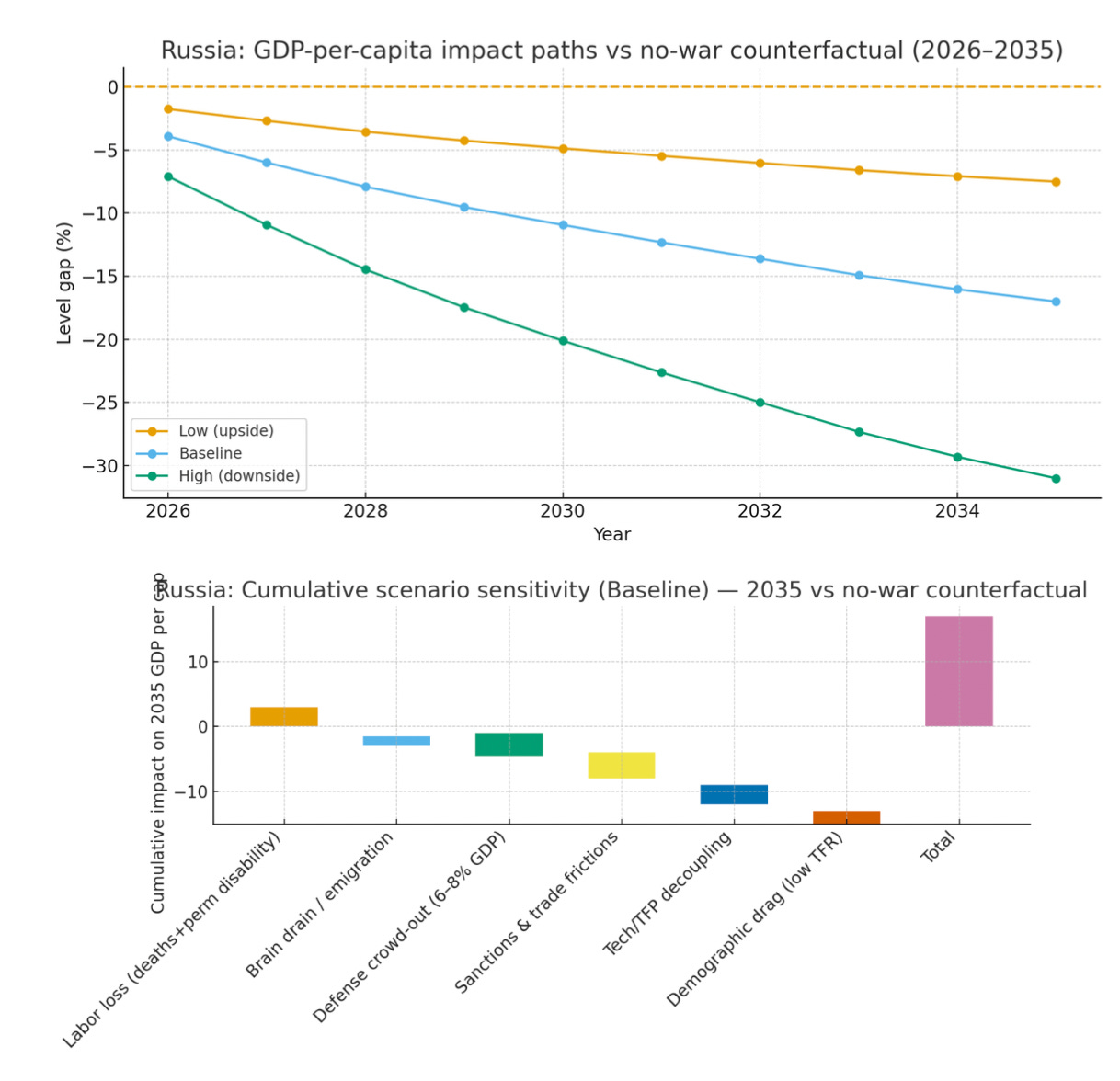
All in all: not too bad!
At least, compared to the >50% hit to GDP that communism falling led to. We know Russia has survived worse than this, it’s one the order of past secular depressions like the Great Recession, and it really doesn’t seem existential.
So has Russia been rendered irrelevant on the world stage?
Ultimate disposition
Probably not. The Russian economic fundamentals aren’t really changed, nor is its position as a nuclear power.
Overall, international sanctions have been priced in since the Crimea annexation in 2014, and Russia is essentially a petrostate whose economy relies on exporting oil and natural gas, which have commodity value on the world market. Economically they’re facing some productivity and labor losses from war casualties, but it’s not much against the losses stemming from their fertility crisis baseline, which it should be pointed out effects essentially EVERY developed country now, so is more or less background noise.
Combined with being a legacy great power with a big nuclear arsenal, I think Russia will probably be in about the same position on the world stage post-Ukraine, with or without the Ukraine war impacts, and likely even with or without Putin.
The biggest lost opportunity within Putin’s term is that he was never able to reign in the corruption and institutional rot and inefficiency that serves as a giant brake on productivity and progress in Russia.
When I’ve met Russian emigrants elsewhere in the world, I’ve been uniformly impressed by just how smart, capable, and pragmatic they are. Russia in general has immense reserves of talented people, as we see in places like their space program, their mathematicians, and their cyber capabilities. And sadly, these are being wasted to a fairly large degree in an environment as corrupt as Putin’s Russia.
Reading the book, for all that Putin is famous for defenestrating various oligarchs and opponents, it sounds like Putin genuinely needs the oligarchs and other power centers (both siloviki and civiliki) in Russia enough that he essentially can’t reign in the corruption, despite several attempts at it.
Just as one data point, compare the other post-Soviet eastern bloc countries to Russia’s economic trajectory - Russia has lagged severely, and this is largely institutional.
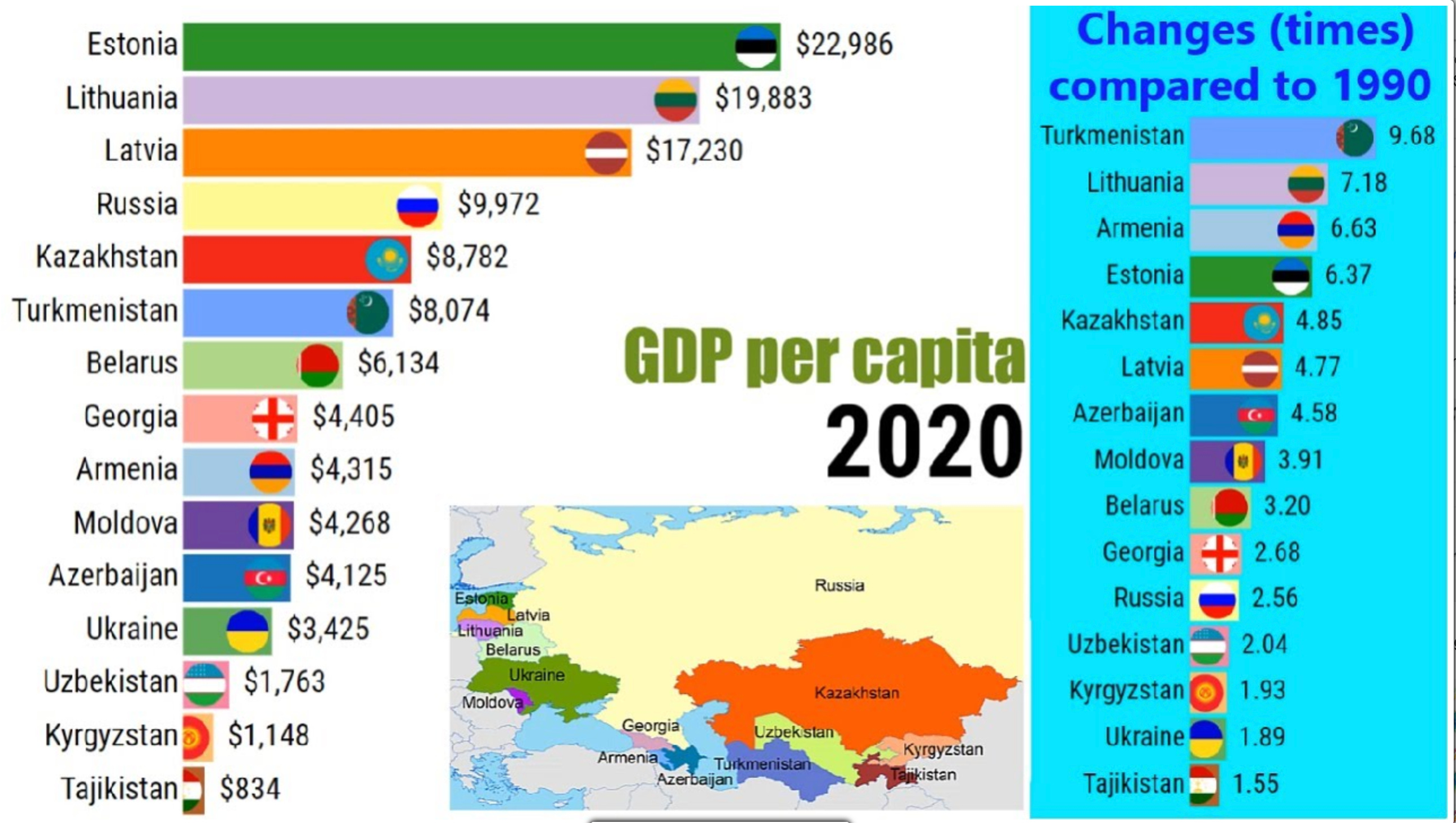
The classic feudal model of a big man at the top paired with a nobility skimming the cream of all good things has been as destructive to Russian GDP and productivity as it was to medieval Europe and today’s Africa.
In a counterfactual world, where Putin was actually able to clean up corruption and enable knowledge-based economic growth like Lee Kuan Yew did in Singapore, Russia would probably be much better off, and this is the true cost of his non-benign tyranny.
“In Russia, there is an important difference between an official who takes bribes, and one who accepts a recompense from a businessman he has helped. According to the St Petersburg historian, Dmitry Travin, it is a distinction which goes back to tsarist times:
Many Russian officials, and not just then, but now, too, don’t think that it is wrong to take kickbacks, they think it is just a legitimate return for the help they give to business. It’s a moral question. In seventeenth-century Russia, there were two expressions for bribes: mzdoimstvo [donations] and likhoimstvo [extortion]. Mzdoimstvo was the proper sum of money for the official’s help – it was accepted, and it was not subject to discussion, because officials never lived just on their salary. The expression is no longer used, but the idea [has survived]. It means that you can take your rightful due and that is fine. Likhoimstvo means asking much too much.”
Which is another point on the “loyalty” front for Putin, who staunchly stood by Medvedev:
“Medvedev was approaching his sell-by date. He had lost all credibility not only with the liberal intelligentsia but with the population at large. But when Aleksei Navalny’s Anti-Corruption Foundation posted a 50-minute documentary on YouTube, alleging that he had received 1.2 billion US dollars in bribes from Russian business magnates, disguised as donations to a charitable foundation, Putin immediately went out of his way to show his support. Whatever thoughts he might have had of replacing Medvedev were shelved.”
Also, on a lighter note, this is funny because we sure the hell can’t cast stones any more in the USA on this front. It used to be “how backward, how uncivilized, IMAGINE having to pay off politicians to get anything done” to “yeah, you can just buy presidential pardons for ~$2M and if you want an AI deal, put $2B into World Liberty Financial and we’ll make it happen.”
And Khodorkovsky accordingly was the richest man in Russia a few years after that, which is not generally an enviable thing to be. He got targeted by Igor Sechin, Putin’s long-term secretary when he was 2nd in command for St Petersburg, who after Putin’s elevation became a cabinet-level minister, and maneuvered Khodorkovsky into making some unwise political statements and maneuvers so he could get him on Putin’s bad side and take over his oil company.
From Yeltsin:
“I’ve made a decision … I would like to offer you the post of Prime Minister,’ I told Putin …
‘I will work wherever you assign me,’ [he] replied with military terseness.
‘And in the very highest post?’
Putin hesitated. I sensed that for the first time, he truly realized what the conversation was about.
‘I had not thought about that. I don’t know if I am prepared for that,’ said Putin.
‘Think about it. I have faith in you,’ I said.”
Let’s call it 100k deaths at average age 25, so 40*100k = 4M years lost from deaths, and 1/3 of the 900k casualties, so 300k wounded enough to affect lifetime productivity, at say 66% productivity from age 25, so 40*.33 = 13.2*300k = 4M, for a total of 4+4= 8M years lost, call that the midpoint and you’ve got 6 - 10M years of productivity lost from the labor pool. Then to be conservative, cut it in half in terms of impact, because like most militaries, Russia recruits from the bottom half of the talent pool, so let’s call it 4M years lost in terms of aggregate economic impact.
Georgia’s fertility went up post war, but famously it’s because of the unrelated Orthodox Patriarch blessing. The Balkans remained on their declining fertility trends, and Armenia had a slight bump (1.7 → 1.9 TFR), which lasted less than a year, which was more than offset by increased post-war emigration.
Speaking at Sberbank’s Corporate University on September 25 2017, economy minister Maksim Oreshkin called Russia’s demographic situation “one of the most difficult in the world,” adding that in the next five to six years “we are going to lose approximately 800,000 working-age people from the demographic structure every year.”
Oreshkin blamed the recession and political tumult that followed the collapse of Communism in 1989. “The lowest birthrate in the country was reached in 1999, and these people are now 18 years old; they are entering the work force. This generation is very small,” he said, warning that the working age population is expected to shrink by 4.8m by 2025.
Good post. I'm not sure i buy the concluding paragraph that Russia has especially poor economic performance or that it needs institutional reform.
It's true other former Soviet states have done better, but those are overwhelming the ones that are closer to the West economically and geographically, like Poland and the Baltics. The central Asian sates have fared even worse than Russia and countries like Belorussia and Ukraine have faired similarly. Ultimately each country has more or less just blended into the geographic gradient of wealth emanating from North Western Europe and declining outwards from there. Russia has also always been relatively poor compared to western Europe throughout history.
Based on those geographic and historical trends it's about as rich as I'd expect it to be.
A large part of me also wonders if this is just as rich as a European country outside the American empire naturally is. But there aren't really any other examples to test that idea. Maybe China is the closest parallel, but China is obviously on it's own unique growth trajectory.
Good overview, with which I have little to disagree. From my perspective, the root cause of the current situation was Putin's decision to return to the presidency after his 'castling' maneuver with Medvedev. When his decision was announced at the United Russia party congress in 2011, he said it was always planned as such. But nobody - neither in Russia or outside - really believes this. I was a baby lawyer at the time doing a lot of Russia work and heard first-hand reports in the 2009-10 timeframe that Putin's people had approached several London law firms inquiring about the feasibility of obtaining international 'immunity' from prosecution, which of course is not a thing. My take is Putin was genuinely worried about his and his family's personal security - he had already thrown down the gauntlet with the West and Russia is, well, Russia. He announced his plan and rather than being welcomed he gets Bolotnaya, which he viewed as a Western provocation. Feeling stuck in his role for life led him to take more risks like Crimea and continued overseas games with polonium, but instead of being punished he got to host the Olympics/WC and faced largely toothless sanctions. The extreme self-isolation during covid led him further down a self-radicalizing rabbit hole, but instead of 4chan he was reading Russian nationalist philosophers and historians. As a result, Putin concluded that his historic role is to remedy the 'tragedy' of Russia and the Kievan Rus being separated. But it was a colossal blunder - anyone who talked to ordinary Ukrainians post-2014 could tell you that their desire to be independent was genuine and arguably stronger than in 1991, when they voted overwhelmingly to become an independent state. It really is a fascinating case - like some perverse version of the heroes journey.