
Sleep - the final, and neglected, frontier
A call for comfier blankets, more tech, and "sleep yogis"

We’re all totally sleeping on sleep.
So we all know about Effective Altruism (EA), the mosquito net dispensers who like to rigorously quantify the QALY’s per dollar that their charitable interventions drive.
I would like to suggest that sleep optimization is shamefully neglected in their calculus (and in most individual people’s priorities), on many fronts.
Whenever you can stack up “literally a third of everyone’s life” and multiply it by “everyone,” I don’t think there’s a bigger QALY pool you could really define, because at the high level, that nets out to roughly “3 billion human lifetimes” getting sucked into…nothingness. No conscious experience.
The only possible bigger lever is “immortality,” and I think “improving sleep” miiiight be a lower hanging fruit than conquering aging and death, while still coming with an impossibly large addressable human QALY pool.
Think about it - if you move that pool 10%, that’s a bigger deal than practically anything else anyone has ever possibly done, up there with Borlaug’s Green Revolution and creating the Internet. Heck, even moving it 1% means you positively impacted the equivalent of ~30M entire lifetimes.
So why aren’t EA’s focusing on sleep? Why aren’t more entrepreneurs focusing on sleep? Why aren’t more individuals focusing on it, just for themselves??
To a first approximation, everyone not hooked into the “bed rotting” trend wishes they could do less of it!
What are people doing today?
Mostly just arguing, both EA’s and regular people. Some advocate sleep hygiene, some advocate cutting back on sleep because you don’t actually need 7-9 hours, some evaluate interventions like melatonin, CBT-I, or light therapy, but none are really doing anything interesting, or at scale.
There are no rigorous schema’s, there are no ongoing RCT’s, there are no “meditation workshop” equivalents for sleep techniques, there are no “sleep hygiene” education programs, there are no “how to sleep better” tutorials or creatives out there spreading a message.
There’s also no “somnonauts” or “sleep yogi” equivalents like there are meditation practitioners - but I’ll argue later that there should be. So not much on the individual level, what about the organized effort level?
Well on the “sleep research” side of things, we throw a whopping ~.002% of GDP into it every year in the USA (about $550M), or ~2% of the NIH funding budget, to something stealing 110k lifetimes worth of hours per DAY worldwide. Internationally across all countries, it seems like we throw a few more tens of millions at it. Rounding error, mostly. That’s it!
We literally have something that steals 3 billion human lifetimes today, and we are essentially throwing unwanted pocket change at doing anything at all about it.
And sure, the government is bad at priorities, but what about the smart set? While EA is quietly faffing around discussing shrimp welfare and whether melatonin is worth it, they too are doing nothing on this front. Literally the largest addressable human QALY pool ever is sitting there untouched, not being optimized!
One thing we know for SURE: the amount of effort, bandwidth, and funding dedicated to this is VASTLY smaller than that addressable QALY pool would argue for, because even sub 1% incremental gains have the potential to drive massive benefit as long as they’re real and replicable.
We are seriously underinvesting in “sleep improvement” as a potential lever compared to the vast potential upsides.
Why should we assume there ARE significant discoverable benefits?
Now the skeptics out there may point out that if there were low hanging fruit in something like sleep, which literally makes you stop eating and stop reproducing entirely for huge chunks of your life in every organism, evolution would have figured it out by now. All those 1% edges I’m talking about would be an impossibly tasty boost to inclusive fitness at the individual level, so if evolution *could* have figured it out, it would have, somewhere back in deep time.
In other words, if there’s one thing we know, sleep is Lindy. Every vertebrate sleeps - heck, forget vertebrates, most insects sleep. Jellyfish sleep. Nematodes sleep!
Sleep goes so far back and is so widespread, this is like looking for a significant lift in breathing!
Breathing - I’m glad you mentioned that
Because there IS significant lift in breathing.
Breathing has been explored, studied, and optimized for millenia, to the extent that there are yogis able to do fantastic phsyiological feats,1 and monks able to breathe tummo and generate enough heat to stay warm with no clothing in frozen Himalayan caves.
Wim Hof, a modern day yogi, is noteworthy as a breathing technique advocate who is known for the following:
He ran a full marathon in the Namib desert in 104+ temperatures, with no water.
He ran a half marathon barefoot in the Arctic, at -20 temperatures.
He summited Kilimanjaro in <31 hours, wearing only shorts and shoes.
He has the longest “submerged in ice” world records, with the latest 1hr and 52 min.
He has - under laboratory conditions - both consciously upregulated and downregulated his immune response, and has taught other people to do the same, also verified in lab conditions.
And this is totally expected! It’s not just “breathing,” either.
You could try to say the same thing about something as Lindy as “having arms,” and sit me down and say “look, PB, vertebrates have had arms for hundreds of millions of years, and if there was some way to do them 10% better, evolution would have found it by now.”
But if you actually look around, lo and behold you would discover that for animals or humans that actually assiduously practice and explore the space, they do indeed come up with radically useful and new ways to use their arms, to improve arm strength, to take a given arm-based ability from “succeeds occasionally” to “succeeds the great majority of the time,” and more. In general, people underestimate what focused effort and attention can achieve, even in extremely Lindy domains.
So if breathing and having arms has this amount of variance and lift available with effort, I think there’s a strong case that sleeping does, too.
And beyond *reducing* the need for sleep,2 there’s always improving the sleep you are having as an intervention area, too.
Which brings us to the elephant in the room.
Lucid dreaming
It’s interesting to think about dreaming practices through time.
There could have been entire societies and cultures that had well-optimized, culturally-transmitted dreaming practices! Before writing, it wouldn’t leave any records, and there’s a deep well of time and a massive long tail of diverse cultures in the hominin timeline. Even in the modern age, any ethnographers or anthropologists studying a given culture could easily be entirely unaware of a culture having notably better widespread cultural dreaming practices due to inferential distance, language barriers, and many other reasons.
Where is the dreaming equivalent of breathing exercises and yogic expertise?
I’m pointing to lucid dreaming here, because it’s the big thing on the landscape that we know about in the West, the one that most people know about today, but I wouldn’t be surprised if it’s the “box breathing” equivalent in a menu of diverse dreaming techniques that other people historically have explored and been able to achieve reliably.
Much like meditation, there are likely hundreds of different techniques and reliably achievable states and modes that we’re capable of achieving during sleep. But nobody is studying this!
Even just simple lucid dreaming itself - if you spent effort on learning and teaching lucid dreaming techniques that could scale, think of that impact! At a minimum, you can claw back billions of hours worth of human QALY’s per year - from “zero conscious experience” in most sleeping humans, to “hundreds of hours of conscious experience dreaming and living as fantastically as you can imagine,” per person, per year.
That’s a huge deal!
Why aren’t EA’s heads down on lucid dreaming workshops and technologies?
Why aren’t we all individually doubling down on this? Do we not value our conscious experiences enough to add tens of thousands of additional conscious hours doing whatever we want to in our lifetimes??
Why aren’t there any “sleep yogi” equivalents, like there are for meditation and breathing?
I mean, at the high level the answer to all this stuff boils down to “because it’s hard, bro!” No clear path, lots of effort, etc - the same reason most people don’t meditate or do breathing exercises, but with even less of a clear path and consensus around what’s possible.
Which brings us to everyone’s favorite “easy mode” button - technology.
Where might we be able to actually move the needle without sleep yogis and lots of effort?
Less sleep entirely - SNP’s
Lucid dreaming
Other dream technologies
Less sleep entirely - SNP’s
We have long known of several SNP mutations that allow people to sleep between 1-3 hours less. DEC2, ADRB1, NPSR1 and GRM1, and there are a few more.
In a frustrating twist, we’ve also recently found that these mutations in particular are not themselves dispositive for sleeping less; larger GWAS’s with people with the relevant SNP but without the lower sleep phenotype have found that the actual effect must be polygenic / familial.
However - that argues that we should be pouring massive, “space race” level amounts of money into this area, to definitively figure that out. At the minimum, we can define a sub population that can be positively gengineered into needing less sleep, and that’s a huge win itself. With enough additional sequencing, we should be able to understand the ancillary genes needed to deploy it more broadly.
If you can eliminate 1-3 hours of sleep for even a third of your population, the boost to productivity, quality of life, and optionality for your populace would be absolutely massive! In the US, that would be 110M-330M hours saved per day! That’s ~150-450 lifetimes-worth of hours saved per day!
Imagine if every day you added another 300 Americans to the country, of exactly the skills, education level, backgrounds, and capabilities of today. Already fully plugged into social and economic networks! Wouldn’t that be a huge deal?? Just the incidental economy boost should make this worth it as a government funded project!
And that’s just for the US, a tiny 3% slice of the world! Write that across a broader geography, and it’s tens of thousands of lives-worths saved per day.
This is THE biggest potential QALY intervention on the market right now.
And how much are we spending today? Oh yes, rounding error in GDP or even just the NIH’s research budget, worldwide.
Governments are asleep at the wheel, yes, but we expect that. Worse, EA’s are asleep at the wheel on this one, too.
Dream technologies
Remember when some Japanese grad students hooked up Stable Diffusion to an fMRI and were able to literally read images from people’s minds?

That technology hasn’t stood still - by adding additional semantic layers and involving LLM’s, a team in Iran was able to take it even farther:
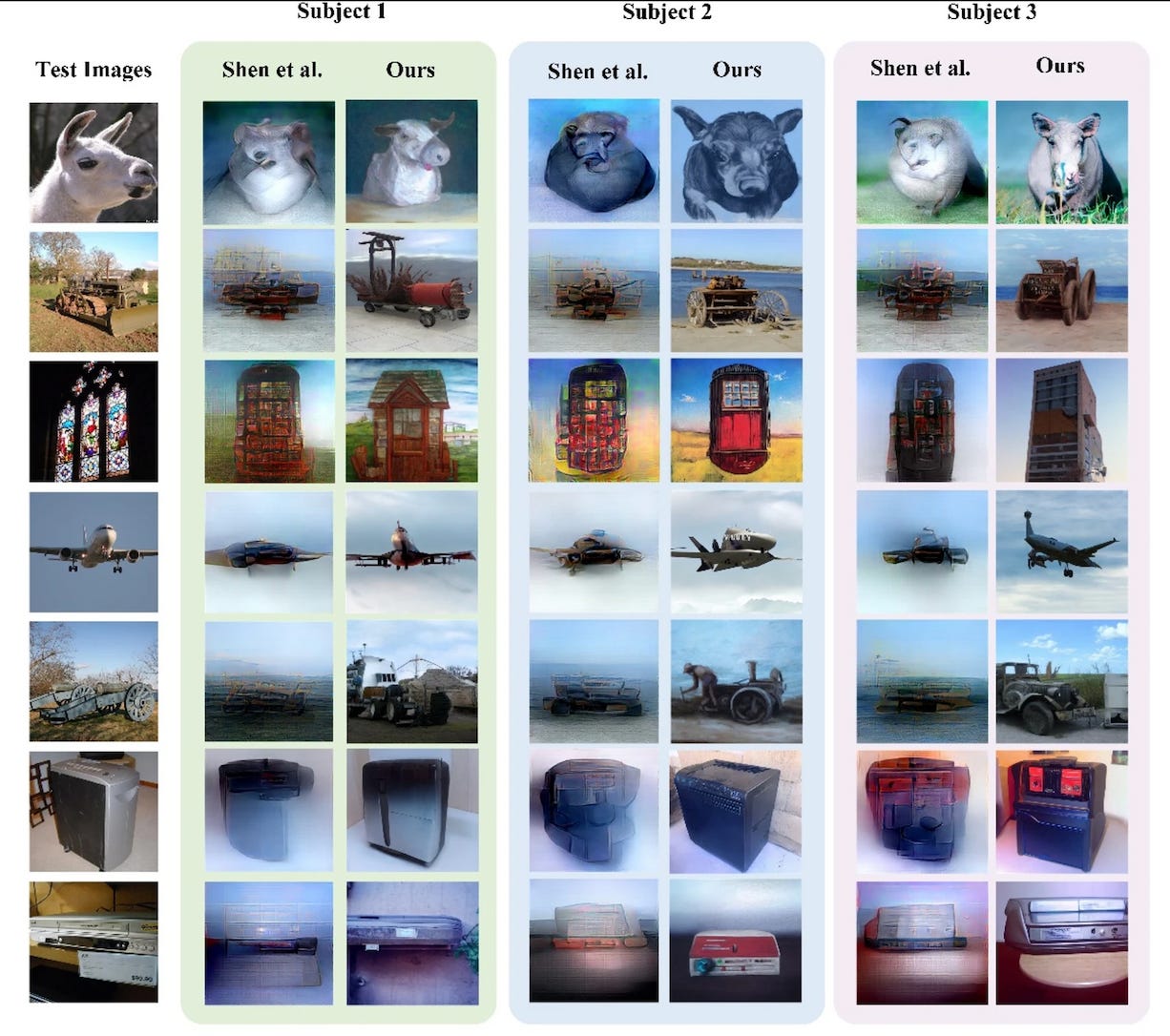
And I’ve been burying the lede all along, because I think these dreamy, half sculpted images being directly read from minds are so cool, and have enjoyed the progress from one year to the next, I thought you might like seeing the images too.
But it’s not just grad students - the big dogs are literally doubling down on reading your mind, in real time - from Meta, who pioneered an entirely new non-fMRI technique for this:
Amazing! And of course, Meta is certainly the one company you’d bet on going hard on literal mind reading (and also the one company you’d least trust with the capability, but that’s democracy for you).
But atavistic horror aside, this implies we can get to a place where we’re able to literally create pictures of what you’re dreaming of via brain scanning, in real time.
What is this but a technological opportunity to try to guide and improve dreams?
Imagine this image stream piped into the latest LLM - the LLM interprets the ongoing stream of images and overall narrative paths, and is prompted to guide them to better valenced experiences and narratives, by whispering to you with an RL loop rewarded for guiding you to better and more lucid dreams?
The whisper earring, dream edition!
Taking you from pointless dreams of you in high school with a pop quiz, to an anthropomorphized version of your childhood dog bursting in the door and handing you a rocket pack, and you jetting off into the sky together.
From dreams of conflict and running from ill defined menaces and predators, to falling down an Alice in Wonderland style tunnel, ending in a lasers-and-foam wooly mammoth rave headlined by your favorite DJ.

This technology can’t be that far off - we’ve already got the components today, we just need to plug them into each other and iterate into the best “dream guiding” interventions.
What everyone wants, technology wise
What’s the perfect sleep set of processes, aside from “less sleep entirely, so I can live my actual life, please and thank you?”
I think it would be something like: “turn me off at the push of a button, fill my night with incredibly satisfying and awesome dreams that I control, and then wake me up refreshed and totally recharged right when I’m supposed to wake up.”
How are we doing on that front?
Turn me off at the push of a button
Did you know sleeping pills are one of the most dangerous commonly prescribed medications out there? That their all cause mortality hazard ratios (HR) range from 1.2 - 3.5, and that’s only considering studies with at least 100k participants?3
That’s basically ranging from “smoking” to “needle drug use” in terms of risk. It’s huge! And they barely even work!
And yet people still take them, because everyone wants an “instant knock out” button - why don’t we have it? That’s a good question!
Because there actually IS an “instant knockout button” inside your head - it’s called the VLPO. It stands for ventrolateral pre‑optic nucleus, and is a pea‑sized cluster of GABA/galanin neurons in the anterior hypothalamus.
When the VLPO neurons fire, they inhibit every major ascending arousal hub in the brain (orexin in the lateral hypothalamus, histamine in the tuberomammillary nucleus, noradrenaline in the locus‑coeruleus, serotonin in the raphe, etc.).
The wake centres, in turn, inhibit the VLPO when firing; together they form a mutually inhibitory “flip‑flop” circuit—a bi‑stable switch that is either ON (wake) or OFF (sleep) with little in‑between.
We can hit this “flip-flop” in mice with transcranial magnetic stimulation (TMS), ultrasound, and can even hit a few precursors in their chain successfully.
But we can’t do this in humans - TMS goes about 2cm deep. There’s a fancy “deep dish” version that can get to 4cm. The VLPO is ~8cm deep in the human brain, with sinuses and lots of stuff in the way. It’s buried as deeply as it’s possible to be buried, more or less:
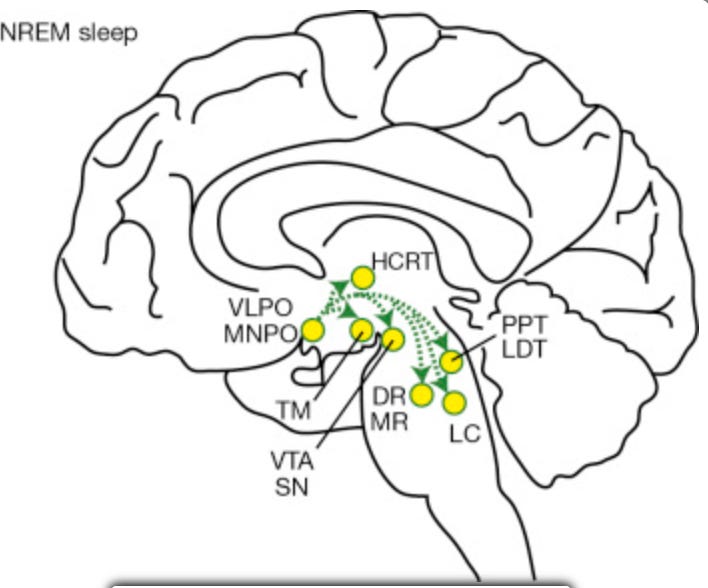
But there’s a bunch of scientists trying to cobble together stuff like “hit a precursor to VLPO with ultrasound, or tiny electric currents, and try to activate it that way” and having limited success.
It’s a really small academic world, apparently. Since it’s just a handful of scientists in a handful of labs, certainly seems like a ripe area for some additional “foundational research” money, or a real effort to divert some big brains headed towards FAANGs or finance to adversarially farm dumber people at scale into doing sleep research instead (hello 80k hours).
What about better lucid dreaming through technology?
Pilot work presented at CNS 2024 where you train to attain a certain brain state in VR, with a tone played when you achieve it. Then the tone is replayed during REM, producing verified lucidity in 59 % of participants with minimal sleep disruption.
Another interesting intervention to try might be taking 4-8mg of galantamine after sleeping for ~3 cycles (roughly 4.5 hours).4 In a double‑blind crossover trial (n = 121), this raised lucid‑dream rates to 42 % (8 mg) vs 12 % in placebo.
There’s actually a pleasing variety of modalities that have been used to try to “engineer” dreams, as this fun paper (Carr et al (2020)) goes over, from smells to sounds, somatic interventions, vestibular interventions, memory cues, auditory cues, and much else. Whenever we can hook up LLM’s to your ongoing dream-image-stream, we should definitely be exploring all of these to find which work best, both in the aggregate and individually.
Syncing and optimizing the time available
Another thing everyone wants - some way to sync your sleep cycles up to the interval of sleep you have available. In theory, every 70-120 min you are asleep, you go through N1, N2, N3 (deep sleep), and REM, and that’s one complete cycle. Waking up at the end of the cycle leaves you feeling refreshed and satisfied, and waking up in the middle leaves you groggy and bleary-eyed. Those cycles are pretty easy to measure! Basic EEG’s do fine.
Surprisingly, there’s basically zero technological progress on this.
Sure, every “fitness tracker” claims to have some half-baked sleep cycle measurement, from Apple Watches to Oura rings, but they’re all extremely noisy, with poor precision and wide error bands. So that’s reading them, at which we do poorly. There’s a number of sleep masks with integrated EEG’s, and in-ear EEG’s and other tricks, but nothing that really does anything it would be worth the overhead for, it seems.
And then when it comes to shaping your cycles, we have almost nothing. The very best I could find is a total nothingburger closed loop auditory or vibratory stimulation. In theory, these help you front load and increase the amount of short wave sleep, but in practice they don’t seem to allow people to sleep less or improve subjective sleep quality.
Wrapping up
Okay, so basically today we have the largest conceivable addressable human QALY pool, and really limited talent, bandwidth, and funding applied to it.
The opportunities literally range from “just some individual person” deciding to introspect and trying different sleeping and dreaming techniques, along the lines of meditation practitioners, and rigorously logging, finding things, and communicating them, to talented college students and scientists deciding to work in the area, to grant making bodies and investors being able to look for and put money into more sleep optimization projects.
What to do as:
An individual for yourself - For your own sleep quality, first make sure you have good sleep hygiene, then you can learn about lucid dreaming, make deliberate efforts to practice it, and / or take galantamine according to the protocol in footnote 2.
An individual helping others - If you’re young, you can think about going into a career trying to impact sleep, whether as a researcher (academic, pharma, clinical, many roads), or entrepreneur. If you’re already in a career, you can be a “somnonaut,” like the psychonauts of yore, and read and engage with the tradition of sleeping and dreaming interventions along the lines of meditation and breathing exercises, and document your path and findings.
A potential founder or investor - the amount of money in “sleep centered” startups is still tiny, about as much as the NIH budget. So consider and keep an eye on anyone doing something in the “sleep and dreams” space, because the TAM is huge for anything real. The area overall seems full of pseudoscience and p-hacked outcomes, but you can do better. And if you DO do better, even 10% better, the cumulative positive effects are immense.
A grant maker or EA fund director - Put more money into sleep researchers, look for and fund some sleep yogis, spend some “80k hours style” effort directing more talented people into sleep research - the addressable QALY pool is so immense, we should be doing thousands of times more than we are now.
Swami Rama, a yogi from India, was studied in the 70’s at the Menninger Clinic in Topeka, Kansas. He could create a temperature difference of 11 degrees between his extremities, raise his heartbeat to 300bpm or lower it to zero for minutes at a time, display delta sleep waves for half an hour and later recount all conversation and events that went on during that half hour, and more. The french cardiologist Therese Brosse recorded a yogi doing similar feats 40 years earlier. A researcher named M.A. Wenger at UCLA tested yogis and found similar abilities.
On reducing now versus in an environment of evolutionary adaptiveness, at least for hominins historically, most of our hunter gatherer past may not have been amenable to the productivity bonuses that individuals can attain on their own today with extra hours. If everyone else in the tribe sleeps for 7-9 hours, you can’t exactly go day trade or write a book while they’re all asleep and personally benefit - most advantages were probably capped by night-time predators, and group benefits in hunting, tool making, and more.
From table in Kripke (2016) - Mortality Risk of Hypnotics: Strengths and Limits of Evidence
https://escholarship.org/uc/item/08d9f3d5#main
You can get into the 5+ HR range if you look at Kripke (2012) - Hypnotics' association with mortality or cancer
The actual protocol is an integrated lucid dream induction protocol, which combined sleep interruption and the Mnemonic Induction of Lucid Dreams (MILD) technique together with cholinergic enhancement.
“Participants interrupted their sleep with a 30-minute period of wakefulness after approximately 4.5 hours of sleep (a rough estimate of 3 REM periods). The 30-minute sleep interruption period was selected based on previous research, as noted above, showing that 30 minutes of sleep interruption is more effective than shorter amounts of time. We did not set the sleep interruption period for longer than 30 minutes because it does not lead to further increases in lucid dream frequency. Furthermore, galantamine reaches peak serum concentration (Cmax) approximately 1 hour after oral ingestion, and we wanted to align Cmax to occur during the next sleep (and dream) period after allowing participants time to fall back to sleep. Participants practiced MILD while returning to sleep for all awakenings after the sleep interruption period.”
I’d add the “Military Sleep Method” to the list, which is basically just a few steps that if you practice right (and haven’t recently consumed stimulants) you’ll fall asleep within a few minutes.
When I was younger I would have trouble falling asleep. I was certainly tired, but I also consumed caffeine at basically any time of day, which made it harder to fall asleep, which made me more tired the next day, which made me consume more caffeine, etc.
Now I can fall asleep in 2-5 minutes every night. If I take Melatonin it’s literally under 2 minutes. The difference between 2 minutes and 20 minutes is major, since not only can you wake up earlier, it also makes the act of going to sleep far more pleasurable.
It’s a pretty simple practice, but done without good sleep hygiene ruins it. All you do is intentionally relax your muscles one by one, especially the shoulders, diaphragm and abdomen. Then focus on breathing for about a minute. I take a few big deep breaths, then slow my breathing to as low as I can get it. Finally either use mental visualization to picture a very relaxing scene, or if you’re a real pro simply think about nothing.
Of course it doesn’t work as well if you consumed caffeine or other stimulants in the afternoon, if you aren’t actually tired at that time because of an inconsistent sleep schedule, if you ate a large meal right before, etc. but it’s a major difference between good and bad sleep.
I don’t practice lucid dreaming since I find it interferes with my sleep quality, especially early in the morning in the last REM cycle before I wake up (I can usually recognize I’m dreaming, recognize that I have to wake up soon, and that sort of ruins it). I’d much rather not be tired in the slightest throughout my day, than have a slightly worse day and also get to be entertained while I sleep.
Sleep deprivation is the commonest and one of the worst forms of torture. It is one of, if not the most, effective ways of breaking a person for brainwashing. Even slight reductions in sleep or sleep quality over months will often cause permanent damage.
School schedules are designed to cause chronic sleep deprivation, not only for brainwashing, but to permanently damage thinking ability. MDs come out of school still smart, a few weeks into internship hazing by sleep deprivarion they're zombies, mental performance down ~15-40 IQ points, killing patients right and left. They usually never fully recover. Similar torture methods are used on young people in other fields such as finance, with similar results, permanent brain damage, personality changes, increased loyalty to the institution and industry doing the torture, belief in their own superiority for enduring the torture, belief in the inferiority of those who refuse to undergo the torture, and advocacy for perpetuating the torture on new recruits.
Give these people the means to demand people get less sleep, and they absolutely will abuse it to create a dystopia far worse than 1984. For productivity!
So not only NO, but HELL NO!